
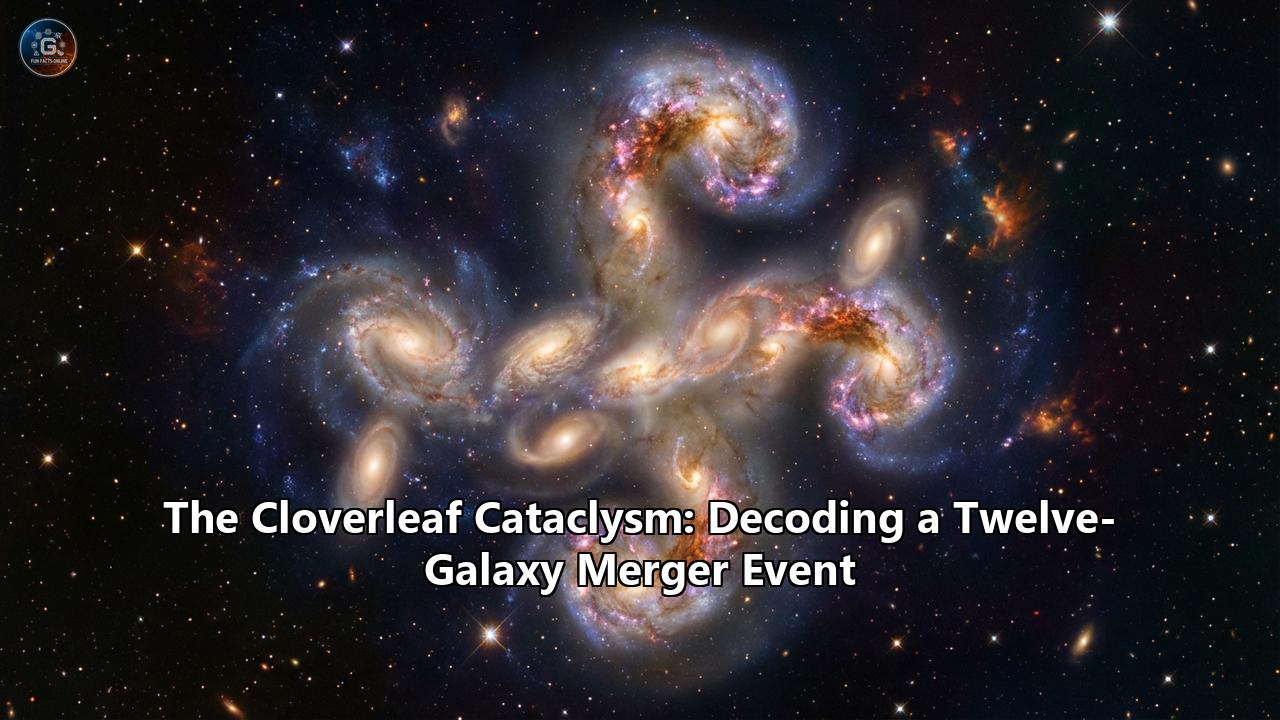
In the vast, silent theatre of the cosmos, galaxies usually dance a slow, gravitational waltz. They drift, spiral, and occasionally graze one another in interactions that span billions of years. But sometimes, the universe stages a spectacle of such violence and magnitude that it defies the serene static of the night sky. Deep within the intergalactic void, astronomers have uncovered evidence of a chaotic pile-up involving no fewer than twelve galaxies—a cosmic train wreck of unprecedented scale that has come to be known as the "Cloverleaf Cataclysm."
This event, formally associated with the enigmatic "Odd Radio Circles" (ORCs) that have puzzled scientists since their discovery, represents more than just a collision; it is a laboratory of extreme astrophysics. It offers a rare glimpse into the death throes of independent galactic groups and the violent birth of massive clusters, illuminated by the ghostly glow of shockwaves that span millions of light-years.
The Mystery of the Rings
To understand the magnitude of the Cloverleaf Cataclysm, we must first rewind to the initial mystery that led astronomers to this chaotic sector of space. In 2019, the Australian Square Kilometre Array Pathfinder (ASKAP) began capturing images of the sky in radio wavelengths, revealing something entirely unexpected: faint, colossal rings of radio emission, ghost-like and nearly perfectly circular. They looked like smoke rings blown by a cosmic giant, floating in the middle of nowhere.
Astronomers dubbed these structures "Odd Radio Circles," or ORCs. For years, they were a complete enigma. Were they the throats of wormholes? The remnants of exploded stars? Or perhaps the shockwaves from some unknown, energetic event? The theories were as numerous as they were exotic.
The breakthrough came when researchers trained their sights on a specific ORC, dubbed the "Cloverleaf." Unlike its perfectly circular cousins, this structure had a slightly distorted, multi-lobed appearance—a cloverleaf shape that hinted at a complex underlying structure. But radio waves alone could not tell the whole story. The radio emission showed the "smoke," but to find the fire, scientists needed to look at the high-energy universe.
Enter the European Space Agency’s XMM-Newton X-ray space telescope. When researchers, led by astrophysicists at the Max Planck Institute for Extraterrestrial Physics, pointed this high-powered observatory at the heart of the Cloverleaf, the ghost turned into a graveyard.
A Dozen-Galaxy Pile-Up
Buried within the center of the Cloverleaf ORC was not a single galaxy, nor a simple pair, but a chaotic swarm. X-ray data revealed the scorching thermal signature of gas heated to over 15 million degrees Fahrenheit (8 million degrees Celsius). This ultra-hot plasma is the telltale sign of a massive gravitational crunch.
The team identified at least twelve individual galaxies trapped in this gravitational well. But they were not orbiting peacefully. The optical and X-ray analysis painted a picture of a "merger of groups"—two separate families of galaxies, each containing half a dozen or more members, that had been drawn together by the inexorable pull of dark matter.
This was the "Cloverleaf Cataclysm." Imagine two swarms of bees, each the size of the Milky Way, smashing into each other at millions of miles per hour. The individual stars within these galaxies are spaced so far apart that they rarely collide, but the vast clouds of gas between them cannot pass through one another like ghosts. Instead, they crash.
The Mechanics of the Crash
The physics of a twelve-galaxy merger are governed by the brutal laws of hydrodynamics and gravity. As the two galaxy groups plunged toward each other, the tenuous gas that fills the space between galaxies—the intracluster medium—was compressed violently.
- The Shockwave: The collision created a bow shock, similar to the sonic boom of a supersonic jet, but on a scale that dwarfs our entire local group of galaxies. This shockwave rippled outward through the intergalactic medium, heating the gas instantly and accelerating particles to near-light speeds.
- The Particle Accelerator: This is where the "Cloverleaf" shape was forged. The galaxies involved in this crash were not pristine; they were old and scarred. Several of them hosted supermassive black holes at their cores that had, in the distant past, spewed out jets of high-energy plasma. These "fossil" electrons had long since lost their energy and faded into invisibility.
- The Re-ignition: When the merger shockwave swept through the system, it hit these pockets of old, dead plasma. Like a bellows fanning dying embers, the shockwave re-energized the fossil electrons, spinning them up to relativistic speeds again. As these rejuvenated particles spiraled around magnetic fields, they began to scream out in radio waves—creating the glowing "Cloverleaf" ring seen by ASKAP.
This mechanism, known as "shock re-acceleration," explained the ORC mystery. The giant radio rings were not explosions from a single point, but the illuminated footprints of a galaxy group merger shockwave passing through a graveyard of ancient black hole outflows.
The Galactic Survivors
What happens to twelve galaxies caught in such a cataclysm? The immediate aftermath is one of transformation and tragedy.
- Stripped Galaxies: As the galaxies plow through the dense, hot gas of the merger center, they experience "ram pressure stripping." The drag force of the hot gas acts like a cosmic wind, blowing the galaxies' own reservoirs of cold gas—the fuel for new stars—right out of them. Many of the twelve participants in the Cloverleaf event are likely being "quenched," turning from vibrant, blue star-forming spirals into red, dead ellipticals.
- Violent Relaxation: The gravitational chaos destroys the delicate spiral arms of the participating galaxies. Over hundreds of millions of years, the orbits of stars are scrambled in a process called violent relaxation. The distinct identities of the twelve galaxies will eventually be erased. They will sink to the center of the new potential well, cannibalizing each other to form a single, monstrous "Brightest Cluster Galaxy" (BCG)—a titan that will dominate the core of the newly formed cluster.
A Window into Cosmic History
The Cloverleaf Cataclysm is more than just a spectacle; it is a Rosetta Stone for understanding the hierarchical growth of structure in the universe. Cosmology tells us that the universe builds itself "bottom-up." Small dwarf galaxies merge to form spirals like the Milky Way; spirals group together into families; and these groups eventually crash together to form massive galaxy clusters—the largest gravitationally bound structures in the universe.
The Cloverleaf system captures this process in the "teenage" phase. It is not yet a fully settled cluster, nor is it a loose collection of groups. It is caught in the transient, violent moment of becoming.
By studying the shock waves in the Cloverleaf, astronomers can measure the magnetic fields of the intergalactic medium, a property that is notoriously difficult to probe. They can also estimate the history of black hole activity in the universe, using the "fossil" electrons as a historical record of past eruptions.
The Future of the Cloverleaf
If we were to watch the Cloverleaf Cataclysm unfold over the next billion years, the radio ring would eventually fade as the shockwave dissipates into the void. The twelve distinct galaxies would spiral inward, friction braking their motion. Their central supermassive black holes might merge, sending ripples of gravitational waves across the fabric of spacetime—signals that future detectors like LISA (Laser Interferometer Space Antenna) might one day catch from similar events.
Eventually, the chaos will settle. The fiery X-ray glow will cool, and a single, massive elliptical galaxy will sit at the center of a quiet cluster, surrounded by a swarm of smaller satellite galaxies. The evidence of the "Cataclysm"—the giant radio cloverleaf—will have vanished, leaving only the silent, red giants to bear witness.
Conclusion
The decoding of the Cloverleaf Cataclysm serves as a reminder that the universe is far more dynamic than the static snapshots of Hubble or JWST might suggest. Between the silent stars lie invisible storms of unimaginable power. It took the combined vision of radio telescopes in the Australian outback and X-ray observatories in orbit to peel back the layers of this event, revealing that what looked like a smoke ring was actually the smoking gun of a twelve-galaxy collision.
As we continue to map the sky, we will likely find more of these cataclysms—more odd circles, more shockwaves, and more evidence that our universe is a place of violent, beautiful evolution, where destruction on a galactic scale is merely the opening act for the creation of something new.