
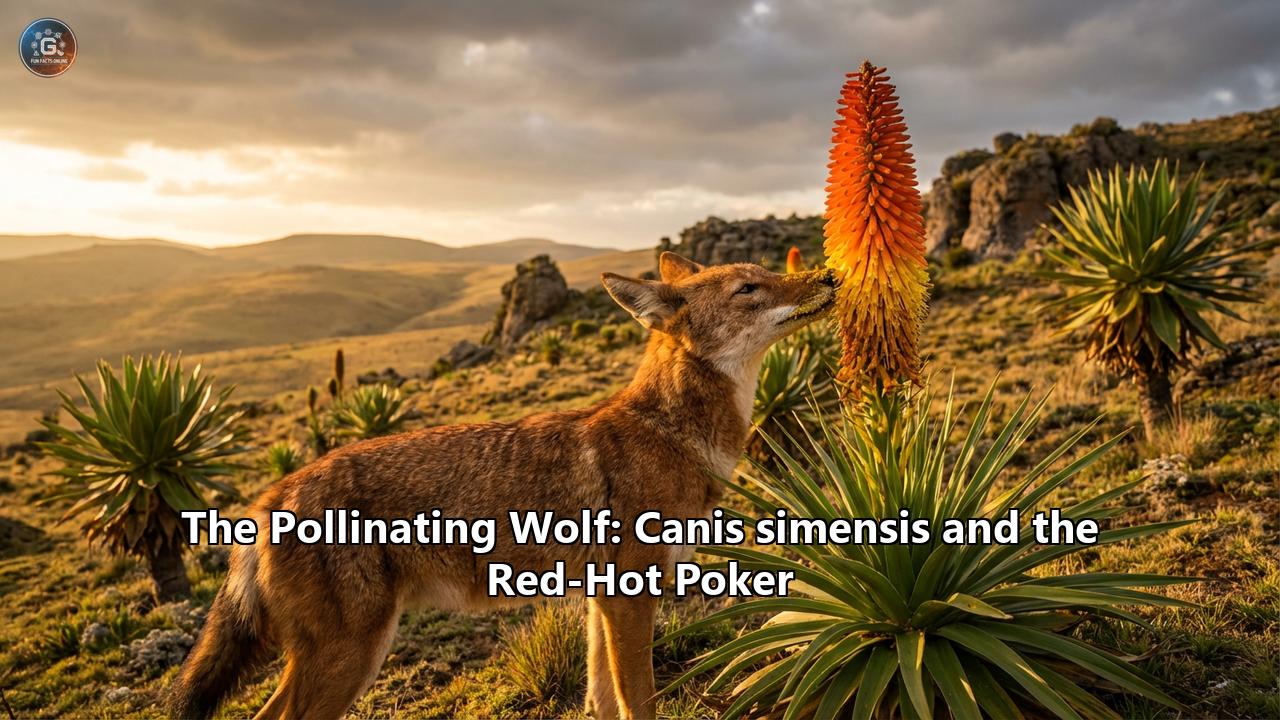
In the rarefied air of the Ethiopian Highlands, where the atmosphere is thin and the light possesses a crystalline clarity, a scene unfolds that defies the conventional laws of nature. A wolf—a creature of tooth, claw, and predatory instinct—approaches a flower. It does not trample the bloom or mark it with scent. Instead, with a surprising delicacy, the carnivore leans in, extends a pink tongue, and begins to lick. When it pulls away, its muzzle is dusted with golden pollen.
This is Canis simensis, the Ethiopian Wolf, and it has just unwittingly enlisted in an ancient service usually reserved for bees, birds, and bats. It has become a pollinator.
For decades, the story of pollination was written in the language of co-evolution between flowering plants and the small, flying creatures that service them. Large carnivores were the antagonists in this story, or at best, indifferent bystanders. But the recent documentation of Ethiopian Wolves feeding on the nectar of the Red-Hot Poker (Kniphofia foliosa) has rewritten a chapter of ecological science. It challenges our understanding of "therophily"—pollination by mammals—and highlights the extraordinary adaptability of life in the Afroalpine ecosystem.
To understand this phenomenon, we must journey to the "Roof of Africa," explore the biology of a wolf with a sweet tooth, and unravel the delicate web of life that connects a predator to a flower.
I. The Roof of Africa: An Island in the Sky
To understand the wolf, one must first understand the stage upon which it plays its part. The Bale Mountains of Ethiopia are a high-altitude island in a sea of dry lowlands. Rising to over 4,000 meters (13,000 feet), this Afroalpine ecosystem is a world apart, isolated for millions of years from similar habitats in East Africa.
The climate here is often described as "summer every day and winter every night." The equatorial sun burns with intense heat during the day, triggering the explosion of plant life. But as soon as the sun dips below the horizon, temperatures plummet, often freezing the dew that settles on the giant lobelias and tussock grasses.
This extreme oscillation has forced life to adapt in strange ways. Plants here are often gigantic, like the Giant Lobelia (Lobelia rhynchopetalum), which shoots a phallic flower spike meters into the air, or the cushions of Helichrysum that hug the ground to escape the biting wind. The fauna is equally specialized. The Mountain Nyala, a spiral-horned antelope, ghosts through the heather forests. The Bale Monkey navigates the bamboo belts below. And scurrying beneath the ground is the architect of this ecosystem: the Giant Mole-rat (Tachyoryctes macrocephalus).
The Giant Mole-rat is the primary reason the Ethiopian Wolf exists in these heights. Unlike its cousins, the Grey Wolves of Eurasia and North America, Canis simensis is not a pack hunter of large game. It does not chase down elk or bison. Instead, it is a solitary, precision hunter of rodents. Evolution has stretched its snout into a long, narrow forceps, perfect for plunging into mole-rat burrows. It is a specialist, a creature honed by the specific demands of the Afroalpine meadow.
But even a specialist needs variety, and in the wet season, when the clouds wrap the Sanetti Plateau in mist, a new resource emerges from the green landscape.
II. The Red-Hot Poker: A Beacon in the Mist
Kniphofia foliosa is a member of the Asphodelaceae family, a robust perennial herb endemic to the Ethiopian Highlands. To the casual observer, it is a "Red-Hot Poker," named for its striking inflorescence—a dense spike of tubular flowers that transition from crimson buds at the top to bright yellow, open flowers at the base.In the Bale Mountains, K. foliosa is not a polite garden ornament; it is a titan. It forms massive clumps, sending up flower spikes that can reach human height. These flowers are nectar factories. Unlike many plants that produce microscopic droplets of sugar water, Kniphofia produces copious amounts of nectar, a high-octane energy drink designed to attract pollinators that have high metabolic needs.
Traditionally, the intended patrons of this bar are sunbirds. The Tacazze Sunbird (Nectarinia tacazze) and the Malachite Sunbird (Nectarinia famosa) are the standard pollinators. Their long, curved bills are perfectly adapted to probe the tubular flowers. As they drink, their foreheads brush against the anthers, picking up pollen to transport to the next flower. It is a classic example of ornithophily—bird pollination.
But Kniphofia foliosa has an open-door policy. Its nectar is accessible enough that it attracts a host of other visitors, including honeybees and other insects. And, as we now know, it attracts the Wolf.
The blooming season of the Red-Hot Poker coincides with the rainy season in the highlands (roughly May to October). This is a time of plenty, but also a time of high energy expenditure for animals regulating their body temperature in the cold, wet conditions. The fields of the Bale Mountains turn into a sea of orange and yellow torches, signaling a feast.
III. The Discovery: A Wolf with a Sweet Tooth
The scientific community is often slow to accept anecdotes, but local shepherds in the Bale Mountains have known for generations that the "Jedala Farda" (Horse's Jackal, a local Oromo name) had a peculiar habit. Children in the region also compete for the nectar, plucking the flowers to suck out the sweet liquid, a practice they share with the wolves.
It wasn't until late 2024 that a team of researchers from the Ethiopian Wolf Conservation Programme (EWCP) and Oxford University, led by Dr. Sandra Lai, formally documented this behavior in the journal Ecology. They observed wolves visiting up to 30 flower stalks in a single foraging trip.
The behavior is methodical. A wolf approaches a clump of Kniphofia, usually selecting the lower, yellow flowers which are mature and brimming with nectar. It doesn't destroy the flower. It licks. The wolf’s tongue laps at the nectar, and in the process, its long, narrow snout becomes coated in the bright orange pollen of the plant.
This observation sent ripples through the fields of zoology and botany. Large carnivores are not supposed to do this.
The "Dessert Hypothesis" vs. Hydration
Why would a carnivore, whose digestive system is built for protein and fat, seek out plant sugar?
One theory is the "Dessert Hypothesis." Nectar provides a quick, easily accessible burst of carbohydrates—sugar energy. For a wolf that spends hours stalking mole-rats, a high-intensity activity with a low success rate, a flower patch represents a "free lunch." The nectar is calorie-dense and requires zero hunting effort.
Another theory, often applied to animals in dry environments, is hydration. However, the Kniphofia blooms during the wet season in Bale. Water is everywhere. Puddles, streams, and rain are abundant. The wolves are not drinking for water; they are drinking for sugar.
This behavior is underpinned by a quirk of genetics. In the order Carnivora, the sense of taste varies wildly. The Felidae family (cats, from house cats to lions) has lost the ability to taste sweet things. A mutation in the Tas1r2 gene rendered their sweet taste receptors non-functional millions of years ago. A lion licking a lollipop tastes nothing but cardboard.
Canids (dogs, wolves, coyotes), however, have retained a functional Tas1r2 gene. They can taste sweet. Anyone who has seen a domestic dog relish a piece of fruit or steal a cookie knows this. The Ethiopian Wolf has retained this ancestral trait, and in the resource-rich environment of the Bale Mountains, it has put it to use.
IV. Therophily: The Rare Club of Mammal Pollinators
Pollination by mammals, or therophily, is a well-documented but relatively rare phenomenon compared to insect or bird pollination. The club of mammal pollinators is usually restricted to three groups:
- Bats: Major pollinators of cactus and agave in the Americas and durian in Southeast Asia.
- Marsupials: Honey possums and sugar gliders in Australia are key pollinators of Banksia and Eucalyptus.
- Primates: Lemurs in Madagascar and some monkeys in South America are known to pollinate travelers' palms and other species.
- Rodents: Certain mice and rats in South Africa pollinate ground-dwelling proteas.
Carnivores are the rarest of the rare. Before the Ethiopian Wolf, there were only fleeting records of carnivores acting as potential pollinators: the Kinkajou in Central America (a raccoon relative), the Masked Palm Civet in Asia, and the Cape Genet and Cape Gray Mongoose in South Africa.
The Ethiopian Wolf is the first large carnivore to be added to this list. Its inclusion changes our perception of pollination syndromes. A "pollination syndrome" is a set of flower traits that suggests who the pollinator is. Red tubular flowers usually mean "birds." Pale, musky-smelling flowers usually mean "bats." Kniphofia foliosa screams "bird," yet it is being serviced by a wolf.
This suggests that pollination is often messier and more opportunistic than the textbooks suggest. Nature does not always color inside the lines. If a resource is available (nectar) and an animal can access it (sweet taste receptors + long snout), an interaction will occur.
V. Friend or Thief?
In the world of pollination science, there is a crucial distinction between a pollinator and a nectar thief.
A pollinator moves pollen from the anthers (male part) of one flower to the stigma (female part) of another, facilitating reproduction.
A nectar thief takes the reward (nectar) without doing the work. They might bite through the base of the flower to bypass the pollen, or they might be so smooth that no pollen sticks to them.
Is the Ethiopian Wolf a true pollinator?
The evidence suggests yes. The researchers observed significant pollen loads on the wolves' muzzles. Because the wolves move from flower stalk to flower stalk, and often travel significant distances between plant clumps (much further than a bee might), they are likely acting as long-distance gene vectors for the plants.
The social structure of the wolves amplifies this. Ethiopian wolves are social animals that live in packs but hunt alone. However, the nectar feeding appears to be a social affair. Researchers have observed adults leading pups to the flower fields. This "social learning" suggests that the behavior is cultural—passed down from generation to generation. A pack of wolves moving through a valley, snacking on flowers, could cross-pollinate Kniphofia populations that are miles apart, promoting genetic diversity in the plants in a way that a territorial sunbird might not.
VI. The Fragility of the Relationship
This beautiful interaction is playing out on the edge of a precipice. The Ethiopian Wolf is Africa's most endangered carnivore. Fewer than 500 individuals remain, scattered across a handful of mountain ranges. The Bale Mountains population is the stronghold, housing more than half of the global population, but it is under siege.
Habitat Loss: The fertile highlands are heavily populated by humans. Agriculture is pushing higher up the mountain slopes, turning the wolf's Afroalpine grassland into barley fields. The Kniphofia plants are often cleared to make way for crops or are trampled by livestock. Disease: The greatest immediate threat to the wolf is disease spilled over from domestic dogs. Rabies and Canine Distemper Virus (CDV) periodically sweep through the wolf packs, decimating their numbers. A single outbreak can reduce the population by 70%.The connection between the wolf and the flower highlights the interconnectedness of this ecosystem. If the wolves disappear, the Kniphofia will likely survive—it still has the sunbirds. But if the Kniphofia fields are plowed under, the wolves lose a critical seasonal energy source.
More importantly, the loss of the wolf would be the loss of a unique ecological function. We are only just beginning to understand the complexity of the Afroalpine web. The wolf controls the rodent population (which eats the vegetation). The wolf pollinates the flowers (which feed the insects and birds). The wolf attracts tourists (who bring money to the local economy, incentivizing conservation).
VII. A Symbol of Resilience
The image of an Ethiopian Wolf, the copper-furred guardian of the plateau, delicately sipping nectar from a fiery torch lily, is a powerful symbol. It reminds us that nature is adaptable. It reminds us that even "specialists" like the rodent-hunting wolf are capable of behavioral plasticity.
It also reminds us of what we stand to lose. This interaction, evolved over millennia in the isolation of the Ethiopian highlands, was unknown to science until just a year or two ago. How many other secrets are hidden in the remote corners of our planet? How many other "impossible" interactions are vanishing before we even name them?
Conservationists like the Ethiopian Wolf Conservation Programme (EWCP) are working tirelessly to protect this species. They vaccinate domestic dogs in surrounding villages to create a buffer against disease. They monitor wolf packs and work with local communities to protect the habitat.
The discovery of the "Pollinating Wolf" adds a new arrow to the quiver of conservation arguments. We are not just saving a predator; we are saving a gardener, a pollinator, a key player in the floral cycle of the mountains.
In the end, the Ethiopian Wolf and the Red-Hot Poker tell a story of survival. In the harsh, beautiful, high-altitude world of the Bale Mountains, you take what you can get. If you are a flower, you make enough nectar for everyone. And if you are a wolf, you learn that sometimes, survival is sweet.
Reference:
- https://www.smithsonianmag.com/smart-news/these-endangered-wolves-have-a-sweet-tooth-and-it-might-make-them-rare-carnivorous-pollinators-180985551/
- https://balemountains.org/tourism/when-to-go/
- https://pmc.ncbi.nlm.nih.gov/articles/PMC11610677/
- https://www.researchgate.net/publication/385944132_Canids_as_pollinators_Nectar_foraging_by_Ethiopian_wolves_may_contribute_to_the_pollination_of_Kniphofia_foliosa
- https://a-z-animals.com/articles/the-endangered-wolf-with-a-sweet-tooth-scientists-didnt-expect/
- https://thetenaflyecho.com/25870/science-tech/ethiopian-wolves-surprise-scientists-by-feeding-on-nectar-and-pollinating-flowers/
- https://www.bethchatto.co.uk/a-z/i-n/kniphofia-species/
- https://afo.birdlife.org.au/afo/index.php/afo/article/viewFile/1359/1884