
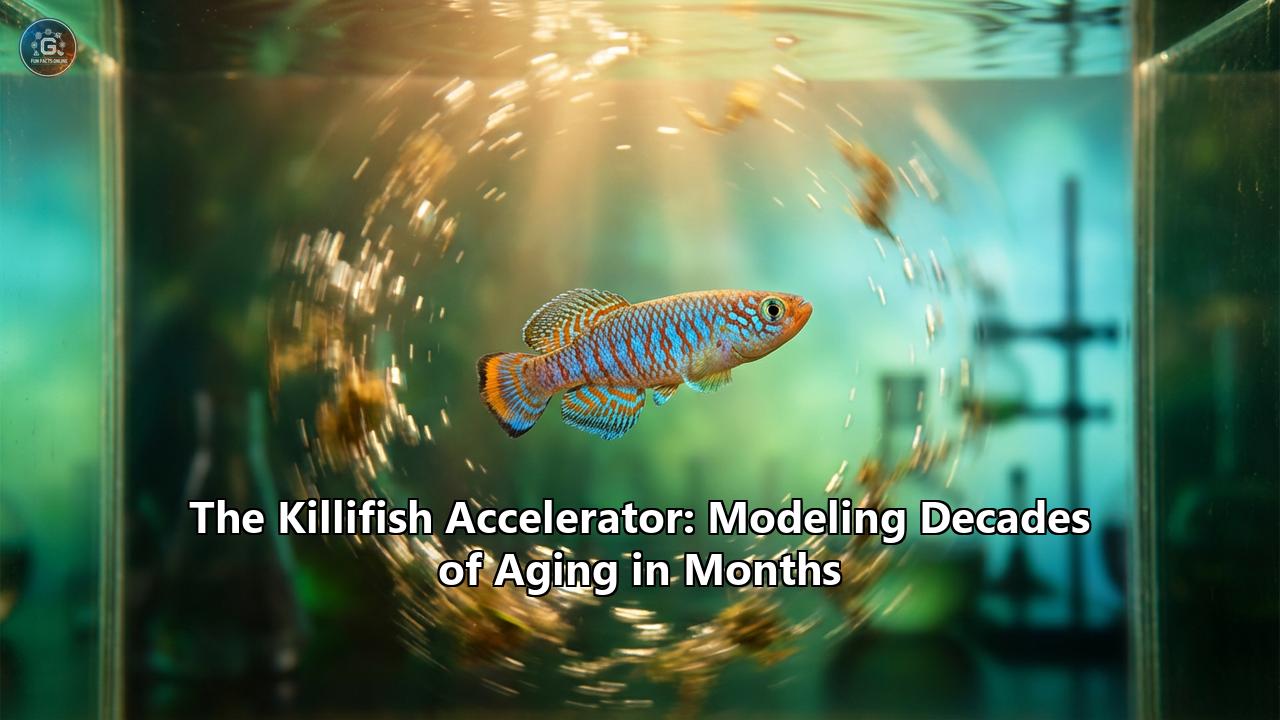
In the ephemeral ponds of Zimbabwe and Mozambique, a small, vibrant fish is swimming against the current of biological time. The African turquoise killifish (Nothobranchius furzeri) lives a life of frantic urgency. From the moment it hatches, it is in a race against the sun, destined to grow, reproduce, and die before its watery home evaporates into the cracked earth of the dry season. This evolutionary pressure has compressed its entire existence into a fleeting four to six months. To the casual observer, it is a tragedy of nature; to the modern biogerontologist, it is a miracle.
For decades, the field of aging research was dominated by the "big two": the mouse and the nematode worm C. elegans. Mice are biologically close to humans but live for nearly three years—a long time to wait for a single experiment. Worms live for weeks but lack the complex organs, adaptive immune systems, and vertebrate brains that define human physiology. The African turquoise killifish has emerged as the "missing link," a vertebrate time machine that compresses decades of human biological decay into a few short months. By studying this tiny swimmer, scientists are unlocking the secrets of longevity, neurodegeneration, and the potential to pause the aging clock itself.
The Paradox of the Ponds
The life history of Nothobranchius furzeri is a masterclass in evolutionary adaptation. Its habitat is not a permanent lake or river, but a seasonal pool formed by monsoon rains. These pools are transient, existing for only a few months before disappearing completely. This boom-and-bust cycle forces the killifish to condense its life cycle to an extreme degree.
Hatching is explosive. Once the rains fill the pool, the killifish fry burst from their eggs and begin a period of growth that is unparalleled in the vertebrate world. In just two weeks, they reach sexual maturity—a feat that takes humans over a decade and mice several months. They mate voraciously, laying drought-resistant eggs into the mud before the water vanishes and the adults perish.
This "live fast, die young" strategy comes with a steep price: rapid aging. By the time a killifish is three months old, it is effectively a geriatric patient. Its bright colors fade, its spine curves (kyphosis), it loses muscle mass (sarcopenia), and its cognitive functions decline. It develops cataracts, its immune system falters, and it becomes prone to cancer. In short, the killifish experiences almost every hallmark of human aging, but at a warp speed that allows researchers to observe the entire process from birth to death in the time it takes to complete a single semester of university.
Molecular Hallmarks: A Mirror to Human Aging
The utility of the killifish lies not just in its speed, but in its fidelity. An aging worm does not develop heart disease or kidney failure in the way a human does. The killifish, however, shares our complex anatomy.
The Eroding GenomeOne of the most striking genomic features of the African turquoise killifish is the instability of its DNA. Its genome is packed with "tandem repeats"—repetitive sequences of DNA that are notoriously difficult to maintain. In N. furzeri, these repeats make up nearly 21% of the genome, a staggeringly high number compared to other vertebrates. This genomic clutter creates a "house of cards" architecture. As the fish ages, the cellular machinery struggles to replicate these unstable regions, leading to DNA damage and genomic instability—a primary driver of aging in all species.
Telomeres: The Human ConnectionTelomeres, the protective caps at the ends of chromosomes, are often compared to the plastic tips of shoelaces. As cells divide, telomeres shorten, eventually leading to cell senescence or death. Mice have notoriously long telomeres that don't shorten in the same way humans' do, which limits their use in studying telomere-driven aging. The killifish, however, has telomeres of a similar length to humans (around 8 kilobases). As they age, their telomeres erode rapidly, leading to the same kind of cellular exhaustion seen in elderly humans. This makes them the premier model for testing telomerase therapies and understanding diseases like Dyskeratosis congenita.
Mitochondrial BurnoutThe mitochondria, the power plants of the cell, are central to the aging process. In the killifish, mitochondrial function plummets as they age. They produce less energy and leak more toxic reactive oxygen species (ROS). Recent studies have shown that the expression of genes involved in the mitochondrial respiratory chain drops significantly in older fish, mirroring the metabolic decline seen in aging human muscles and brains.
The Diapause Miracle: Pausing the Clock
While the adult killifish is a model of rapid decay, its embryo holds the secret to immortality—or at least, "suspended animation." Because the ponds dry up, the eggs must survive in the baking mud for months or even years until the next rain. To do this, they enter a state called diapause.
Diapause is not merely sleep; it is a complete metabolic arrest. The embryo pauses its development, lowers its heart rate to almost zero, and stops growing. Crucially, it stops aging. An embryo can remain in diapause for a year—twice the lifespan of an adult fish—and yet, when it wakes up, it grows into a normal adult with a normal lifespan. The time spent in diapause essentially "doesn't count" against its life expectancy.
The Polycomb KeyHow does the embryo preserve its cells so perfectly? The answer lies in epigenetics. Research led by Stanford University has identified a specific protein complex, known as the Polycomb complex, as the guardian of this stasis. Specifically, a gene called CBX7 (Chromobox 7) is dramatically upregulated during diapause.
CBX7 acts as a master repressor. It binds to DNA and shuts down genes related to metabolism and muscle development, effectively putting the cell's engine into neutral. It prevents the accumulation of cellular damage that typically comes with the passage of time. When researchers knocked out the CBX7 gene using CRISPR, the embryos could not maintain diapause; their muscles withered, and they burned out, unable to survive the long wait.
This discovery is profound because humans also have the Polycomb complex. While we cannot enter diapause, the machinery for cellular preservation is encoded in our DNA, lying dormant. If we could learn to activate CBX7 or similar pathways in human organs—perhaps in a donor kidney waiting for transplant, or in neurons threatened by stroke—we might be able to induce a localized "pause" that prevents damage.
The Neurodegeneration Accelerator
The brain of the African turquoise killifish is perhaps its most valuable asset to medicine. Unlike the mouse brain, which is resistant to many forms of human neurodegeneration, the killifish brain is surprisingly fragile in a human-like way.
Parkinson’s in a DishParkinson's disease is characterized by the accumulation of a protein called alpha-synuclein, which clumps together to form toxic Lewy bodies that kill dopamine-producing neurons. Creating a mouse model of Parkinson’s usually requires heavy genetic engineering to force the mouse to overproduce the protein.
The killifish, however, develops these aggregates naturally. As the fish ages, researchers have observed the spontaneous formation of alpha-synuclein inclusions in its neurons. Furthermore, the specific populations of neurons that die in human Parkinson’s—dopaminergic and noradrenergic neurons—also degenerate in the aging killifish. This offers a "clean" model to test drugs that might dissolve these aggregates or protect neurons, without the confounding variables of artificial genetic manipulation.
Alzheimer’s and the APP ParadoxIn Alzheimer's research, the focus is often on amyloid-beta plaques. The killifish has an APP gene (Amyloid Precursor Protein) that is highly conserved. A groundbreaking study created a "knock-out" killifish strain lacking the appa gene. The results were counterintuitive and fascinating: the mutant fish without the amyloid protein had reduced cell death and performed better in learning memory tests in their old age than their normal counterparts.
This suggests that the wild-type amyloid protein, even before it forms massive plaques, plays a role in the natural aging and cognitive decline of the fish. It provides a platform to study the earliest, subtlest stages of Alzheimer's pathology—the "silent" phase that occurs decades before diagnosis in humans.
SGLT2 Inhibitors: A Kidney Breakthrough
The speed of the killifish model allows for rapid drug screening. A prime example occurred in 2026, when researchers turned their attention to SGLT2 inhibitors (like dapagliflozin), a class of drugs originally designed for diabetes. While clinical trials had shown these drugs protected the heart and kidneys, the mechanism was unclear.
Using the killifish, researchers could treat the animals and watch their kidneys age in real-time. They found that the drug didn't just lower blood sugar; it fundamentally rewired the metabolism of the kidney cells. It mimicked a state of "nutrient deprivation," tricking the cells into activating survival and repair pathways (similar to autophagy) that are normally turned off by the abundance of food. The treated fish maintained youthful vascular density in their kidneys and avoided the fibrosis typical of aging. Because the experiment took only months, the data was available years faster than a comparable mouse study would have allowed.
The Future of the Accelerator
The African turquoise killifish is more than just a novelty; it is a technological platform. With the killifish genome fully sequenced and CRISPR-Cas9 gene editing fully optimized for the species, we are entering an era of "high-throughput vertebrate aging."
We can now create hundreds of different mutant strains, each missing a different gene, to screen for "longevity genes" in a way that was previously only possible in worms or yeast. We can test thousands of drug compounds for anti-aging effects in a timeframe that matches the pace of modern pharmaceutical development.
Furthermore, the killifish bridges the gap in regenerative medicine. While zebrafish can regenerate their hearts and fins indefinitely, killifish—like humans—lose this ability as they age. A young killifish can repair a fin injury; an old one cannot. By comparing the gene expression of a young healer vs. an old non-healer, scientists are identifying the specific "brakes" that turn off regeneration in older tissue.
In the end, this tiny fish offers a humbling lesson: biological time is elastic. It can be compressed into the frantic four months of the killifish life, or paused indefinitely in the suspended animation of its embryo. By mastering the dials that control this biological clock, the African turquoise killifish may help us buy the one thing humans have always craved: more time.
Reference:
- https://elifesciences.org/articles/41548
- https://pubmed.ncbi.nlm.nih.gov/19210790/
- https://pmc.ncbi.nlm.nih.gov/articles/PMC2688266/
- https://pmc.ncbi.nlm.nih.gov/articles/PMC8177498/
- https://www.biorxiv.org/content/10.1101/2021.10.25.465616v1.full-text
- https://med.stanford.edu/news/all-news/2020/02/scientists-find-clues-to-how-tiny-fish-pauses-its-life.html
- https://pmc.ncbi.nlm.nih.gov/articles/PMC10890783/