
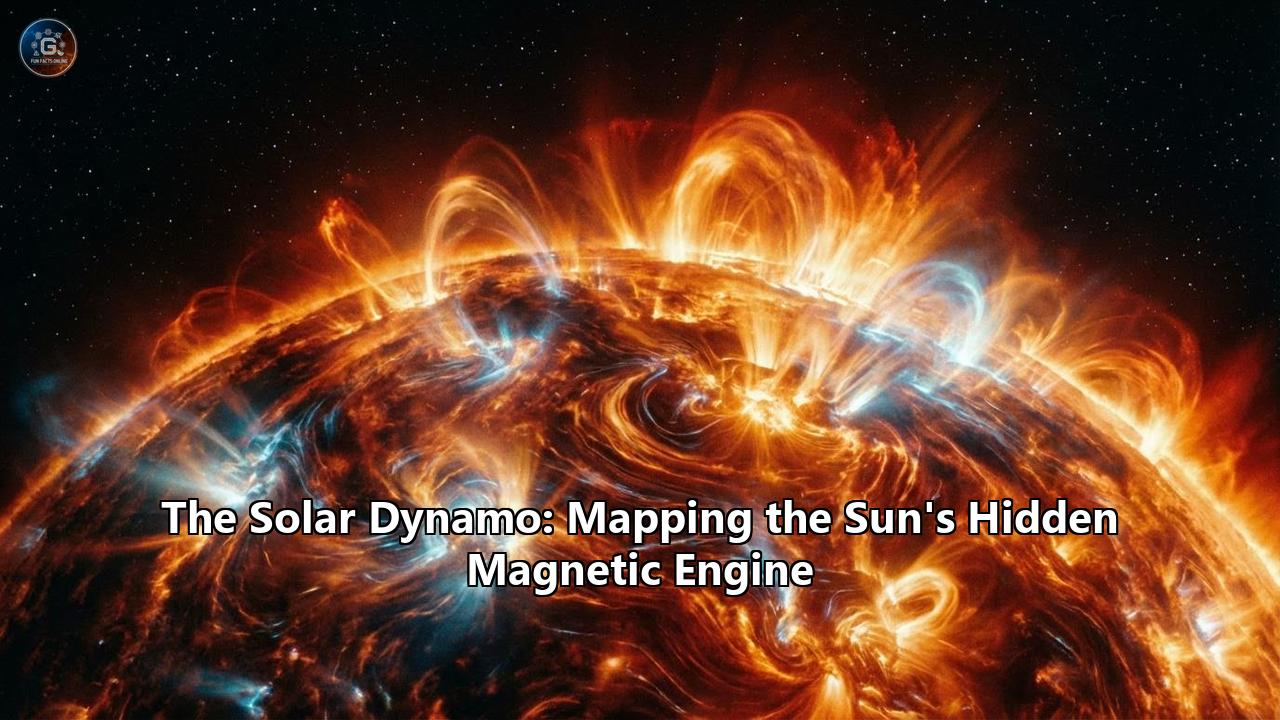
When we look up at the daytime sky, the Sun appears as a constant, unwavering disk of blinding light. For millennia, humanity viewed it as a perfect, static sphere of fire, a divine beacon that reliably warmed the Earth and governed the passing of the seasons. But this tranquil image is a cosmic illusion. Beneath that blindingly brilliant surface lies a seething, violent, and unfathomably complex beast. Our local star is not just a ball of hot gas; it is a colossal, churning magnetic engine. The secret to its behavior, its temper tantrums, and its life-giving energy lies in a phenomenon known as the solar dynamo—a hidden mechanism that generates, sustains, and continuously transforms the Sun’s magnetic field.
For centuries, astronomers have observed the outward symptoms of this hidden engine. They watched dark blemishes known as sunspots march across the solar disk. They witnessed spectacular flares of energy bursting into the void. They tracked the ebb and flow of solar activity over an eleven-year cycle. Yet, the exact location and mechanics of the engine room driving these phenomena remained one of astrophysics' most enduring mysteries. Today, we are living in a golden age of solar astronomy. Thanks to an armada of space probes, groundbreaking ground-based telescopes, and decades of painstakingly collected helioseismic data, we are finally mapping the Sun’s magnetic engine in unprecedented detail.
This is the story of the solar dynamo. It is a tale of twisted magnetic fields, subterranean plasma rivers, and the cutting-edge technology allowing humanity to peer inside a star.
To understand the solar dynamo, we must first peel back the blinding layers of the Sun and venture into its interior. The Sun is not solid; it is composed of plasma, the fourth state of matter, where immense heat has stripped electrons away from their atomic nuclei, creating a superheated soup of electrically charged particles. Because the plasma is electrically charged, its movements generate electrical currents, and where there are electrical currents, there are magnetic fields.
At the very center of the Sun lies the core, a nuclear furnace where hydrogen fuses into helium at temperatures exceeding 15 million degrees Celsius. Here, energy is born. Surrounding the core is the radiative zone, a dense region where energy slowly bounces its way outward in the form of photons—a journey that can take over 100,000 years.
Above the radiative zone, starting at about 70% of the Sun's radius and extending to the visible surface, is the convection zone. If the radiative zone is like a dense, quiet sponge slowly soaking up light, the convection zone is a violently boiling pot of water. Hot plasma from the depths rises toward the surface, cools, and then sinks back down to be reheated. These colossal, churning convective cells, known as supergranules, can be the size of Texas.
But there is a catch. The Sun does not rotate like a solid object such as the Earth. Because it is a massive ball of fluid plasma, it experiences "differential rotation." The plasma at the Sun's equator spins much faster than the plasma at the poles. At the equator, a full rotation takes about 25 days, while near the poles, it takes over 34 days. Furthermore, the outer layers of the convection zone spin at different speeds compared to the deeper layers.
This differential rotation, combined with the boiling, convective motions of the plasma, provides the kinetic energy required to power the solar dynamo. In the realm of magnetohydrodynamics—the study of the magnetic properties of electrically conducting fluids—these movements are the gears and pistons of the magnetic engine.
The solar dynamo is generally understood through two primary mechanisms that work in tandem to amplify and twist the Sun's magnetic field: the Omega effect and the Alpha effect.
Imagine the Sun during a period of magnetic calm, known as solar minimum. At this stage, the Sun's magnetic field is relatively simple, resembling the magnetic field of a standard bar magnet or the Earth. It has a north magnetic pole and a south magnetic pole, with field lines running straight from pole to pole, parallel to the axis of rotation. This north-south alignment is known as a poloidal magnetic field.
Now, the Omega effect takes over. Because the Sun’s equator rotates faster than its poles, the magnetic field lines frozen into the electrically conductive plasma are dragged along. Over months and years, the fast-spinning equator pulls the field lines ahead of the slower-spinning poles. The magnetic lines are stretched, bent, and wrapped tightly around the Sun's equator like thread being spun onto a spool. As they are stretched, the magnetic field becomes increasingly concentrated and exponentially stronger. What started as a simple north-south (poloidal) field is transformed into a highly wound, east-west aligned field known as a toroidal magnetic field.
Eventually, these toroidal magnetic bands become so tightly wound and intensely pressurized that they become buoyant. Like bubbles of air forced underwater, loops of this concentrated magnetic field rise through the convection zone and burst through the Sun's visible surface, the photosphere. Where these magnetic loops pierce the surface, they inhibit the flow of hot convective plasma from below. Consequently, these areas cool down relative to their surroundings, appearing dark to our telescopes. We call these dark, magnetic puncture wounds "sunspots".
But the dynamo cannot simply wind up forever; if it did, the Sun's magnetic field would eventually tear itself apart. This brings us to the Alpha effect. As the hot plasma rises in the convection zone, the rotation of the Sun imparts a twisting motion to the fluid—much like the Coriolis effect that causes hurricanes to spin on Earth. This helical, twisting motion warps the rising toroidal magnetic loops, tilting them and generating a new poloidal magnetic field, but with a reversed polarity from the one that started the cycle.
This beautiful, violent dance of physics—the Omega effect stretching the field horizontally and the Alpha effect twisting it back vertically—is the heartbeat of the Sun. It creates a continuous, self-sustaining loop. The entire process takes approximately 11 years to complete one phase, a period we call the solar cycle. At the peak of this cycle (solar maximum), the Sun is peppered with sunspots, flares, and intense activity. By the time the cycle concludes, the Sun's entire magnetic field has flipped; its magnetic north pole becomes the south, and vice versa. It takes two complete 11-year cycles—a 22-year span known as the Hale cycle—for the magnetic field to return to its original orientation.
While astronomers have mapped the symptoms of the dynamo by watching sunspots migrate from the mid-latitudes toward the equator (forming a shape known as a "butterfly diagram" when plotted on a graph over time), the precise location of the engine itself has been the subject of fierce debate. Since we cannot send a probe into the crushing, million-degree depths of the solar interior, scientists have had to find clever ways to look inside the star.
Their primary tool is helioseismology. Just as geologists use the seismic waves from earthquakes to map the Earth's interior, heliophysicists study the sound waves bouncing around inside the Sun. The Sun is essentially a giant bell, ringing continuously as convective turbulence creates low-frequency sound waves. By meticulously observing the surface vibrations—which cause the gases to rise and fall—scientists can deduce the temperature, density, and rotational speeds of the plasma deep underground.
For decades, the prevailing theory suggested that the solar dynamo operated deep within the Sun, in a transition layer called the tachocline. Located approximately 200,000 kilometers (124,000 miles) below the visible surface, the tachocline is the boundary where the rigidly rotating radiative zone meets the violently churning, differentially rotating convection zone. Across this narrow boundary, the rotational speed of the plasma shears drastically. Physicists believed this massive shear zone was the only place with enough friction and force to generate the massive toroidal magnetic fields that eventually bubble up as sunspots.
In early 2026, a monumental breakthrough provided the most compelling evidence yet for this theory. Researchers at the New Jersey Institute of Technology (NJIT) analyzed a staggering 30 years of solar oscillation data. They aggregated data from ground-based networks like the Global Oscillation Network Group (GONG) and space-based instruments like the Michelson Doppler Imager (MDI) on the SOHO spacecraft and the Helioseismic and Magnetic Imager (HMI) on the Solar Dynamics Observatory.
By analyzing how sound waves were perturbed by magnetic fields over three decades, the NJIT team mapped migrating rotation bands deep inside the Sun. Astonishingly, they found that these deep-flowing rivers of plasma formed a butterfly-like pattern that perfectly mirrored the sunspot migrations observed on the surface years later. The origin point of these rotation bands? The tachocline. The researchers essentially found the footprints of the magnetic engine, proving that the rotational bands start 200,000 kilometers down and take several years to propagate up to the surface. It was a triumph of observational science, firmly linking deep interior dynamics with the space weather we experience on Earth.
Yet, science is a landscape of constant questioning. Just a couple of years prior, in mid-2024, a team from Northwestern University ran state-of-the-art numerical simulations on a NASA supercomputer, proposing an entirely different model. Their models suggested that the dynamo might not originate in the deep tachocline, but rather in a near-surface shear layer, roughly 20,000 miles (32,000 kilometers) below the photosphere. They argued that near-surface models better explained certain rotational patterns of the Sun's gas and avoided predicting strong magnetic fields at high latitudes, which are rarely observed.
This scientific tension highlights the sheer complexity of the solar dynamo. While the recent 2026 helioseismic observations provide heavy, empirical weight to the tachocline origin, the debate pushes astrophysicists to refine their models continually. The Sun likely possesses multiple layers of magnetic generation, a deeply complex interplay where the massive tachocline engine interacts with localized, near-surface dynamos to produce the chaotic beauty we observe.
Understanding the engine room is only half the battle. We also need to understand how the magnetic fields behave once they erupt from the surface and stretch out into the solar system. The region above the photosphere—the chromosphere and the outermost atmosphere known as the corona—is entirely dominated by these magnetic fields.
The corona presents one of astrophysics' most glaring paradoxes: the coronal heating problem. The surface of the Sun is a relatively balmy 5,500 degrees Celsius. However, if you move outward into the corona, the temperature inexplicably skyrockets to millions of degrees. It defies common sense; it is like stepping away from a campfire and suddenly feeling thousands of times hotter.
To solve this, humanity built machines to touch the Sun.
NASA's Parker Solar Probe, launched in 2018, is a marvel of modern engineering. Protected by a cutting-edge carbon-composite heat shield, it has performed a series of daring gravitational slingshots around Venus, progressively shrinking its orbit until it dips directly into the scorching solar corona.
Parker’s instruments have revealed that the corona’s intense heat is intrinsically linked to the solar dynamo’s magnetic fields. As the magnetic loops bubble up from the convection zone, they are constantly jostled by the boiling surface. The magnetic field lines twist, tangle, and snap. When these lines cross and reconnect—a process known as magnetic reconnection—they act like violently snapped rubber bands, releasing massive amounts of stored magnetic energy. Parker discovered that the corona is saturated with small-scale magnetic reconnection events, originally theorized as "nanoflares" by astrophysicist Eugene Parker, after whom the probe is named. Furthermore, the probe observed magnetic "switchbacks"—rapid, S-shaped flips in the magnetic field lines flowing out in the solar wind, providing direct evidence of magnetic turbulence transferring energy from the Sun's interior into the outer atmosphere.
While Parker touches the corona, other instruments are stepping back to map the entire magnetic architecture. In 2023, the European Space Agency's Solar Orbiter used its Polarimetric and Helioseismic Imager (PHI) to capture high-resolution maps of the magnetic fields across the entire solar disc. These "magnetograms" provided vivid, pixel-perfect illustrations of how magnetic lines cluster fiercely around sunspots, inhibiting convection and making them appear darker.
Later, in January 2026, Solar Orbiter provided another breathtaking puzzle piece. Peering at the Sun from 45 million kilometers away, its instruments captured an event dubbed a "magnetic avalanche". Researchers watched a dark plasma loop stretching into the corona, anchored by arc-like magnetic fields. Suddenly, minor disturbances triggered a cascading effect of magnetic reconnections, setting off a massive solar flare. It proved that the dynamo's eruptions are highly complex, nonlinear events where a single snapped magnetic thread can cause an explosive unraveling of the whole structure.
Back on Earth, ground-based observatories are matching the space probes stride for stride. In September 2024, the Daniel K. Inouye Solar Telescope in Hawaii, the most powerful solar telescope on Earth, released groundbreaking 3D maps of the magnetic fields in the solar corona. Previously, mapping the corona's magnetic field was incredibly difficult due to its faintness. The Inouye telescope utilized a quantum phenomenon called the Zeeman effect—where light spectral lines split in the presence of a magnetic field—to observe the exact strength and polarization of coronal magnetism. Shortly after, in October 2024, scientists utilizing the Upgraded Coronal Multi-channel Polarimeter (UCoMP) published 114 consecutive daily maps of the coronal magnetic field, allowing researchers to track the daily global evolution of the magnetic atmosphere as the Sun rotated.
These maps are not just beautiful scientific triumphs; they are a vital necessity for the survival of our modern way of life.
Why do we spend billions of dollars and decades of research to understand the solar dynamo? The answer lies in space weather.
When the solar dynamo winds up during the solar maximum, the frequency of sunspots increases. Where there are sunspots, there is magnetic instability. When those massive magnetic loops snap and reconnect, they don't just heat the corona; they trigger solar flares and Coronal Mass Ejections (CMEs). A CME is a billion-ton cloud of magnetized plasma violently ejected from the Sun at millions of miles per hour.
If Earth happens to be in the crosshairs of a major CME, the results can be catastrophic. When the magnetized cloud slams into Earth’s own magnetic field (our magnetosphere), it causes a geomagnetic storm. Minor storms create beautiful auroras at the poles. Major storms, however, induce massive electrical currents in the ground.
In 1859, a massive solar storm known as the Carrington Event struck Earth. It was so powerful that telegraph wires burst into flames, and operators were shocked by their equipment. If a Carrington-level event were to strike today, the consequences would be devastating. Induced currents could melt the copper wiring of massive power grid transformers, plunging entire continents into darkness for months. GPS satellites, upon which our global logistics, aviation, and financial timing systems depend, would be severely degraded or destroyed. High-frequency radio communications would be blacked out, and astronauts in space would be subjected to lethal doses of radiation.
We cannot stop a solar storm any more than we can stop a hurricane. Our only defense is prediction and preparation. By mapping the solar dynamo and understanding its deep-seated engines, scientists can forecast the intensity of upcoming solar cycles. The 2026 NJIT study locating the dynamo's origin at the tachocline is a monumental step toward this goal. By tracking the rotation bands 200,000 kilometers beneath the surface, heliophysicists can now look years into the future, anticipating how the magnetic engine is winding up before the sunspots even break the surface.
Furthermore, improved coronal mapping, such as the modeling efforts spearheaded by institutions using coronagraph data in the UK (like the CorMag project), allows meteorologists at space weather prediction centers to accurately model the trajectory and magnetic orientation of CMEs. If a CME’s magnetic field is aligned opposite to Earth’s, it will seamlessly connect with our magnetosphere, pouring energy into our atmosphere and causing maximum damage. If we know the magnetic structure of an incoming CME before it arrives, power grid operators can deliberately decouple grids to prevent cascading failures, and satellite operators can put their instruments into protective safe modes.
The solar dynamo is the ultimate master of our solar system. Its invisible magnetic tendrils reach out past Pluto, carving out a protective bubble called the heliosphere that shields our planetary neighborhood from deadly interstellar cosmic rays. The very engine that threatens our technology with solar storms also creates the magnetic shield that makes life on Earth possible.
For centuries, the Sun kept its secrets locked away beneath a blinding veil of light. But through human ingenuity—by listening to the sound waves echoing in the solar depths, by launching probes that dive through the scorching corona, and by capturing the subtle splitting of light in magnetic fields—we have finally begun to chart the unchartable.
We now know that 200,000 kilometers beneath the surface, rivers of hot plasma are winding up a magnetic spring. We know how these magnetic bands float up, erupt through the surface, and violently reconnect in the atmosphere to unleash the fires of the corona. We have transitioned from simply looking at the Sun to fundamentally understanding it as a dynamic, three-dimensional, magnetic machine.
As we progress through current and future solar cycles, the continuous mapping of the Sun’s hidden magnetic engine will safeguard our civilization against the wrath of space weather. It will also provide us with a master key to understanding other stars across the cosmos. Every star you see in the night sky is its own dynamo, humming with the same fundamental physics. By looking deeply into our own star, we are illuminating the magnetic engines that drive the universe itself.
Reference:
- https://scitechdaily.com/scientists-finally-locate-the-suns-hidden-magnetic-engine-deep-beneath-its-surface/
- https://www.sciencealert.com/groundbreaking-maps-of-magnetic-field-in-suns-atmosphere-revealed
- https://www.esa.int/ESA_Multimedia/Images/2024/11/PHI_s_map_of_the_Sun_s_magnetic_field
- https://en.wikipedia.org/wiki/Solar_dynamo
- https://www.cora.nwra.com/~werne/eos/text/dynamo.html
- https://starlust.org/the-suns-magnetic-engine-is-located-200-000-kilometers-below-its-surface-new-study-claims/
- https://www.quantamagazine.org/how-a-nasa-probe-solved-a-scorching-solar-mystery-20240429/
- http://www.scholarpedia.org/article/Solar_dynamo
- https://modernmechanics24.com/post/sun-magnetic-engine-200k-kms-within/
- https://www.sciencedaily.com/releases/2024/05/240522130423.htm
- https://www.sciencefriday.com/segments/parker-solar-probe-new-glimpse-sun/
- https://www.smithsonianmag.com/science-nature/how-three-new-tools-will-revolutionize-our-understanding-sun-180975650/
- https://starlust.org/es-as-solar-orbiter-captures-unprecedented-view-of-magnetic-avalanche-on-sun/
- https://www.iflscience.com/magnetic-field-of-the-suns-atmosphere-seen-like-never-before-thanks-to-114-new-maps-76302
- https://www.preventionweb.net/news/new-model-forecast-space-weather-way
- https://trends.glance.com/story/articles/Auto/US/en/rapid-read/s-c06640630b-05fa2257-5642-5892-bcb2-cd06fa08f8ab
- https://www.aanda.org/articles/aa/full_html/2020/10/aa38245-20/aa38245-20.html