
In the vast, silent archives of the cosmos, the earliest chapters have long remained unread, their pages stuck together by the fog of deep time. For decades, astronomers have stared into the abyss of the early universe, trying to reconcile a mathematical impossibility: the existence of supermassive black holes mere hundreds of millions of years after the Big Bang. Standard stellar evolution could not explain them; the timeline was too short, the growth rates too slow.
But recently, the James Webb Space Telescope (JWST) has inadvertently unlocked a new room in this cosmic library. It has detected a specific, peculiar chemical signature emanating from the dawn of time—a "chemical echo" so distinct and extreme that it cannot be produced by any star known to modern science. This signature points to the existence of a long-hypothesized but never-before-seen class of celestial monsters: Primordial Nitrogen Titans.
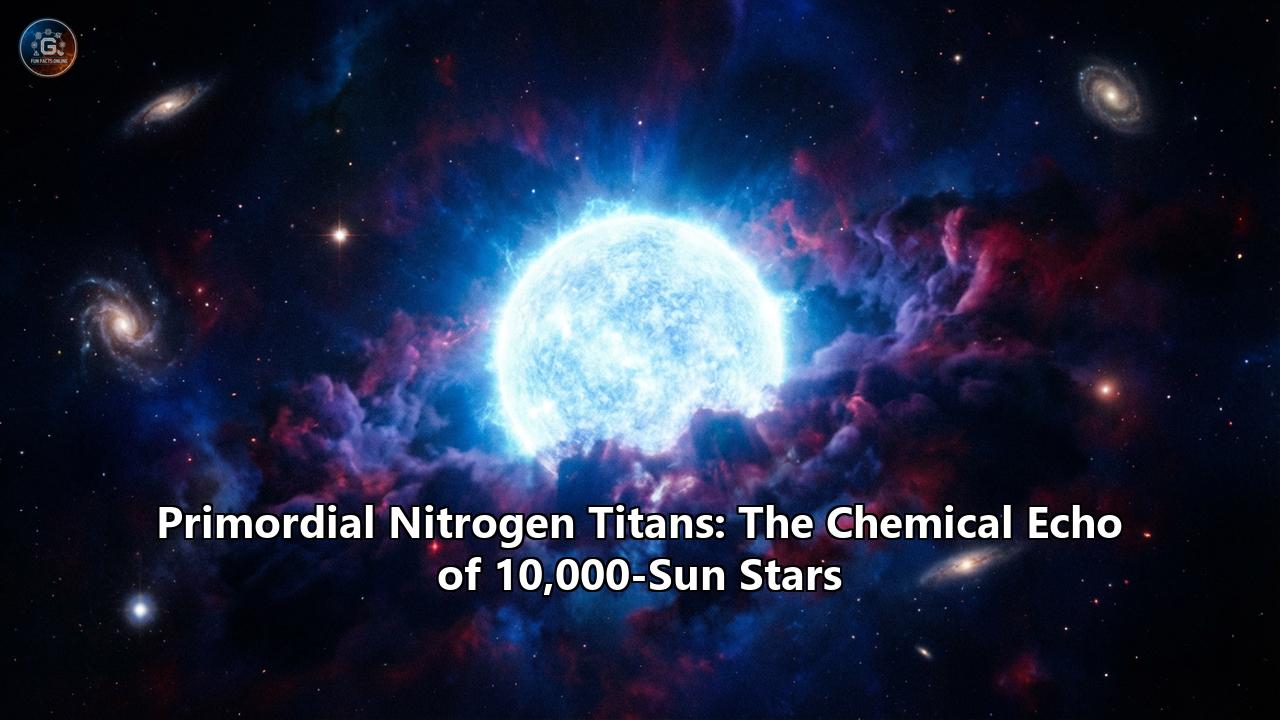
These are not merely large stars; they are leviathans of 10,000 solar masses, burning with a fury that dwarfs entire galaxies, forging the heavy elements that would one day seed life, and collapsing to become the anchors of the first galaxies. This is the story of their discovery, their impossible physics, and how they solve the greatest riddles of the early universe.
I. The Nitrogen Anomaly: A Crisis in Cosmology
To understand the magnitude of this discovery, one must first understand the "Nitrogen Crisis." In the local universe, nitrogen is a common element, produced leisurely by intermediate-mass stars as they age. When astronomers look at a galaxy, they expect the ratio of nitrogen to oxygen (N/O) to follow a predictable scaling relation. As a galaxy evolves and creates more metals, both nitrogen and oxygen abundance rise in tandem.
However, when JWST peered back to redshifts of $z \approx 10.6$ (galaxy GN-z11) and $z \approx 5.55$ (galaxy GS 3073), it found something that shouldn't exist. It saw galaxies that were "chemically impossible" by standard models.
The GS 3073 Smoking Gun
The galaxy GS 3073, in particular, became the focal point of this mystery. Spectroscopic analysis revealed a super-solar nitrogen abundance. Specifically, the ratio of nitrogen to oxygen ($\log(N/O)$) was measured at approximately $-0.3$ to $+0.46$.
In the context of standard stellar physics, this is enormous.
- Standard Stars: Produce oxygen primarily through supernova explosions (Type II). Nitrogen is a secondary product. In the early universe, oxygen should vastly outweigh nitrogen.
- Wolf-Rayet Stars: These massive, windy stars were the initial suspects. They do shed nitrogen, but they also shed massive amounts of carbon and oxygen, diluting the N/O ratio. They simply cannot hit the high peaks observed in GS 3073.
The data presented a paradox: How do you flood a young galaxy with nitrogen without also flooding it with the carbon and oxygen that usually accompany it? You need a "pure" nitrogen factory. You need a star that operates on a completely different set of rules.
II. The Anatomy of a Titan: 10,000 Solar Masses
The solution, proposed by teams including researchers Devesh Nandal, Daniel Whalen, and Mark Gieles in late 2025, lies in the existence of Supermassive Stars (SMS)—primordial titans weighing between 1,000 and 10,000 times the mass of the Sun.
These are not the Population III stars of popular imagination, which were thought to be a few hundred solar masses. These are true monsters, objects so massive that they flirt with the stability limits of general relativity.
The "Conveyor Belt" Mechanism
The secret to their nitrogen production lies in their internal structure, which is radically different from a star like our Sun.
- The Core: The core of a Nitrogen Titan is a fusion engine of unimaginable pressure, burning helium to forge carbon and oxygen at a feverish pace.
- The Hydrogen Shell: Surrounding this core is a massive shell of hydrogen.
- The CNO Cycle on Overdrive: In a normal star, the CNO cycle (Carbon-Nitrogen-Oxygen) is a side process. In a Nitrogen Titan, it is the main event. The carbon forged in the core diffuses outward into the hydrogen shell. There, temperatures are high enough to trigger the "hot" CNO cycle.
In this cycle, the star acts as a catalytic converter. It takes the carbon and oxygen and ruthlessly converts them into nitrogen-14 ($^{14}$N).
Crucially, these stars are fully convective. Picture a pot of boiling water rather than a solid layered onion. Giant currents of plasma dredge this newly minted nitrogen up from the depths and transport it to the surface, while pushing fresh fuel down. This "dredge-up" continuously enriches the surface with nitrogen while keeping the oxygen locked away or converted.
The Chemical Fingerprint
The resulting "chemical echo" matches the JWST observations perfectly:
- Extreme Nitrogen: The star pumps out massive amounts of $^{14}$N.
- Depleted Oxygen: Oxygen is consumed to make the nitrogen.
- Specific Isotope Ratios: The models predict unique ratios of Carbon-12 to Carbon-13, a signature that acts as a DNA match for this specific stellar type.
When these stars shed their mass—via terrifyingly strong stellar winds or during their final explosive death—they pollute their host galaxy with this distinct "nitrogen-pure" mix.
III. The Birth of Monsters: The Inertial-Inflow Model
How does nature build a star 10,000 times the mass of the Sun? For decades, the "Eddington Limit" was thought to prevent this. As a star grows, its brightness increases. Eventually, the outward pressure of its own light becomes so strong that it blows away any infalling gas, halting growth. Standard theory capped star size around 150-300 solar masses.
To form a Titan, the universe had to cheat the limit. The mechanism is known as the Inertial-Inflow Model.
Cold Streams and Supersonic Turbulence
In the chaotic environment of the early universe (the Cosmic Dawn), gas clouds were not calm pools; they were turbulent storms. The Inertial-Inflow Model suggests that in the densest centers of these clouds, gas wasn't just falling in; it was being driven in by supersonic flows.
These streams of cold gas strike the protostar with such momentum that they crush through the radiation barrier. The "accretion rate" (the speed at which the star eats) becomes astronomical—potentially 1 solar mass per year. The star grows faster than it can radiate the energy away.
The Proto-Globular Cluster Connection
This formation scenario solves another long-standing mystery closer to home: Globular Clusters.
Astronomers have known for years that the ancient globular clusters orbiting the Milky Way contain "multiple populations" of stars with weird chemical abundances—specifically, high nitrogen and sodium, but low oxygen. This is the exact same signature seen in the distant galaxy GS 3073.
The conclusion is staggering: Globular Clusters are the fossils of these Nitrogen Titans.
Billions of years ago, when the Milky Way was forming, its globular clusters were likely birthing grounds for these 10,000-solar-mass monsters. The Titans formed in the center, polluted the remaining gas with nitrogen, and then died. The thousands of smaller stars we see in the cluster today formed from that polluted gas, inheriting the chemical echo of the dead Titan.
IV. The Death of a Titan: Seeds of Darkness
A star with the mass of 10,000 Suns lives life in the fast lane. Its lifespan is measured not in billions of years, but in mere millions—perhaps as short as 2 million years.
When the fuel runs out, the end is catastrophic and inevitable. But unlike a normal star that leaves behind a neutron star or a small black hole, a Nitrogen Titan has a darker destiny.
Direct Collapse and the IMBH
Because of their immense gravity, these stars are the primary candidates for the "Direct Collapse" scenario. The core collapses so quickly and with such mass that a supernova explosion may not even be able to break out. Instead, the entire star implodes, vanishing almost instantly.
What is left behind is an Intermediate-Mass Black Hole (IMBH)—a single black hole weighing thousands of solar masses.
Solving the Quasar Mystery
This provides the missing link for supermassive black holes.
- The Problem: If you start with a 10-solar-mass black hole (from a normal star), it takes billions of years to grow into a billion-solar-mass quasar. There isn't enough time in the early universe.
- The Titan Solution: If you start with a 10,000-solar-mass black hole seed (from a Nitrogen Titan), you have a massive head start. These seeds can merge and accrete gas rapidly enough to become the supermassive monsters JWST sees at the edge of time.
Thus, the Nitrogen Titans are not just chemical factories; they are the mothers of the supermassive black holes that anchor all modern galaxies, including our own.
V. The Era of Verification
We are currently living through the "Era of Verification" for this hypothesis. The detection of GS 3073 was the opening salvo.
What JWST is Looking For Next
Astronomers are now combing through deep-field data for more "nitrogen-loud" galaxies. They are looking for:
- The "Turnover" Point: Finding the upper and lower mass limits of these stars by analyzing slight variations in the N/O ratio in different galaxies.
- He II Emission Lines: Ionized helium lines that indicate incredibly hot surface temperatures ($100,000K+$), a hallmark of these massive objects.
- Gravitational Waves: Future observatories like LISA (Laser Interferometer Space Antenna) will listen for the "ringing" of these massive black hole seeds merging. If the Titan hypothesis is correct, the universe should be humming with the mergers of 10,000-solar-mass black holes from this epoch.
VI. Conclusion: A Universe More Violent and Majestic
The discovery of the chemical echo of 10,000-sun stars rewrites the narrative of the Cosmic Dawn. It changes the early universe from a place of slow, gradual lighting to an arena of violent, gargantuan processes.
We now know that before the familiar stars of the night sky existed, there was a generation of Titans. They were the alchemists of the void, turning the primordial hydrogen of the Big Bang into the nitrogen that makes up our atmosphere and the DNA in our cells. They lived fast, died spectacularly, and left behind the black holes that hold our galaxy together.
The nitrogen in the air you breathe right now may well be the exhaust plume of a 10,000-sun monster that burned and died 13 billion years ago. We are, quite literally, the children of Titans.
Reference:
- https://arxiv.org/abs/1911.04465
- https://www.researchgate.net/publication/337184036_The_Origin_of_Massive_Stars_The_Inertial--Inflow_Model
- https://www.researchgate.net/publication/345925775_The_Origin_of_Massive_Stars_The_Inertial-inflow_Model
- https://en.wikipedia.org/wiki/Intermediate-mass_black_hole
- https://arxiv.org/html/2502.04435v3