
Introduction: The Chaos Paradox
For centuries, our understanding of the liquid state has been defined by a single, unshakeable tenet: chaos. In a solid, atoms are the disciplined soldiers of the material world, locked into rigid lattices, vibrating in place but never breaking rank. In a gas, they are the anarchists, flying apart at high speeds with no regard for their neighbors. But a liquid? A liquid is the bustling crowd. It is a state defined by constant, fluid motion, where atoms jostle, slide, and flow past one another in an eternal, restless dance. This ceaseless movement, governed by the laws of thermodynamics and described by Brownian motion, is what gives liquids their ability to flow, to take the shape of their container, and to splash.
Or so we thought.
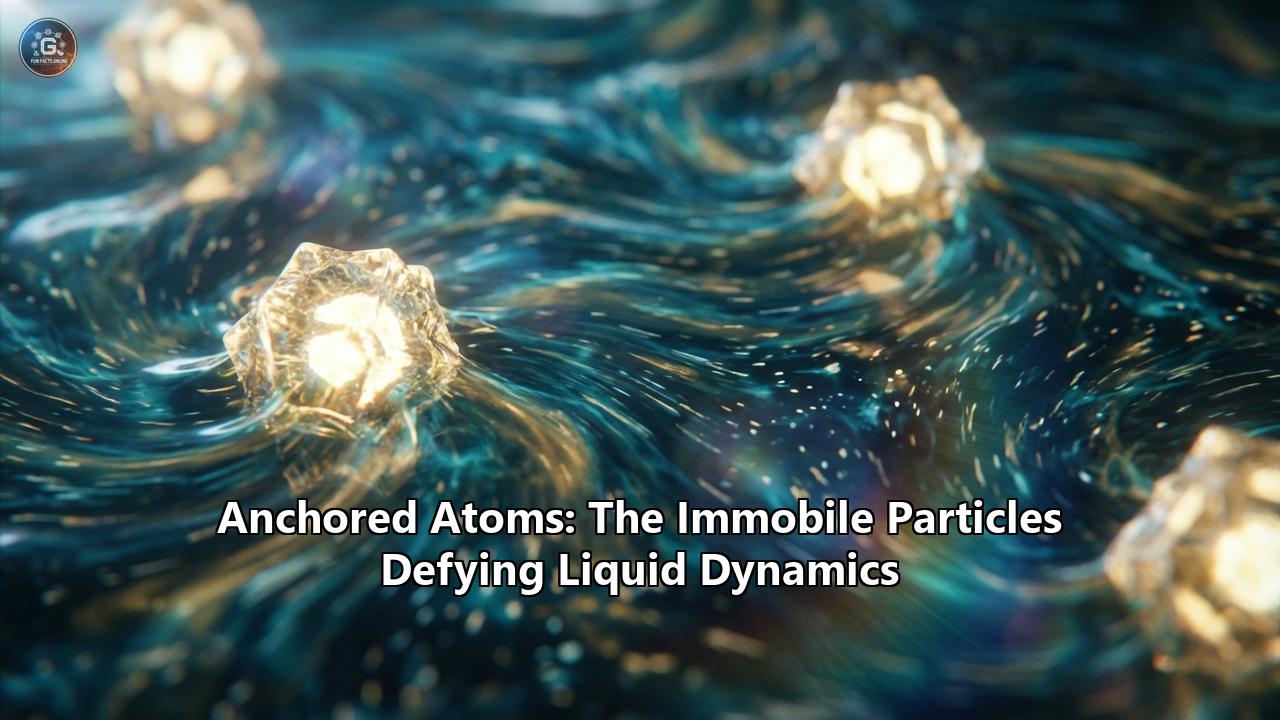
In a discovery that has sent shockwaves through the fields of condensed matter physics and material science, researchers have unveiled a phenomenon that shouldn't exist: Anchored Atoms. Deep within the molten churn of liquid metals, scientists have observed particles that—defying all known rules of liquid dynamics—simply refuse to move. These atoms stand stoic and still, anchored in place while their neighbors rush past them in a superheated frenzy.
This is not merely a curiosity; it is a violation of our intuition about how matter behaves. These immobile particles do not just sit there; they actively dictate the behavior of the liquid around them. They trap swirling atoms in "atomic corrals," prevent liquids from freezing even when temperatures plummet, and give rise to a hybrid state of matter that is neither fully solid nor fully liquid.
This article delves deep into the heart of this anomaly. We will journey into the atomic-scale experiments that revealed these "ghosts in the machine," explore the quantum mechanics that allow such a paradox to exist, and examine how this discovery—along with other fluid anomalies like negative mass fluids and shape-recovering liquids—is rewriting the textbooks. We stand on the precipice of a new era in materials science, where the chaotic dance of the liquid can finally be choreographed, atom by atom.
Part I: The Discovery of the Unmoving
The Experiment at the Edge of Physics
The revelation of anchored atoms did not happen in a massive particle collider or a theoretical chalkboard, but on the glowing screen of one of the world's most powerful microscopes. The discovery emerged from a collaboration between the University of Nottingham in the UK and Ulm University in Germany, two institutions at the forefront of electron microscopy.
The team, led by Professors Andrei Khlobystov and Ute Kaiser, was investigating the solidification processes of metal nanoparticles. Their goal was to understand how molten metals like platinum, gold, and palladium transform into crystals as they cool. To do this, they placed nanoscopic droplets of these metals onto a sheet of graphene—a single, atom-thick layer of carbon that serves as the ultimate "petri dish" for atomic observation.
Using the SALVE (Sub-Angstrom Low-Voltage Electron microscopy) instrument, a tool capable of visualizing individual atoms without destroying them with high-energy beams, they heated the metals until they melted.
The expectation was standard: as the heat rose, the metal's crystalline lattice should collapse, and the atoms should dissolve into a frenetic, incoherent blur of motion.
"When we consider matter, we typically think of three states: gas, liquid, and solid," Professor Khlobystov explained. "Atoms in liquids move in a complex way, resembling a jostling crowd. They constantly and rapidly pass by each other."
But that is not what they saw.
The "Impossible" Observation
As the metal melted and the majority of atoms began their high-speed, chaotic swirling, a subset of atoms remained eerily still. They were not merely moving slowly; they were effectively immobile.
In the video feeds from the electron microscope, these atoms appeared as bright, stationary pillars amidst a river of flowing greyscale. They held their ground even as the temperature soared hundreds of degrees above the metal's melting point. It was as if someone had placed a rock in a stream, but in this case, the "rock" was chemically identical to the "water."
This observation challenged the fundamental definition of a liquid. In a true liquid, every atom should be equivalent, possessing the same freedom of movement as any other. The existence of a "caste system" of atoms—some free to roam, others shackled in place—suggested that the liquid state is far more complex than the homogenous soup we once imagined.
The Mechanism: The Graphene Trap
Why were these atoms stuck? The answer lay in the substrate: the graphene.
Graphene is often touted as a "wonder material" for its perfect honeycomb lattice of carbon atoms. However, in the real world, no material is perfect. The graphene sheets used in the experiment contained tiny imperfections—point defects—where a carbon atom was missing or chemically altered.
The researchers discovered that the metal atoms were forming a unique, ultra-strong bond with these defects. The interaction was so potent that it overcame the thermal energy trying to push the atom into motion. The defect acted as a microscopic anchor, pinning the metal atom to the "floor" of the droplet.
Crucially, the electron beam used to observe the sample wasn't just a passive observer; it played a role in creating these defects. By tuning the intensity of the beam, the scientists realized they could effectively "write" anchors into the material, determining how many atoms would get stuck. They had stumbled upon a way to remotely control the atomic freedom of a liquid.
Part II: The Physics of Atomic Corrals
The Fence That Stops the Freeze
The presence of a few stationary atoms might seem like a minor nuisance, but in the world of nanophysics, they acted as powerful disruptors. The researchers found that these anchored atoms exerted an influence far beyond their immediate vicinity. They acted as obstacles, creating a phenomenon known as "geometric frustration."
In a normal cooling process, a liquid turns into a solid when a "seed" crystal forms. A few atoms lock into a pattern, and that pattern spreads rapidly through the liquid like a wave.
However, the anchored atoms blocked this wave. When the liquid metal tried to align itself into a crystal lattice, it would "bump" into an anchored atom that was in the wrong spot. The lattice couldn't grow around it. The anchored atoms effectively confused the liquid, preventing it from organizing.
The "Corralled" Supercooled Liquid
The most spectacular consequence of this disruption was the creation of Atomic Corrals. When the anchored atoms were arranged in a circle or a dense cluster, they trapped a pool of liquid metal inside them.
Because the anchored atoms prevented the crystallization wave from entering the corral, the liquid inside remained liquid far below its freezing point.
- Normal Platinum Melting Point: 1,768°C (3,214°F)
- Corralled Platinum: Remained liquid at temperatures as low as 350°C (662°F).
This is a staggering difference. Imagine water that stays liquid at -100°C simply because a few ice cubes are glued to the bottom of the glass in a specific pattern.
This state—where a liquid is trapped in a fluid state by the geometry of its container's atoms—represents a hybrid state of matter. It is a "solid-stabilized liquid." The atoms inside are free to move and flow, retaining all the catalytic and chemical properties of a liquid, but the overall droplet is held in a fixed shape by the skeletal framework of the anchored atoms.
Violating Classical Nucleation Theory
This discovery forces a revision of Classical Nucleation Theory (CNT), the prevailing model used to predict how and when liquids freeze. CNT assumes that nucleation (the birth of a crystal) is a stochastic (random) process driven by temperature and pressure.
The "Anchored Atom" phenomenon introduces a new variable: Topological Confinement. It suggests that the geometry of the boundary is just as important as the temperature. If you can control the boundary at the atomic level, you can suppress freezing indefinitely. This is a concept that was previously theoretical, often discussed in the context of "glassy dynamics" or "jamming transitions," but never observed with such clarity in simple elemental metals.
Part III: Beyond Anchors – A Universe of Anomalous Fluids
The discovery of anchored atoms is part of a broader, emerging narrative in modern physics: the realization that fluids are capable of behaviors that seem to defy the classical laws of nature. While anchored atoms defy mobility, other recent discoveries have defied thermodynamics and Newtonian mechanics.
To understand the magnitude of the anchored atom discovery, we must place it in the context of these other "rebel" fluids.
1. The Shape-Recovering Liquid (The "Immortal" Droplet)
Just months prior to the full understanding of anchored atoms, researchers at the University of Massachusetts Amherst discovered a liquid that defies gravity and entropy.
They were working with a mixture of oil, water, and magnetic nanoparticles. Typically, if you mix oil and water, they separate. If you shake them, they form a messy emulsion that eventually separates again.
However, when they doped the mixture with magnetic nanoparticles and applied a magnetic field, something bizarre happened. The droplet formed a specific shape (like a spindle or a torus). When they destroyed the shape—shaking it, smashing it, dispersing it—the liquid reassembled itself back into the original shape the moment the interference stopped.
The Defiance:According to the Second Law of Thermodynamics, systems tend toward disorder (entropy). A smashed droplet should not spontaneously put itself back together into a complex shape.
The Explanation:The magnetic particles formed a "jammed" layer at the interface between the oil and water. Similar to the anchored atoms, these particles became immobile at the surface, creating a flexible armor. This "ferromagnetic liquid shell" stored the energy of the shape, allowing the liquid to have a "memory."
2. Negative Mass Fluids
At Washington State University, physicists created a fluid composed of rubidium atoms cooled to near absolute zero (a Bose-Einstein Condensate) that exhibited negative mass.
In our universe, Newton’s Second Law ($F=ma$) dictates that if you push an object, it moves away from you.
The Defiance:When the researchers "pushed" this rubidium fluid with a laser, it accelerated backwards, moving toward the push.
The Explanation:This is a quantum phenomenon where the "effective mass" of the particles becomes negative due to the dispersion relation in the condensate. While not a liquid you could pour in a cup, it demonstrates that at the atomic limit, "fluid dynamics" can completely invert standard logic.
3. Frictionless Superfluids
The grandfather of all anomalous fluids is Superfluid Helium. When cooled to near absolute zero, helium-4 loses all viscosity.
The Defiance:If you stir a cup of superfluid helium, it will spin forever. It can climb up the walls of a glass and drip out the bottom, defying gravity.
The Connection:Anchored atoms represent the opposite extreme of superfluidity. In a superfluid, atoms are so coherent they flow without resistance. In the "anchored" state, atoms are so incoherent (due to the trap) that they refuse to flow at all, yet allow the surrounding medium to remain fluid. Both phenomena show that the "liquid" state is a spectrum of quantum possibilities, not just a simple phase of matter.
Part IV: The Technology of Immobility
Why does it matter that we can anchor atoms? The implications for technology, industry, and environmental science are profound. The ability to pin atoms in place turns a liquid from a chaotic mess into a programmable tool.
1. The Holy Grail of Catalysis
The most immediate application of anchored atoms is in the field of catalysis.
Catalysts are materials that speed up chemical reactions. They are essential for everything from refining oil to cleaning car exhaust (catalytic converters) and producing fertilizer. The most effective catalysts are often expensive metals like platinum, gold, and palladium—the very metals used in the anchored atom experiments.
The Problem:Solid catalysts are inefficient because only the atoms on the surface can interact with chemicals. The atoms inside the bulk solid are wasted.
Liquid catalysts are hyper-efficient because every atom is available to react, but they are unstable, hard to contain, and typically require extreme heat to stay molten.
The Anchored Solution:The "Corralled Supercooled Liquid" offers the best of both worlds.
- High Efficiency: It is a liquid, so the atoms are mobile and active.
- High Stability: It is trapped by anchored atoms, so it doesn't flow away or clump up.
- Low Energy: It stays liquid at 350°C instead of 1,700°C.
Imagine a chemical plant that runs at half the temperature, uses 90% less platinum, and produces zero waste because the catalyst never degrades (it's a self-healing liquid). This could revolutionize hydrogen fuel cell production, making green energy significantly cheaper.
2. Atom-by-Atom Manufacturing
We are entering the age of Atomtronics—electronics and machines built at the atomic scale.
Currently, our smallest transistors are a few nanometers wide, but they are "carved" out of solid blocks of silicon (lithography).
Anchored atoms provide a method for "bottom-up" assembly. By using an electron beam to create defects in graphene, we could "draw" a blueprint of anchors. Then, we pour liquid metal over it. The metal would flow into the corrals and solidify only where we want it to, guided by the anchors.
This could allow for the creation of:
- Atomic wires: Conductive pathways only a few atoms wide.
- Quantum dots: Perfectly sized clusters of atoms for high-efficiency solar panels and quantum screens.
- Self-repairing circuits: Circuits made of corralled liquid metal that can "heal" a break because they remain fluid.
3. Phase-Change Memory Devices
Computers store data in "1s" and "0s." In Phase-Change Memory (PCM), a 1 is a crystalline solid and a 0 is an amorphous glass. The computer heats and cools the material to switch between them.
The "Anchored Atom" effect provides a new way to control this switch. Instead of relying on clumsy heating elements, a device could use electric fields to "engage" or "disengage" atomic anchors, freezing or melting a bit of information instantly. This could lead to memory storage that is faster than RAM and permanent like a hard drive.
Part V: Theoretical Shockwaves
The discovery of anchored atoms does more than build better gadgets; it forces theoretical physicists to return to the drawing board.
The Breakdown of Ergocity
In statistical mechanics, the Ergodic Hypothesis states that, given enough time, a system (like a liquid) will explore all possible states. Every atom should eventually visit every location in the volume.
Anchored atoms violate this. The system is non-ergodic. Some atoms are forbidden from moving. This means the standard equations used to calculate entropy, free energy, and reaction rates in liquids may need to be rewritten to include terms for "atomic friction" or "localization."
The Glass Transition Mystery
One of the deepest unsolved problems in physics is the Glass Transition. Why do some liquids (like silica) turn into glasses (amorphous solids) rather than crystals when cooled?
The anchored atom experiment provides a "toy model" for this. The researchers observed that when the number of anchored atoms was high, the entire liquid solidified into an amorphous glass rather than a crystal.
This suggests that glass formation might be driven by "random pinning sites"—atoms that get stuck and jam the machinery of crystallization. If we can understand the anchors, we might finally solve the mystery of glass, leading to "unbreakable" glass or new types of amorphous metals (metallic glasses).
Part VI: The Future – Designing Matter
We are witnessing a shift from observing material properties to dictating them.
For the vast majority of human history, we were passive recipients of the phases of matter. Water freezes at 0°C. Iron melts at 1,538°C. We could change the temperature, but we couldn't change the rules.
The discovery of anchored atoms tells us that the "melting point" is not a fixed law of nature, but a negotiation between the atoms and their environment. By intervening in that negotiation—by placing anchors, creating defects, and building corrals—we can create materials that defy their natural instincts.
What lies ahead?
- Room Temperature Liquid Metals: Currently, mercury is the only common metal liquid at room temperature (and it's toxic). By using anchored atom techniques on alloys like Gallium-Indium, we might stabilize liquid metals for use in flexible robotics (like the T-1000 from Terminator, but benevolent) and wearable electronics.
- Tunable Solvents: Imagine a solvent that is liquid when you want to mix a drug, but instantly turns solid to lock the drug in place for storage, triggered simply by a pulse of electrons.
- Space Exploration: Materials that can self-heal in the vacuum of space or lubricants that never freeze on Mars. The robustness of "anchored" states makes them ideal for extreme environments.
Conclusion: The Anchor and the Sea
The image of an atom—a tiny, vibrating sphere—is the logo of the atomic age. But the image of the anchored atom—a sphere held fast against the tide—may become the symbol of the next age of materials science.
By discovering that the chaotic sea of liquid dynamics can be tamed by a few stubborn particles, scientists have opened a door to a world where solids and liquids are no longer distinct categories, but tunable variables on a sliding scale. We have found the anchors; now we can begin to build the ships that will sail this new ocean of matter.
The immobile particle does not just defy liquid dynamics; it defines the future of them.
Reference:
- https://www.sciencedaily.com/releases/2025/12/251210092017.htm
- https://www.youtube.com/watch?v=PId0FYnb7eM
- https://www.youtube.com/watch?v=KeLldeRtlbU
- https://happydaze.io/anchored-atoms/
- https://www.youtube.com/watch?v=fjDZ1h00M9s
- https://scitechdaily.com/this-self-shaping-liquid-defies-thermodynamics-and-always-rebuilds-its-form/
- https://www.popularmechanics.com/science/a69758384/emulsification-magnetism-laws-broken/
- https://www.youtube.com/watch?v=CzVoGMZ61To
- https://www.youtube.com/watch?v=HJ92U37seBA