
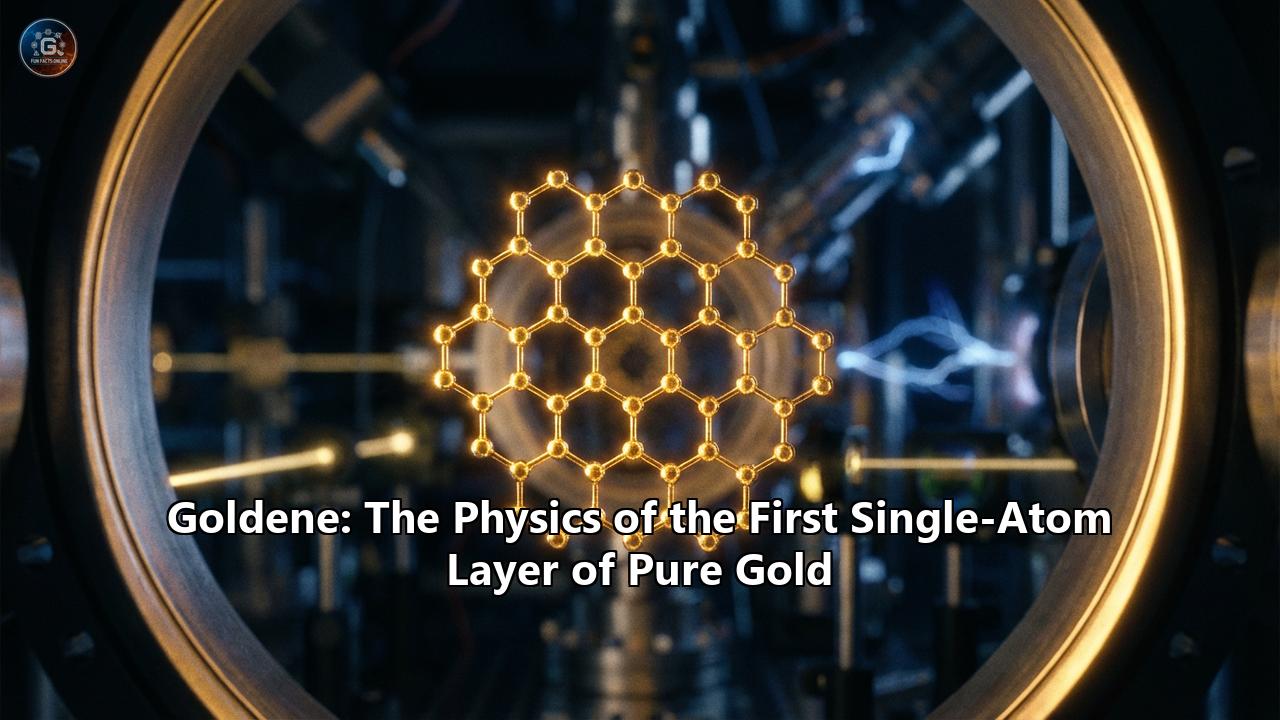
In the annals of materials science, few discoveries have bridged the ancient allure of precious metals with the futuristic promise of nanotechnology as profoundly as "Goldene." For millennia, gold has been the symbol of wealth, permanence, and divine power. It has adorned the sarcophagi of pharaohs, driven empires to war, and underpinned the global economy. Yet, for all its history, gold has kept one secret hidden—a secret that reveals itself only when the metal is stripped down to a single layer of atoms.
Welcome to the era of Goldene.
This is not merely a story of making gold thin; it is a narrative of alchemical transformation where a noble, inert metal is reborn as a chemically active semiconductor. It is a story of Swedish ingenuity colliding with ancient Japanese sword-making techniques. It is the physics of the impossible becoming possible.
What follows is a comprehensive deep dive into the discovery, synthesis, physics, and future of the first single-atom layer of pure gold.
Part I: The Flatland Frontier
The Two-Dimensional Revolution
To understand the magnitude of Goldene, we must first look at the revolution that preceded it. In 2004, the world of physics changed forever with the isolation of graphene. By peeling layers of carbon off a block of graphite using simple sticky tape, researchers revealed a material that was 200 times stronger than steel, more conductive than copper, and completely transparent. It earned its discoverers a Nobel Prize and launched the "2D materials" gold rush.
Scientists realized that when you reduce a 3D material to 2D—a single atomic sheet—its rules of existence change. Quantum confinement effects take over. Electrons are forced into a flatland where they behave in bizarre, hyper-efficient ways.
Following graphene, researchers synthesized "silicene" (from silicon), "phosphorene" (from phosphorus), and "borophene" (from boron). But the Holy Grail remained elusive: 2D metals.
The Metallic Paradox
Metals are fundamentally different from carbon or silicon. In a non-metal like graphite, the atoms are arranged in distinct layers held together by weak forces (Van der Waals forces), making them easy to peel apart. Metals, however, are held together by "metallic bonding"—a communal sea of electrons where atoms are tightly packed in 3D crystals. They don't have layers to peel. They want to clump together.
For decades, the consensus was that a free-standing, single-atom layer of metal was thermodynamically impossible. The surface energy would be too high; the atoms would instantly snap back into a 3D cluster to stabilize themselves. To make a 2D metal would be like trying to flatten a drop of water into a sheet and asking it to stay that way without a container.
That was the prevailing wisdom until the spring of 2024, when a team at Linköping University in Sweden proved physics wrong.
Part II: The Alchemists of Linköping
The Serendipitous Discovery
Scientific breakthroughs often happen not when someone yells "Eureka!" but when someone mutters, "That's funny..." This was the case for Lars Hultman, a professor of thin film physics, and Shun Kashiwaya, a researcher at Linköping University.
The team was not originally hunting for Goldene. They were working with a specialized class of electrically conductive ceramics known as MAX phases. These are layered materials that combine the best properties of metals and ceramics. They are tough, heat-resistant, and machinable.
The researchers were interested in a specific MAX phase: Titanium Silicon Carbide (Ti3SiC2). Their goal was to coat this material with gold to create a better electrical contact for high-temperature applications. But when they exposed the material to high heat, something unexpected happened.
Instead of sitting on top, the gold atoms melted and diffused into the ceramic. They engaged in a game of atomic musical chairs, kicking out the silicon atoms and taking their place within the layered structure. The result was a new material: Titanium Gold Carbide (Ti3AuC2).
They had successfully trapped single layers of gold inside a ceramic sandwich. The gold was there, flat and monatomic, but it was imprisoned between layers of titanium and carbon. The challenge was now one of liberation.
The Japanese Sword Connection
How do you remove the "bread" of a sandwich without touching the "filling," especially when the filling is a delicate layer of atoms that wants to crumble?
Standard chemical etching was too harsh. Hydrofluoric acid, the go-to etchant for many 2D materials, would destroy the gold or fail to remove the titanium carbide effectively. The team hit a wall.
The solution came from an unlikely source: the history of Japanese craftsmanship. Shun Kashiwaya looked into ancient techniques used by Japanese blacksmiths to forge swords and decorate metalware. He rediscovered a chemical concoction known as Murakami’s Reagent.
Murakami's reagent is a mix of potassium ferricyanide and potassium hydroxide. In metallurgy, it is used to etch grain boundaries in steel to reveal the microstructure or to remove carbon residues. It had never been used to synthesize a 2D material.
The "Dark" Experiment
The team hypothesized that Murakami's reagent could gently etch away the titanium carbide layers while leaving the gold intact. But it wasn't as simple as mixing chemicals. The process was incredibly delicate.
- Concentration Control: If the reagent was too strong, it dissolved everything. If too weak, nothing happened.
- The Light Sensitivity: The researchers discovered a critical nuance. When exposed to light, potassium ferricyanide can degrade into cyanide—which dissolves gold. To save the Goldene, the entire etching process had to be conducted in varying degrees of darkness.
- The Stabilization: Even if they freed the gold, it would naturally want to curl up like a scroll. To prevent this, they added a surfactant (a soap-like molecule) called cysteine. The surfactant acted as a scaffold, attaching to the gold surface and holding the sheet flat in the liquid solution.
After months of trial and error, tinkering with concentrations and etching times, they succeeded. They filtered the solution and peered through an electron microscope.
Staring back at them were not clumps of gold, but sheets. Ultra-thin, transparent, hexagonal lattices of pure gold. Goldene had been born.
Part III: The Physics of Goldene
A Metal That Behaves Like a Semiconductor
The most shocking property of Goldene is that it doesn't act like gold.
In its bulk 3D form, gold is the quintessential metal: it is one of the best conductors of electricity known to man. This is because its electrons are "delocalized," free to flow anywhere in the material.
However, when you constrain gold to a single atomic layer, you restrict the movement of its electrons. You introduce "quantum confinement." The continuous energy bands that allow electrons to flow freely in 3D gold are broken up.
Goldene exhibits semiconducting properties. This is a monumental shift. It means Goldene has a "band gap"—an energy hurdle that electrons must jump over to conduct. This tunable conductivity is the foundation of all modern electronics (transistors, chips, solar cells). Bulk gold is useless for logic (it's just a wire), but Goldene could theoretically be used to build the processor itself.
The "Free Bond" Phenomenon
In a block of gold, every gold atom is surrounded by 12 other gold atoms. They are comfortable, fully coordinated, and chemically inert. This is why gold doesn't rust or tarnish.
In Goldene, each atom is only surrounded by 6 neighbors in a flat hexagonal ring (similar to chicken wire). This leaves every atom with "dangling bonds" or unsaturated valencies. The atoms are chemically "frustrated." They are desperate to bond with something.
This transforms Goldene from a noble, inert material into a catalytic powerhouse. It becomes hyper-reactive, eager to interact with gases and other molecules.
Optical Sorcery: Plasmonics
Gold nanoparticles have long been used for their optical properties (they are why medieval stained glass has that rich ruby red color). Goldene takes this to a new level.
The interaction between light and the free electrons on the surface of a metal is called Surface Plasmon Resonance (SPR). Because Goldene is all surface (there is no "inside"), its interaction with light is incredibly intense. It can concentrate light energy millions of times more effectively than bulk gold. This has profound implications for sensing and photothermal therapies.
Part IV: The Synthesis Recipe (A Deep Dive)
For the scientifically minded, understanding the specific recipe reveals the elegance of this discovery. Here is the step-by-step breakdown of how Goldene is made.
Step 1: The Precursor (The MAX Phase)The starting material is titanium silicon carbide (Ti3SiC2). This is a hexagonal crystal structure. Think of it as a deck of cards where the "TiC" layers are the cards and the "Si" atoms are the air between them.
Step 2: Substitution ReactionThe ceramic is coated with pure gold and heated to 670°C. This is the "Goldilocks" temperature—hot enough for diffusion but not so hot that the crystal melts.
- Chemical Mechanism: Au + Ti3SiC2 → Ti3AuC2 + Si
- The gold atoms diffuse into the crystal, physically pushing the silicon atoms out. The silicon migrates to the surface and is later removed. You are left with Ti3AuC2.
The Ti3AuC2 powder is placed in the Murakami reagent (alkaline K3[Fe(CN)6]).
- Reaction: The reagent attacks the Titanium-Carbon bonds. It oxidizes the titanium, turning it into soluble ions that wash away.
- Duration: This is a slow process, taking up to two months in the dark.
- Result: The "bread" (TiC) dissolves, leaving the "filling" (Goldene) floating in the solution.
Without intervention, the floating gold sheets would collide and fuse back into gold nuggets due to Van der Waals attraction. The researchers introduce a surfactant (like CTAB or cysteine).
- The surfactant molecules have a "head" that loves metal and a "tail" that loves water. They coat the Goldene sheets, creating a fluffy buffer zone that keeps the sheets separated.
The solution is centrifuged and filtered. The liquid is removed, and the Goldene sheets are collected.
Part V: Applications – The Golden Age of Technology
The transition of gold from a passive store of value to an active functional material opens up billion-dollar industries.
1. The Green Hydrogen Revolution
The world is desperate for clean fuel. Hydrogen is the answer, but making it is dirty (using natural gas) or expensive (using electricity and platinum catalysts).
Goldene could change the equation. Its hyper-reactive surface makes it a potential electrocatalyst for water splitting (turning H2O into H2 and O2). Currently, we rely on platinum, which is scarcer and more expensive than gold. If Goldene can achieve similar efficiency with a fraction of the material mass (since it's only one atom thick), it could drastically lower the cost of green hydrogen.
2. Carbon Capture (Turning CO2 into Gold)
Goldene's "dangling bonds" make it hungry for carbon dioxide. Preliminary research suggests Goldene could act as a highly efficient catalyst for converting CO2 into useful fuels like ethanol or methane.
Imagine industrial smokestacks fitted with Goldene filters that don't just catch CO2 but instantly convert it into fuel that can be reused. It closes the carbon loop.
3. The End of Antibiotic Resistance?
Bulk gold is biocompatible (safe for the body). Goldene, however, might be deadly—to bacteria.
The sharp edges and charge properties of 2D gold sheets can physically slice through bacterial membranes or disrupt their metabolic processes. Yet, because it is gold, it remains non-toxic to human cells. This could lead to a new class of "mechanical antibiotics" that bacteria cannot develop resistance against.
4. Photothermal Cancer Therapy
Goldene's plasmonic properties allow it to absorb specific wavelengths of light (like near-infrared) and convert that energy into heat with near-perfect efficiency.
- The Scenario: Goldene particles are injected into the bloodstream and targeted to a tumor. An infrared laser (which passes harmlessly through skin) is shone on the area. The Goldene heats up, cooking the cancer cells from the inside out without harming surrounding healthy tissue.
5. Next-Gen Electronics
As silicon chips reach their physical limits (Moore's Law is dying), manufacturers are looking for new semiconductors. Goldene offers a material that is conductive, ultra-thin (allowing for smaller transistors), and flexible. It could lead to:
- Transparent Electronics: Invisible circuits on glass or contact lenses.
- Wearable Tech: Sensors woven into clothing that never corrode.
- Flexible Screens: Phones that fold like paper without breaking their internal circuits.
Part VI: The Economic Implication
Doing More With Less
Gold is expensive. At the time of writing, it hovers around $2,000+ per ounce.
The beauty of Goldene is the "surface area to volume ratio." In a solid gold bar, 99.9% of the atoms are stuck inside, doing nothing but adding weight. In Goldene, 100% of the atoms are on the surface, doing work.
You could theoretically achieve the catalytic activity of a 1-kilogram gold bar with just a few grams of Goldene. This "democratizes" gold. It makes gold-based technologies economically viable for mass production in a way they never were before.
Part VII: Future Prospects and Challenges
The Stability Problem
While Goldene is stable in liquid with surfactants, creating a dry, free-standing sheet that lasts for years is the next hurdle. Researchers need to find ways to transfer Goldene onto substrates (like silicon wafers) without it curling or degrading.
Scaling Up
Currently, Goldene is made in test tubes. Scaling this to industrial vats will require overcoming the slowness of the etching process. Waiting two months for a batch is not viable for Apple or Tesla. Accelerating the synthesis without destroying the delicate sheets is the primary engineering challenge for the next decade.
The "Metallene" Family
Goldene is just the beginning. The method used to create it (Intercalation + Etching of MAX phases) is a blueprint.
- Iridene (2D Iridium): Could revolutionize spark plugs and heavy-duty catalysts.
- Platinene (2D Platinum): The ultimate prize for hydrogen fuel cells.
- Silverene (2D Silver): The ultimate conductor, potentially for loss-less power transmission.
Part VIII: Conclusion
The discovery of Goldene is a reminder that even the most familiar materials harbor secrets. For 5,000 years, humans have dug gold from the earth, melted it, beaten it, and hoarded it, thinking we knew everything there was to know about the yellow metal. We were wrong.
By shaving gold down to its atomic soul, we have unlocked a new element entirely. Goldene is not just a thinner version of gold; it is a material with a new personality—reactive, semiconducting, and versatile.
As we stand on the precipice of this new discovery, the phrase "good as gold" takes on a new meaning. The future isn't just bright; it's Goldene.
Reference:
- https://en.wikipedia.org/wiki/MAX_phases
- https://www.researchgate.net/figure/A-brief-history-for-the-development-of-MAX-phases_fig16_383038147
- https://taylorandfrancis.com/knowledge/Engineering_and_technology/Chemical_engineering/MAX_phases/
- https://www.azom.com/article.aspx?ArticleID=5133
- https://en.wikipedia.org/wiki/Haruki_Murakami
- https://spectrum.ieee.org/gold-in-electronics-2d-sheet
- https://www.despatch.com/blog/the-first-free-standing-2d-metal-goldene-challenges-graphenes-title/
- https://eng.libretexts.org/Bookshelves/Materials_Science/Supplemental_Modules_(Materials_Science)/Semiconductors/Plasmon_Resonance/Semiconductors/Plasmon_Resonance)
- https://www.researchgate.net/publication/252160394_Physics_of_Surface_Plasmon_Resonance
- https://en.wikipedia.org/wiki/Surface_plasmon_resonance