
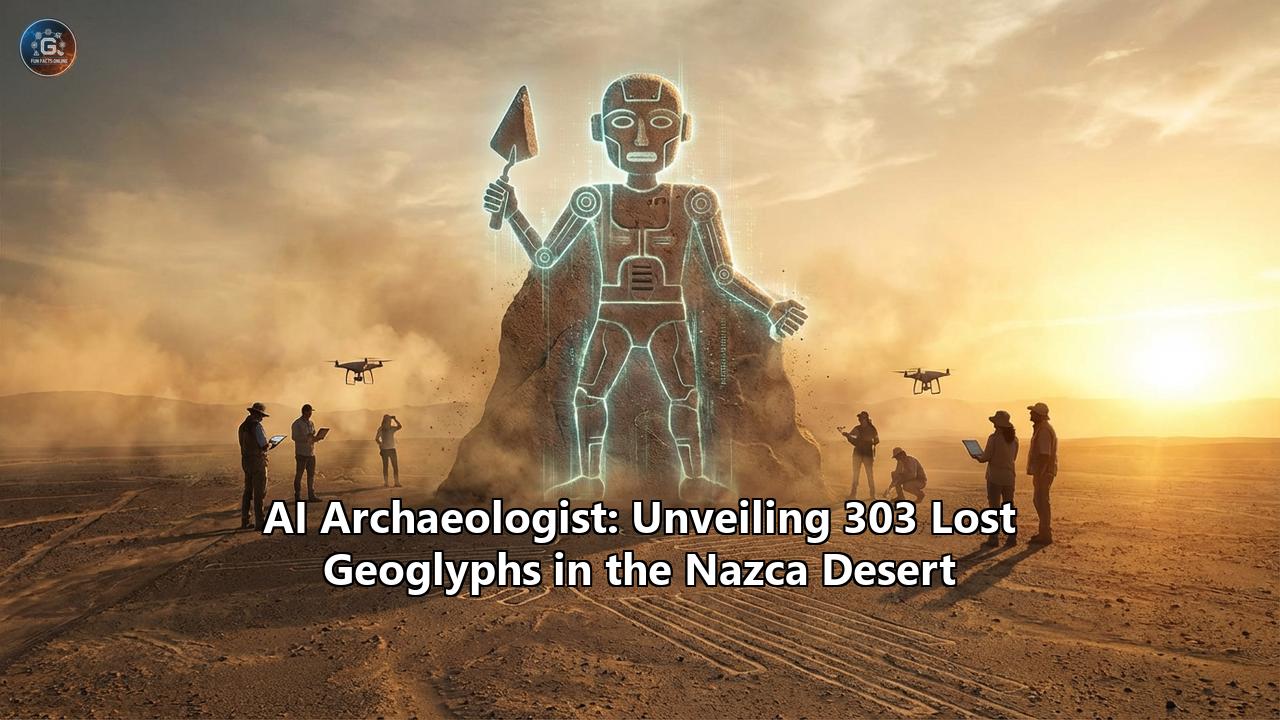
The Peruvian desert, a vast, arid canvas stretching between the Andes and the Pacific, has long held one of humanity's most enigmatic secrets. For nearly a century, pilots, archaeologists, and dreamers have gazed down at the Nazca Lines—immense geoglyphs etched into the earth—wondering who created them and why. From the iconic hummingbird to the spider, these lines have fueled theories ranging from astronomical calendars to alien landing strips. But for decades, the desert yielded its secrets slowly. Finding a new geoglyph was a rare, career-defining event, requiring years of scouring high-resolution imagery and grueling desert treks.
That changed in 2024. In a discovery that has sent shockwaves through the scientific community, a collaboration between Yamagata University in Japan and IBM Research has unveiled 303 previously unknown geoglyphs in a mere six months. This finding, which nearly doubles the known census of figurative Nazca designs, was not achieved by luck or traditional foot patrols alone, but by a new, powerful partner in the field of history: Artificial Intelligence.
This article explores the depths of this monumental discovery, the cutting-edge technology that made it possible, and the profound new insights it offers into the ancient Nazca civilization. We will journey through the sands of time to understand the "relief-type" versus "line-type" geoglyphs, decode the strange motifs of knife-wielding orcas and decapitated heads, and look ahead to the future of AI-powered archaeology.
Part 1: The Great Unveiling – A Quantum Leap in Archaeology
For nearly 100 years, since the first academic study of the Nazca Lines in the 1920s, the scientific community had identified approximately 430 figurative geoglyphs. These are the recognizable shapes—animals, plants, and humans—distinct from the thousands of geometric lines and trapezoids that crisscross the pampa. It took generations of archaeologists to build this catalog.
In one sweeping six-month project, the AI-human team added 303 new figures to the map.
The Scale of the Discovery
The sheer volume of this find is unprecedented. To put it in perspective, the rate of discovery before this project was linear and slow. This project represents a 16-fold increase in the discovery rate. The newly found geoglyphs are not just faint scratches; they are distinct, purposeful artworks that have been hiding in plain sight, obscured by centuries of erosion and the limitations of the human eye.
What Was Found?
The 303 new geoglyphs are a menagerie of the bizarre and the mundane. Unlike the famous giant lines that are easily spotted from airplanes, these new finds are largely "relief-type" geoglyphs. They are smaller, averaging about 9 meters (30 feet) in diameter, and are often etched into the slopes of hills rather than the flat desert floor.
The motifs are startlingly different from the classic Nazca repertoire:
- Humanoid Figures: Dozens of strange, abstract human shapes, some wearing headdresses or carrying objects.
- Decapitated Heads: A grim reminder of the Nazca culture's ritualistic practices, these motifs appear frequently, sometimes held by human figures or isolated as symbols.
- Domesticated Animals: Llamas and alpacas feature prominently, suggesting a focus on daily life and livestock.
- The Killer Whale with a Knife: One of the most striking finds is a 22-meter-long orca that appears to be wielding a knife. This imagery links back to Nazca pottery, where marine deities are often depicted as fierce headhunters.
- Scene-like Compositions: Unlike the solitary giant animals of the pampa, these smaller glyphs often interact. We see humans with animals, suggesting narrative scenes or mythological stories.
Part 2: The AI Archaeologist – How Technology Pierced the Veil
The hero of this story, alongside the archaeologists, is a deep learning model developed by IBM. But training an AI to find Nazca lines is not like training it to spot cats on the internet.
The Challenge: The "Few-Shot" Problem
In the world of Artificial Intelligence, "Big Data" is king. To train a model to recognize a car, you feed it millions of images of cars. But in archaeology, data is scarce. There were only about 400 known figurative geoglyphs in existence. This is a tiny dataset for training a robust neural network. Furthermore, the "noise" in the Nazca desert is deafening—ancient flood paths, modern truck tracks, and natural erosion all look confusingly similar to eroded geoglyphs.
The Solution: Weak Supervision and High-Res Imagery
The team at IBM and Yamagata University, led by Masato Sakai, employed a clever workaround. They didn't just teach the AI what a geoglyph looked like; they taught it to look for the probability of a geoglyph based on subtle changes in soil contrast and texture.
- Data Ingestion: The team fed the system terabytes of high-resolution aerial photography and laser scanning (LiDAR) data covering the entire Nazca Pampa.
- Training: They used a method called "semi-supervised" or "weakly supervised" learning. They used the limited known geoglyphs as positive examples and vast stretches of empty desert as negative examples.
- The Probability Map: The AI didn't just say "Here is a llama." Instead, it generated a heat map of the desert, highlighting areas with a high statistical likelihood of containing artificial modification.
- The Human Loop: This is crucial. The AI was not the final authority. It flagged 1,309 likely candidates. It was then up to the human archaeologists to trek to these specific coordinates and verify the findings.
Efficiency Redefined
The results were staggering. Out of the candidates the AI flagged, verifying them took a fraction of the time a blind survey would have required.
- Traditional Method: Walking the desert in a grid, hoping to stumble upon a line. Years of work for a handful of finds.
- AI Method: Targeted "surgical strikes." Archaeologists went exactly where the AI pointed.
- Success Rate: About 1 in 4 of the AI's high-probability targets turned out to be a genuine, previously unknown geoglyph.
Part 3: A Tale of Two Geoglyphs – Relief vs. Line
Perhaps the most scientifically significant aspect of this discovery is not just the number of new glyphs, but the type. The study has fundamentally altered our understanding of how the Nazca people used their landscape by distinguishing between two distinct categories of geoglyphs.
1. The Line-Type (The Giants)
- Examples: The Hummingbird, The Monkey, The Spider.
- Size: Massive, averaging 90 meters (300 feet).
- Technique: Made by removing the dark, oxidized stones from the surface to reveal the lighter, lime-rich soil underneath. They are linear and often drawn with a single continuous line.
- Location: Flat pampas (plains).
- Purpose: The new study reinforces the theory that these were communal ritual spaces. They are often connected to large trapezoids and rectangles—geometric clearings where hundreds of people could gather. They were likely walked upon during large-scale ceremonies dedicated to water deities or agricultural fertility. They are meant to be seen by the gods (from the sky) but experienced by the community (on the ground).
2. The Relief-Type (The New Discovery)
- Examples: The 303 newly found figures—humanoids, camelids, heads.
- Size: Small, averaging 9 meters (30 feet).
- Technique: "Relief" style involves removing stones to form a visible depression, but often using the natural topography of slopes and hills to create the image. They are more like bas-relief carvings in the dirt.
- Location: Slopes, hillsides, and winding ancient footpaths.
- Purpose: This is the breakthrough. The distribution of these new glyphs correlates almost perfectly with ancient walking trails.
The "Billboard" Theory: Unlike the giant lines, which are secluded on the flat plain, the relief glyphs were positioned to be seen by people walking along the paths.
Information Sharing: They likely served as markers, warnings, or storytelling devices for travelers. A depiction of a "killer whale with a knife" might warn of dangerous coastal waters or mark a path toward a specific ritual site. A llama might indicate a trade route.
Individual Rituals: Because they are smaller and more numerous, they may have been made by individuals or small family groups, rather than the state-sponsored labor required for the giant lines.
Part 4: Into the Mind of the Nazca
To understand these lines, we must understand the people who made them. The Nazca civilization flourished from roughly 100 BCE to 800 CE in one of the driest places on Earth. Survival was a constant negotiation with the environment.
The Obsession with Heads
The recurrence of "decapitated heads" in the new AI discovery confirms a darker aspect of Nazca culture: the Trophy Head Cult. The Nazca believed that the head contained the life force. Warriors would take the heads of enemies (and sometimes their own people) and modify them into ritual objects. Seeing these etched into the desert slopes suggests that these trails may have been procession routes for head-taking rituals or offerings to the ancestors.
The Oracles of Water
Water was the most precious resource. The "Killer Whale" (Orca) was a powerful deity in Nazca mythology, often associated with the sea and rain. A "knife-wielding" Orca is a mythological hybrid—a supernatural being that bridges the human practice of sacrifice with the raw power of the ocean. Finding this specific motif helps link the geoglyphs to the iconography found on Nazca pottery, solidifying the idea that the desert floor was an extension of their canvas.
Part 5: The Future of Archaeology
The success of the "AI Archaeologist" in Peru is a proof-of-concept for the entire world. This technology is already being adapted to:
- Amazonian Rainforests: Using LiDAR to strip away tree cover and finding lost cities beneath the canopy.
- Mayan Ruins: Detecting subtle elevation changes that indicate hidden pyramids in Mexico and Guatemala.
- Silk Road Sites: Mapping lost caravanserais buried under Central Asian sands.
Preservation in the Age of Climate Change
The Nazca lines are fragile. A single truck driving off-road can destroy a 2,000-year-old masterpiece in seconds. Flash floods, driven by El Niño, wash them away. By using AI to create a complete, high-precision map of every geoglyph (not just the famous ones), preservationists can better protect these sites. We cannot protect what we do not know exists. The AI has given the Peruvian Ministry of Culture a "hit list" of sites that need immediate fencing and legal protection.
Conclusion: The Message in the Sand
The discovery of 303 new geoglyphs is more than just a statistic; it is a restoration of history. For centuries, these small, intimate drawings—etched by travelers, traders, and families—sat in silence, overshadowed by their giant cousins on the pampa. The giant lines told us about the Nazca gods; the relief lines tell us about the Nazca people*.
They tell us about their fears (the knife-wielding monsters), their daily lives (the llamas), and their journeys. Thanks to the marriage of ancient dirt and modern silicon, the "AI Archaeologist" has allowed us to walk these ancient trails once more, seeing the desert not as a barren wasteland, but as a crowded gallery of messages left by a civilization that refused to be forgotten.
As the AI continues to scan the desert, processing terabytes of data while we sleep, one has to wonder: What else is out there, waiting to be seen? The 303 figures are likely just the beginning. The desert is still waking up.
Reference:
- https://en.as.com/latest_news/ai-reveals-303-hidden-messages-from-the-past-archaeologys-next-frontier-f202510-n/
- https://www.forbes.com/sites/carlymiller/2024/09/29/ai-discovers-303-nazca-geoglyphs-from-aerial-photos-of-the-peruvian-desert/
- https://www.jpost.com/archaeology/article-868967
- https://archaeologymag.com/2024/09/ai-uncovers-303-new-nazca-geoglyphs-in-peru/
- https://latinamericanpost.com/science-technology/revealing-old-secrets-with-ai-in-latin-america/
- https://www.yamagata-u.ac.jp/en/information/info/20240924/
- https://www.sciencefocus.com/planet-earth/how-were-about-to-solve-the-worlds-greatest-archaeological-puzzle
- https://news.ssbcrack.com/ai-uncovers-303-new-nazca-geoglyphs-doubling-known-figures-in-peruvian-desert/
- https://indiandefencereview.com/ai-solved-303-nazca-geoglyphs-rewriting-ancient-peru/
- https://www.theguardian.com/world/2024/sep/26/nazca-lines-peru-new-geoglyphs
- https://en.worldpeoplenews.com/news/science/2024-09/44182
- https://dailygalaxy.com/2025/04/artificial-intelligence-archaeology-puzzle/
- https://360onhistory.com/blog-posts/the-history-of-the-nazca-lines-and-the-discovery-of-new-ones/
- https://www.pnas.org/doi/10.1073/pnas.2407652121
- https://www.ancient-origins.net/news-history-archaeology/ai-discovers-new-nazca-lines-0021477
- https://en.wikipedia.org/wiki/Nazca_lines
- https://www.machutravelperu.com/blog/how-were-the-nazca-lines-made
- https://www.thecollector.com/puzzling-origins-nazca-lines/