
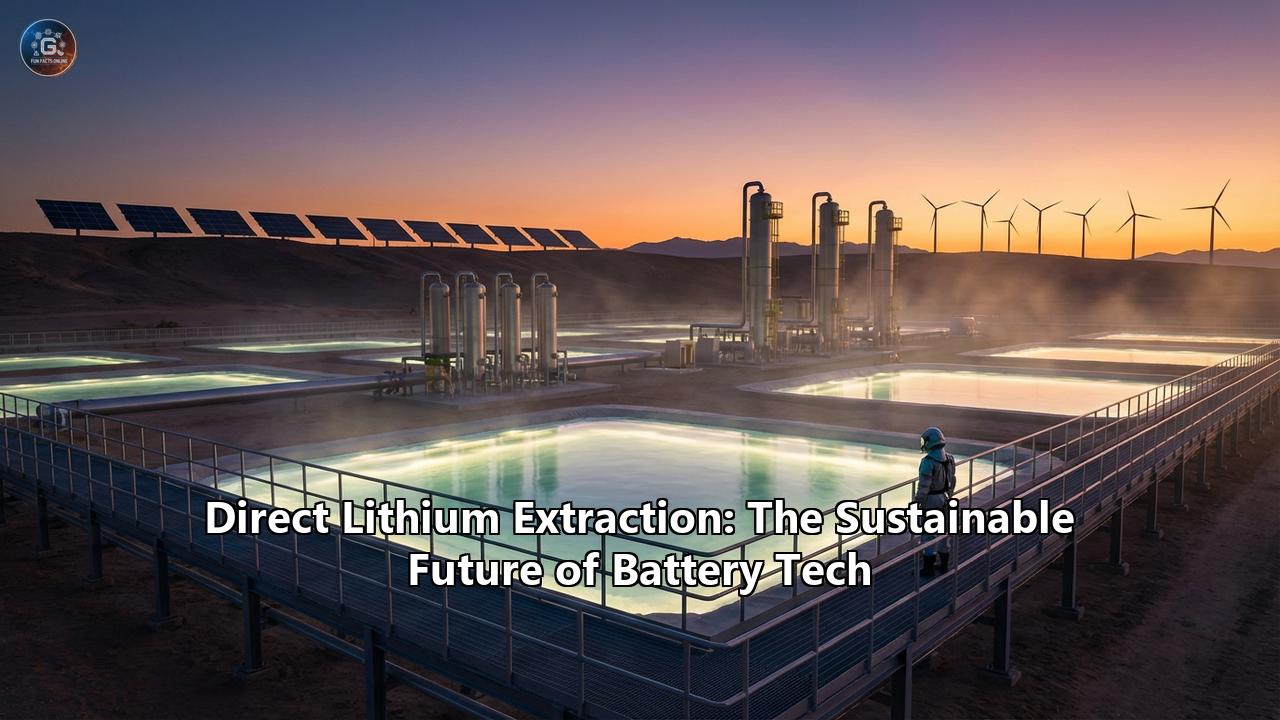
The dawn of the twenty-first century was defined by the silicon chip; the next era will be defined by the lithium ion. As the global energy matrix pivots violently away from fossil fuels, a single element has emerged as the linchpin of our collective future: Lithium. It is the "white gold" of the energy transition, the irreducible heart of the electric vehicle (EV) revolution, and the critical component in grid-scale storage systems designed to tame the intermittency of wind and solar power. Yet, for all its importance, the lithium industry is facing an existential crisis. The traditional methods of extraction—brutal, slow, and environmentally scarring—are no longer fit for purpose. They cannot scale fast enough to meet the voracious appetite of the Gigafactories rising across the globe, nor can they align with the environmental ethos that drives the very transition they are meant to enable.
Enter Direct Lithium Extraction (DLE).
Often described as the "fracking moment" for the lithium industry—minus the geological destabilization—DLE represents a technological quantum leap. It promises to unlock vast, previously unviable reserves, slash production times from years to hours, and reduce the physical footprint of mining operations by orders of magnitude. As we stand in early 2026, the technology is no longer a science experiment; it is rapidly becoming the industrial standard that will determine the geopolitical winners of the coming decade. This is the story of how a set of advanced chemical filtration technologies is poised to save the battery revolution from stalling, reshaping economies and ecosystems in the process.
Part I: The Lithium Paradox
To understand the revolutionary potential of DLE, one must first confront the inadequacy of the status quo. For decades, lithium production has been a tale of two extremes: the high-altitude deserts of South America and the hard-rock mines of Australia.
The Evaporation BottleneckIn the "Lithium Triangle"—straddling Chile, Argentina, and Bolivia—lies more than half of the world's known lithium resources. Here, beneath the shimmering crust of salt flats (salars), ancient aquifers hold lithium-rich brine. The traditional method of extraction is archaic: pump the brine to the surface and pour it into massive evaporation ponds. Then, wait.
For 12 to 18 months, the sun does the work, slowly evaporating the water to concentrate the lithium. It is a process of agonizing slowness, vulnerable to weather patterns (an unexpected rainstorm can ruin months of concentration), and incredibly inefficient, recovering only about 40% to 50% of the available lithium. Worse, it is a water-intensive catastrophe in some of the driest places on Earth, depleting aquifers and threatening local indigenous communities and biodiversity.
The Hard Rock Carbon ProblemThe alternative—spodumene mining, primarily in Australia—is faster but dirtier. It involves open-pit mining, blasting tons of rock, crushing it, and roasting it at 1,000°C in fossil-fuel-fired kilns to extract the metal. While it yields lithium quickly, the carbon footprint is massive—up to three times higher than brine-based production. It is a perverse irony: burning fossil fuels to dig up minerals for green energy.
The Supply CliffBy 2025, the cracks in this supply chain had turned into chasms. With EV sales passing 20% of the global market share and grid storage deployments skyrocketing, the demand for lithium carbonate equivalent (LCE) is projected to hit 2.5 million metric tons by 2030. Traditional mining cannot ramp up fast enough. Evaporation ponds take up to 7 years to permit and build, plus the 18-month processing time. Hard rock mines take nearly a decade to bring online. The world needs a third way.
Part II: The DLE Revolution—How It Works
Direct Lithium Extraction is not a single technology but a family of processes that share a common philosophy: surgical precision. Instead of evaporating all the water to find the lithium, or melting the rock to release it, DLE technologies act like a chemical magnet. They selectively pluck lithium ions (Li+) out of the brine solution, leaving everything else—magnesium, calcium, boron, and the water itself—behind.
The implications of this shift are profound.
- Speed: Processes that took 18 months now take hours.
- Recovery: Recovery rates jump from ~40% to over 90%, effectively doubling the resource base of any given salar.
- Footprint: Sprawling evaporation ponds covering thousands of acres are replaced by compact processing plants the size of a warehouse.
Let us dissect the four primary "flavors" of DLE technology that are vying for dominance in 2026.
1. Adsorption (The Frontrunner)
Adsorption is currently the most commercially mature DLE technology. It uses a sorbent material—typically based on aluminum hydroxide (Al(OH)3)—that is structurally tailored to capture lithium chloride molecules.
- The Process: Brine flows through a column packed with these sorbent beads. The lithium chloride adheres to the surface of the beads (adsorbs), while the rest of the brine flows through. Once the beads are saturated, the flow is stopped, and the column is washed with fresh water or a dilute lithium solution to release (desorb) the lithium.
- The Status: This is the technology powering Livent’s (now Arcadium Lithium) operations in Argentina, which have been running for decades, albeit in a hybrid format. In 2025, we saw a massive scale-up of this tech in the Qinghai province of China and new projects in the Lithium Triangle. It is robust, uses no organic solvents, and works well with heated brines.
2. Ion Exchange (The High-Yield Contender)
Where adsorption holds the lithium on the surface, ion exchange swaps it out. These systems use specialized ceramic or polymer materials (often manganese or titanium oxides) that contain specific ions (like hydrogen protons).
- The Process: As brine passes through, the material swaps its hydrogen ions for lithium ions. To get the lithium back, the material is washed with an acid, which swaps the hydrogen back in and releases the lithium.
- The Edge: Ion exchange can achieve incredibly high purities and works efficiently even in brines with low lithium concentrations. Companies like Lilac Solutions have championed this approach, using ceramic beads that are highly durable and resistant to degradation.
- The Challenge: It requires significant amounts of acid (usually hydrochloric) and base for regeneration, necessitating robust chemical management systems.
3. Solvent Extraction (The Liquid Magnet)
This method uses an organic liquid phase that is immiscible with water (like oil and vinegar).
- The Process: The brine is mixed with an organic solvent containing an "extractant" molecule designed to grab lithium. The lithium moves from the water phase to the organic phase. The two liquids are allowed to separate, and the lithium-loaded solvent is then stripped with acid to recover the lithium.
- The Trade-off: While offering high selectivity, the use of organic solvents raises environmental concerns regarding potential leaks and flammability. However, newer "green solvents" and closed-loop systems are mitigating these risks.
4. Membrane Technology (The Nanotech Solution)
The frontier of DLE lies in advanced membranes and electrochemical dialysis.
- The Process: These systems use electricity to drive lithium ions through selective membranes that block other elements. It is essentially a specialized form of desalination.
- The Promise: This is a reagent-free process. No acids, no solvents, just electricity. If paired with renewable energy, it is the "Holy Grail" of green lithium.
- The Reality: Membrane fouling and the high energy cost of pushing ions through barriers remain hurdles, but breakthroughs in 2024 and 2025 regarding graphene-oxide membranes have accelerated its pilot-phase success.
Part III: The Sustainability Dividend
The environmental argument for DLE is its strongest selling point, but it is nuanced.
Water: The Great ReinjectionIn traditional evaporation, the water in the brine is lost to the atmosphere—billions of liters essentially deleted from the hydrological cycle. In DLE, the "spent brine" (brine minus the lithium) is reinjected back into the aquifer.
This is transformative. It maintains reservoir pressure, preventing the ground subsidence that plagues areas like the Atacama. It preserves the water table for local ecosystems. However, it presents a technical challenge: the chemistry of the reinjected brine must be compatible with the aquifer to prevent clogging or contamination.
Land Use: The End of the PondsA traditional evaporation operation producing 20,000 tons of lithium per year might require 15 to 20 square kilometers of ponds. A DLE plant with the same capacity requires less than 0.5 square kilometers. This minimal footprint allows DLE to be deployed in sensitive areas where large-scale earthworks would be politically or ecologically impossible.
Carbon IntensityWhen powered by geothermal energy (more on this later) or solar, DLE can produce "Zero Carbon Lithium." Traditional hard rock mining emits roughly 15 tons of CO2 for every ton of lithium hydroxide. Solar evaporation sits around 5 tons. DLE, utilizing renewable heat and power, can drive this down to near zero.
Part IV: The Geopolitics of Brine—The New Map
DLE is not just changing how we mine; it is changing where we mine. By making lower-grade brines economically viable, it unlocks resources in North America and Europe that were previously ignored.
1. The Salton Sea: California’s Lithium Valley
Perhaps the most exciting development in the global lithium landscape is occurring in the imperial dust of Southern California. The Salton Sea, a shrinking, toxic lake, sits atop a massive geothermal reservoir. For decades, companies have pumped this hot brine to generate steam for electricity, then injected it back underground.
The brine is rich in lithium.
Companies like Controlled Thermal Resources (CTR), EnergySource Minerals, and BHE Renewables (a Berkshire Hathaway company) are integrating DLE directly into these geothermal power plants.
- The Synergy: The geothermal plant provides the hot brine (feedstock) and the clean electricity (power) to run the DLE process. It is a closed loop: heat, power, and lithium, all from the same hole in the ground.
- 2026 Status: After years of pilots and permitting delays, the "Hell's Kitchen" project and others are moving toward commercial production. The region is projected to supply enough lithium for 375 million EV batteries, transforming a region of high unemployment into a green energy powerhouse.
2. The Smackover Formation: Arkansas's Second Act
In the mid-20th century, Arkansas was an oil giant. Today, the depleted oil fields of the Smackover Formation are seeing a new rush. The brine produced as a waste product of oil extraction is laden with lithium.
Standard Lithium, partnered with chemical giant Lanxess, has led the charge here, utilizing existing pipeline infrastructure to bolt DLE units onto existing chemical plants. ExxonMobil has also entered the fray, acquiring extensive acreage. This region represents the perfect "brownfield" adaptation—repurposing fossil fuel infrastructure for the clean energy age.3. The Lithium Triangle: A Modernization
South America is not standing still. The governments of Chile and Bolivia are increasingly mandating DLE for new concessions. President Boric’s National Lithium Strategy in Chile explicitly favors DLE to protect the salt flats.
Eramet (France) and Tsingshan (China) inaugurated a massive DLE plant in Argentina's Centenario-Ratones salar in 2024. Arcadium Lithium continues to expand its DLE-hybrid operations. The shift here is political as much as technical; DLE is the key to maintaining "social license to operate" among indigenous communities tired of water depletion.4. Europe’s Geothermal Dream
In the Upper Rhine Graben (Germany/France) and Cornwall (UK), companies like Vulcan Energy Resources are pursuing the Zero Carbon Lithium™ model. By tapping into deep geothermal brines for district heating and power, they extract lithium as a co-product. In early 2026, Vulcan’s commercial plant is ramping up, promising Europe a domestic source of battery metal that travels miles, not continents, to reach German auto plants.
Part V: The Economics of Abundance
For years, skeptics argued that DLE was too expensive. They pointed to the high cost of reagents (acids, bases, water treatment) and energy compared to the "free" energy of the sun used in evaporation.
However, the economics have shifted dramatically by 2026.
1. The Cost of CapitalTime is money. An evaporation pond project ties up capital for nearly a decade before revenue flows. A DLE plant can be built in 2-3 years. The internal rate of return (IRR) for DLE projects is often superior simply because of the velocity of cash flow.
2. The Purity PremiumBattery makers, particularly those moving toward high-nickel cathodes (NMC 811) and solid-state batteries, demand ultra-high purity lithium hydroxide. Traditional brine carbonate requires expensive reprocessing to reach this grade. DLE, particularly ion exchange and solvent extraction, produces a highly pure lithium chloride solution that can be converted directly into battery-grade hydroxide, bypassing costly refining steps.
3. The OpEx ConvergenceWhile DLE has higher energy costs, it has lower reagent costs per ton of recovered LCE due to higher efficiency. As the cost of membranes and sorbents falls with mass production (Wright’s Law), the operating expenditure (OpEx) of DLE is converging with, and in some cases beating, hard rock mining costs ($4,000 - $6,000 per ton).
Part VI: The Challenges—It’s Not Magic
Despite the hype, DLE is not a magic wand. It is complex chemical engineering, and the road to 2026 has been paved with failed pilots and delayed startups.
The "Every Brine is Unique" ProblemThere is no "one size fits all" DLE solution. A sorbent that works perfectly in the high-magnesium brines of Argentina might fail miserably in the hot, silica-rich brines of the Salton Sea. Each project requires bespoke customization, extending the R&D phase.
Fresh Water ConsumptionWhile DLE saves brine water, the process itself often requires significant amounts of fresh water to wash the sorbents and strip the lithium. In arid regions, sourcing this fresh water is a major hurdle. Companies are now deploying massive Reverse Osmosis (RO) plants to recycle 90%+ of their process water, but this adds to the energy load.
Energy IntensityPumps, heaters, and filtration units consume megawatts of power. If a DLE plant in Argentina connects to a grid powered by natural gas, its "green" credentials evaporate. The viability of DLE is inextricably linked to the availability of renewable energy or geothermal heat.
Waste ManagementIon exchange processes produce waste acid solutions. Adsorption processes can degrade over time, creating solid waste. Managing these streams responsibly is critical to avoiding the environmental pitfalls of the past.
Part VII: The Players and The Market (2026 Landscape)
The corporate landscape of 2026 looks vastly different from just five years prior. The dichotomy between "Major Miners" and "Tech Startups" has collapsed.
- The Giants Adapt: Albemarle and SQM, the titans of the industry, have pivoted aggressively. SQM has committed to transitioning its Atacama operations to DLE technologies to meet Chilean government mandates for water conservation.
- The Integrators: Rio Tinto's acquisition of Arcadium Lithium created a behemoth with deep DLE expertise. Their Rincon project in Argentina is a showcase of next-gen adsorption tech.
- The Technology Providers: Companies like Sunresin (China) are the quiet powerhouses, supplying the equipment and resins for a vast majority of active DLE projects. Lilac Solutions, backed by Bill Gates’s Breakthrough Energy Ventures, has moved from pilot to commercial deployment, proving that their ion-exchange beads can survive the harshest industrial conditions.
- The Oil Majors: ExxonMobil, Chevron, and Equinor have entered the game. Their expertise in pumping fluids, managing reservoirs, and chemical processing makes them natural giants in the DLE space. They view lithium brine essentially as "salty oil" and are leveraging their massive balance sheets to dominate the North American brine sector.
Part VIII: Future Outlook—Beyond 2030
As we look toward the horizon of 2030 and 2035, DLE is the foundation upon which the next generation of energy storage will be built.
Solid-State BatteriesThe shift toward solid-state batteries requires lithium metal anodes. This necessitates lithium production of extreme purity, which DLE is uniquely positioned to provide. The synergy between DLE refining and next-gen battery manufacturing will tighten.
Urban Mining and RecyclingInterestingly, DLE technology is finding a second life in battery recycling. The same ion-selective membranes and sorbents used to pull lithium from brine are being adapted to pull lithium from "black mass" (shredded recycled batteries) with higher efficiency than pyrometallurgical methods.
The Price of StabilityBy diversifying supply away from a few fragile supply chains, DLE will help stabilize global lithium prices. The boom-and-bust cycles of 2018-2024, which terrified investors, will likely smooth out as DLE plants—which can be throttled up or down more easily than massive evaporation ponds—bring elasticity to the market.
Conclusion: The Essential Element
The transition to a net-zero economy is the largest industrial undertaking in human history. It requires materials—billions of tons of them. For too long, we accepted that obtaining these materials required sacrificing the environment we sought to save. Direct Lithium Extraction breaks that Faustian bargain.
It transforms lithium from a mined commodity into a manufactured chemical product. It turns waste brines into strategic assets. It brings the supply chain home. As the DLE plants of the Salton Sea steam into operation and the high Andes see their water tables rise for the first time in decades, the message is clear: The future of energy is not just about renewable power; it is about sustainable matter. DLE is not just a better way to mine; it is the only way to build a world that runs on batteries without running down the planet.
Reference:
- https://literature.rockwellautomation.com/idc/groups/literature/documents/ar/min-ar002_-en-p.pdf
- https://www.oreateai.com/blog/top-direct-lithium-extraction-companies-to-watch-in-2025/7723bb1e65520f0cd765c3f5b322f971
- https://lithiumharvest.com/knowledge/lithium-extraction/what-is-direct-lithium-extraction/
- https://farmonaut.com/mining/best-lithium-extraction-companies-2025-dle-vs-mining
- https://ctlithium.com/lithium/dle-vs-hardrock-vs-evaporation/
- https://carboncredits.com/lithium-market-insight-2025-price-recovery-ev-demand-and-the-future-of-extraction-exclusive-interview/
- https://www.idtechex.com/en/research-report/direct-lithium-extraction/1026
- https://www.nacleanenergy.com/energy-storage/direct-lithium-extraction-dle-fastest-growing-segment-in-lithium-mining-projected-19-6-cagr-between-2025-2035-idtechex-forecasts
- https://www.youtube.com/watch?v=feUWdj3sOmg
- https://ctlithium.com/about/direct-lithium-extraction/
- https://lithium.org/wp-content/uploads/2024/06/Direct-Lithium-Extraction-DLE-An-introduction-ILiA-June-2024-v.1-English-web.pdf
- http://luxresearchinc.com/wp-content/uploads/2022/09/lux-research-critical-minerals-the-opportunity-in-direct-lithium-extraction-executive-summary.pdf
- https://farmonaut.com/mining/top-lithium-mining-companies-to-invest-in-2025