
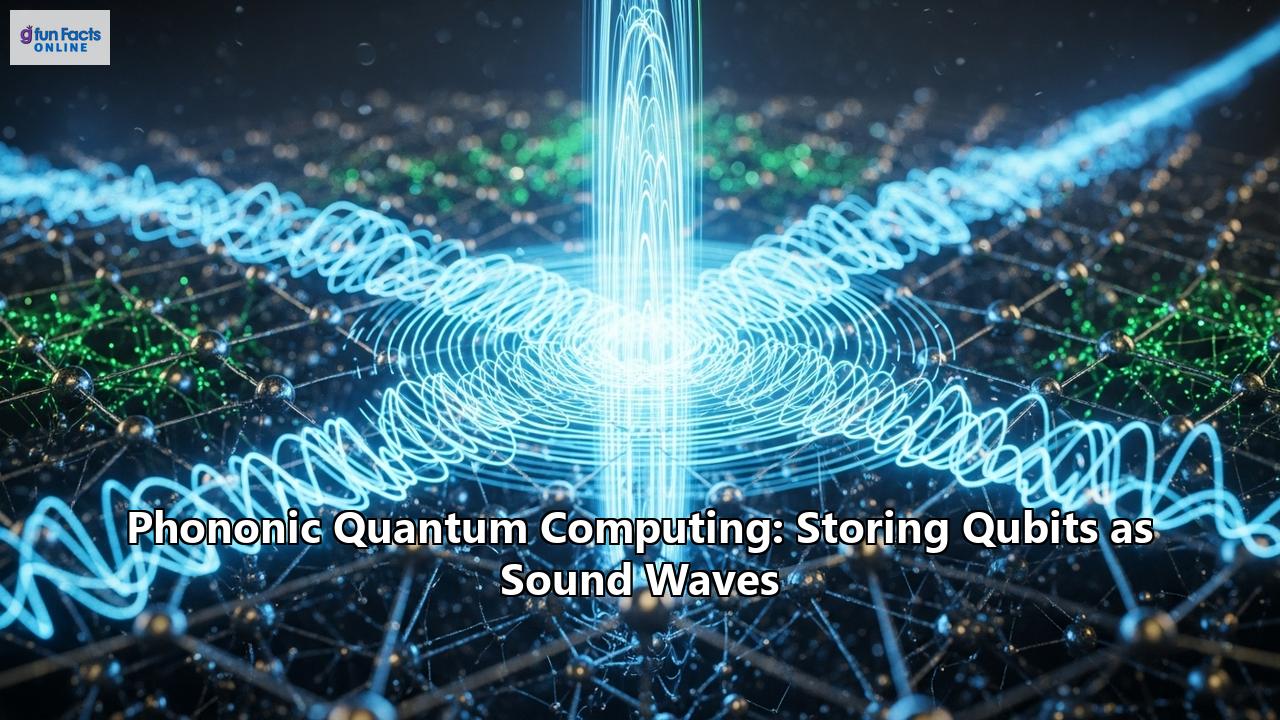
In the relentless pursuit of computational supremacy, a new and fascinating contender has emerged in the quantum realm. While many are familiar with the race to build quantum computers using light (photons) or superconducting circuits, a quieter, yet profoundly powerful, revolution is taking shape. Scientists are now exploring the possibility of harnessing the most fundamental form of mechanical vibration—sound—to encode and store the delicate states of quantum information. This is the world of phononic quantum computing, a field that promises to address some of the most persistent challenges in the development of a scalable and robust quantum machine by storing qubits in the form of quantized sound waves.
This burgeoning area of research is not just a theoretical curiosity; it's a rapidly advancing frontier with leading universities and research institutions demonstrating remarkable breakthroughs. From extending the lifespan of quantum information by orders of magnitude to creating new pathways for connecting disparate quantum systems, the good vibrations of phonons are sending powerful signals throughout the scientific community. This article will delve into the heart of this "sound" revolution, exploring how these quantized packets of vibrational energy are being used to build the future of computing, one phonon at a time.
The Bedrock of a Quantum World: From Qubits to Phonons
At the core of every quantum computer lies the qubit, the quantum counterpart to the classical bit. Unlike a classical bit, which can only be a 0 or a 1, a qubit can exist in a superposition of both states simultaneously, a property that unlocks the potential for immense parallel processing. Furthermore, multiple qubits can be entangled, a quantum phenomenon where the state of one qubit is inextricably linked to the state of another, regardless of the distance separating them. It is this combination of superposition and entanglement that gives quantum computers their revolutionary potential.
However, these quantum states are notoriously fragile. They are incredibly susceptible to environmental "noise" such as temperature fluctuations, vibrations, and electromagnetic fields, which can cause the qubit to lose its quantum properties in a process called decoherence. This fragility is one of the most significant hurdles in building a large-scale, fault-tolerant quantum computer.
Enter the phonon. In the language of quantum mechanics, a phonon is a quantized unit of vibrational energy, or simply, a particle of sound. Just as light can be thought of as both a wave and a particle (a photon), sound in a crystalline lattice can be described as discrete packets of energy—phonons. These quantized vibrations travel through a material's atomic lattice, much like a ripple spreading across the surface of a pond. Scientists are now exploring how to use these phonons as a robust medium for storing the precious information held by qubits.
The Symphony of Creation: How to Store a Qubit in a Sound Wave
The process of encoding a qubit into a phonon is a remarkable feat of engineering that bridges the gap between the electrical world of superconducting qubits and the mechanical world of sound. This translation is made possible through a phenomenon known as piezoelectricity.
The Piezoelectric Bridge
Piezoelectricity is the property of certain materials to generate an electric charge in response to applied mechanical stress. Conversely, when an electric field is applied to a piezoelectric material, it deforms mechanically. This two-way street of energy conversion is the lynchpin of phononic quantum computing.
In a typical setup, a superconducting qubit, which operates at microwave frequencies, is coupled to a tiny mechanical resonator made of a piezoelectric material. By applying a microwave signal to the system, the electrical energy of the qubit is converted into a mechanical vibration in the resonator—a phonon. The quantum state of the qubit, its superposition and entanglement information, is thereby imprinted onto this quantized sound wave. To retrieve the information, the process is simply reversed: the phonon's vibration is converted back into an electrical signal that can be read by the superconducting circuit.
Architectures of Sound: SAW and BAW
Researchers are primarily exploring two types of architectures to harness phonons for quantum computing: Surface Acoustic Waves (SAWs) and Bulk Acoustic Wave (BAW) resonators.
Surface Acoustic Waves (SAWs) are sound waves that travel along the surface of a material, much like an earthquake's tremor on the Earth's surface. In the context of quantum computing, SAW devices can be designed to create a moving potential well that can trap and transport a single electron, with the electron's spin serving as the qubit. This "flying qubit" architecture offers a way to move quantum information across a chip.Pioneering work in this area has been conducted at the University of Chicago's Pritzker School of Molecular Engineering. A team led by Professor Andrew Cleland has made significant strides in manipulating phonons with unprecedented control. In a groundbreaking experiment, they developed an "acoustic beamsplitter" that could put a single phonon into a quantum superposition of being in two places at once, a fundamental step towards building a linear mechanical quantum computer. More recently, Cleland's lab has demonstrated the high-fidelity entanglement of two acoustic wave resonators, a key building block for larger quantum processors. This research has been recognized with a prestigious Vannevar Bush Faculty Fellowship from the Department of Defense to continue exploring the potential of phonon-based quantum computing.
Bulk Acoustic Wave (BAW) resonators, on the other hand, confine sound waves within the volume of a material. These devices can be engineered to have extremely high frequencies and, crucially, very long coherence times. A key advantage of BAW resonators is their ability to act as a high-quality quantum memory.Researchers at Caltech and Yale University have been at the forefront of this approach. The Schoelkopf and Rakich labs at Yale have demonstrated the successful coupling of superconducting qubits to BAW resonators, showing a dramatic increase in coherence times. Building on this, a team at Caltech, led by Professor Mohammad Mirhosseini, has achieved a remarkable breakthrough in quantum memory. They have demonstrated that by converting quantum information from a superconducting qubit into a phonon in a mechanical oscillator, they can extend the storage time of the quantum state by a factor of 30 compared to traditional superconducting systems. This leap in quantum memory performance addresses a critical challenge in quantum computing: the need to keep quantum information stable long enough to perform complex calculations.
The Resounding Advantages of a Phononic Approach
The excitement surrounding phononic quantum computing stems from a number of key advantages it holds over other platforms.
- Extended Coherence Times: Mechanical vibrations are inherently less susceptible to the electromagnetic noise that plagues many other qubit modalities. This isolation from the environment allows phononic qubits to maintain their delicate quantum states for much longer periods. The work at Caltech, extending storage times to 25 milliseconds, is a testament to this potential.
- Compact Device Size and Scalability: The speed of sound is about 100,000 times slower than the speed of light. This vast difference means that the wavelength of a phonon is much shorter than that of a photon of the same frequency. Consequently, quantum devices that use phonons can be made significantly smaller and more compact than their photonic counterparts. This miniaturization offers a promising path to overcoming the scalability challenges that currently hinder the development of large-scale quantum computers.
- A Bridge Between Quantum Worlds: Phononic systems are uniquely positioned to act as intermediaries, or transducers, between different quantum technologies. For instance, they can efficiently convert quantum information from the microwave frequencies of superconducting qubits to the optical frequencies required for long-distance communication over fiber optic networks. This capability is essential for creating a "quantum internet" that could connect quantum computers across the globe.
The Dissonant Notes: Challenges on the Horizon
Despite its immense promise, the field of phononic quantum computing is still in its early stages and faces several significant hurdles.
- Decoherence from Within: While phonons are well-isolated from external electromagnetic noise, they are not immune to decoherence. Thermal phonons, which are random vibrations caused by heat, can interfere with the fragile quantum state of a phononic qubit. Imperfections in the crystal lattice of the material can also scatter phonons and destroy quantum information.
- Fabrication on the Nanoscale: The devices used in phononic quantum computing are incredibly small and must be fabricated with atomic-level precision. Creating these nanoscale mechanical resonators and ensuring their consistent performance is a major engineering challenge.
- The Scalability Puzzle: While the compactness of phononic devices is an advantage for scalability, the challenge of interconnecting a large number of these devices while maintaining their quantum coherence remains. As the system grows, so does the complexity of controlling and measuring each individual phononic qubit.
- Precision Measurement: Developing techniques to accurately and reliably measure the quantum state of a phonon without destroying it is an ongoing area of research. This is a critical component for performing quantum computations and error correction.
The Vanguard of Vibration: Leading Research and Recent Breakthroughs
The rapid progress in phononic quantum computing is being driven by a global community of researchers. In addition to the pioneering work at the University of Chicago, Caltech, and Yale, other institutions are making significant contributions:
- ETH Zurich: The Hybrid Quantum Systems Group is exploring how acoustic resonators coupled with superconducting circuits can be used for quantum information, metrology, and fundamental physics research.
- UC Berkeley: The Quantum Devices Group is studying how to engineer the interaction between superconducting qubits and phonons to create higher-coherence qubits and quantum memories.
- Rice University: Researchers have recently achieved unprecedented levels of interference between phonons, a discovery that could revolutionize quantum sensing and molecular detection technologies.
These and other research groups are continually pushing the boundaries of what is possible, with recent breakthroughs including the creation of quantum states in massive objects and the development of new materials and algorithms for controlling acoustic waves.
The Future is Sound: Applications and the Road Ahead
The unique properties of phononic systems open up a range of exciting applications for the future of quantum technology.
- High-Fidelity Quantum Memory: The most immediate and promising application is in the development of robust, long-lived quantum memories. These devices are essential for storing the results of intermediate calculations in a complex quantum algorithm and for synchronizing operations in a large-scale quantum computer.
- Quantum Transduction and Networking: As mentioned, phonons are ideal candidates for converting quantum information between different physical platforms. This will be a cornerstone technology for building a future quantum internet, enabling secure communication and distributed quantum computing.
- Ultrasensitive Sensing: The same sensitivity to their environment that makes phononic qubits challenging to work with also makes them incredibly powerful sensors. They could be used to detect minute changes in gravitational fields, temperature, or the presence of single molecules.
The road to a fully-fledged phononic quantum computer is still long. Key milestones include further improvements in fabrication techniques to create more uniform and defect-free devices, the development of sophisticated error correction codes tailored to the unique properties of phononic systems, and the demonstration of scalable architectures with a large number of interconnected qubits.
A Symphony of Possibilities
Phononic quantum computing represents a paradigm shift in our approach to building a quantum future. By turning to the world of sound, scientists have found a way to address some of the most persistent challenges in the field, offering a path to more robust, compact, and interconnected quantum systems. While the challenges are not insignificant, the rapid pace of innovation and the symphony of breakthroughs emerging from laboratories around the world suggest a future where the delicate dance of quantum information is conducted not just with light and electricity, but with the very vibrations of matter itself. The future of computing, it seems, has a new and compelling sound.
Reference:
- https://www.youtube.com/watch?v=KGM1f_VcGQE
- https://linqs.stanford.edu/research/quantum-acoustics
- https://en.wikipedia.org/wiki/Quantum_acoustics
- https://pme.uchicago.edu/news/researchers-split-phonons-or-sound-step-toward-new-type-quantum-computer
- https://www.hpcwire.com/off-the-wire/ucla-and-uc-riverside-demonstrate-room-temperature-ising-machine-for-optimization/
- https://www.yalescientific.org/2018/01/the-sound-of-qubits-how-acoustics-and-qubits-will-contribute-to-the-next-computing-revolution/
- https://pme.uchicago.edu/news/world-quantum-day-2024-latest-developments-quantum-science-and-technology
- https://southlandmarquee.com/stories/669777806-uchicago-scientists-advance-understanding-of-quantum-sound-through-new-research
- https://pme.uchicago.edu/news/innovative-phonon-based-quantum-computing-research-uchicago-engineering-gets-3-million-boost
- https://rakichlab.yale.edu/research-overview/quantum-acoustics
- https://www.youtube.com/watch?v=qGtvt8poA9E
- https://www.caltech.edu/about/news/using-sound-to-remember-quantum-information
- https://www.yalescientific.org/2024/01/the-phonon-phenomenon/
- https://hyqu.ethz.ch/research/area-1.html
- https://quantumdevices.berkeley.edu/
- https://quantumdevices.berkeley.edu/research/
- https://www.sterlingtimes.co.uk/i-felt-terror-ripple-new-quantum-phonon-breakthrough-sparks-fear-of-mind-reading-tech-in-everyday-sensors/946/
- https://www.youtube.com/watch?v=vmGQhUPj8Ms
- https://scitechdaily.com/sound-science-how-phononic-crystals-are-shaping-quantum-computing/