
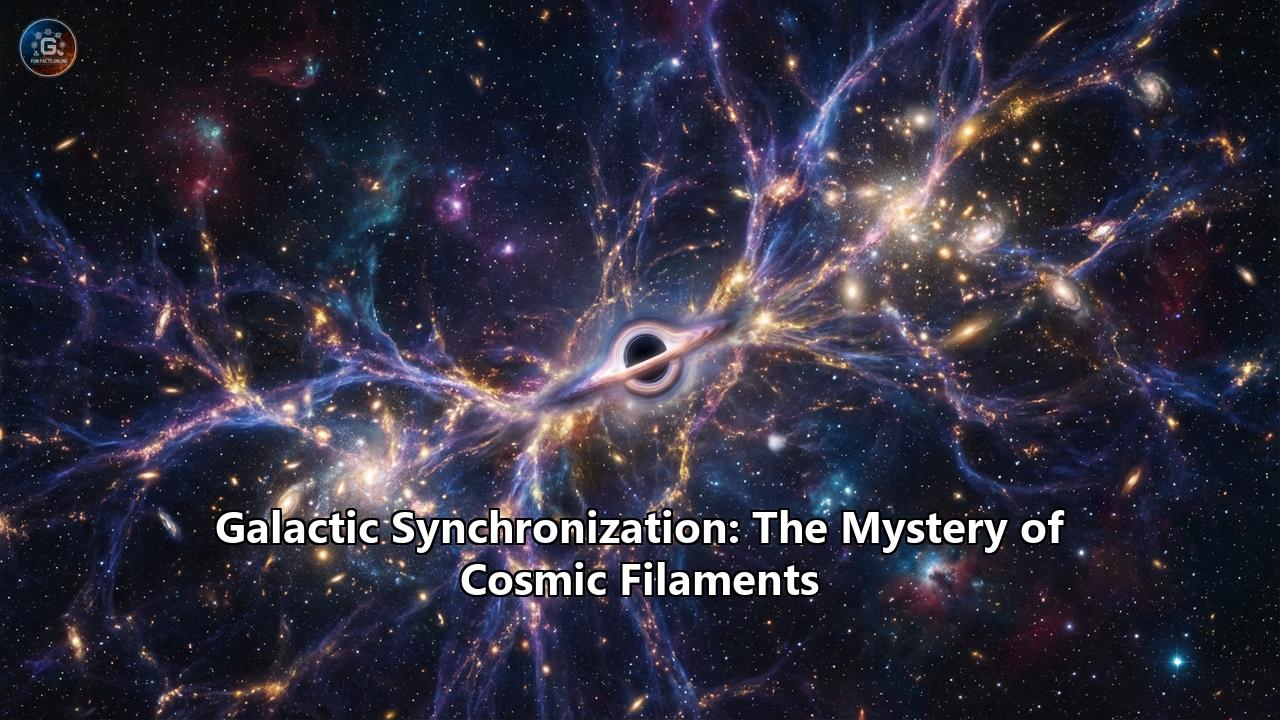
In the vast, seemingly chaotic expanse of the cosmos, astronomers have stumbled upon a phenomenon that defies the laws of probability and challenges our fundamental understanding of the universe. It is a discovery that whispers of a hidden order, a grand design woven into the very fabric of space and time. They call it Galactic Synchronization.
For decades, we viewed galaxies as "island universes"—isolated cities of stars, drifting alone through the dark, their rotations and evolutions governed solely by their own local history. But a revolution is underway. New data suggests that galaxies separated by millions of light-years, with absolutely no way to communicate or interact, are moving in lockstep. They spin in the same direction, align their axes to the same invisible grid, and dance to the beat of a conductor we cannot see.
This is the story of the Cosmic Web, the dark filaments that thread the universe together, and the mystery of why the cosmos is far more connected than we ever dared to imagine.
Part 1: The "Impossible" Discovery
December 2025: A Razor-Thin ClueThe scientific world was recently rocked by a study led by astrophysicists at the University of Oxford, who identified a structure that simply shouldn't exist under standard theories. Deep within the cosmic void, approximately 140 million light-years from Earth, lies a cosmic filament—a river of dark matter and gas connecting galaxy clusters.
While filaments themselves are known, this one was different. Embedded within it was a "razor-thin" chain of 14 hydrogen-rich galaxies, stretching over 5.5 million light-years. But they weren't just sitting there. They were spinning.
The Cosmic Baton
Crucially, these galaxies weren't spinning randomly. They were rotating in perfect synchronization with the filament itself. The entire structure, a colossus spanning 50 million light-years, was rotating like a giant cosmic baton.
"You can liken it to the teacups ride at a theme park," explained Dr. Lyla Jung, co-lead author of the study. "Each galaxy is like a spinning teacup, but the whole platform—the cosmic filament—is rotating too."
The rotation speed was clocked at a staggering 110 kilometers per second (roughly 250,000 mph). For a structure of this immense size to possess such coordinated angular momentum suggests that spin is not a local property born in the chaos of galaxy formation. Instead, it is inherited from the architecture of the universe itself.
This finding was the "smoking gun" for a phenomenon that had been haunting data sets for years: Large-Scale Coherence.
Part 2: The Web of Dark Matter
To understand why this synchronization is so spooky, we must first understand the stage upon which this drama plays out: the Cosmic Web.
If you were to zoom out from the universe until entire galaxy clusters looked like mere specks of dust, you wouldn't see a random scatter. You would see a sponge-like structure.
- Nodes: Dense knots where thousands of galaxies congregate (Galaxy Clusters).
- Filaments: Long, thread-like highways of dark matter and gas that stretch between the nodes.
- Voids: Massive, empty bubbles of space between the filaments.
This "Cosmic Web" is the scaffolding of the universe. It is made primarily of Dark Matter, the invisible substance that outweighs visible matter 6-to-1. The galaxies we see—the Milky Way, Andromeda, the distant spirals—are merely the bioluminescent plankton drifting along these invisible currents.
The Pipeline of Creation
We used to think filaments were just static bridges. Now, we know they are pipelines. Cold hydrogen gas flows along these dark matter threads, funneling fuel into the massive clusters at the nodes. This flow is what feeds supermassive black holes and triggers star formation.
But the new discovery implies these pipelines are not just flowing; they are twisting. They are giant, corkscrewing vortices of matter. Any galaxy born inside such a twisting river doesn't stand a chance of spinning its own way—it is swept up in the grand rotation of the filament, synchronized with its neighbors millions of light-years away.
Part 3: A History of "Spooky" Alignments
The 2025 discovery was not an isolated incident. It was the culmination of a decade of anomalies that have slowly eroded the "island universe" theory.
The Quasar Puzzle (2014)
The first major crack in the standard model appeared in 2014, when a team using the Very Large Telescope (VLT) in Chile looked at Quasars—the ultra-bright cores of active galaxies powered by supermassive black holes.
Looking at 93 quasars spread over billions of light-years, they found something impossible. The rotation axes of these black holes were aligned with each other. Even more strangely, they were aligned with the large-scale structure of the cosmic web they inhabited.
- The Odds: Calculations showed the probability of this happening by chance was less than 1%.
- The Implication: How does a black hole tell another black hole a billion light-years away which way to point? It doesn't. They are both responding to a larger, invisible geometry that was imprinted when the universe was young.
The Satellite Plane Problem
Closer to home, we have the "Planes of Satellite Galaxies Problem." According to our best simulations of Dark Matter (the ΛCDM model), dwarf galaxies should swarm around giant hosts (like our Milky Way) in a messy, random beehive pattern.
They don't.
- The Milky Way: Our satellite galaxies orbit in a neat, flat plane.
- Andromeda (M31): Its satellites also form a thin, rotating disk.
- Centaurus A: Recent observations confirm it, too, has a synchronized plane of satellites.
This "co-rotation" implies that dwarf galaxies aren't just falling in randomly. They are sliding in along specific, organized pathways—likely the cosmic filaments themselves—retaining the synchronized motion of their entry.
Part 4: The Science of Spin
How does this happen? This is the billion-dollar question in modern astrophysics.Theory 1: Tidal Torque Theory (The Standard View)
The traditional explanation is "Tidal Torque." As a cloud of gas collapses to form a galaxy, the gravitational pull of nearby structures tugs on it unevenly, causing it to spin up. In this view, spin is a result of the local neighborhood.
- The Problem: Tidal Torque works well for close neighbors. It fails to explain why galaxies separated by 20 million light-years (where gravity should be negligible) are still moving in sync.
Theory 2: The "Fossil Record" of the Big Bang
The Oxford team proposes that these rotating filaments are "fossil records." They suggest that the spin was generated in the very early universe, during the initial collapse of matter after the Big Bang. As the primordial gas collapsed into the dark matter sheets, it created massive vortices—turbulence on a cosmic scale.
These ancient swirls never stopped. They stretched out as the universe expanded, becoming the rotating filaments we see today. The galaxies inside them are merely preserving the angular momentum of the infant universe.
Theory 3: The "Electric" Universe (The Alternative View)
While not the mainstream consensus, some theorists argue that gravity alone is insufficient to explain these alignments. They point to magnetohydrodynamics—the behavior of electrically charged fluids (plasmas).
If cosmic filaments are conducting massive electrical currents (Birkeland currents) through the intergalactic medium, these currents would naturally twist into helical shapes, creating the corkscrew rotation observed. While most astronomers stick to Dark Matter as the cause, the "twisting" nature of these filaments bears a striking resemblance to magnetic ropes found in solar flares.
Part 5: Why It Matters
Why should we care if distant galaxies are dancing in sync? Because it fundamentally changes our picture of reality.
1. The Universe is a Single Organism
We can no longer treat galaxies as independent samples. The universe is a highly coupled system. The motion of a star in a galaxy 100 million light-years away is mathematically linked to the structure that formed our own Local Group. We are physically connected to the farthest reaches of the cosmos by these dark threads.
2. A Challenge to Dark Matter Models
Current Dark Matter simulations (like the famous "Millennium Run") produce a cosmic web, but they struggle to reproduce the intensity of this synchronization. They predict messy, random spins. The fact that the real universe is so neat, ordered, and synchronized suggests our simulations—and perhaps our understanding of Dark Matter itself—are missing a key piece of the puzzle.
3. Future Mapping
This discovery changes how we map the universe. Missions like the European Space Agency's Euclid and NASA's Nancy Grace Roman Space Telescope are currently mapping the shapes of billions of galaxies. If these galaxies are naturally aligned by filaments, it creates a "false signal" in the data that mimics the effects of Dark Energy. Understanding this synchronization is crucial to measuring the expansion of the universe correctly.
Conclusion: The Cosmic Dance
We are standing on the precipice of a new era in cosmology. The static night sky is a deception. In reality, we are embedded in a churning, flowing, spinning web of unimaginable scale.
The discovery of the "razor-thin" synchronized filament is just the beginning. It hints that the universe has a memory—that the rotation of a galaxy today is a direct echo of the swirling chaos of the Big Bang, preserved across 13 billion years of history.
As we peer deeper into the dark, we find that we are not alone, and we are not still. We are part of a grand, rotating cosmic ballet, synchronized across the void by the invisible strings of the Cosmic Web.
Glossary of Terms
- Cosmic Filament: Huge bridges of dark matter and gas that connect galaxy clusters.
- Angular Momentum: The rotational force or "spin" of an object.
- ΛCDM (Lambda-CDM): The standard model of the Big Bang, dominated by Dark Energy and Cold Dark Matter.
- Quasar: An extremely luminous active galactic nucleus.
- Redshift: The stretching of light caused by the expansion of the universe, used to measure distance.
Reference:
- https://kids.kiddle.co/CfA2_Great_Wall
- https://grokipedia.com/page/CfA2_Great_Wall
- https://astrobites.org/2018/07/11/satellite-galaxies-all-in-a-row/
- https://www.skyatnightmagazine.com/space-science/cfa2-great-wall-galaxies
- https://par.nsf.gov/servlets/purl/10508372
- https://cyprus-mail.com/2025/12/20/huge-rotating-structure-of-galaxies-and-dark-matter-is-detected
- https://nasaspacenews.com/2025/12/largest-rotating-structures/
- https://www.sciencedaily.com/releases/2025/12/251225080729.htm
- https://astronomynow.com/2014/11/19/quasar-axes-align-with-large-scale-cosmic-structures/
- https://www.sci.news/astronomy/science-alignment-quasar-axes-large-scale-structures-02285.html
- https://www.eso.org/public/news/eso1438/
- https://en.wikipedia.org/wiki/Quasar
- https://lup.lub.lu.se/luur/download?func=downloadFile&recordOId=9075753&fileOId=9075758
- https://astro.uni-bonn.de/~pavel/CONFERENCES/MOND2019/website/Talks/Thursday/Pawlowsk_BonnGravity2019.pdf
- https://en.wikipedia.org/wiki/CfA2_Great_Wall