
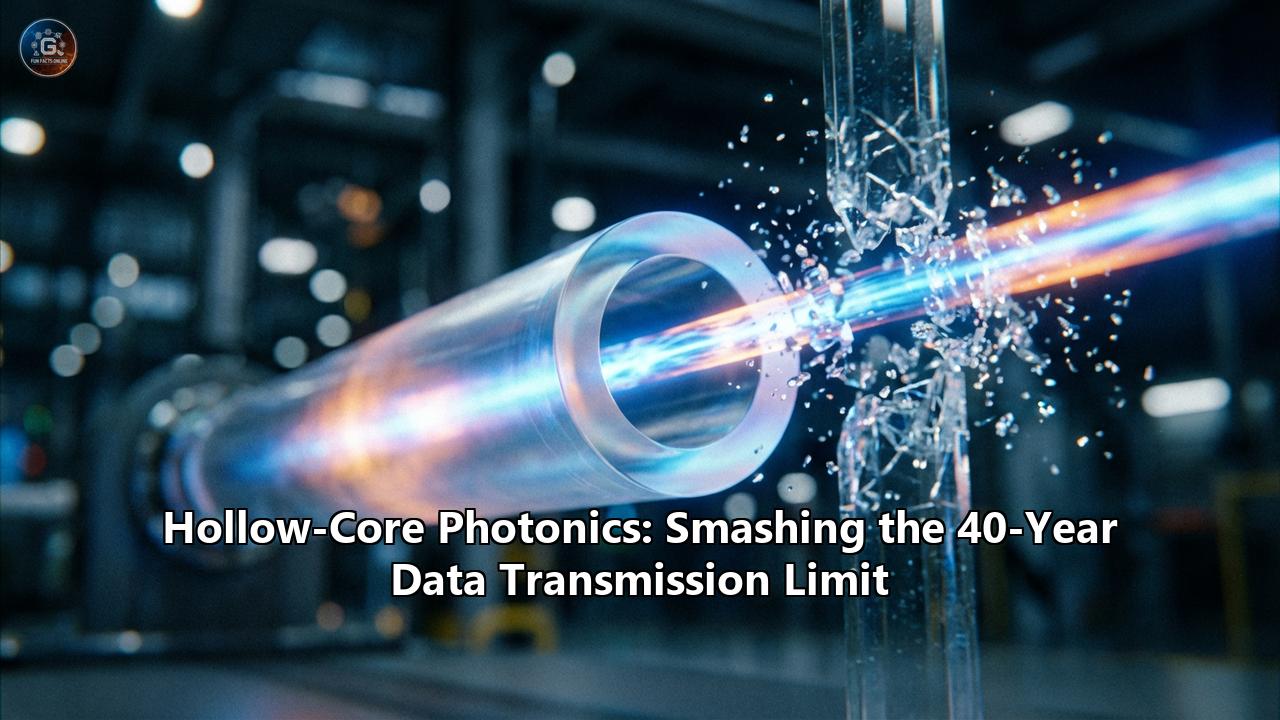
It was a barrier that stood for four decades—a physical ceiling that many experts believed would never be broken. For nearly half a century, the global internet, the financial markets, and the world’s telecommunications infrastructure have been built on a single, fundamental technology: solid strands of silica glass. This technology, while revolutionary, had hit a wall. The laws of physics seemed to dictate that we had squeezed every possible drop of efficiency out of glass. We had reached the "Nonlinear Shannon Limit," a point where pushing more data through a fiber optic cable resulted in chaos rather than clarity.
Then, a team of researchers did the unthinkable. They threw the glass away.
By successfully guiding light through nothing—literally, a vacuum or air—inside a fiber optic cable, scientists have not only smashed the 40-year transmission limit but have ushered in a new era of physics. This is the story of Hollow-Core Photonics, the technology that is rewriting the rules of the internet, accelerating the speed of light itself, and preparing our civilization for the next great leap in artificial intelligence and quantum computing.
Chapter 1: The Glass Ceiling
To understand the magnitude of this breakthrough, we must first understand the empire of glass that currently connects our world.
Since the pioneering work of Charles Kao in the 1960s—work that would later earn him a Nobel Prize—fiber optics has been governed by the principle of Total Internal Reflection (TIR). The concept is elegant in its simplicity: you take a core of ultra-pure glass and surround it with a "cladding" layer of glass that has a slightly lower refractive index. When light enters the core, it bounces off the boundary between the core and the cladding, trapped inside like water in a pipe.
For decades, this was perfect. Engineers spent forty years perfecting the purity of silica glass. They removed impurities at the atomic level, reducing the attenuation (signal loss) from decibels per meter to a miraculous 0.14 decibels per kilometer. They developed Wavelength Division Multiplexing (WDM) to send multiple colors of light down the same strand, and coherent detection to pack more bits into every photon.
But by the early 2020s, the "Glass Ceiling" had become undeniable. Solid glass has three fundamental flaws that no amount of engineering can fix.
1. The Speed LimitWe are taught that the speed of light ($c$) is constant. That is true in a vacuum. But in a medium like glass, light slows down. The refractive index of silica is approximately 1.45, meaning light travels roughly 31% slower in fiber than it does in the vacuum of space. For decades, we have accepted that the internet operates at two-thirds the speed of light. In a world of high-frequency trading and real-time AI clusters, that 31% delay is an eternity.
2. The Nonlinear Shannon LimitThis was the true "40-year limit." To send more data, you typically need to increase the power of the laser signal. But glass is a material. When you pump too much energy into a tiny solid core, the glass itself begins to react. It creates "nonlinear effects"—essentially, the intense light changes the properties of the glass, causing the signal to distort, scatter, and interfere with itself. This is the Kerr Effect. It creates a hard cap on capacity. You cannot simply "turn up the volume" on the data because the medium itself screams back.
3. Chromatic DispersionDifferent colors of light travel at slightly different speeds through glass. Over long distances, a tightly packed pulse of data spreads out, turning a sharp "1" or "0" into a blurry mess. Dealing with this requires massive amounts of digital signal processing (DSP), which consumes enormous amounts of power.
For years, the industry solution was "more fibers." If one fiber is full, lay another. But this doesn't solve the latency problem, and it doesn't solve the energy problem. The world needed a new medium.
Chapter 2: The Physics of Nothing
The solution was theoretically obvious but practically impossible: send the light through air.
In air (or a vacuum), the refractive index is 1.0. Light travels at $c$, its maximum cosmic speed. Air has almost zero nonlinearity—you can blast terawatts of power through it without distortion. And air has virtually zero chromatic dispersion.
The problem, of course, is that light doesn't like to stay inside a tube of air. If you shine a laser down a regular pipe, it just spreads out and absorbs into the walls. You cannot use Total Internal Reflection because that only works when the core is denser than the cladding. If the core is air (low density) and the cladding is glass (high density), light naturally wants to escape into the glass.
For 30 years, physicists tried to force light to stay in an air core. They built "Photonic Bandgap Fibers" that looked like honeycombs, trying to use quantum interference to trap the light. They worked, but they were lossy, narrow-bandwidth, and difficult to make.
The breakthrough came with a radical new design: Nested Anti-Resonant Nodeless Fiber (NANF).
Imagine looking at a soap bubble. You see swirling rainbows. This is not reflection; it is interference. Light waves bouncing off the inner and outer surfaces of the thin soap film interfere with each other, reflecting certain colors perfectly while letting others pass.
NANF fibers use this principle. Instead of a solid block of glass, the fiber consists of a hollow tube. Inside this tube, attached to the walls, are smaller, thin-walled glass tubes (capillaries). Inside those tubes are even smaller tubes. This "nested" structure is designed with mathematical precision so that light of a specific wavelength trying to pass through the glass wall is destructively interfered with. The glass membrane effectively becomes a perfect mirror for that specific frequency, bouncing the light back into the hollow center.
The light is not guided by density; it is guided by the geometry of the glass membranes. It bounces down the fiber, barely touching the glass at all. In the latest designs, 99.99% of the optical power travels through the air, overlapping with the glass by less than a fraction of a percent.
Chapter 3: Smashing the Record
For years, hollow-core fibers were a scientific curiosity—fast, but too "leaky" to be useful. Solid fiber had a loss of 0.14 dB/km. Early hollow fibers had losses of 100 dB/km, then 10, then 1. They were fast, but they couldn't carry a signal for more than a few hundred meters without it fading away.
The "40-Year Limit" was the 0.14 dB/km floor of solid silica. No solid fiber could ever go lower because of Rayleigh Scattering—the light literally bouncing off the molecules of the glass itself.
In a landmark achievement that stunned the photonics world, researchers from the University of Southampton (and their spin-out company Lumenisity, later acquired by Microsoft) shattered this floor.
Using a sophisticated "Double Nested" anti-resonant design, they achieved a signal loss of 0.091 dB/km.
Read that number again. It is lower than the fundamental limit of solid glass.
By moving the light out of the glass and into the air, they bypassed the scattering of silica molecules entirely. The light was traveling through a medium so sparse that Rayleigh scattering was virtually non-existent.
This was the moment the industry changed. Hollow-core fiber was no longer just a "low latency" niche product for high-frequency traders. It was now, fundamentally, a superior transmission medium to solid glass in every metric: speed, loss, and capacity.
Chapter 4: The Speed Demon (Latency)
The most immediate and commercially valuable aspect of this technology is speed. In the world of modern computing, latency is the new currency.
In a standard solid fiber, light travels at approximately 200,000 kilometers per second. In a hollow-core fiber, it travels at roughly 299,000 kilometers per second.
That is a 47% increase in speed.
To a human, a few microseconds seem irrelevant. To a computer, it is an eternity.
- High-Frequency Trading (HFT): In the financial markets, algorithms trade stocks in nanoseconds. A hedge fund utilizing hollow-core fiber between New York and London could execute a trade milliseconds faster than a competitor on solid fiber. In this winner-take-all market, that advantage is worth billions. This was the first early-adopter market for the technology.
- Distributed Computing: Modern supercomputers are rarely single machines; they are clusters of thousands of GPUs connected by cables. The bottleneck in training massive AI models (like GPT-4 or its successors) is often not the speed of the chip, but the time it takes for Chip A to talk to Chip B. Hollow-core fiber reduces this "interconnect latency," effectively making the supercomputer act like one giant brain rather than thousands of fragmented ones.
Chapter 5: Unlimited Power
Perhaps more profound than speed is the power handling capability.
In solid fiber, the "Nonlinear Shannon Limit" kicks in because you can't put more than a few hundred milliwatts of power into a channel before the glass reacts.
In hollow-core fiber, the light is traveling through air. The threshold for nonlinear effects in air is roughly 1,000 times higher than in glass.
This means engineers can potentially pump signals with vastly higher power without distortion. This has two massive implications:
- Longer Reach: If you can start with a stronger signal, it can travel further before it needs to be amplified. This reduces the number of expensive, power-hungry repeaters needed on the ocean floor or across continents.
- Simplified Electronics: Because there is no chromatic dispersion and no nonlinearity to correct, the Digital Signal Processors (DSPs) at the ends of the fiber can be much simpler and consume less energy.
Chapter 6: The AI and Cloud Revolution
The timing of this breakthrough is not a coincidence. It aligns perfectly with the rise of Generative AI.
Microsoft’s acquisition of Lumenisity was a strategic move to secure the infrastructure for the next decade of cloud computing. As AI models grow into the trillions of parameters, they require data centers that span huge physical areas.
In a traditional data center, if you move a server rack 100 meters away, you introduce latency that can desynchronize a training run. With hollow-core fiber, you can space data centers miles apart and have them perform as if they were in the same room. This allows for "Geo-Distributed AI Training"—a concept that was previously impossible due to the speed of light in glass.
Chapter 7: The Green Network
We live in an energy-conscious world. The internet currently consumes a significant percentage of the world's electricity, much of it used to cool lasers and power the DSP chips that correct errors in transmission.
Hollow-core photonics is a green technology.
- Less Cooling: Because the fiber can handle higher power without heating up the core (air doesn't absorb heat like glass), there is less thermal management required.
- Fewer Amplifiers: With lower loss (0.091 dB/km), signals go further. Removing electronic amplifiers from the network reduces both power consumption and points of failure.
- Spectral Efficiency: The wider bandwidth allows more data to be sent over a single strand, reducing the total amount of plastic and glass needed to cable the world.
Chapter 8: The Challenges Ahead
If this technology is so perfect, why isn't it everywhere?
1. Manufacturing ComplexityMaking a solid glass rod is easy. Making a glass tube filled with nested, microscopic glass capillaries that must maintain their geometry perfectly over hundreds of kilometers is incredibly hard. The "draw towers" that produce these fibers require a level of precision that borders on the atomic. Scaling this from lab samples to millions of kilometers of cable is the current engineering challenge.
2. Splicing and ConnectivityYou cannot simply glue a hollow tube to a solid block of glass. If you do, the light reflects off the interface (Fresnel reflection) and you lose the signal. Engineers have had to develop entirely new connectors and "mode field adapters" to allow hollow-core fibers to plug into the existing solid-core internet.
3. CablingHollow fibers are, by definition, hollow. They are potentially more susceptible to crushing or bending than solid blocks. Developing protective cabling that protects the delicate microstructures inside without adding too much bulk is an ongoing process.
The Future Outlook
We are standing at the precipice of a phase change in human communication. The Copper Age gave way to the Glass Age. Now, the Glass Age is giving way to the Air Age.
The "40-Year Limit" has been smashed. The theoretical constraints that defined the bandwidth of the 20th and early 21st centuries are gone. We now have a transmission medium that is faster, clearer, and more capable than the material we have relied on for decades.
As manufacturing scales up and costs come down, we will see hollow-core fibers first in the "pain points" of the network—undersea cables, AI clusters, and financial trunks. But eventually, as with all superior technologies, it will trickle down.
Someday, the fiber running to your home may contain nothing but air, delivering the sum of human knowledge at the absolute speed limit of the universe. The glass ceiling is broken. The sky is the limit.
Reference:
- https://physicsworld.com/a/new-hollow-core-fibres-break-a-40-year-limit-on-light-transmission/
- https://www.tomshardware.com/tech-industry/hollow-core-fiber-research-smashes-optical-loss-record
- https://www.baymrotech.com/fiber-optic-innovations-2025-telecom-future/
- https://www.hfcl.com/blog/hollow-core-fiber
- https://adtek-fiber.com/unlocking-the-capacity-potential-of-hollow-core-fiber-benefits-and-technical-challenges/
- https://mapyourtech.com/shannons-limits-for-fiber-optics/
- https://mapyourtech.com/hollow-core-fiber-fundamentals-advantages-and-the-road-ahead/
- https://www.theregister.com/2025/09/01/hollowcore_optical_fiber_research/
- https://www.theweek.in/wire-updates/national/2025/09/01/lst2-research-optical-fibre-new-design.html
- https://www.lindenphotonics.com/an-introduction-to-ultra-low-attenuation-hollow-core-fiber
- https://www.techspot.com/news/109324-new-hollow-core-fiber-outperforms-glass-pushing-data.html
- https://www.fibermanialink.com/blog/hollow-core-fiber-technology-breakthrough/
- https://www.nestifot.com/news/next-gen-hollow-core-fiber-optics-boost-data-speeds-and-cut-signal-loss/
- https://www.fiber-cabling.com/hollow-core-fibers-historical-evolution-and-cutting-edge-innovation/
- https://www.researchgate.net/publication/317242115_Nonlinear_Shannon_Limit_in_Optical_Fiber_Transmission_System
- https://www.fiber-mart.com/news/hollowcore-fiber-shatters-physical-limits-ushering-in-a-new-era-for-optical-communications-a-6476.html
- https://www.tekcn.cn/html/LEARNING/Leading_edge_information/95.html
- https://www.xhfiber.com/comparison-between-hollow-core-optical-fiber-and-traditional-optical-fiber-and-the-difficulties-of-fusion-splicing_n162
- https://www.lindenphotonics.com/emerging-trends-in-optical-fiber-hollow-core-and-multicore-fibers
- https://www.china-tscom.com/introduction-to-hollow-core-fibers-historical-evolution-and-cutting-edge-innovation.html
- https://www.optic.ca/pages/ultra-low-latency-inter-data-centre-links-using-hollow-core-fiber