
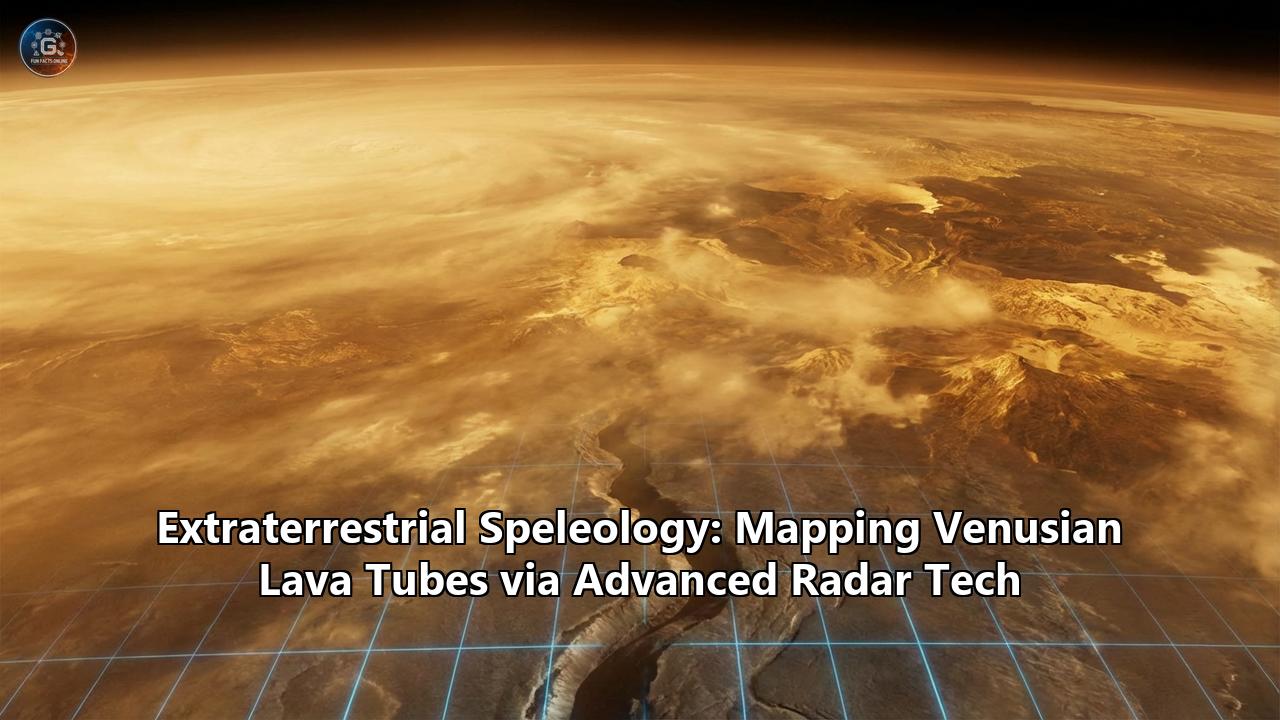
To the naked eye, Venus is a brilliant, serene jewel suspended in the twilight sky. But beneath its unbroken veil of pale, sulfuric acid clouds lies a world of apocalyptic extremes. Often dubbed Earth’s "evil twin," the second planet from the Sun features a crushing atmospheric pressure 90 times greater than our own, corrosive skies, and surface temperatures soaring past 460 degrees Celsius—hot enough to melt lead,. For decades, scientists viewed this hellscape as a largely static, inhospitable wasteland where the prospect of exploration seemed as doomed as the fragile, short-lived landers that dared to touch its surface,.
However, a groundbreaking revelation in the field of extraterrestrial speleology has forever shattered that assumption. In a monumental discovery published in the journal Nature Communications in February 2026, researchers confirmed the existence of a colossal, intact lava tube hidden deep beneath the Venusian crust,. This subterranean leviathan, mapped through the ingenious reanalysis of decades-old radar data, represents the first direct evidence of accessible underground cavities on Earth’s sister planet,.
The identification of these massive subterranean networks is not merely a geological curiosity; it is a paradigm shift. It opens a completely new frontier in planetary science, promising hidden vaults where ancient geological records—and perhaps echoes of a more habitable past—remain perfectly preserved, shielded from the terrifying extremes of the Venusian surface. As we stand on the precipice of a new golden age of space exploration, advanced radar technologies are poised to map these alien underworlds, potentially laying the groundwork for the most ambitious robotic, and theoretically human, exploration missions in history,.
The Dawn of Venusian Extraterrestrial Speleology
Speleology, the scientific study of caves, has traditionally been the domain of intrepid explorers armed with ropes, harnesses, and headlamps, navigating the dark, damp limestone fissures of Earth. Extraterrestrial speleology, however, is a profoundly different discipline. It requires astrobiologists, planetary geologists, and radar engineers to hunt for voids on worlds millions of miles away, utilizing orbital data, gravitational anomalies, and ghostly radio echoes,.
Until recently, the search for planetary caves was largely restricted to the Moon and Mars, where scientists have successfully identified thousands of potential cave entrances, known as "skylights". A skylight forms when the ceiling of an underground lava tube structurally fails and collapses inward, creating a distinct, sheer-walled pit on the surface,. On worlds with thin atmospheres like Mars, or no atmosphere like the Moon, orbiting optical cameras can simply photograph these gaping black holes.
Venus, however, fiercely guards its secrets. The planet is completely enshrouded in a hyper-dense atmosphere of carbon dioxide and thick clouds of sulfuric acid, rendering traditional optical imaging entirely useless,. To peer beneath the clouds, scientists must rely on radar. Extraterrestrial speleology on Venus is thus a forensic science of the highest order, demanding that researchers infer the existence of hidden abysses by analyzing the way radio waves bounce off the planet's jagged, heavily fractured crust,.
Dusting Off the Magellan Archives
The breakthrough discovery of the Venusian lava tube did not come from a newly launched spacecraft, but from the digital ghosts of a mission long past. Between 1990 and 1994, NASA’s Magellan spacecraft orbited Venus, piercing the planetary cloud cover with a pioneering Synthetic Aperture Radar (SAR) system. Over its four-year mission, Magellan successfully mapped approximately 98 percent of the Venusian surface before eventually burning up in the planet's toxic atmosphere.
Magellan’s SAR worked by beaming radio waves down to the surface and precisely measuring the time it took for the echoes to bounce back to the orbital receiver. The intensity and timing of these backscattered signals allowed scientists to construct a comprehensive topographic map of the planet. However, the data possessed a relatively coarse spatial resolution of between 120 and 300 meters per pixel, meaning that smaller surface features, such as narrow pit chains or isolated skylights, were incredibly difficult to identify and analyze.
For over thirty years, the Magellan data sat in the archives, its most profound secrets locked away by the technological limitations of the 1990s. It wasn't until a team of researchers led by Lorenzo Bruzzone, a professor of telecommunications and head of the Remote Sensing Laboratory at the University of Trento in Italy, applied modern computational analysis to the legacy data that the underworld of Venus was finally brought to light,.
Bruzzone and his team developed a novel, highly specialized image processing technique designed specifically to detect the subtle radar signatures of localized surface collapses,. They systematically scoured the Magellan maps, hunting for specific patterns of microtopography and radar reflection that distinguish solid ground from hollow voids. Their search led them to the flanks of a gargantuan volcanic feature, and there, the algorithms detected an anomaly,.
Nyx Mons and the Anatomy of the Abyss
The researchers focused their attention on the western flank of Nyx Mons, a massive shield volcano named after the ancient Greek goddess of the night,. This region is scarred with winding channels and "pit chains"—linear sequences of circular depressions that planetary geologists have long suspected were the surface expressions of collapsed underground lava tubes,.
Applying their advanced imaging techniques to a specific skylight near Nyx Mons, the University of Trento team modeled the radar backscatter to reveal the exact geometry of the void beneath. The results were staggering. The radar data confirmed a massive, intact subsurface cavity—a feature scientists refer to as a pyroduct,.
The dimensions of this Venusian lava tube dwarf almost anything found on Earth. The skylight opens into an empty void that is estimated to be approximately one kilometer in diameter,. The ceiling protecting this cavern is a massive slab of basaltic rock at least 150 meters thick, while the empty cavity itself plunges to a staggering height of no less than 375 meters,. In total, the floor of this subterranean cathedral rests more than 500 meters beneath the punishing Venusian surface.
Due to the limitations of the decades-old Magellan radar angles, the researchers could only directly confirm and measure the portion of the tube immediately surrounding the skylight, stretching for roughly 300 meters,. However, the geological context tells a much grander story. By analyzing the morphology, the elevation of the surrounding terrain, and the alignment of adjacent collapse pits, the team hypothesized that this continuous underground conduit likely extends for at least 45 kilometers across the volcanic plains,. If confirmed, this structure would rank among the largest known cave systems in the entire solar system,.
The Geological Forge: How Do You Bake a Venusian Lava Tube?
To understand how such a monstrous cavity could form, one must look at the violent, fiery history of Venus. Despite early assumptions that the planet was a geologically "dead" world, recent studies—including a 2023 analysis of Magellan data showing an actively changing volcanic vent—have proven that Venus is still volcanically alive.
Lava tubes, or pyroducts, are born from rivers of low-viscosity, basaltic magma,. When a massive volcanic eruption occurs, the lava flows rapidly across the planetary surface. As the top layer of the lava river is exposed to the atmosphere, it begins to cool and harden, eventually creating a solid crust. Meanwhile, the superheated lava beneath this newly formed roof remains insulated and continues to flow like a subterranean river,. This continuous flow can erode the ground beneath it, deepening the channel. When the eruption finally ceases and the magma source is exhausted, the remaining liquid lava drains away, leaving behind a hollow, tunnel-like cavern.
But why are the lava tubes on Venus so exceptionally large? The answer lies in the planet's unique, extreme environmental conditions.
First, Venus possesses a surface gravity that is about 90 percent of Earth's,. This slightly lower gravity allows for wider subterranean cavities to remain structurally stable without their roofs collapsing under their own weight. Recent numerical modeling utilizing finite element limit analysis has confirmed that, under Venusian gravity, rock masses can support stable underground voids spanning up to a kilometer in width.
Secondly, the extreme atmospheric pressure and surface temperatures play a paradoxical role. While a surface temperature of 460°C is blistering by human standards, it is still significantly cooler than erupting magma, which can exceed 1,000°C,. The hyper-dense atmosphere of Venus facilitates a rapid initial cooling of the outermost layer of the lava, allowing a thick, highly insulating crust to form very quickly,. Once this thick roof is established, it acts as a perfect thermal blanket. Because the surrounding ambient temperature of the Venusian surface is already so hot, the lava flowing inside the tube cools incredibly slowly, allowing it to remain fluid and travel for dozens, if not hundreds, of kilometers before solidifying. This unique thermodynamic interplay is what enables Venus to forge subterranean channels of such titanic scale.
A Vault of Ancient Secrets
The confirmation of the Nyx Mons lava tube is a watershed moment for planetary science because of what these caves might contain. Venus is a cautionary tale of planetary evolution. Billions of years ago, Venus and Earth were nearly identical twins, formed from the same cosmic materials, possessing similar sizes, and existing in similar regions of the solar system,. There is growing consensus among astrophysicists that ancient Venus may have possessed liquid water oceans and a temperate climate. However, a runaway greenhouse effect eventually boiled the oceans away, trapping solar heat and transforming the planet into the toxic, high-pressure furnace it is today.
Understanding exactly when and how Venus transitioned from a potentially habitable water-world to a lethal wasteland is one of the most pressing questions in modern astronomy. The problem with studying the surface of Venus is that it has been thoroughly reshaped and sterilized by intense heat, corrosive chemistry, and relentless volcanic resurfacing. Any delicate geological clues regarding its ancient oceans or potential early biospheres have likely been obliterated.
This is where extraterrestrial speleology becomes vital. Deep inside a massive lava tube, the environment is radically different from the surface. Shielded by 150 meters of solid rock, the interior of the pyroduct is protected from the corrosive, acidic winds and the harsh cosmic radiation. While the temperatures inside the cave are still extreme, the insulated environment could preserve ancient mineralogies, unique geological strata, and atmospheric trapped gases that have long since been erased from the surface.
Furthermore, some astrobiologists speculate that if microbial life ever arose during Venus's temperate past, it might have sought refuge as the surface conditions deteriorated. While the recent Cambridge University studies effectively ruled out the presence of sulfur-eating airborne microbes in the Venusian clouds based on atmospheric chemical signatures, the subsurface remains an uncharted frontier. Even if life is entirely absent, these untouched subterranean vaults are the holy grail for geologists seeking to read the uncorrupted diary of Venus's planetary evolution.
Advanced Radar Tech: The Next Generation of Explorers
Lorenzo Bruzzone noted that the discovery utilizing the Magellan archives represents "only the beginning of a long and fascinating research activity",. The limitations of 1990s technology mean we are currently observing these underground leviathans through a keyhole. However, the 2030s are poised to become the ultimate "Decade of Venus," with a fleet of next-generation spacecraft armed with cutting-edge advanced radar technologies preparing to set sail for our sister planet.
The spearhead of this new era is NASA's VERITAS (Venus Emissivity, Radio Science, InSAR, Topography, and Spectroscopy) mission, scheduled to launch around 2031,. VERITAS will dramatically revolutionize our understanding of Venusian topography. Unlike Magellan’s 120-to-300-meter resolution, the radar aboard VERITAS will map the entire planetary surface at a stunning 30 meters per pixel,. Furthermore, it will generate global 3D topographical maps with a height resolution of just 5 meters. This unprecedented level of detail will allow scientists to easily spot tiny skylights, narrow pit chains, and the subtle surface deformations that indicate underlying tube systems across the entire globe,.
Joining VERITAS will be the European Space Agency’s EnVision orbiter, also targeting a launch in the early 2030s,. While VERITAS maps the surface topography in high definition, EnVision will do something far more magical: it will look through the solid rock,. EnVision will be equipped with a specialized instrument known as the Subsurface Radar Sounder (SRS),. This orbital ground-penetrating radar is specifically engineered to emit low-frequency radio waves capable of penetrating the Venusian crust to depths of several hundred meters,.
The Subsurface Radar Sounder is the ultimate tool for extraterrestrial speleology. It will allow scientists to detect the hollow echoes of lava tubes, map their underground trajectories, and measure their internal dimensions even where there are no collapsed skylights visible on the surface,. By coordinating their observations, VERITAS and EnVision will provide a holistic, 3D architectural blueprint of the Venusian underworld.
Adding to this international armada, NASA’s DAVINCI (Deep Atmosphere Venus Investigation of Noble gases, Chemistry, and Imaging) mission will plunge a spherical probe directly through the atmosphere, capturing high-resolution optical images of the surface beneath the clouds before it impacts the ground. Meanwhile, the Indian Space Research Organisation (ISRO) is finalizing the configuration of its Venus Orbiter Mission (Shukrayaan), which will also carry advanced radar arrays similar to VERITAS, alongside a comprehensive suite of subsurface mapping tools,. Russia’s Venera-D mission concept also plans to contribute to this global effort to uncover the planet's structural secrets.
Shelters in the Abyss: The Future of Landers and Human Exploration
The discovery of massive, stable lava tubes on Venus dramatically alters the engineering mathematics of future surface exploration. Landing on Venus is notoriously difficult; the Soviet Union's Venera landers in the 1970s and 1980s were marvels of engineering, yet the longest any of them survived the 90-bar pressure and 460°C heat was a mere 127 minutes. Creating a rover that can survive for months on the Venusian surface requires heavy, expensive, and highly experimental heat-resistant electronics and cooling systems.
However, a massive lava tube could provide a natural sanctuary. By navigating a specially designed rover or lander down through a skylight and into the cavernous interior, engineers could bypass the worst of the planetary hazards,. While the ambient temperature inside the tube is still incredibly high, the space is entirely shielded from the corrosive, hurricane-force winds of the surface, direct solar radiation, and the relentless atmospheric friction,.
In the realm of visionary space architecture, some scientists and aerospace engineers have even begun to speculate about the implications for human exploration. The idea of sending astronauts to Venus has largely been confined to concepts of "cloud cities"—dirigibles floating 50 kilometers high in the atmosphere where temperatures and pressures are Earth-like. However, a sufficiently large lava tube—spanning a kilometer in width—presents the tantalizing, science-fiction-esque possibility of constructing shielded, pressurized basecamps deep underground,. Inside these subterranean vaults, the crushing weight of the atmosphere could be structurally mitigated, allowing human explorers or advanced robotic habitats to operate safely, utilizing the surrounding basaltic rock as an impenetrable thermal and radiation shield,.
A New Chapter for Earth's Twin
For centuries, Venus has deflected our gaze, hiding its scarred and violent face behind an impenetrable wall of toxic clouds. But the relentless march of human ingenuity and the advent of advanced radar technologies have finally begun to pull back the veil. The monumental discovery of the colossal Nyx Mons pyroduct by the University of Trento is a testament to the fact that discovery does not always require launching a new rocket; sometimes, it merely requires looking at old data with new eyes,.
The revelation that Earth's "evil twin" is riddled with massive, structurally sound subterranean networks forces us to completely reevaluate our understanding of planetary geology. Venus is not a dead, static rock. It is a dynamic, complex world that actively forged majestic underground architectures capable of dwarfing entire terrestrial cities,.
As we look toward the 2030s, the combined might of VERITAS, EnVision, DAVINCI, and Shukrayaan will usher in the true era of extraterrestrial speleology. By firing targeted radio pulses through the sulfuric skies and deep into the basaltic crust, humanity will soon map the dark, silent abysses of the Venusian underworld. In those dark, silent caverns, locked away from the blistering heat and crushing pressure, we may finally discover the missing pages of Venus's history, solving the ultimate cosmic mystery of how a world so much like our own descended into an apocalyptic inferno.
Reference:
- https://www.indiatoday.in/science/story/radar-finds-moon-like-lava-tubes-beneath-venus-first-discovery-beyond-earth-2865875-2026-02-10
- https://www.youtube.com/watch?v=r8Q_K4H126c
- https://www.youtube.com/watch?v=7iRMDTdiHlU
- https://indiandefencereview.com/venus-subsurface-lava-tube/
- https://www.sciencenews.org/article/venus-massive-lava-tube-caves
- https://hayadan.com/venus-radar-evidence-giant-lava-tube-underground
- https://www.youtube.com/watch?v=6VGPGEgj9Uk
- https://www.primetimer.com/features/research-suggests-large-stable-lava-tubes-may-exist-beneath-venus-surface
- https://www.sciencedaily.com/releases/2022/11/221116090006.htm
- https://www.eurekalert.org/news-releases/1115497
- https://www.universetoday.com/articles/massive-venus-lava-tube-detected-using-data-from-nasas-long-defunct-magellan-spacecraft
- https://www.youtube.com/watch?v=jrsu-J0bSBc
- https://thedebrief.org/radar-data-has-revealed-a-large-structure-beneath-the-surface-of-venus-heres-what-that-could-mean/
- https://www.sciencedaily.com/releases/2026/02/260212023020.htm
- https://connectsci.au/news/news-parent/7819/Radar-reveals-subsurface-structures-on-Venus
- https://www.labxchange.org/library/items/lb:LabXchange:6fc09910:html:1
- https://www.youtube.com/watch?v=Dag-wbjc5PU