
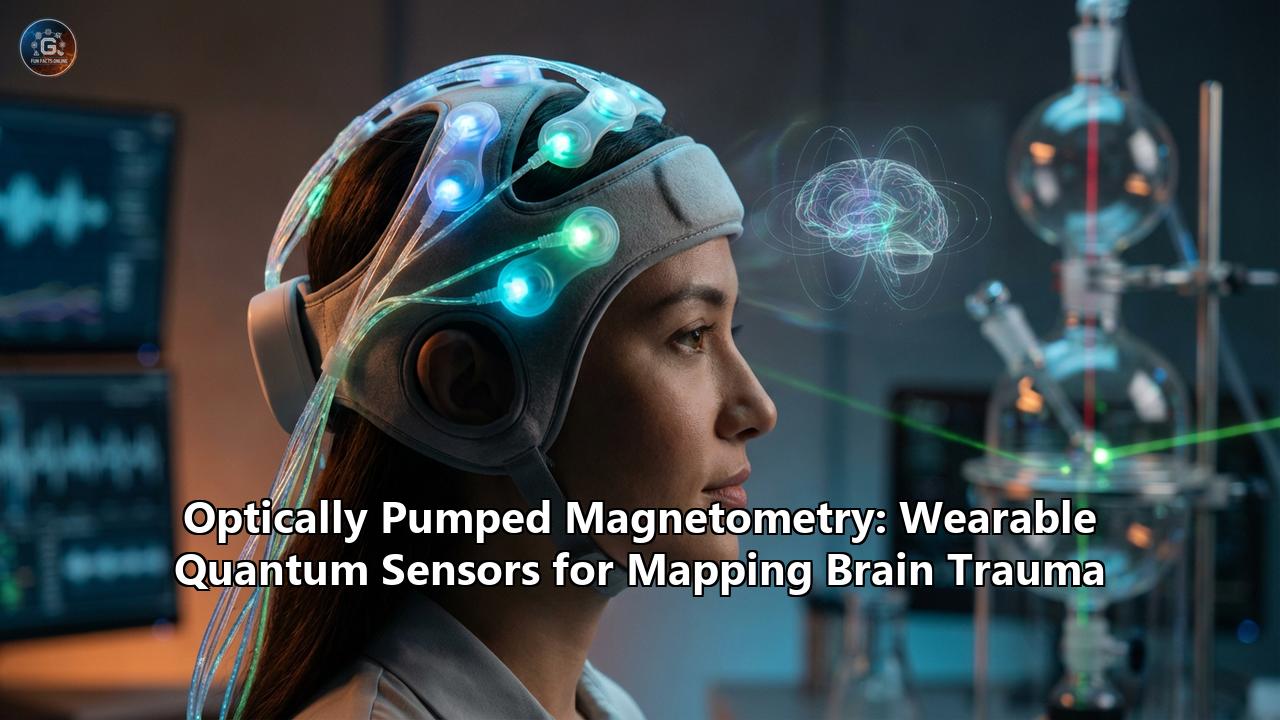
Introduction: The Invisible Wound and the Quantum Lens
In the dim, sterile light of a trauma bay, a physician looks at a CT scan of a young football player who took a helmet-to-helmet hit. The scan is pristine. No bleeding, no skull fracture, no bruising. The patient is sent home with a diagnosis of "mild concussion" and instructions to rest. Yet, inside that skull, a microscopic storm is raging. Neural connections have been stretched, ionic balances disrupted, and the delicate electrical symphony of the brain has been thrown into chaotic dissonance. Months later, the player suffers from memory lapses, dizziness, and depression. The scan said he was fine. The physics of his brain said otherwise.
This scenario represents the "silent epidemic" of mild Traumatic Brain Injury (mTBI). For decades, neurology has been handcuffed by a fundamental limitation: our best tools, like CT and MRI, are excellent at mapping anatomy but terrible at mapping function. They can show us the hardware of the brain, but they cannot hear the software running on it. To hear the brain—to detect the millisecond-by-millisecond firing of neurons—we have relied on Magnetoencephalography (MEG). But traditional MEG is a beast: a 500-kilogram monolith requiring liquid helium cooling to near absolute zero, immobilizing the patient in a claustrophobic chamber.
Enter the Optically Pumped Magnetometer (OPM).
Emerging from the intersection of quantum physics and advanced microfabrication, OPMs are a new class of sensor that is shattering the old paradigms of neuroimaging. These are not room-sized machines; they are the size of a LEGO brick. They do not require supercooled liquids; they run at room temperature. And most importantly, they are wearable.
This article delves deep into the world of OPM technology, exploring how these quantum sensors work, why they are revolutionizing our ability to map brain trauma, and how they are poised to turn the science of the mind into a mobile, accessible clinical reality.
Part 1: The Quantum Mechanic – How OPMs Work
To understand why OPMs are revolutionary, we must first descend into the quantum realm. The human brain operates on electricity. When a neuron fires, ions flow across its membrane, creating a tiny electric current. According to Ampère's Law, every electric current generates a magnetic field. However, the magnetic fields generated by the brain are infinitesimally small—measured in femtoteslas ($10^{-15}$ Tesla). For comparison, the Earth's magnetic field is about 50 microteslas ($10^{-6}$ Tesla). We are trying to hear a whisper in a hurricane.
1.1 The Limitations of SQUIDs
For the last 50 years, the only way to detect these faint signals was using Superconducting Quantum Interference Devices (SQUIDs). SQUIDs rely on quantum tunneling through a Josephson junction, a phenomenon that only occurs at superconducting temperatures. This necessitates immersing the sensors in a bath of liquid helium (-269°C).
- The Stand-off Problem: Because the sensors must be insulated from the patient's head to prevent frostbite, they are fixed in a rigid helmet with a 2-3 cm gap between the sensor and the scalp. Since magnetic field strength drops off with the square of the distance ($1/r^2$), this gap results in a massive loss of signal.
- The Motion Problem: If the patient moves their head even a few millimeters inside the rigid helmet, the data is ruined. This makes scanning children, claustrophobic patients, or anyone with movement disorders nearly impossible.
1.2 The Alkali Vapor Revolution
OPMs ditch the superconductor for a glass cell filled with a hot vapor of alkali atoms—typically Rubidium-87 ($^{87}\text{Rb}$), Cesium-133 ($^{133}\text{Cs}$), or Potassium ($^{39}\text{K}$). These atoms possess a quantum property called spin, which makes them behave like tiny magnetic gyroscopes.
The operation of an OPM can be broken down into three quantum steps:
- Optical Pumping (Polarization): A laser beam, tuned to a specific resonance frequency of the alkali atoms (e.g., the D1 transition line), is shot through the vapor cell. The photons in the laser beam transfer their angular momentum to the atoms, forcing the atomic spins to align in the same direction. The vapor becomes "polarized." In this state, the atoms are transparent to the laser light because they can no longer absorb photons.
- Larmor Precession: When a magnetic field (like the one from a firing neuron) passes through the cell, it exerts a torque on these aligned spins. The atoms begin to wobble or "precess" around the magnetic field line, much like a spinning top wobbles under gravity. The speed of this wobble is the Larmor Frequency, which is directly proportional to the strength of the magnetic field.
- Probing (Detection): As the atoms precess, they move out of alignment with the laser. They begin to absorb photons again, reducing the amount of light that passes through the cell. A photodetector on the other side measures this dip in light intensity. By monitoring the modulation of the light, the sensor can calculate the exact strength of the magnetic field.
1.3 The SERF Regime: Achieving Femtotesla Sensitivity
To rival the sensitivity of SQUIDs, OPMs operate in a special state known as the Spin-Exchange Relaxation-Free (SERF) regime.
In a normal gas, atoms constantly collide, knocking each other's spins out of alignment (decoherence). This noise limits sensitivity. However, if you heat the gas to increase density and lower the background magnetic field to near zero, a quantum magic trick occurs: the atoms collide so frequently that the collisions no longer randomize their spins. The "spin-exchange" relaxation is suppressed.
- Result: The atoms maintain their coherence for much longer, allowing for incredibly precise measurements of magnetic fields, down to 10-15 femtoteslas per root Hertz ($\text{fT}/\sqrt{\text{Hz}}$)—comparable to, and theoretically better than, SQUIDs.
Part 2: The Wearable Revolution – Engineering the OPM Helmet
The transition from a 500kg machine to a 500g helmet is not just a reduction in size; it is a paradigm shift in how we interact with the brain.
2.1 The Inverse Square Advantage
The most critical advantage of OPMs is their proximity. Because they operate at room temperature (the internal heater is insulated by a thin vacuum layer), the sensor can be placed directly on the scalp.
- The Math of Proximity: Reducing the distance from the brain from 30mm (SQUID) to 5mm (OPM) results in a signal magnitude increase of 400% to 500%.
- High Spatial Frequency: Closer proximity allows OPMs to detect finer spatial details. While SQUIDs blur the magnetic signals from adjacent brain regions, OPMs can resolve distinct neuronal populations with millimeter precision.
2.2 The Challenge of Zero Field
There is a catch. SERF magnetometers only work if the ambient background magnetic field is effectively zero. The Earth's field is 50,000 nT; the SERF regime collapses above ~20 nT.
To make OPMs work, researchers at institutions like the University of Nottingham and companies like Cerca Magnetics and QuSpin have developed sophisticated active magnetic shielding.
- Bi-planar Coils: The subject sits between two large panels containing electromagnetic coils. These coils generate a magnetic field that is exactly equal and opposite to the Earth's field, cancelling it out in a specific volume.
- On-board Nulling: Each OPM sensor also contains tiny internal coils that fine-tune the local field to zero. This allows the person wearing the helmet to move their head. As they turn, the coils dynamically adjust to keep the sensor in the "zero-field" sweet spot.
2.3 Freedom of Movement
This dynamic nulling capability is the "killer app" of OPM-MEG. In a SQUID scanner, if a patient sneezes, the data is useless. In an OPM helmet, a patient can nod, drink from a cup, or even play a musical instrument. This opens the door to naturalistic neuroscience: scanning brains while they are doing real-world tasks, not just lying frozen in a tube.
Part 3: Mapping Brain Trauma – The Clinical Breakthrough
Traumatic Brain Injury, particularly mild TBI (concussion), is notoriously difficult to diagnose objectively. It is a functional injury, not a structural one. This is where OPM-MEG shines.
3.1 The Spectral Fingerprint of Trauma
When brain tissue is injured, the timing of neuronal firing changes. Healthy waking brains are dominated by Alpha waves (8-12 Hz) and Beta waves (13-30 Hz). Injured brain tissue often shifts to a slower rhythm, generating abnormal Delta (1-4 Hz) and Theta (4-8 Hz) oscillations.
- The "Slow-Wave" Biomarker: Traditional SQUID-MEG has shown that the presence of focal slow-wave activity is a highly accurate predictor of axonal injury. However, SQUIDs often miss subtle, deep, or highly focal injuries because of the distance standoff.
- OPM Sensitivity: Recent simulations and pilot studies suggest that OPMs, sitting on the scalp, can detect these pathological slow waves with significantly higher signal-to-noise ratio (SNR). A study by Zahran et al. (2022) demonstrated that OPM arrays could detect signals from deep brain sources with fidelity comparable to whole-head SQUID systems, despite using far fewer sensors.
3.2 The "MEGAbIT" Study and Real-World Impact
At the Queen's Medical Centre in Nottingham, the MEGAbIT study (Magnetoencephalography for the Assessment of mild Traumatic Brain Injury) has been pioneering the use of OPMs in acute trauma.
- The Objective: To catch the "invisible" injury. Many patients with persistent post-concussion symptoms (brain fog, irritability) are told "it's all in your head" because their MRI is normal. OPM-MEG provides objective evidence of the physiological dysfunction.
- Connectivity Mapping: Beyond just "hotspots" of damage, OPM-MEG maps the functional connectivity of the brain. TBI often involves Diffuse Axonal Injury (DAI)—the shearing of long-range connection fibers. OPMs can measure the "lag" in communication between different brain areas (phase-locking values), revealing a fragmented network that structural imaging cannot see.
3.3 The Military Application: Blast Injury
One of the most promising frontiers is military medicine. Soldiers exposed to blast waves often suffer from "shell shock" or blast-induced TBI, which mimics PTSD but has a distinct organic cause.
- Mobile Screening: Because OPM systems are lightweight and don't need liquid helium, the UK Ministry of Defence and research partners are exploring "mobile MEG" units. Imagine a humvee-mounted system that can scan a soldier immediately after an IED blast. This immediate functional triage could prevent the catastrophic "second impact syndrome" by identifying soldiers who need to be pulled from the line before their brain has healed.
Part 4: Beyond Trauma – The Pediatric & Epilepsy Frontier
While TBI is a massive application, the unique form factor of OPMs solves a decades-old problem in pediatrics.
4.1 The "One-Size-Fits-None" Problem
Traditional MEG helmets are sized for adults. Put a 5-year-old in one, and their head rattles around, far from the sensors. The signal loss is catastrophic, often rendering the scan useless.
- The OPM Solution: OPM sensors can be mounted in 3D-printed helmets custom-sized to the patient. For the first time, we can get high-fidelity functional maps of infant and child brains.
- Hill et al. (2020) Infant Study: A landmark study by Ryan Hill and the Nottingham team successfully scanned toddlers wearing OPM helmets. They measured brain responses to touch and sound with clarity that SQUIDs could never achieve in that age group.
4.2 Epilepsy: Pinpointing the Source
For children with drug-resistant epilepsy, surgery is often the only cure. Success depends on removing the exact piece of tissue causing the seizure.
- Feys et al. (2024) Study: This study compared OPM-MEG to SQUID-MEG in children with epilepsy. The results were stunning: OPMs detected interictal epileptic discharges (spikes) with 2.3 to 4.6 times higher amplitude than SQUIDs.
- Clinical Implication: Higher amplitude means clearer localization. OPMs could allow surgeons to define the "resection margin" with millimeter accuracy, sparing healthy brain tissue and improving surgical outcomes for children.
Part 5: The Road Ahead – Challenges and Commercialization
If OPMs are so superior, why aren't they in every hospital? The technology is currently in the "Valley of Death" between academic breakthrough and commercial ubiquity.
5.1 The Economic Landscape
- Cost: A traditional SQUID-MEG system costs ~$3-4 million, plus ~$100,000/year in liquid helium. An OPM system eliminates the helium cost. While early prototypes are expensive due to the custom manufacturing of vapor cells, mass production (leveraging techniques from the semiconductor industry) promises to drive the cost down significantly.
- Key Players:
QuSpin (USA): The pioneer in commercializing the "Zero-Field Magnetometer" sensor package.
Cerca Magnetics (UK): A spin-off from the University of Nottingham, selling the first integrated "whole-head" OPM-MEG systems to research labs worldwide.
* FieldLine Medical: Developing high-density arrays for clinical markets.
5.2 Technical Hurdles
- Bandwidth: SERF OPMs typically have a bandwidth of 0-150 Hz. This is fine for most brain waves but misses high-frequency oscillations (HFOs) sometimes used in epilepsy mapping. New "MFMF" (Matrix-Free Magnetic-Field) variants and total-field sensors are being developed to push this limit to 1-2 kHz.
- Crosstalk: When you pack 100 magnetometers onto a helmet, the magnetic field generated by the internal coils of one sensor can interfere with its neighbor. Sophisticated algorithms and "tri-axial" sensor designs are being refined to manage this.
- The Shielding Requirement: You still need a magnetically shielded room (MSR). While lighter and cheaper than SQUID MSRs (because you can use active shielding), it is still an infrastructure constraint.
5.3 Regulatory Status
Currently, most OPM-MEG systems are sold as "Research Use Only" devices. Gaining FDA (510k) and CE approval requires rigorous standardization. The data formats must be integrated into standard hospital PACS systems, and the "wearable" aspect introduces new safety checks (e.g., ensuring the sensor surface doesn't get too hot, though current models are well-insulated).
Conclusion: The "Stethoscope for the Brain"
For centuries, the stethoscope has been the symbol of medicine—a simple, non-invasive tool to listen to the rhythm of the heart. Neurology has lacked such a tool. We have had only the "autopsy" of MRI (structure) or the "imperfect echo" of EEG (distorted by the skull).
Optically Pumped Magnetometry represents the arrival of a true "stethoscope for the brain." By harnessing the quantum dance of alkali atoms, we have created a sensor that is sensitive enough to hear the whisper of a neuron, small enough to wear like a hat, and robust enough to work in the real world.
For the athlete with a concussion, the soldier with blast injury, and the child with epilepsy, this is not just a physics experiment. It is the promise of being seen, being understood, and finally, being healed. The quantum revolution in neuroscience has begun, and it is wearable.
Reference:
- https://pmc.ncbi.nlm.nih.gov/articles/PMC10896867/
- https://www.mdpi.com/1424-8220/22/8/3093
- https://www.researchgate.net/publication/360038941_Performance_Analysis_of_Optically_Pumped_He_Magnetometers_vs_Conventional_SQUIDs_From_Adult_to_Infant_Head_Models
- https://clinicaltrials.gov/study/NCT03867513
- https://pubs.rsna.org/doi/pdf/10.1148/radiol.212453
- https://www.medrxiv.org/content/10.1101/2025.05.07.25326414v1.full
- https://pubmed.ncbi.nlm.nih.gov/35779970/
- https://direct.mit.edu/imag/article/doi/10.1162/imag_a_00535/128516/Determining-sensor-geometry-and-gain-in-a-wearable
- https://pmc.ncbi.nlm.nih.gov/articles/PMC12320009/
- https://www.cercamagnetics.com/cerca-opm-meg
- https://www.nottingham.ac.uk/research/groups/spmic/research/meg-and-opm.aspx
- https://pmc.ncbi.nlm.nih.gov/articles/PMC11790644/