
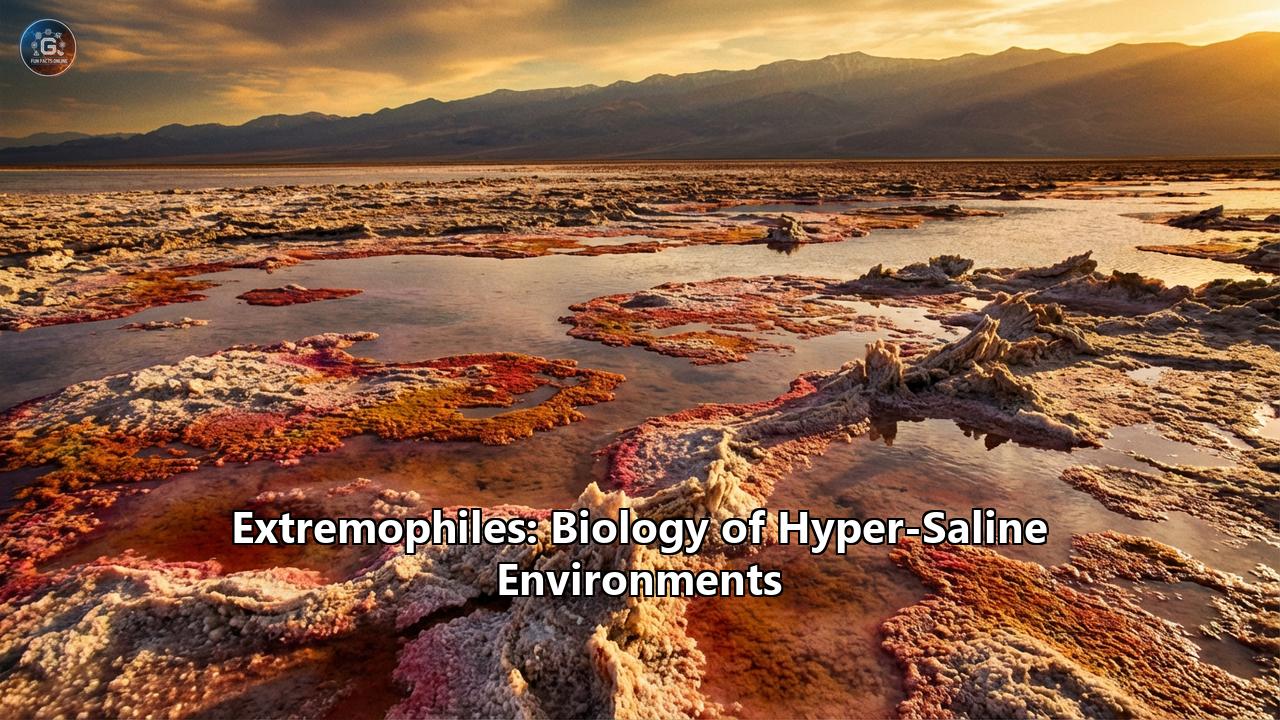
Imagine a world where water is as thick as syrup, where the sun beats down with unforgiving intensity, and where the chemistry of the environment is so hostile that it would strip the water from the cells of most living things, leaving them as desiccated husks in seconds. This is not the surface of a distant exoplanet, though it could well be. These are the hyper-saline environments of Earth: the salt flats, the deep-sea brine pools, and the pink lakes that defy our intuitive understanding of what constitutes a "habitable" zone.
For centuries, humanity viewed these landscapes as barren wastelands. The Dead Sea was named "Dead" for a reason; the crystallizer ponds of solar salterns were seen merely as industrial basins. Yet, under the microscope, these environments are teeming with life. They are not just surviving; they are thriving in conditions that push the absolute limits of biochemistry. This is the world of halophiles—the "salt-lovers"—and their story is one of the most remarkable tales of adaptation, evolution, and biological ingenuity on our planet.
This exploration will take us deep into the molecular machinery that allows life to function in saturated salt, tour the most exotic locations on Earth, introduce the "celebrities" of the halophilic world, and reveal how these extremophiles are reshaping biotechnology and our search for extraterrestrial life.
Part I: The Salt Paradox and the struggle for Water
To understand the biology of halophiles, one must first understand the enemy they face: salt. Sodium chloride (NaCl) and other salts are not merely seasoning; in high concentrations, they are potent destroyers of biological structure.
The Tyranny of Osmosis
The primary challenge in a hyper-saline environment is osmotic pressure. Water naturally flows from areas of low solute concentration to areas of high solute concentration to equalize the balance. For a typical cell placed in a brine pool, the environment is hypertonic. The physical laws of the universe demand that the water inside the cell—the solvent of life—rush out into the brine.
Without specific adaptations, a cell in this environment would undergo plasmolysis. Its membrane would pull away from the cell wall, its cytoplasm would shrink, and its metabolic machinery would grind to a halt. The DNA would precipitate, proteins would unfold (denature), and the cell would die.
But the challenge goes beyond simple water loss. High concentrations of ions can be toxic. They interfere with the hydration shells of proteins, stripping away the water molecules that keep proteins dissolved and functional. This phenomenon, known as the "salting-out" effect, causes proteins to clump together into useless aggregates. To survive here, an organism must not only hold onto its water with an iron grip but also redesign its entire molecular architecture to function in a soup of ions.
Water Activity: The limit of Life
Biologists measure the availability of water in an environment using a parameter called water activity ($a_w$). Pure distilled water has an $a_w$ of 1.0. Seawater is approx 0.98. Most common bacteria, like E. coli, cannot grow below an $a_w$ of 0.91.
Hyper-saline environments push this number perilously low. Saturated NaCl solution has an $a_w$ of about 0.75. Some magnesium-rich brines go even lower. Halophiles have conquered these low-water activities, with some specialized fungi and archaea capable of metabolism at $a_w$ values near 0.61—a limit often considered the absolute floor for life as we know it.
Part II: Two Roads to Survival
Evolution has devised two distinct, divergent strategies to solve the salt problem. These strategies represent a fundamental split in the tree of life, dictating everything from the organism's bioenergetics to the very sequence of its proteins.
Strategy 1: The "Salt-In" Strategy (The Archaeal Way)
This is the more radical of the two solutions. It is primarily employed by the Order Halobacteriales (Haloarchaea) and a specific group of anaerobic bacteria (Order Halanaerobiales) and the remarkably convergent bacterium Salinibacter.
Instead of fighting the salt, these organisms embrace it. They do not pump salt out; they let it in. To balance the massive osmotic pressure of the outside world, they accumulate potassium chloride (KCl) in their cytoplasm to concentrations that match or exceed the external salinity—often reaching 4 to 5 Molar.
This creates a new problem: the intracellular machinery must now function in a solution that is essentially concentrated potash. A normal protein placed in 4 M KCl would instantly denature. Consequently, the "salt-in" strategists have undergone a massive, genome-wide evolutionary overhaul.
- The Acidic Proteome: If you analyze the proteins of a "salt-in" halophile, you will find a striking anomaly. They are overwhelmingly acidic. The surface of these proteins is covered in negatively charged amino acids like aspartic acid and glutamic acid. In a high-salt environment, these negative charges interact with the cloud of positive potassium ions and water molecules, creating a hydration shell that keeps the protein soluble and flexible.
- Obligate Dependence: This adaptation comes at a steep price. These organisms are now "addicted" to salt. If you place a Halobacterium cell in fresh water, its proteins—adapted to be stable only in high salt—will mutually repel each other due to their negative charges. The cell wall, also stabilized by ions, will disintegrate, and the cell will lyse (burst). They are prisoners of their own adaptation, unable to survive in the "moderate" world.
Strategy 2: The "Compatible Solute" Strategy (The Bacterial/Eukaryotic Way)
Most halophilic bacteria, along with algae and fungi, take a more flexible approach. They maintain a cytoplasm that is relatively free of salt. To balance the external osmotic pressure, they synthesize or accumulate massive amounts of organic molecules known as "compatible solutes" (or osmolytes).
These molecules are called "compatible" because they can exist at extremely high concentrations without interfering with the cell's delicate enzymatic machinery.
- The Chemical Arsenal: Common compatible solutes include amino acid derivatives (proline, glycine betaine), sugars (sucrose, trehalose), and polyols (glycerol).
- The Mechanism: These molecules work by "preferential exclusion." They are excluded from the immediate hydration shell of proteins, which forces the water structure around the protein to remain intact. This stabilizes the native state of the protein.
- Flexibility: Unlike the "salt-in" specialists, these organisms can often survive in a wider range of salinities. If the external salt concentration drops, they can simply break down or excrete the compatible solutes. This strategy is energetically expensive—synthesizing these complex molecules costs a lot of ATP—but it provides ecological versatility.
Part III: The Cast of Characters
The world of halophiles is populated by a bizarre cast of microscopic characters, each with unique "superpowers."
1. Halobacterium salinarum: The Purple Ion Pump
Perhaps the most famous of all halophiles, Halobacterium salinarum is not a bacterium at all, but an Archaeon. It is the organism responsible for the purple/red hue of salted fish and solar salterns.
- The Purple Membrane: H. salinarum possesses one of nature's most elegant inventions: bacteriorhodopsin. This protein, purple in color, acts as a light-driven proton pump. When oxygen levels in the brine drop (which happens often, as warm, salty water holds very little oxygen), this organism switches to a primitive form of photosynthesis. It uses light energy to pump protons out of the cell, creating a gradient that drives ATP synthesis. It captures sunlight, but without chlorophyll.
- Gas Vesicles: To ensure it stays in the photic zone where the sunlight is, H. salinarum produces gas vesicles—proteinaceous, gas-filled balloons that grant it buoyancy. It can float up or sink down to find the optimal position in the water column.
2. Haloquadratum walsbyi: The Living Tile
For decades, microbiologists were baffled by "square bacteria" seen in microscopy samples from the Red Sea. In 2004, the organism was finally cultivated and named Haloquadratum walsbyi ("Walsby's salt square").
- Geometry of Survival: Cells are perfectly flat, square tiles, about 2-5 microns wide but only 0.1 microns thick. This extreme surface-to-volume ratio is an adaptation to nutrient limitation in dense brines.
- Postage Stamp Sheets: These cells often link together to form large, fragile sheets that float on the surface of magnesium-rich brines, looking like sheets of microscopic postage stamps.
- Halomucin: To prevent complete desiccation, they secrete a giant protein called halomucin, which holds a layer of water around the cell like a microscopic wetsuit, allowing the square cell to retain moisture even when the surrounding brine is almost crystallized.
3. Salinibacter ruber: The Imposter
Salinibacter ruber is a bacterium that thinks it’s an archaeon. Living in the same crystallizer ponds as Halobacterium, it has evolved to look and act almost exactly like its archaeal neighbors.- Convergent Evolution: It uses the "salt-in" strategy, accumulating KCl. Its proteins are acidic, indistinguishable in profile from haloarchaeal proteins. It produces a red pigment (salinixanthin) to protect against UV radiation. It is a stunning example of convergent evolution: two completely different domains of life arriving at the exact same solution for an extreme problem.
4. Dunaliella salina: The Beta-Carotene Factory
This unicellular green alga is the reason many salt lakes look pink or orange.
- The Sunscreen Mechanism: When exposed to high light and high salt, D. salina goes into survival mode. It pumps its chloroplasts full of beta-carotene (the same pigment found in carrots). This pigment acts as a sunscreen, absorbing harmful UV radiation and dissipating it as heat, protecting the cell's DNA.
- Glycerol Production: To balance osmotic pressure, D. salina can accumulate glycerol to concentrations of 4-5 Molar. Its cell lacks a rigid wall, allowing it to swell and shrink rapidly in response to salinity changes without bursting.
5. Wallemia ichthyophaga: The Fungal Extremist
Fungi are usually not fans of extreme salt, but Wallemia ichthyophaga is an exception. It is the most halophilic fungus known, requiring at least 10% salt just to grow (obligate halophile). It grows in chocolate-brown clumps (sarcina-like structures) to minimize surface area exposure and thickens its cell walls to armor itself against the osmotic crushing force.
Part IV: A Tour of the Impossible
To truly appreciate these organisms, we must visit their homes—places that look more like alien landscapes than terrestrial ecosystems.
1. The Dead Sea: The Terminal Lake
The Dead Sea is the lowest point on Earth, and its waters are ten times saltier than the ocean. It is a "terminal lake," meaning water flows in but leaves only by evaporation, concentrating minerals for millennia.
- The Bloom: For years, the Dead Sea is relatively clear. But after rare, massive winter rains, the top layer of the lake gets diluted. This triggers a biological explosion. Dunaliella algae bloom first, turning the water green. They produce organic compounds that feed the haloarchaea. Weeks later, the lake turns a deep, blood-red as the archaea bloom in the trillions, feasting on the algal leftovers.
- The Magnesium Barrier: The Dead Sea is unique because it is rich in Magnesium (Mg) and Calcium (Ca), not just Sodium. Magnesium is "chaotropic"—it destabilizes biological molecules even more than sodium. This makes the Dead Sea a harder environment to conquer than a simple salt lake, limiting life to only the hardiest specialists like Haloferax volcanii.
2. Lake Hillier & The Pink Lakes of Australia
From the air, Lake Hillier looks like a pool of bubblegum pink paint dropped on a green island.
- The Colour Mystery: For years, scientists debated the cause. Was it algae? Bacteria? Recent metagenomic studies settled it: while Dunaliella is present, the vibrant pink comes primarily from Salinibacter ruber. The bacterium is so abundant that its red pigments dominate the visual spectrum. These lakes are dynamic; their color can change with the season, salinity, and temperature, shifting from pale lilac to deep crimson.
3. The Danakil Depression: The Hell on Earth
Located in Ethiopia, the Danakil Depression is a poly-extreme environment. It is hot (regularly 50°C/122°F), acidic (pH can drop to 0), and hyper-saline.
- The Limits of Habitability: Researchers studying the hydrothermal pools here have found that there are places where no life exists. The combination of high temperature, high acidity, and high concentrations of chaotropic magnesium salts creates a barrier that even extremophiles cannot cross. This "zone of sterility" helps astrobiologists define the theoretical limits of life. However, just adjacent to these sterile pools, in slightly cooler or less acidic brines, unique nano-sized archaea cling to existence.
4. Deep-Sea Brine Pools: The Underwater Lakes
Deep in the ocean, distinct pools of water sit on the seafloor, refusing to mix with the seawater above. These are Deep Hypersaline Anoxic Basins (DHABs), like the L'Atalante and Discovery basins in the Mediterranean, or the Orca Basin in the Gulf of Mexico.
- The Interface: The boundary between the seawater and the brine is a sharp "halocline." This interface is a trap for organic matter falling from above. It is a banquet table for bacteria.
- The Anoxic World: The brine is so dense oxygen cannot penetrate it. The organisms here are anaerobes, evolving in complete darkness and isolation for thousands of years. They rely on sulfur and methane metabolism. In the Discovery basin, the magnesium concentration is so high (5 Molar) that it was thought sterile until recently, when evidence of specialized microbial activity was found, suggesting life can adapt to conditions previously thought impossible.
Part V: The Viral Overlords
Wherever there is life, there are viruses, and hyper-saline environments are no exception. In fact, viruses (haloviruses) may be the most dominant biological entities in these ecosystems.
- The Lemon-Shaped Mystery: Haloviruses often have morphologies seen nowhere else. The most iconic is the spindle or "lemon" shape (e.g., virus His1 or SSV1). This shape is thought to be an adaptation to the high viscosity of the brine or the structure of the archaeal cell wall.
- The Morphological Shifters: Some lemon-shaped viruses, like the Acidianus Two-Tailed Virus (ATV) - distinct but related to haloviruses - can change shape outside the host. When excreted into the hot, salty environment, they grow two long tails on either end of the lemon, acting like grappling hooks to find a new host.
- Ecological Control: In a saltern crystallizer pond, the density of archaea can reach $10^8$ cells per milliliter. Without viruses to kill them (lyse), the population would crash due to nutrient depletion. Haloviruses facilitate "nutrient turnover," releasing the carbon and nitrogen locked inside cells back into the soup to feed the survivors. They are the engines of the salt ecosystem.
Part VI: Biotechnology and the Future
The unique adaptations of halophiles have turned them into goldmines for biotechnology. If a protein can remain stable in saturated salt and high heat, it is virtually indestructible in an industrial setting.
1. Ectoine: The Magic Molecule
Ectoine is a compatible solute produced by Halomonas elongata. It binds water molecules so effectively that it is used in:
- Cosmetics: As an anti-aging cream ingredient (marketed as a "natural cell protection factor") to keep skin cells hydrated and protect them from UV stress.
- Medicine: In nasal sprays and eye drops to reduce inflammation and stabilize cell membranes against allergens.
- Production: Industries use a process called "bacterial milking." They grow Halomonas in high salt (inducing ectoine production), then suddenly shock them with fresh water. The bacteria, sensing the osmotic drop, open safety valves (mechanosensitive channels) and dump their ectoine into the water to avoid bursting. The bacteria are then returned to salt to start the cycle again—milked like microscopic cows.
2. Bacteriorhodopsin: The Bio-Computer
The purple protein from Halobacterium is photochromic—it changes color and shape when hit by light, and it does so with incredible speed and durability (it doesn't degrade even after millions of cycles).
- Holographic Memory: Scientists have used bacteriorhodopsin to create 3D volumetric optical memory cubes. Data is written into the protein cube using lasers, storing vast amounts of information in a tiny space.
- Artificial Retinas: Because the protein generates an electrical signal when hit by light, it is being tested as a component in artificial retinas and high-speed motion sensors.
3. Biofuels and Beta-Carotene
Dunaliella salina is already farmed globally in massive open-air ponds (pink lakes) for natural beta-carotene production (sold as vitamin supplements and food coloring). Researchers are now engineering it to produce high-density lipids for jet fuel. Since these algae grow in salt water on non-arable land, they don't compete with food crops—a "holy grail" for sustainable biofuel.4. Bioremediation
Halophiles are being deployed to clean up oil spills in marine environments. Alcanivorax borkumensis, a halotolerant bacterium, feeds on hydrocarbons. In high-salinity wastewater from fracking or textile industries, normal bacteria die, but halophilic enzymes (amylases, proteases) thrive, offering a way to treat toxic, salty industrial waste.
Part VII: Astrobiology - The Cosmic Connection
The study of halophiles is not just about Earth; it is about the search for life in the universe.
- Mars: We know Mars was once wet and salty. As it dried up, it likely formed hypersaline lakes similar to the Dead Sea or the Danakil Depression. If life existed there, it would likely have been halophilic. Furthermore, halophiles can survive trapped inside fluid inclusions in salt crystals for millions of years (some claim up to 250 million years, though this is debated). Finding salt crystals on Mars could mean finding time capsules of ancient Martian biology.
- Europa and Enceladus: The moons of Jupiter and Saturn hide vast liquid water oceans beneath miles of ice. These oceans are briny. The "salt-in" strategy or the compatible solute strategy are the most likely blueprints for life in these alien seas.
- Planetary Protection: Because halophiles are so resilient—resistant to radiation, desiccation, and vacuum (to a degree)—they are the organisms we most fear accidentally sending to Mars on a rover. If a Halobacterium hitched a ride on the Perseverance rover, it could potentially survive the journey and contaminate the Martian brine.
Conclusion: Life on the Edge
Extremophiles, and halophiles in particular, challenge our anthropocentric view of nature. We tend to think of "extreme" environments as marginal, difficult places where life struggles to exist. But for a Halobacterium in a sun-drenched salt pond, or a Haloquadratum floating in a magnesium brine, this is paradise.
They teach us that life is not fragile. It is robust, adaptable, and incredibly creative. By understanding the biology of the hyper-saline, we unlock new technologies for our future, gain a window into the ancient history of our own planet, and prepare ourselves to recognize the face of life when we finally find it among the stars. The salt of the Earth is not barren; it is one of the most vibrant stages for the dance of life.
Reference:
- https://www.mdpi.com/2227-9717/11/2/339
- https://opus4.kobv.de/opus4-bam/frontdoor/deliver/index/docId/37680/file/0004CBIOT.pdf
- https://royalsocietypublishing.org/doi/10.1098/rsif.2013.0197
- https://www.tandfonline.com/doi/full/10.4161/bioe.21445
- https://science.thewire.in/science/ethiopics-danakil-depression-gives-clues-life-mars/
- https://www.researchgate.net/publication/348819832_Unveiling_microbial_communities_along_the_polextreme_physicochemical_gradients_of_Dallol_and_its_surroundings_Danakil_depression_Afar_region_Ethiopia
- https://communities.springernature.com/posts/archaea-biomorphs-and-life-limits-at-the-geothermal-field-of-dallol
- https://academic.oup.com/femsec/article/94/7/fiy085/4995905
- https://en.wikipedia.org/wiki/Brine_pool
- https://www.pnas.org/doi/10.1073/pnas.1425008112