
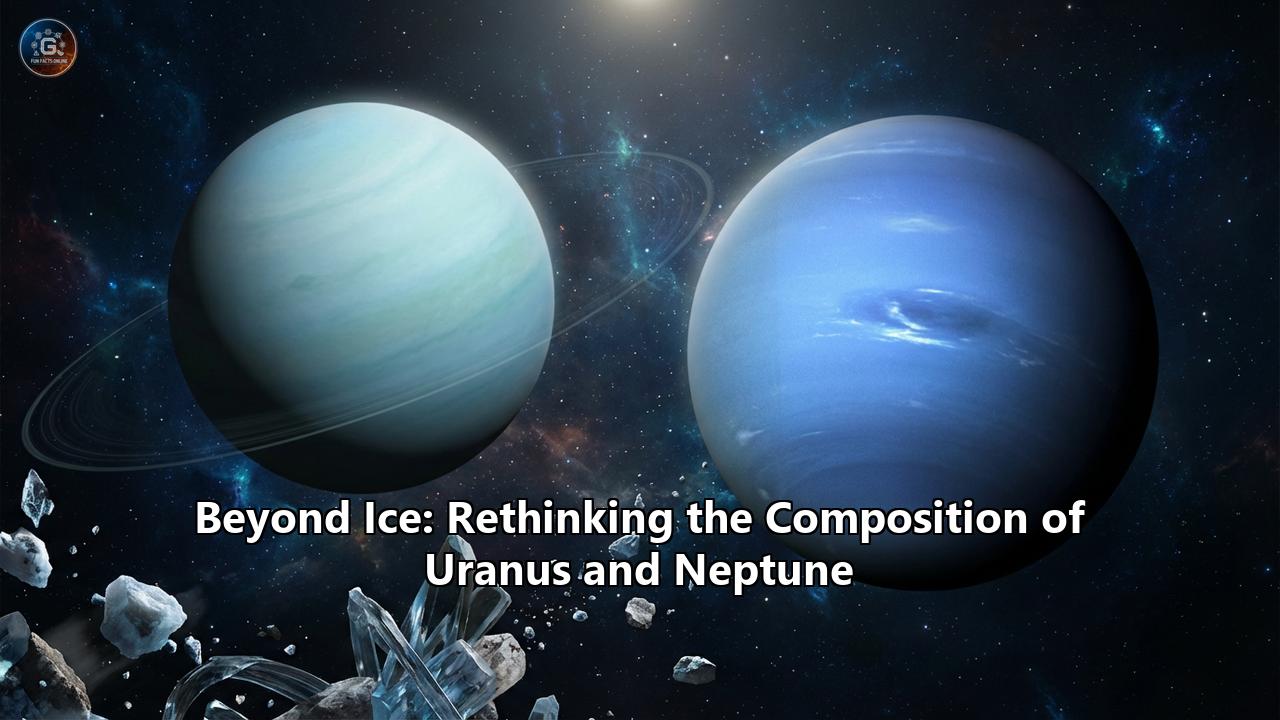
For decades, they were the solar system’s quietest residents. Sitting in the freezing periphery, Uranus and Neptune were classified simply as "Ice Giants"—a label that evoked images of frozen, slushy worlds dominated by water, ammonia, and methane. They were the intermediate siblings, neither terrestrial rocks like Earth nor gas behemoths like Jupiter. They were assumed to be understood, even if they were visited only once, briefly, by Voyager 2 in the late 1980s.
But that understanding is now crumbling.
A wave of groundbreaking research from 2024 and 2025 has begun to rewrite the biography of these distant worlds. New simulations, laboratory experiments on matter at extreme pressures, and fresh analyses of old data are converging on a startling conclusion: we may have been wrong about almost everything inside them. They may not be "Ice Giants" at all, but rather "Rock Giants" or "Methane Worlds," hiding interiors composed of exotic states of matter—black superionic ice, diamond rain, and vast oceans of "mushy" methane—that defy our earthly imagination.
The Identity Crisis: Why "Ice Giant" Might Be Wrong
To understand why the scientific community is rethinking these planets, we must first look at the "Ice Giant" standard model. For forty years, the accepted recipe for Uranus and Neptune was roughly:
- A small rocky core (silicates and iron) about the size of Earth.
- A massive mantle of "ices" (water, ammonia, methane) comprising about two-thirds of the planet's mass.
- A thin atmosphere of hydrogen and helium.
The term "ice" here is an astronomical convenience. At the pressures inside these planets, these substances are dense, hot fluids, not the ice cubes in your freezer. However, this model was built on a premise that is now being challenged: the assumption that these planets formed from the same water-rich building blocks as the comets we see today.
The Carbon Paradox
The first crack in the ice came from a simple accounting problem. The objects in the outer solar system—the comets and planetesimals of the Kuiper Belt—are not just blocks of water ice. They are rich in organic refractory materials and carbon. If Uranus and Neptune formed by gobbling up these planetesimals billions of years ago, they should be packed with carbon.
Yet, traditional models assumed they were water-dominated. If they were truly formed from the "building blocks" available in the outer solar system, the math didn't add up. Where did all the carbon go?
In 2024, researchers from the Technion–Israel Institute of Technology proposed a solution that upends the internal map of these worlds. Their study suggests that as these planets grew, the carbon-rich planetesimals reacted chemically with the hydrogen atmosphere. This didn't just sprinkle a little methane on top; it likely created a massive, distinct layer of methane ice—potentially accounting for 10% to 20% of the planet's entire mass.
This isn't a thin cloud layer; it is a planetary shell thousands of kilometers thick. But it wouldn't look like ice on Earth. Under the crushing pressures of the deep interior, this methane would exist in a "mushy" state—a viscous, semi-solid lattice somewhere between a solid block and a thick sludge. If this model holds, Uranus and Neptune are not water worlds with a dash of gas; they are Methane Giants.
The "Rock Giant" Revolution
While some scientists argue for methane, others are pushing the density dial even further. A landmark 2024 study from the University of Zurich challenged the "Ice Giant" moniker by suggesting these planets might be dominated by rock.
By running hundreds of thousands of random internal models and checking which ones matched the gravitational data from Voyager 2, the researchers found that models with a high rock-to-water ratio fit the data just as well, if not better, than water-rich models. In some scenarios, Uranus could be almost entirely rock and gas, with very little water at all.
This implies that Uranus and Neptune might be less like "failed Jupiters" and more like "Super-Earths" on steroids—massive balls of silicate rock wrapped in a thick hydrogen blanket. This reclassification blurs the line between the giant planets and the terrestrial ones, suggesting a continuum of planetary formation that we are only just beginning to understand.
The Exotic Interior: A Zoo of Strange Matter
If we could peel back the azure clouds of these planets, we would not find a simple ocean. We would descend into a realm of physics that exists nowhere on Earth, where the rules of chemistry are twisted by millions of atmospheres of pressure.
Superionic Water: The Black Ice
Deep in the mantles of these planets, where the "ice" layer was supposed to be, scientists now believe there lies a phase of matter known as Superionic Water.
On Earth, water is liquid, solid (ice), or gas. But at pressures exceeding 2 million atmospheres and temperatures of several thousand degrees—conditions found about a third of the way into Uranus or Neptune—water molecules break apart. The oxygen atoms freeze into a rigid, crystal lattice (a solid), while the hydrogen nuclei (protons) flow through this lattice like a liquid.
This material is a hybrid: it is simultaneously a solid and a liquid. It is electrically conductive, like a metal. And perhaps most strikingly, it is black. If you could see a block of superionic water, it would look like a piece of hot, black coal.
The existence of superionic water is no longer just a theory. In recent years, laser experiments at facilities like the Lawrence Livermore National Laboratory have created this material for fractions of a second, confirming that water really does enter this bizarre state at ice-giant pressures. This "black ice" mantle is likely responsible for generating the planets' magnetic fields (discussed later) and acts as a barrier that changes how heat moves through the planet.
Diamond Rain and "Diamond-Bergs"
Perhaps the most captivating feature of the new internal models is the precipitation. For years, "diamond rain" was a fringe theory. Now, it is becoming a central pillar of our understanding of these worlds.
The process begins in the carbon-rich layers (the "methane mush" discussed earlier). As pressure increases, methane molecules ($CH_4$) are squeezed until they break. The hydrogen escapes, and the carbon atoms are forced together. Under extreme pressure, carbon's most stable form is diamond.
These are not microscopic gems; models suggest they could grow to the size of hailstones or even boulders. Because diamonds are denser than the surrounding hydrocarbon fluid, they sink.
- The Descent: Imagine a slow-motion rain of glittering diamonds falling through a thick, hot, black sky of hydrocarbons, descending for thousands of kilometers.
- The Destination: As they sink deeper, the temperature rises. Eventually, even diamond cannot remain solid. They may melt into a layer of liquid carbon.
- Diamond-Bergs: Recent simulations suggest that near the core, there might be a "sea" of liquid carbon with chunks of solid diamond floating in it—literal "diamond-bergs" drifting on a metallic ocean.
This process releases gravitational potential energy (friction from the falling diamonds), which is converted into heat. This "diamond heat" might explain why Neptune radiates so much more energy than it receives from the Sun, while Uranus (which might have a different internal stratification) is much colder.
Phase Separation: The Oil and Water Effect
One of the biggest mysteries of the Ice Giants is why they look so different. Neptune is active, with high-speed winds and dark storms. Uranus is pale, calm, and eerily cold.
A 2025 study led by researchers at UC Berkeley provides a compelling answer: Phase Separation.
We tend to think of planetary interiors as well-mixed smoothies. But at these pressures, water and hydrogen-carbon mixtures (hydrocarbons) might become immiscible, like oil and vinegar. The study suggests that inside Uranus, these fluids have separated into distinct layers.
- Uranus: May have a stable, stratified interior where a clean water layer sits distinct from a hydrocarbon layer. This stratification inhibits convection. Heat from the core cannot bubble up to the surface because the layers don't mix. The heat is trapped inside, leaving the surface cold and the atmosphere calm.
- Neptune: May have not fully separated yet, or has a different composition that allows for more convection, letting internal heat escape to drive the ferocious storms we observe.
The Magnetic Mystery Solved?
The Voyager 2 flyby in the 1980s left scientists baffled by the magnetic fields of Uranus and Neptune. Unlike Earth, Jupiter, or Saturn—whose magnetic fields are roughly aligned with their rotation axes and centered in the core—the Ice Giants' fields are a mess.
- They are offset from the planet's center by huge distances (up to 30% of the radius).
- They are tilted at wild angles (60 degrees for Uranus) relative to the rotation axis.
- They are multipolar, possessing not just a North and South pole, but a chaotic mix of quadrupole and octupole components.
For decades, this was dismissed as "maybe we caught the planet during a pole reversal." But the odds of catching both planets in a reversal are astronomically low.
The new "Beyond Ice" models finally explain this. If the interior is not a fluid ball of iron (like Earth) but a stratified layer of superionic water and mushy methane, the magnetic field isn't generated in the deep core. Instead, it is generated in a thin, conductive shell of fluid much closer to the surface (the ionic water ocean).
Because the dynamo is generated in this shallow, "thin" shell rather than the deep core, the resulting magnetic field is unstable, lopsided, and multipolar. The "Diamond Rain" layer may also contribute, as liquid carbon is electrically conductive. We are seeing the signature of a complex, layered interior projected into space as a twisted magnetic cage.
Why This Matters: The Exoplanet Connection
Rethinking Uranus and Neptune is not just about solving a local puzzle; it is about understanding the universe.
When we hunt for exoplanets (planets orbiting other stars), the most common type of planet we find is not a "Super-Jupiter" or an "Earth-twin." It is a planet about 2 to 4 times the size of Earth—a Mini-Neptune.
Because we don't have a Mini-Neptune in our solar system, Uranus and Neptune are the closest analogs we have. If we misunderstand them, we misunderstand the majority of planets in the galaxy.
- If Uranus is a "Rock Giant," then many of the Mini-Neptunes we see might be habitable super-Earths with thick atmospheres, rather than uninhabitable gas balls.
- If the "Methane Mush" theory is correct, then organic chemistry is a fundamental driver of planetary evolution across the cosmos.
Understanding the "Ice Giants" is the Rosetta Stone for decoding the data coming from the James Webb Space Telescope (JWST) regarding distant worlds.
The Future: The Uranus Orbiter and Probe (UOP)
The scientific community has officially recognized that our ignorance of these planets is a gap that must be filled. The National Academies' 2023-2032 Decadal Survey—the "bible" of planetary science priorities—ranked a mission to Uranus as the highest priority new flagship mission for NASA.
The proposed mission, the Uranus Orbiter and Probe (UOP), is designed specifically to test these new theories.
- The Orbiter: Will spend years circling Uranus, mapping its gravitational and magnetic fields to "X-ray" the interior. It will look for the tell-tale gravitational signatures of the "methane mush" layer and the separate shells of rock and ice.
- The Probe: A small capsule will detach and plunge into Uranus’s atmosphere. This is the critical piece. It will measure the abundance of noble gases (helium, neon, argon, xenon). These gases are the "fingerprints" of formation. If the probe finds low levels of helium (because it rained out?) or high levels of carbon, it will validate the new formation models.
The launch window is targeted for the early 2030s, arriving in the 2040s. Until then, we are left with these sophisticated simulations and laboratory experiments.
Conclusion
We used to think of Uranus and Neptune as the "boring" planets—frozen, static balls of water. We were wrong.
The "Beyond Ice" revolution has transformed them into the solar system's most exotic laboratories. They are likely worlds where oceans of black, hot ice swirl beneath clouds of green methane; where the sky rains diamonds into a liquid carbon sea; and where the magnetic fields are tangled knots of energy.
By moving beyond the simple "Ice Giant" label, we are finally beginning to see these worlds for what they likely are: complex, stratified, and dynamic bodies that bridge the gap between rock and gas, holding the secrets to the formation of our solar system and the thousands of planetary systems beyond.
Reference:
- https://www.newsweek.com/uranus-neptune-atmosphere-layers-magnetic-field-space-1991349
- https://en.wikipedia.org/wiki/Neptune
- https://pages.uoregon.edu/jschombe/ast121/lectures/lec20.html
- https://en.wikipedia.org/wiki/Uranus
- https://www.astronomy.com/science/uranus-and-neptune-cloudy-with-a-chance-of-diamonds/
- https://www6.slac.stanford.edu/news/2017-08-21-scientists-create-diamond-rain-forms-interior-icy-giant-planets
- https://www.reddit.com/r/explainlikeimfive/comments/pqip2s/eli5_how_and_why_dies_it_rain_diamonds_on_neptune/