
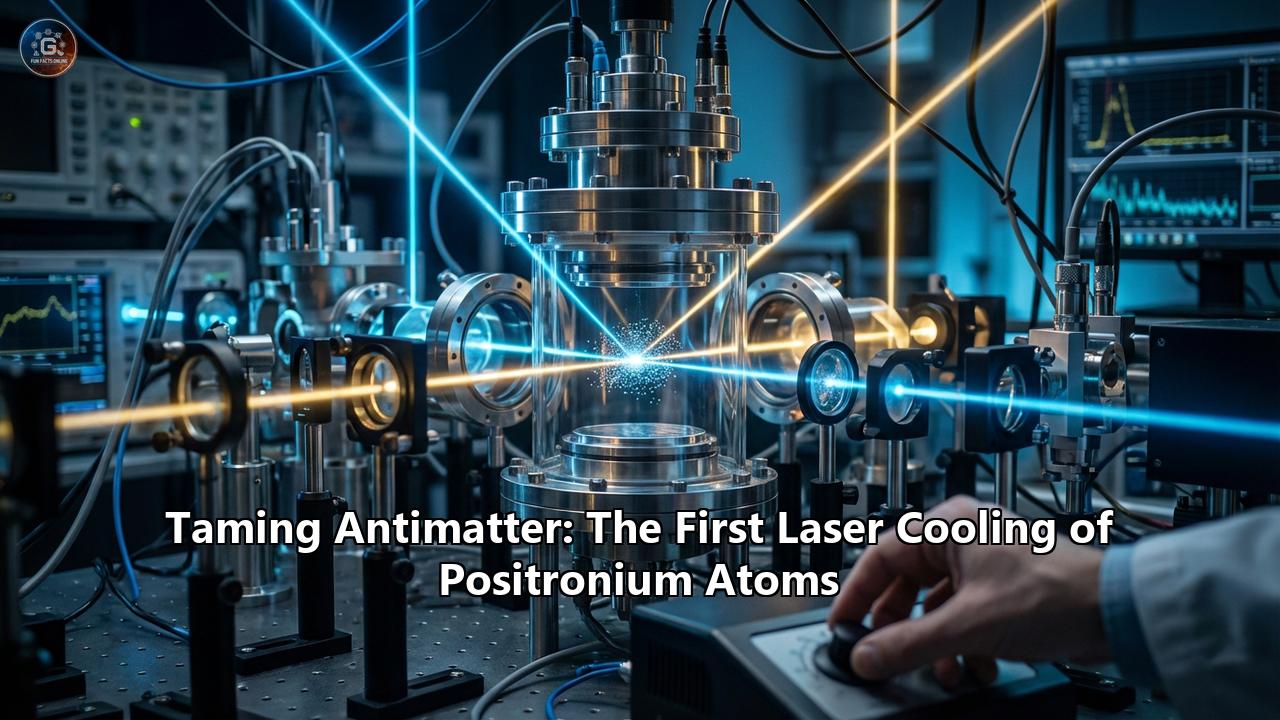
The physics world recently witnessed a moment that will be etched into textbooks for decades to come. In the cavernous, complex halls of CERN’s Antimatter Factory, a collaboration of physicists known as AEgIS achieved the "impossible": they used a laser to cool down positronium—an exotic, fleeting atom made of matter and antimatter—slowing its frantic dance enough to potentially unlock the deepest secrets of the universe.
Below is a comprehensive deep dive into this monumental achievement, the history that led to it, and the science-fiction-like future it promises.
Part I: The Antimatter Enigma
The Mirror Universe
To understand the magnitude of cooling positronium, one must first grapple with the substance itself: antimatter. It is the stuff of science fiction, the fuel of starships in Star Trek, and the destructive force in Angels & Demons. Yet, it is very real.
In 1928, British physicist Paul Dirac formulated an equation that combined quantum mechanics and special relativity to describe the behavior of an electron moving at a relativistic speed. The equation works beautifully, but it had a quirk: it allowed for two solutions. Just as the equation x² = 4 has two answers (2 and -2), Dirac’s equation predicted an electron with positive energy and one with negative energy. This "negative" solution was the mathematical birth of antimatter. Dirac realized that for every particle of matter, there must exist a "mirror" particle with the same mass but opposite electric charge.
Four years later, Carl Anderson confirmed this experimentally by discovering the positron—the antimatter twin of the electron—in cosmic rays. This discovery upended our understanding of reality. If matter and antimatter meet, they annihilate instantly, releasing their mass as pure energy according to Einstein’s E=mc². This volatility makes antimatter the most potent energy source known to physics, but also the most elusive substance to study.
The Great Cosmic Mystery
The existence of antimatter poses one of the biggest unanswered questions in cosmology: Where is it? According to the Big Bang theory, the universe should have been created with equal amounts of matter and antimatter. Yet, everything we see—from the stars in the sky to the screen you are reading this on—is made of matter. If they were created equally, they should have annihilated each other in the first instants of the universe, leaving nothing but light.
Somehow, matter won. A tiny asymmetry allowed a fraction of matter to survive and form the universe we know. Physicists believe that the keys to understanding this asymmetry—and thus, our very existence—lie in the subtle differences between matter and antimatter. To find those differences, we must measure antimatter with extreme precision. And to measure it, we must catch it.
Part II: The Ghost Atom
Meet Positronium
While antihydrogen (an antiproton orbited by a positron) is the most famous antimatter atom, it is not the lightest. That title belongs to Positronium (Ps).
Positronium is a unique, purely leptonic atom. It has no nucleus. It consists simply of an electron and a positron orbiting each other. It is a system of pure balance—matter and antimatter dancing in a vacuum. Because it has no protons or neutrons (which are made of quarks), positronium is free from the "messy" strong nuclear force interactions that complicate the study of heavier atoms. It is the perfect laboratory for testing Quantum Electrodynamics (QED), the theory of how light and matter interact.
The Death Spiral
However, positronium has a fatal flaw: it is suicidal. Since it is composed of a particle and its antiparticle, they are destined to collide.
- Para-positronium: In this state, the spins of the electron and positron are opposite. It lives for a mere 0.125 nanoseconds before annihilating into two gamma-ray photons.
- Ortho-positronium: In this state, the spins are parallel. It lives "long" by quantum standards—about 142 nanoseconds—before annihilating into three gamma rays.
142 nanoseconds. That is the window physicists have to create it, study it, and manipulate it. To make matters worse, when positronium is created (usually by firing a beam of positrons into a target), it is "hot." The atoms move at tremendous speeds, bouncing around randomly. This thermal motion creates a "Doppler blur," making it impossible to measure their properties with high precision.
For 30 years, physicists have dreamed of cooling positronium. If they could slow it down, they could measure its spectral lines (its "fingerprint") to see if it behaves exactly like the Standard Model predicts. Any deviation could reveal new physics. But how do you cool something that vanishes in the blink of an eye?
Part III: The Cold War of Physics
The Laser Cooling Revolution
Laser cooling is one of the triumphs of 20th-century physics, earning Steven Chu, Claude Cohen-Tannoudji, and William D. Phillips the Nobel Prize in 1997. The concept is counterintuitive: we usually think of lasers as things that heat or burn. But if tuned correctly, a laser can freeze atoms in their tracks.
It works via the Doppler effect. Imagine an atom moving toward a laser beam. If the laser is tuned to a frequency slightly lower than what the atom "likes" to absorb, the atom won't interact with it much when standing still. However, if the atom moves toward the laser, the Doppler effect shifts the light's frequency up (blueshift), bringing it into resonance. The atom absorbs the photon and receives a tiny "kick" of momentum backward, slowing it down. It then re-emits the photon in a random direction. Over thousands of cycles, these tiny kicks bring the atom to a near halt.
The Positronium Challenge
Applying this to positronium seemed impossible for three main reasons:
- Mass: Positronium is incredibly light (about 1/2000th the mass of a hydrogen atom). This means every time it absorbs a photon, the "kick" is violent. It’s like trying to slow down a ping-pong ball with a firehose rather than a bowling ball. The recoil is massive.
- Time: Normal atoms can be cooled over milliseconds. Positronium dies in nanoseconds. You don't have time for the thousands of gentle cycles used in standard laser cooling. You need to cool it instantly.
- Wavelength: The laser light needed to cool positronium is in the deep ultraviolet (243 nanometers). Creating a laser that is powerful enough, pulsed correctly, and tuned to this difficult wavelength is an engineering nightmare.
For decades, this was the "final boss" of atomic physics. Many theoretical papers were written, but the experimental hardware simply didn't exist.
Part IV: The Breakthrough at CERN
The AEgIS Collaboration
Enter AEgIS (Antimatter Experiment: Gravity, Interferometry, Spectroscopy). Located at CERN's Antiproton Decelerator (AD) facility in Geneva, AEgIS is a collaboration of physicists from across Europe and India. Their primary goal is actually to test gravity: Does antimatter fall down?
According to Einstein’s Weak Equivalence Principle, gravity should affect all mass equally, regardless of what it is made of. But some theories suggest antimatter might experience "antigravity" or fall at a slightly different rate. To test this, AEgIS wants to make antihydrogen atoms and watch them fall.
To make antihydrogen, they smash antiprotons into a cloud of positronium. The reaction is:
Antiproton + Positronium → Antihydrogen + ElectronThis reaction works much better if the positronium is moving slowly (i.e., is cold). If the positronium is zooming past the antiprotons too fast, they miss each other. Thus, cooling positronium became a critical technological milestone for AEgIS.
The Experiment: February 2024
The breakthrough, published in Physical Review Letters, utilized a novel approach that broke from tradition. Instead of using a standard continuous-wave laser (which is too slow), the team developed a special broadband pulsed laser.
Here is how they did it:
- The Source: They generated a beam of positrons using a radioactive sodium source and guided them into a magnetic trap.
- The Target: They fired the positrons into a "nano-target" made of porous silica. Inside the tiny pores of this glass-like material, the positrons stole electrons from the silica atoms, forming positronium.
- The Cloud: The positronium atoms drifted out of the silica into a vacuum chamber. At this point, they were "hot"—moving at typical thermal speeds.
- The Laser Strike: This was the magic moment. The team hit the cloud with a custom-built Alexandrite laser system. Unlike standard cooling lasers that use a very narrow frequency (like a single pure note), this laser was broadband—it covered a wider range of frequencies.
Because positronium is so light and moves so fast, the Doppler shift is enormous and varies wildy from atom to atom. A narrow laser would only "talk" to a tiny fraction of the atoms. The broadband laser was like a "choral" shout, able to interact with a large percentage of the fast-moving cloud simultaneously.
The Result
In just 70 nanoseconds—less than the blink of an eye, less than a lightning strike—the laser plummeted the temperature of the positronium cloud from 380 Kelvin (106°C) down to 170 Kelvin (-103°C).
It may not sound like absolute zero yet, but in the world of antimatter physics, this is a landslide victory. They effectively halved the thermal energy of the system before the atoms could annihilate. They proved that the violent recoil of the light atom could be managed and that the cooling could happen faster than the annihilation clock.
Part V: A Tale of Two Teams
Science is often a race, and remarkably, AEgIS was not alone. Around the same time, a team from the University of Tokyo, led by K. Yoshioka, achieved a similar feat using a different method called "Chirp Cooling."
While AEgIS used a "broadband" hammer to cool the cloud for antihydrogen production, the Tokyo team used a "chirped" laser—a laser where the frequency changes rapidly (chirps) over time to track the atoms as they slow down. The Tokyo team managed to cool the atoms to around 1 Kelvin, a much lower temperature, though with a different density and setup.
Far from being rivals, these two results complement each other perfectly. AEgIS demonstrated the robust, high-yield cooling needed for making antimatter beams and factories. The Tokyo team demonstrated the deep-freeze cooling needed for ultra-precise measurements. Together, they have kicked open the door to a new era.
Part VI: The Implications – Why This Changes Everything
Why does cooling a ghost atom matter to the average person? Because it is the first step toward technologies that sound impossible today.
1. The Gamma-Ray Laser
This is the "Holy Grail" application. Conventional lasers use electrons jumping between energy levels to emit light (photons). A Gamma-Ray Laser would use the annihilation of matter and antimatter to produce a coherent beam of high-energy gamma rays.
Until now, this was fantasy. To make a gamma-ray laser, you need a Bose-Einstein Condensate (BEC) of positronium—a state of matter where all the atoms cool down enough to sync up and act as a single quantum wave. Once you have a BEC of positronium, the atoms could be triggered to annihilate in unison, releasing a focused, coherent pulse of gamma radiation.
Such a laser would have a wavelength huge orders of magnitude smaller than visible light. It could:
- Image the nucleus of an atom: Just as optical microscopes see cells, a gamma-ray laser could "see" the internal structure of nuclei.
- Revolutionize radiation therapy: It could target cancer cells with sub-atomic precision, sparing healthy tissue entirely.
- Nuclear communication: It could potentially allow for high-bandwidth communication through solid rock or water.
2. Testing Einstein (Gravity)
As mentioned, AEgIS wants to know if antimatter falls up. If they find even a 0.0001% difference in how gravity pulls on antimatter versus matter, it would break the General Theory of Relativity. It would imply a "fifth force" of nature or require a complete rewrite of our understanding of the universe. Cold positronium increases the production rate of antihydrogen, making these gravity experiments feasible in the next few years rather than decades.
3. Cracking the Code of the Universe (CPT Symmetry)
The Standard Model relies on "CPT Symmetry"—the idea that if you swap Charge (matter to antimatter), Parity (left to right), and Time (forward to backward), the laws of physics stay the same.
If we measure the energy levels of cold positronium and find they don't match the predictions for hydrogen perfectly, it implies CPT violation. If CPT is violated, our entire framework of physics is wrong. It might explain why the universe exists at all (why matter defeated antimatter in the Big Bang).
Part VII: The Future is Antimatter
The successful laser cooling of positronium is not just a technical footnote; it is a gateway. We have moved from the era of observing antimatter to the era of controlling it.
In the immediate future, we can expect:
- Positronium BECs: Labs will now race to condense this gas into a quantum superfluid.
- Antihydrogen Factories: Experiments at CERN will ramp up, producing more stable neutral antimatter than ever before.
- New Physics: We are now zooming in on the fine print of the universe's rulebook.
For nearly a century, humans have looked at the equations of Dirac and wondered about the mirror universe. For 30 years, experimentalists have banged their heads against the wall of thermal motion. In 2024, that wall crumbled. We have tamed the ghost. Now, we get to see what it can do.
Reference:
- https://home.cern/news/news/physics/aegis-experiment-paves-way-new-set-antimatter-studies-laser-cooling-positronium
- https://www.spacedaily.com/reports/Cooling_positronium_with_lasers_could_reveal_antimatter_secrets_999.html
- https://www.infn.it/en/cern-first-laser-cooling-of-a-cloud-of-positronium-atoms/
- https://physicsworld.com/a/positronium-gas-is-laser-cooled-to-one-degree-above-absolute-zero/
- https://ruj.uj.edu.pl/server/api/core/bitstreams/cb85b900-1f09-4d8c-b86e-8cdd2668423f/content
- https://www.aero.polimi.it/en/magazine/positronium-laser-cooling
- https://news.liverpool.ac.uk/2024/02/26/unlocking-the-mysteries-of-antimatter-positronium-laser-cooling-breakthrough/
- https://cerncourier.com/a/the-promise-of-laser-cooled-positronium/
- https://arxiv.org/abs/2310.08761
- https://physicsworld.com/a/matter-antimatter-gas-of-positronium-is-laser-cooled/
- https://ep-news.web.cern.ch/content/aegis-experiment-breakthrough-laser-cooling-opens-door-new-antimatter-studies
- https://www.drishtiias.com/daily-updates/daily-news-analysis/laser-cooling-of-positronium
- https://www.mrj-lasermark.com/news/scientists-succeed-in-laser-cooling-of-positro-75292334.html
- https://www.physics.ucr.edu/news/2019/12/05/gamma-ray-laser-moves-step-closer-reality
- https://www.uibk.ac.at/en/newsroom/2024/successful-laser-cooling-of-positronium/