
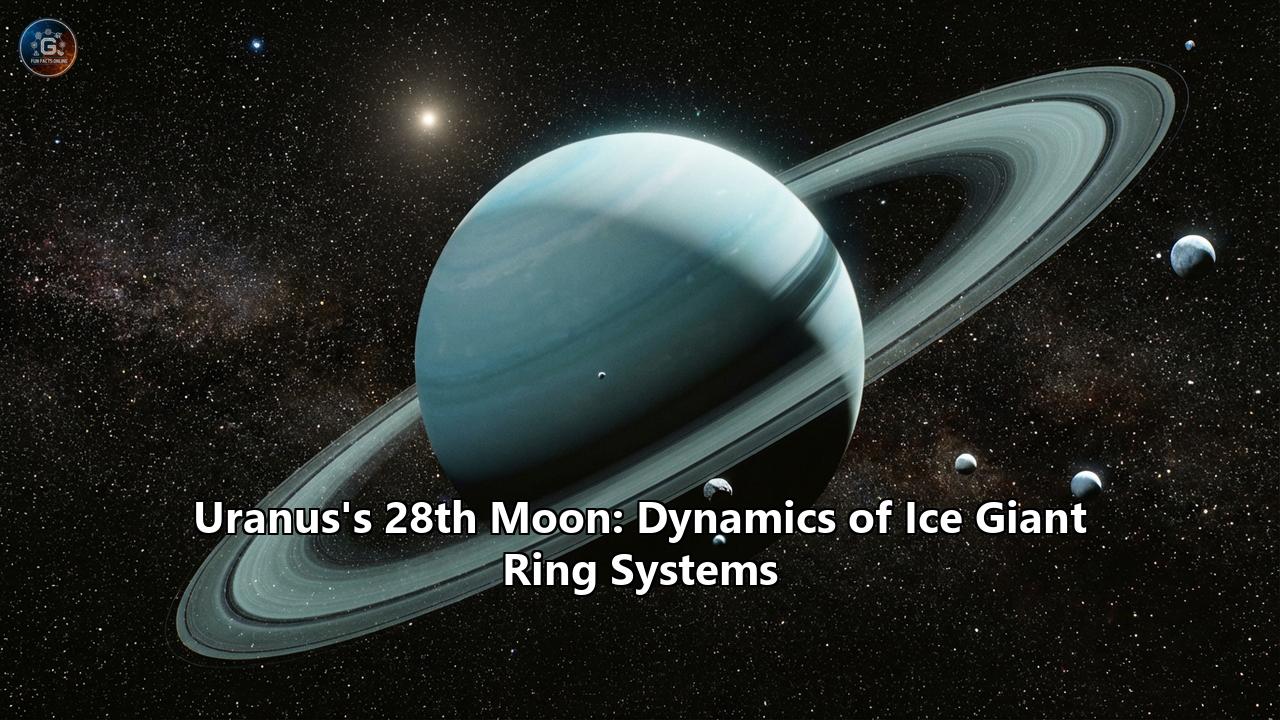
Recent discoveries in the outer solar system have once again turned the gaze of the astronomical community toward the ice giants. The identification of S/2023 U 1, the 28th moon of Uranus, serves not merely as an incremental addition to a planetary catalog, but as a key that unlocks a broader discussion on the chaotic, violent, and exquisitely complex dynamics of ice giant systems. Unlike the clockwork precision of Jupiter’s Galilean moons, the Uranian and Neptunian systems are graveyards of ancient collisions and nurseries of short-lived rings, governed by orbital mechanics that balance on the knife-edge of stability.
The following comprehensive exploration delves into the discovery of Uranus's 28th moon, the dynamical architecture of its irregular satellites, the "chaotic clockwork" of its inner ring-moon system, and the comparative planetology that defines the unique nature of the ice giants.
Part I: The 28th Moon – A Shadow in the Dark
The discovery of S/2023 U 1 was a triumph of persistence and technology over distance and darkness. Announced in early 2024 by the Minor Planet Center, this small satellite was identified by astronomer Scott Sheppard using the 6.5-meter Magellan-Baade telescope at Las Campanas Observatory in Chile.
1. The Hunt for the FaintFinding a moon like S/2023 U 1 is akin to spotting a candle on the rim of a lighthouse from miles away. Uranus is nearly 2 billion miles from the Sun, and its reflected light can easily wash out the faint signature of a small rock only 8 kilometers (5 miles) in diameter. The discovery required a technique known as "shift-and-add" processing. By taking dozens of long-exposure images and digitally shifting them to match the predicted motion of Uranus, astronomers could stack the light from the moon while blurring out the background stars. This revealed S/2023 U 1 as a faint point of light, magnitude 26.7—millions of times fainter than what the human eye can see.
2. Orbital CharacteristicsS/2023 U 1 is an irregular satellite, a classification that speaks volumes about its history. Unlike the "regular" inner moons that orbit in the planet's equatorial plane (the same plane as the rings), S/2023 U 1 follows a distant, highly eccentric, and retrograde orbit.
- Distance: It orbits at an average distance of approximately 8 million kilometers from Uranus.
- Period: A single orbit takes roughly 680 days (almost two Earth years).
- Inclination: Its orbit is tilted at approximately 144 degrees relative to the ecliptic, meaning it travels "backwards" compared to the planet's rotation.
Dynamical analysis places S/2023 U 1 within the Caliban group of irregular moons. These objects share similar orbital elements, suggesting they are likely fragments of a single, larger parent body that was shattered by a collision billions of years ago. The discovery of S/2023 U 1 supports the theory that the outer Uranian system is a debris field of captured objects, frozen in the midst of a multi-billion-year collisional cascade.
Part II: The Architecture of Capture – Irregular Moon Dynamics
The existence of S/2023 U 1 and its kin challenges the simple model of planetary formation where moons form from a dusty disk surrounding the infant planet. These outer moons are immigrants, not natives.
1. The Nice Model and Planetary MigrationTo understand why Uranus has a swarm of distant, retrograde moons, we must look to the Nice Model of solar system evolution. This theory suggests that about 4 billion years ago, the giant planets migrated significantly. Uranus and Neptune were likely pushed outward into a primordial disk of icy debris (the Kuiper Belt).
- Gravitational Drag: As the ice giants plowed through this debris, their gravity acted like a net. Three-body interactions (involving the Sun, the planet, and the planetesimal) allowed Uranus to capture passing objects.
- The Retrograde Preference: It is dynamically easier to capture an object into a retrograde orbit (moving opposite to the planet) than a prograde one. This explains why the majority of Uranus’s outer moons, including S/2023 U 1, orbit in this "backward" direction.
Once captured, these irregular moons are subjected to the Kozai-Lidov mechanism, a secular resonance that exchanges eccentricity for inclination.
- For a moon in a highly inclined orbit, the gravitational tug of the Sun can cause its orbit to become rounder but more tilted, or more elliptical but flatter, in a periodic cycle.
- This mechanism dictates the "stability zones" where moons can exist. If an orbit becomes too eccentric, the moon might crash into the planet or escape entirely. S/2023 U 1 resides in a stable island of phase space where it is safe from these destabilizing effects for the age of the solar system.
Part III: The Inner Chaos – A Clockwork of Destruction
While the outer system where S/2023 U 1 resides is a relic of ancient capture, the inner system of Uranus—the realm of the rings and the "Portia group" of moons—is a dynamic, chaotic environment that is evolving on human timescales.
1. The Most Crowded Real Estate in the Solar SystemThe region between the main rings of Uranus and the large moon Miranda is packed with small satellites: Cordelia, Ophelia, Bianca, Cressida, Desdemona, Juliet, Portia, Rosalind, Cupid, Belinda, and Perdita.
- The Portia Group: This cluster of moons is so tightly packed that their gravitational interactions are chaotic. Dynamical simulations predict that the orbits of Cressida and Desdemona will intersect within the next 1 to 10 million years—a blink of an eye in cosmic time.
- Collision and Rebirth: When these moons inevitably collide, they will pulverize each other, creating a massive debris cloud. This cloud will spread out to form a new ring, which will eventually reaccrete into new, smaller moons. This cyclic process suggests that the current inner moons of Uranus are likely "Gen 3" or "Gen 4" descendants of the original satellites.
The discovery of the tiny moon Cupid in 2003 (by the Hubble Space Telescope) added another layer of instability. Cupid orbits only 800 kilometers away from the moon Belinda.
- Resonance Locking: Recent studies suggest that the Belinda group is kept temporarily stable by a delicate web of mean-motion resonances (where the orbital periods are integer ratios, like 5:4).
- The Crash of 2023? Dynamical models have shown that the Belinda-Cupid pair is so unstable that they could collide at any time. Some astronomers speculate that strange dusty features seen in the rings could be the aftermath of unobserved collisions between smaller, unseen moonlets.
Part IV: Dynamics of the Ice Giant Rings
Uranus’s ring system is fundamentally different from Saturn's broad, bright sheets of ice. They are narrow, dark, and sharp-edged—characteristics that pose a major problem for classical orbital mechanics.
1. The Confinement ProblemWithout intervention, a narrow ring of particles should spread out due to collisions (viscous spreading) and drag forces (Poynting-Robertson effect). A ring as narrow as Uranus’s Epsilon ring (20–100 km wide) should dissipate in just a few million years. The fact that they are still there implies an active confinement mechanism.
- Shepherding Moons: The standard solution is "shepherd moons." The moon Cordelia orbits just inside the Epsilon ring, pushing particles outward, while Ophelia orbits just outside, pushing them inward. Their combined gravitational torques keep the ring focused.
- The Missing Shepherds: However, for many of the other narrow rings (Alpha, Beta, Gamma), no shepherd moons have been found. This suggests one of two things: either the shepherds are too small to be seen (less than 10km), or there is a different dynamical mechanism at play, such as resonances with distant moons.
The dynamics of the Uranian rings are heavily influenced by Lindblad resonances. These occur when the natural orbital frequency of a ring particle matches a forcing frequency from a moon.
- Instead of simply scattering particles, these resonances can launch density waves—spiral patterns that wind through the rings like grooves on a vinyl record.
- Analysis of the ring edges suggests they are often truncated exactly at these resonance locations, indicating that distant moons like Porcia and Rosalind are remotely sculpting the rings, acting as "virtual shepherds."
One of the most fascinating dynamical systems is the relationship between the small moon Mab and the diffuse Mu ring.
- Mab is too small to hold onto an atmosphere or geologically active surface. However, it is constantly bombarded by micrometeoroids.
- This bombardment ejects dust from Mab’s surface. Because Mab has low gravity, the dust escapes and forms a torus along the moon's orbit—the Mu ring.
- This blue-colored ring (rare in the solar system) indicates the dust is made of tiny, sub-micron particles of pure water ice. It is a regenerative system: Mab creates the ring, and the ring likely slowly re-accretes onto Mab.
Part V: A Tale of Two Ice Giants – Uranus vs. Neptune
To fully appreciate the dynamics of Uranus's 28th moon and its rings, one must compare them to its twin, Neptune. Despite their similar mass and composition, their dynamical histories diverged radically.
1. The Tilt vs. The Capture- Uranus: The entire system is tilted 98 degrees. This is believed to be the result of a massive, grazing impact with an Earth-sized protoplanet shortly after formation. This impact spun out a debris disk from which the regular moons formed in-situ. This explains why the moons orbit the equator, even though the equator is vertical.
- Neptune: Neptune’s system was disrupted by the capture of Triton. Triton is a Kuiper Belt Object (likely larger than Pluto) that was captured into a retrograde orbit. This violent event likely destroyed Neptune's original moon system, scattering debris that eventually settled into the current, sparse ring system.
- Uranus: Has a system of dense, complete, narrow rings.
- Neptune: Has "ring arcs"—clumps of dust that do not go all the way around the planet. The Adams ring, for instance, has five distinct arcs (named Courage, Liberté, Egalité 1, Egalité 2, and Fraternité).
- Dynamics: These arcs are confined by a corotation resonance with the moon Galatea. The gravity of Galatea prevents the dust from spreading out into a full ring, trapping it in specific stable points (Lagrange points) along the orbit. This is a dynamical regime unique to the Neptunian system.
Part VI: The Future of Ice Giant Exploration
The discovery of S/2023 U 1 is a reminder of how much of the Ice Giant systems remains hidden in the dark.
1. The Uranus Orbiter and Probe (UOP)The 2023 Planetary Science Decadal Survey listed a Uranus Orbiter and Probe as the highest priority flagship mission for NASA.
- Mission Goals: This mission would arrive at Uranus in the 2040s. One of its key objectives would be to map the gravity field of the inner system to detect the "missing shepherds" and understand the mass distribution of the rings.
- Irregular Moon Flybys: The mission trajectory would likely include flybys of irregular moons like S/2023 U 1 or Sycorax to determine their density and composition, testing the hypothesis that they are chemically identical to Kuiper Belt Objects (and thus, captured "pristine" remnants of the solar nebula).
S/2023 U 1 may be small, but it is a survivor. It survived the chaos of the early solar system, the migration of the giants, and the aeons of isolation. Its discovery helps astronomers calibrate their models of how many small bodies lurk in the outer halos of the giants. Current estimates suggest Uranus could have hundreds of such moonlets, waiting for the next generation of "extremely large telescopes" (ELTs) to reveal them.
Conclusion
The Uranian system is a paradoxical realm. Its outer reaches, inhabited by S/2023 U 1, are a frozen museum of the solar system's chaotic youth, preserving the history of planetary migration. Its inner reaches are a frantic, evolving machine where moons are destroyed and rings are born in a cycle of violence. Understanding the dynamics of this system—from the eccentric wanderings of its 28th moon to the resonant confinement of its razor-thin rings—provides a crucial window into the physical laws that shape not just our solar system, but the countless exoplanetary systems now being discovered across the galaxy. As we prepare to return to the Ice Giants, every new moon discovered is a breadcrumb leading us closer to understanding our cosmic origins.
Reference:
- https://www.youtube.com/watch?v=1hIwD17Crko
- https://en.wikipedia.org/wiki/S/2023_U_1
- https://www.forbes.com/sites/briankoberlein/2020/02/08/early-collisions-led-to-striking-differences-between-uranus-and-neptune/
- https://www.universetoday.com/articles/the-rings-of-uranus-and-neptune-could-help-map-their-interiors
- https://en.wikipedia.org/wiki/Moons_of_Uranus
- https://science.nasa.gov/moon/formation/
- https://en.wikipedia.org/wiki/Formation_and_evolution_of_the_Solar_System
- https://spacemesmerise.com/blogs/planets/exploring-the-mysteries-of-uranus-rings-characteristics-and-origins
- https://www.researchgate.net/publication/346759164_The_rings_and_small_moons_of_Uranus_and_Neptune
- https://spacemath.gsfc.nasa.gov/planets/10Page13.pdf
- https://www.news.uzh.ch/en/articles/2021/Uranus-satellites.html
- https://nccr-planets.ch/blog/2021/12/15/how-did-the-peculiar-moons-of-uranus-form/
- https://www.nationalgeographic.com/science/article/111010-uranus-planets-tilted-impact-double-blows-moons-space-science