
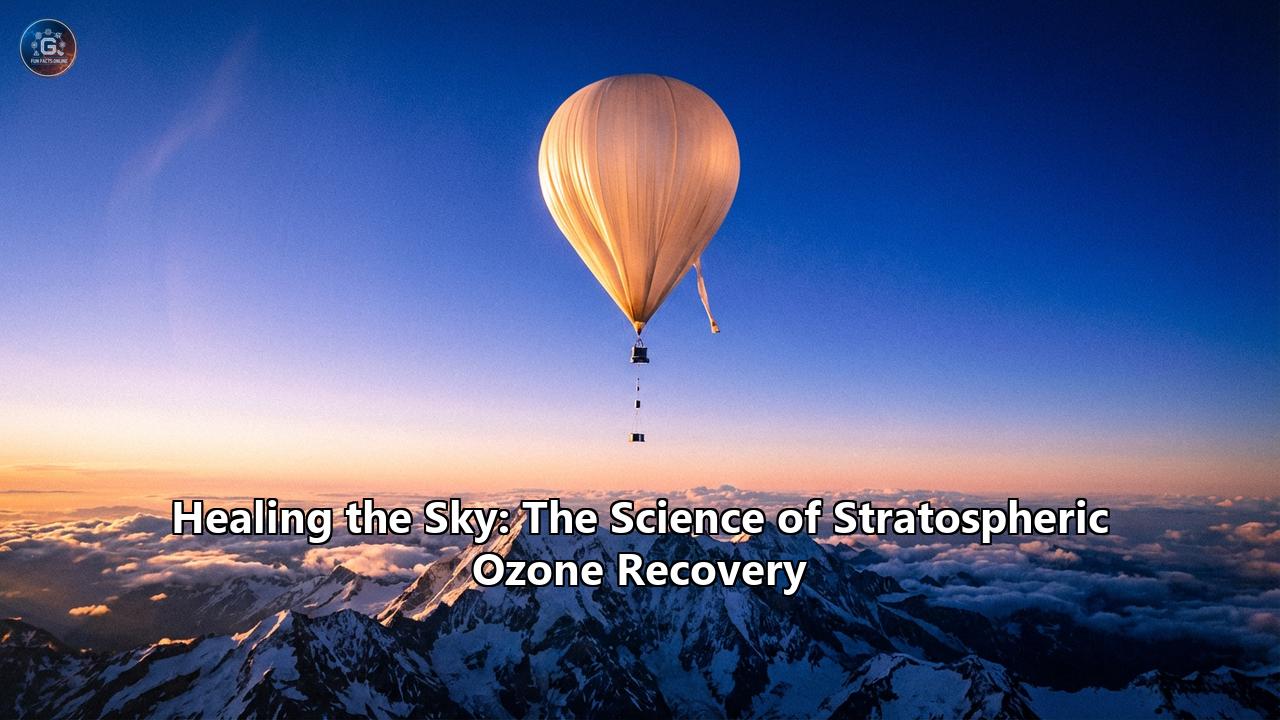
In the grand theatre of Earth’s history, humanity usually plays the role of the antagonist—burning, polluting, and extracting until the systems that sustain us begin to crack. But there is one chapter in this story where we flipped the script. It is a tale of invisible poisons, scientific detective work, and a moment when every nation on Earth agreed to save the sky.
As we look up today, in late 2025, the news is complex but hopeful. The Antarctic ozone hole, a recurring seasonal scar in our atmosphere, has behaved erratically over the last three years, whipped into strange shapes by the aftershocks of a massive volcanic eruption. Yet, beneath these short-term tantrums of the atmosphere, the long-term data is undeniable: the patient is healing.
This is the story of how we nearly destroyed our planetary shield, and the unprecedented science and diplomacy that is bringing it back.
Part I: The Thin Blue Shield
To understand the stakes, we must first understand the architecture of our atmosphere. If you were to drive a car straight upwards, within ten minutes you would pass through the troposphere—the chaotic, weather-beaten layer where we live and breathe. Above that, from about 10 to 50 kilometers up, lies the stratosphere.
The stratosphere is calm, dry, and stratified (layered). And sitting right in the middle of it is the Ozone Layer.
Ozone is a paradox. At ground level, it is a pollutant—a component of smog that burns our lungs. But up in the stratosphere, it is a superhero. An ozone molecule is simply three oxygen atoms bound together ($O_3$). This chemical structure has a unique ability to absorb Ultraviolet-B (UV-B) radiation from the sun. Without this filtration system, UV-B would scour the surface of the Earth, shredding the DNA of plants, animals, and humans alike. Life as we know it could not exist on land without the ozone layer.
Scientists measure ozone in Dobson Units (DU). A healthy layer over Antarctica should be about 300 to 400 DU. If you took all that ozone and compressed it to sea-level pressure, it would be only 3 millimeters thick—roughly the height of two pennies stacked together. That is all that stands between us and a radiated wasteland.
Part II: The Perfect Chemical
The story of the ozone layer's near-death experience begins with an American engineer named Thomas Midgley Jr. In the 1920s, he invented a class of chemicals called Chlorofluorocarbons (CFCs).
At the time, CFCs seemed like a miracle. They were non-toxic, non-flammable, and incredibly stable. They became the industrial blood of the 20th century, used in everything from refrigerators and air conditioners to spray cans and foam insulation. For decades, we pumped millions of tons of CFCs into the air, believing they were harmless.
But their stability was a trap. Because CFCs don't react with anything in the lower atmosphere, they don't wash out with rain or break down. Instead, they drift upward, taking decades to reach the stratosphere. Once there, they are bombarded by the very UV radiation they floated past. The UV light shears off a chlorine atom from the CFC molecule, and the massacre begins.
The Catalytic Cycle of Destruction
The chemistry is terrifyingly efficient.
- A free Chlorine atom ($Cl$) encounters an Ozone molecule ($O_3$).
- It steals an oxygen atom, creating Chlorine Monoxide ($ClO$) and leaving behind ordinary Oxygen ($O_2$).
- The $ClO$ then collides with a free oxygen atom. The chlorine drops its oxygen passenger and is free again.
This is a catalytic cycle. One single chlorine atom can destroy over 100,000 ozone molecules before it is finally neutralized. It is like a serial killer that never sleeps and never stops.
Part III: The Hole in the World
In 1974, scientists Mario Molina and Sherwood Rowland published a paper hypothesizing that CFCs could destroy the ozone layer. Industry giants ridiculed them. The chairman of DuPont famously called their theory "a science fiction tale... a load of rubbish."
But nature does not spin fiction. In the early 1980s, Joe Farman and his team from the British Antarctic Survey noticed something impossible at their Halley Bay research station. Their instruments showed that during the Antarctic spring (September/October), ozone levels were dropping by 40-50%. The drop was so severe that Farman initially assumed his old sensors were broken. He bought new ones. They showed the same thing.
They had discovered the Antarctic Ozone Hole.
Why Antarctica?
Why did the hole open over the pristine South Pole and not over the factories of Europe or the USA? The answer lies in the Polar Vortex.
During the long, dark Antarctic winter, a strong wind encircles the continent, isolating the air inside. Temperatures drop to a bone-crushing -78°C (-109°F). In this extreme cold, unique clouds form called Polar Stratospheric Clouds (PSCs). These clouds act as a surface for chemical reactions. They "activate" the chlorine from CFCs, storing it up like ammunition.
When the sun finally rises in September, its light strikes this stockpiled chlorine, triggering a sudden, massive explosion of ozone destruction. The "hole" isn't a physical gap, but a region of severely depleted ozone—often dropping below 100 DU.
Part IV: The Treaty That Saved Us
The discovery of the hole terrified the world. The threat of skin cancer, cataracts, and collapsing agricultural food webs became real. In a rare triumph of foresight, the global community mobilized.
In 1987, the Montreal Protocol on Substances that Deplete the Ozone Layer was signed. It was the first treaty in the history of the United Nations to achieve universal ratification. It mandated a phase-out of CFCs and other ozone-depleting substances (ODSs).
It worked. But not overnight. Because CFCs live for 50 to 100 years in the atmosphere, the damage was already baked in. The hole continued to grow, peaking in size in the years 2000 and 2006, stretching over 27 million square kilometers—an area larger than North America.
Part V: The "Volcanic" Curveball (2022–2025)
Fast forward to our current era. By the early 2020s, the narrative seemed clear: the ozone hole was slowly shrinking. But nature had a surprise in store.
On January 15, 2022, the Hunga Tonga-Hunga Ha’apai underwater volcano erupted in the Pacific. It was the most explosive eruption of the 21st century. Unlike normal volcanoes that spew ash and sulfur, Hunga Tonga was underwater. It blasted a colossal amount of water vapor—an estimated 150 million tons—straight into the stratosphere.
This increased the total water vapor in the stratosphere by a staggering 10%.
The 2023 and 2025 Anomalies
Water vapor is a greenhouse gas, but in the stratosphere, it has a cooling effect. As we learned earlier, colder temperatures mean more Polar Stratospheric Clouds, which means more ozone destruction.
- 2023: The year following the eruption saw one of the largest and earliest-forming ozone holes in recent history.
- 2024: The hole was smaller, ranking as the 7th smallest since recovery began, leading to a sigh of relief.
- 2025: This year, the hole behaved erratically again, developing ahead of schedule in August and persisting into November.
Scientists confirm that these "bad" years are not a failure of the Montreal Protocol. They are the temporary scars of the Hunga Tonga eruption. The excess water vapor is slowly dissipating, but it will likely influence the ozone hole until around 2028. Without the Montreal Protocol, however, these volcanic years would have been catastrophic rather than just concerning.
Part VI: The World Avoided
To truly appreciate where we are, we must look at the timeline we rejected. NASA scientist Paul Newman led a simulation called "The World Avoided," modeling what would have happened if we had done nothing.
In this alternate 2025:
- The Antarctic Ozone Hole would be a permanent fixture, year-round.
- A second "hole" would have opened up over the Arctic, exposing Northern Europe and Canada.
- By 2065, ozone levels globally would have collapsed to below 67%.
- UV Index values in Washington D.C. or London would hit 15 on a standard summer day. In the tropics, they would hit 33. For context, a UV Index of 11 is currently considered "Extreme."
- Skin cancer rates would have soared. The simulation estimated that the Montreal Protocol is preventing 443 million cases of skin cancer and 63 million cases of cataracts in the US alone by the end of the century.
We didn't just fix a hole; we prevented a biological apocalypse.
Part VII: The Future and The "Super-Recovery"
So, when will it be fixed?
According to the latest WMO/UNEP assessments, if current policies hold, the ozone layer is expected to recover to 1980 values:
- By 2040 for the rest of the world.
- By 2045 over the Arctic.
- By 2066 over the Antarctic.
However, the future holds a strange twist: Super-Recovery.
Climate change is warming the lower atmosphere (where we live) but cooling the stratosphere (because heat is trapped below). Paradoxically, a cooler stratosphere (outside of the polar vortex) actually slows down the chemical reactions that destroy ozone naturally.
Models predict that by 2100, the global ozone layer might be thicker than it was in 1980. While this sounds good, it has side effects. Too much ozone at high latitudes could reduce UV radiation so much that vitamin D deficiency becomes a major health issue in places like Scandinavia and Canada.
The Nitrogen Brake
There is a catch, though. New research suggests that "super-recovery" might be canceled out over Antarctica. Climate change is strengthening atmospheric circulation, pulling nitrogen oxides ($NO_x$) down from the upper atmosphere. These nitrogen compounds destroy ozone, potentially acting as a "brake" on the recovery, ensuring that while the hole closes, it may never fully "over-heal" in the way other regions might.
Part VIII: New Threats on the Horizon
We cannot declare "Mission Accomplished" just yet. As the old threats fade, new ones rise.
1. The Rise of Rockets
In 2025, the space economy is booming. But rockets—particularly those burning kerosene—leave behind trails of black carbon (soot) and alumina particles directly in the stratosphere.
A 2024 study by NOAA and the University of Canterbury warned that a tenfold increase in launch rates (which we are approaching) could undo progress. The black carbon warms the stratosphere locally, changing wind patterns, while alumina particles can act like mini-clouds, activating chlorine just like PSCs do.
2. The Geoengineering Gamble
Desperation to stop global warming has led to serious discussions about Stratospheric Aerosol Injection (SAI)—intentionally pumping sulfates into the stratosphere to reflect sunlight.
While this could cool the planet, it would be a nightmare for the ozone layer. The sulfates would provide a massive surface area for chlorine activation, potentially delaying ozone recovery by decades or even reopening the hole permanently while the injection continues.
3. The "Zombie" Gases
In 2018, scientists detected a mysterious spike in CFC-11, traced back to illegal factories in eastern China. The global community pounced, and by 2021, the emissions had stopped. However, it was a stark reminder that the treaty requires constant vigilance. We are also watching Very Short-Lived Substances (VSLS)—chemicals not regulated by the treaty that are now being used in industrial solvents.
Conclusion: A Blueprint for Hope
The recovery of the stratospheric ozone layer is the greatest environmental success story in human history. It proves that science can identify a planetary threat, that governments can listen, and that humanity can pivot away from destruction.
As we watch the erratic ozone holes of the mid-2020s stabilize and shrink in the coming decade, we are witnessing the Earth healing itself—with a little help from us. It is a reminder that the sky is not limitless, but neither is our capacity to repair the damage we have done.
The ozone layer is healing. The question now is: can we apply the same resolve to the climate crisis unfolding below it?
Reference:
- https://www.space.com/antarctic-ozone-hole-early-hunga-tonga
- https://www.researchgate.net/publication/394932480_The_impact_of_the_Hunga_Tonga-Hunga_ha'apai_volcanic_eruption_on_the_2023_Antarctic_Ozone_hole_as_observed_from_Arrival_Heights_Antarctica
- https://ntrs.nasa.gov/citations/20240004093
- https://ntrs.nasa.gov/api/citations/20110007812/downloads/20110007812.pdf
- https://www.unep.org/news-and-stories/press-release/ozone-layer-recovery-track-helping-avoid-global-warming-05degc
- https://newsroom.ucla.edu/releases/stratospheric-cooling-vertical-fingerprinting
- https://www.researchgate.net/publication/349521734_Ozone_super_recovery_cancelled_in_the_Antarctic_upper_stratosphere
- https://www.mdpi.com/2072-4292/14/21/5364