
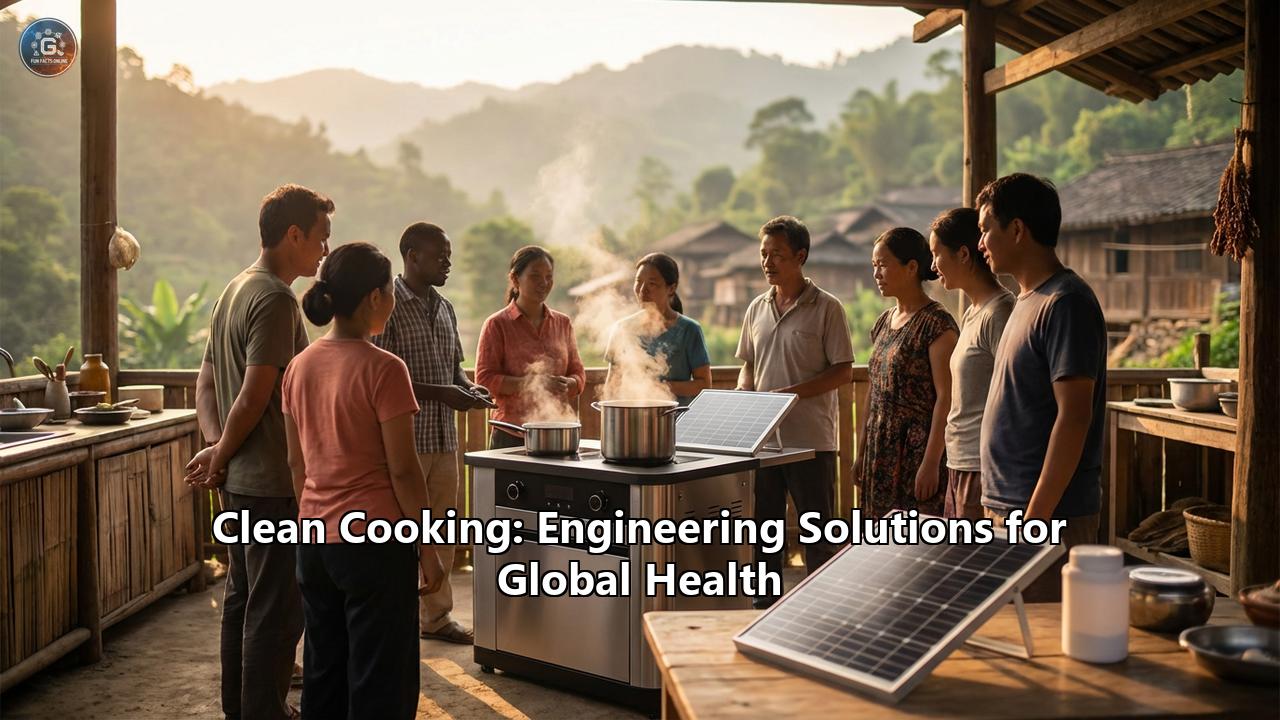
In the 21st century, while humanity explores the frontiers of artificial intelligence and plans colonies on Mars, nearly 2.3 billion people—roughly one-third of the global population—still rely on the most primitive technology to prepare their daily meals: an open fire. The simple act of cooking, a cornerstone of human survival and culture, is currently a global emergency. It is a silent crisis that claims approximately 4 million lives annually, more than malaria, HIV/AIDS, and tuberculosis combined.
The solution to this crisis is not merely social or political; it is fundamentally an engineering challenge. It requires a radical reimagining of thermodynamics, fluid mechanics, power electronics, and biochemical engineering to deliver energy that is affordable, reliable, and, above all, clean. This article explores the deep engineering behind the clean cooking revolution, moving from the fluid dynamics of rocket stoves to the circuit topologies of solar-induction cooktops and the digital architecture of carbon finance.
1. The Physics of the Problem: Why "Fire" is Failing
To understand the engineering solution, one must first understand the thermodynamic failure of the traditional "three-stone fire." In a traditional open fire, biomass (wood, dung, crop residue) burns inefficiently. The physics of this combustion is characterized by:
- Incomplete Combustion: Ideally, biomass combustion would react carbon and hydrogen with oxygen to produce only carbon dioxide (CO₂) and water vapor (H₂O). In reality, the three-stone fire suffers from poor air-fuel mixing and low combustion temperatures. This leads to the formation of Products of Incomplete Combustion (PICs), including carbon monoxide (CO), methane (CH₄), and Polycyclic Aromatic Hydrocarbons (PAHs).
- Particulate Matter (PM2.5): The most dangerous by-product is PM2.5—black carbon and organic carbon particles smaller than 2.5 microns. These particles penetrate deep into the alveolar regions of the lungs and enter the bloodstream. A single open fire in a kitchen can generate PM2.5 concentrations exceeding 20,000 µg/m³; for context, the World Health Organization (WHO) guideline is 15 µg/m³ (24-hour mean).
- Low Thermal Efficiency: An open fire has a thermal efficiency of roughly 10-15%. The vast majority of the energy generated is lost to the environment via convection and radiation, rather than being transferred to the cooking pot. This forces households to gather or purchase 5 to 10 times more fuel than necessary, driving deforestation and time poverty.
The engineering mandate is clear: maximize heat transfer efficiency ($\eta_{thermal}$) while minimizing emissions ($E_{PM2.5}$, $E_{CO}$).
2. Advanced Biomass: Taming the Flame with Fluid Dynamics
For many regions, biomass remains the only accessible fuel. Engineers have thus focused on optimizing the combustion process itself through two primary stove architectures: the Rocket Stove and the Gasifier.
2.1 The Rocket Stove: Optimizing the Draft
The rocket stove, developed initially by Dr. Larry Winiarski, applies principles of fluid dynamics to improve efficiency. The core design features an L-shaped or J-shaped combustion chamber that is insulated and has a vertical "riser."
- The Chimney Effect: The insulated vertical riser creates a strong thermal draft. As the air inside heats up, it becomes less dense and rises rapidly. This pressure differential ($\Delta P$) pulls fresh air into the combustion chamber at the bottom, increasing oxygen supply to the fire.
- Adiabatic Combustion: By insulating the combustion chamber with low-thermal-conductivity materials (like ceramic liners or refractory bricks), engineers aim to keep the temperature inside the chamber above 600°C. High temperatures are crucial for cracking the complex long-chain hydrocarbons found in wood smoke, effectively "burning the smoke" before it exits the stove.
- Heat Transfer: The pot is placed on top of the riser with a carefully calculated "skirt." The gap between the pot and the skirt is engineered to maintain a constant cross-sectional area, forcing the hot flue gases to scrape against the sides of the pot. This increases the convective heat transfer coefficient ($h_c$), raising thermal efficiency to 25-35%.
2.2 The Top-Lit Up-Draft (TLUD) Gasifier
Gasifier stoves represent a leap in sophistication. Instead of burning wood directly, they operate as micro-chemical plants that separate the process into two distinct stages: pyrolysis and combustion.
- Pyrolysis Zone: Biomass is loaded into a vertical reactor and lit from the top. Primary air enters from the bottom but is restricted (starved oxygen environment). This partial combustion generates heat that drives a "pyrolysis front" downward through the fuel bed. The biomass decomposes into volatile gases (hydrogen, carbon monoxide, methane) and leaves behind solid biochar.
- Combustion Zone: The volatile gases rise to the top of the stove where they meet a stream of pre-heated secondary air. This turbulent mixing zone ignites the gases, creating a clean, blue flame similar to LPG.
3. The Electric Revolution: Power Electronics for Weak Grids
The "Gold Standard" of clean cooking is electricity. It produces zero emissions at the point of use and offers the highest efficiency (80-90%). However, grid instability and low voltage in developing nations present unique electrical engineering challenges.
3.1 The Electric Pressure Cooker (EPC)
The EPC has emerged as a front-runner because it addresses the energy density problem. By pressurizing the cooking vessel, it raises the boiling point of water to ~121°C. This reduces cooking time for staples like beans and grains by 50-70%, directly reducing energy consumption ($kWh$).
The "Pulse" Algorithm:Engineers have redesigned the control logic of EPCs for energy-constrained environments. Instead of maintaining continuous power, smart EPCs use a "pulse" heating method. Once pressure is reached, the heating element switches off. The heavy insulation retains the heat. When the temperature drops slightly, a short burst of current restores it.
- Result: An EPC can cook a meal using only 0.3 - 0.5 kWh, making it feasible to power with small solar home systems.
3.2 DC Induction Stoves & Quasi-Resonant Topology
Standard induction stoves require AC grid power (220V/110V). For off-grid solar households, converting DC (battery) to AC (stove) via an inverter introduces efficiency losses (~15%).
Engineers are now deploying Direct DC Induction Cooktops.
- Circuit Topology: These stoves utilize a Quasi-Resonant Inverter topology. The DC input from the battery goes directly to a high-frequency switching circuit (IGBTs or MOSFETs) that drives the copper induction coil.
- Soft Switching: To minimize switching losses, the circuit uses Zero Voltage Switching (ZVS). This ensures the transistors switch when the voltage across them is zero, reducing heat stress on components and boosting efficiency to near 95%.
- Solar Integration: These units often feature integrated MPPT (Maximum Power Point Tracking) controllers to connect directly to PV panels, bypassing the need for a separate charge controller/inverter ecosystem.
3.3 The "Weak Grid" Challenge
In many rural villages, the grid is "skinny"—long distribution lines with high resistance lead to significant voltage drops. If 50 households turn on 1,000W hotplates simultaneously, the voltage can collapse (brownout).
- Engineering Solution: Battery-Buffered Cooking. New stove designs incorporate a Lithium-Iron-Phosphate (LiFePO4) battery inside the stove. The stove "trickle charges" slowly from the weak grid (drawing only 100-200W) throughout the day. When the user cooks, the stove draws high power (1kW+) from the battery, not the grid. This "peak shaving" approach stabilizes the grid while guaranteeing the user high power on demand.
4. Biochemical Engineering: The Biogas Promise
Biogas systems turn a waste management problem into an energy solution. The engineering core is the Anaerobic Digester, a sealed tank where methanogenic bacteria break down organic matter in the absence of oxygen.
4.1 Digester Designs
- Fixed Dome: A masonry structure built underground. As gas is produced, pressure builds up, pushing the slurry into a displacement tank. The gas pressure is variable, which can be a challenge for stove burner design.
- Floating Drum: A steel or fiberglass drum floats on top of the slurry. The drum rises as gas is produced, providing constant pressure. However, the moving parts are prone to corrosion.
- Flexible Bag (Balloon): Made of reinforced PVC or geomembranes. These are low-cost and easy to transport (plug-and-play).
4.2 Optimization Parameters
Biochemical engineers optimize the "recipe" for methanogenesis:
- C/N Ratio: The Carbon-to-Nitrogen ratio must be balanced (optimally 20:1 to 30:1). Too much Nitrogen (e.g., pure chicken manure) produces ammonia, which inhibits bacteria. Too much Carbon (e.g., straw) slows digestion.
- pH Buffering: The process naturally produces volatile fatty acids which can drop the pH and kill the bacteria. Engineers design the system to self-buffer or require additives (lime) to maintain a neutral pH (6.8 - 7.2).
- Temperature: Mesophilic bacteria thrive at 35°C. In the Andean Altiplano or Himalayan winters, engineers must design passive solar heating or thermal jackets for the digesters to prevent the biology from going dormant.
5. Solar Thermal: Engineering for Storage
Solar cookers have historically been limited by a simple flaw: you can't cook dinner at night. The engineering fix is Thermal Energy Storage (TES) using Phase Change Materials (PCMs).
- The Physics of PCMs: PCMs are substances that absorb massive amounts of "latent heat" as they melt (phase transition from solid to liquid) at a constant temperature.
- Materials:
Erythritol: Melts at 118°C, perfect for frying and boiling.
Paraffin Wax: Melts at various temperatures depending on chain length.
Nitrate Salts: For higher temperature applications (>200°C).
- The Design: A solar collector (parabolic dish or vacuum tube) focuses sunlight onto a receiver containing the PCM during the day. The PCM melts, storing energy. In the evening, the user places a pot on the receiver. The PCM re-solidifies, releasing its latent heat to cook the food.
- Heat Transfer Enhancement: Since most PCMs have low thermal conductivity, engineers embed copper fins, graphite matrices, or metal foams into the PCM vessel to ensure rapid heat extraction when cooking is needed.
6. The Digital Layer: IoT and Carbon Finance
Perhaps the most disruptive engineering innovation is not in the stove, but in the data. To finance these high-tech stoves for low-income users, the industry is turning to Results-Based Financing (RBF) and Carbon Markets. This requires rigorous proof of usage, known as MRV (Measurement, Reporting, and Verification).
6.1 IoT Hardware Architecture
Modern clean cookstoves are becoming "smart devices."
- Sensors: Thermocouples (K-type) measure combustion temperature; Hall-effect sensors measure fan RPM; Shunt resistors measure current in e-cookers.
- Microcontrollers: Chips like the ESP32 or STM32 process this data locally.
- Connectivity: GSM/GPRS modules (2G/3G) or LoRaWAN/NB-IoT radios transmit usage packets to the cloud.
- PAYG (Pay-As-You-Go): The firmware integrates with mobile money APIs (like M-Pesa). If the user pays, the stove unlocks via a token or remote command. If credit runs out, the stove locks. This engineering feature "de-risks" the asset, allowing companies to lease $100 stoves to customers for $0.50 a day.
6.2 Digital MRV (dMRV)
The "Gold Standard" and "Verra" have recently approved methodologies for metered cooking devices.
- The Algorithm: instead of estimating usage via surveys (which are prone to recall bias), the dMRV platform calculates emission reductions in real-time.
$$ ER_y = \sum (E_{baseline} - E_{project}) $$
Where $E_{project}$ is measured directly by the IoT meter.
- Blockchain Integration: Some pilots are anchoring these data packets onto immutable ledgers (blockchains) like IXO or Hedera Hashgraph. This creates a "Digital Twin" of the stove, issuing a fractional carbon credit token for every specific cooking event, creating total transparency for buyers.
7. Health and Standards: The ISO 19867-1 Framework
For decades, "improved" stoves were distributed without rigorous proof of performance. Today, the engineering benchmark is ISO 19867-1. This standard rates stoves on Tiers 0 to 5 across four categories:
- Thermal Efficiency: How much energy enters the pot?
- Carbon Monoxide Emissions: Safety from acute poisoning.
- Particulate Matter (PM2.5) Emissions: Safety from chronic disease.
- Safety & Durability: Burn risks, tipping stability.
8. Future Frontiers: Green Hydrogen and Integrated Systems
The horizon of clean cooking engineering is merging with the broader energy transition.
- Green Hydrogen: Research at institutes like NETRA (India) is testing hydrogen cookstoves. The engineering challenge is the burner. Hydrogen has a high flame velocity and low ignition energy (flashback risk). Catalytic burners using porous media combustion are being developed to burn hydrogen flamelessly at lower temperatures, producing only water vapor and zero NOx.
- The Smart Kitchen: In the "Smart Village" concept, the cooking load is an asset. Smart inverters can communicate with the mini-grid controller. If solar generation spikes at noon, the grid can send a signal to smart EPCs to turn on and "cook" thermal storage meals (load building). If clouds roll in, the stoves can throttle down (load shedding). Cooking becomes a battery for the grid.
Conclusion
Clean cooking is no longer just about stacking bricks to make a better fire. It is a convergence of high-tech engineering disciplines. It is the fluid dynamics of a rocket stove, the biochemistry of a digester, the power electronics of a solar inductor, and the cryptographic security of a digital carbon credit.
By treating the humble cookstove as a piece of precision engineering, we are finally closing in on a solution that can save millions of lives, protect the forests, and empower billions of people. The "engineering solution" is not just a device; it is a system that delivers the dignity of a clean meal to every human being.
Reference:
- https://www.scribd.com/document/877337235/Hydrogen-Gas-Stove
- https://globalgoals.goldstandard.org/standards/431_V1.0_EE_ICS_Methodology-for-Metered-and-Measured-Energy-Cooking-Devices.pdf
- https://globalgoals.goldstandard.org/standards/431_V1.2_EE_ICS_Methodology-for-Metered-and-Measured-Energy-Cooking-Devices-1.pdf
- https://carboncredits.com/verras-cookstove-credits-get-icvcm-green-light-boosting-carbon-market-trust/
- https://www.pv-magazine-india.com/2024/01/15/ntpc-demonstrates-zero-emission-hydrogen-cooking/
- https://www.youtube.com/watch?v=jE8TZZDER7M
- https://www.clearbluemarkets.com/knowledge-base/verra-launches-new-cookstove-methodology
- https://medium.com/ixo-blog/cooking-carbon-credits-with-integrity-3b164223a69f
- http://www.rericjournal.ait.ac.th/index.php/reric/article/download/2991/pdf
- https://www.researchgate.net/publication/355759785_Cookstove_Emissions_and_Performance_Evaluation_Using_a_New_ISO_Protocol_and_Comparison_of_Results_with_Previous_Test_Protocols
- https://pmc.ncbi.nlm.nih.gov/articles/PMC8855438/
- https://pmc.ncbi.nlm.nih.gov/articles/PMC4256045/
- https://dash.harvard.edu/bitstreams/7312037c-8879-6bd4-e053-0100007fdf3b/download