
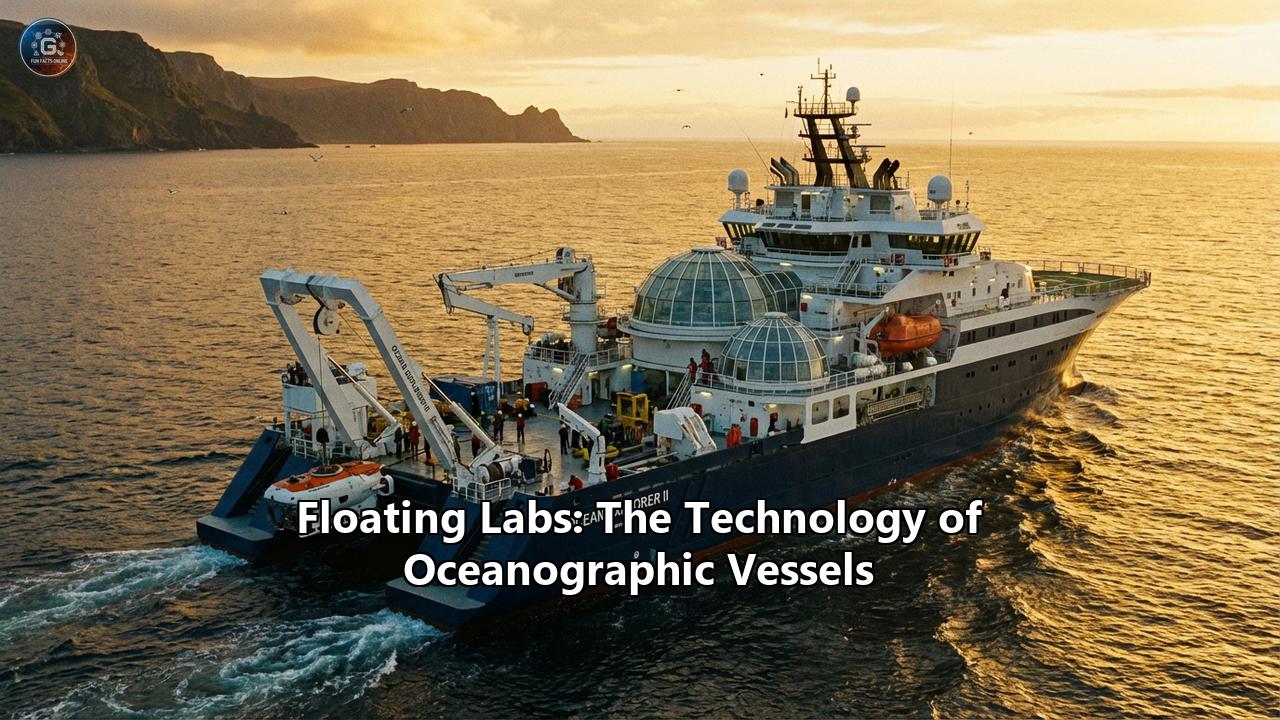
The ocean is Earth’s ultimate frontier, a sprawling, dynamic expanse that covers more than 70 percent of our planet yet remains largely a mystery. For centuries, our understanding of the deep blue was limited to what could be hauled up in nets or glimpsed from the precarious decks of wooden sailing ships. Today, the pursuit of marine science has undergone a radical transformation. The romanticized image of the salty, wind-battered explorer has been replaced by a new reality: the floating laboratory.
Modern oceanographic research vessels (R/Vs) are marvels of human engineering. They are not merely modes of transportation; they are hyper-advanced, self-sustaining campuses that bring the cutting edge of Silicon Valley and the analytical rigor of a university directly to the most hostile environments on Earth. Crammed with supercomputers, wet and dry laboratories, submersibles, and robotic swarms, these vessels are decoding the secrets of the deep—from the mechanics of climate change and the discovery of novel marine biodiversity to the mapping of the seafloor with millimeter precision.
As we navigate through 2026, a renaissance in marine technology is actively reshaping the global research fleet. We are entering an era of absolute acoustic silence, artificial intelligence-driven autonomous drones, and zero-emission propulsion. To understand the future of our planet, we must first understand the technology of the ships that study it.
The Anatomy of a Floating Laboratory
At first glance, a modern oceanographic vessel might look like a standard commercial ship, but beneath the steel plating lies a bespoke architecture designed for one singular purpose: the relentless pursuit of data. Designing these vessels requires an agonizing balance between operational seaworthiness and extreme scientific sensitivity.
Dynamic Positioning and Moonpools
The ocean is rarely still, yet scientific measurements demand absolute stability. Enter the Dynamic Positioning System (DPS). Using a complex network of satellite navigation, gyrocompasses, and wind sensors, a ship’s DPS calculates the exact counter-thrust needed from multi-directional thrusters and azimuth pods to hold the vessel perfectly stationary. Whether a team is drilling a sediment core from a benthic trench miles below or deploying delicate optical sensors, the ship can maintain its coordinates within a matter of inches, even in churning swells and gale-force winds.
To deploy this equipment safely, many advanced floating labs utilize a "moonpool"—a specialized opening in the base of the hull that allows scientists to lower instruments, Remote Operated Vehicles (ROVs), and Autonomous Underwater Vehicles (AUVs) directly into the water. By bypassing the turbulent surface waves crashing against the sides of the ship, the moonpool offers a calm, shielded vertical corridor to the deep.
The Quest for Absolute Silence
One of the greatest engineering challenges in building an oceanographic ship is mitigating underwater radiated noise. The ocean is an acoustic world; marine mammals communicate over vast distances using sound, and scientists rely on highly sensitive sonar transducers to map the seabed and track biomass. A noisy ship is not only ecologically disruptive but scientifically blind, as the roar of its own engines masks the delicate acoustic data bouncing back from the depths.
To combat this, modern vessels are built to incredibly strict acoustic standards, such as the ICES 209 and DNV SILEN-R certifications. Achieving this level of silence requires Computational Fluid Dynamics (CFD) modeling to optimize hull shapes, appendages, and propellers, ensuring water flows over the hull without generating noise-inducing cavitation.
A prime example of this acoustic mastery is the Spanish Oceanographic Institute’s Odón de Buen, which commenced operations recently. Spanning 85 meters, this massive vessel features Ingeteam green propulsion technology, including highly specialized electric motors and power converters that allow the ship to run in complete silence. This silent running capability is paramount for operating scientific echo-sounders and preserving the natural behavior of the marine life being studied.
Eyes in the Deep: The Subsea Robotics Revolution
While the ship serves as the nerve center, the true explorers of the deep are the robotic proxies deployed from its decks. The integration of ROVs and AUVs has fundamentally expanded the mission potential of oceanographic vessels, effectively giving scientists telepresence in the abyss.
Remotely Operated Vehicles (ROVs)
ROVs are tethered behemoths, connected to the floating lab via thousands of meters of armored umbilical cable. This lifeline provides the vehicle with continuous high-voltage power from the ship and transmits ultra-high-definition video and sensor data back to the surface at the speed of light. Work-class ROVs are outfitted with hydraulic manipulator arms capable of tying a knot in a rope, taking delicate biological samples of deep-sea corals, or turning valves on subsea infrastructure.
Today’s ROVs are undergoing an artificial intelligence integration that borders on science fiction. Technologies like the QYSEA FIFISH E-MASTER are bringing AI-powered underwater measurement systems to the deep. Using machine vision, these vehicles can conduct real-time analysis of underwater objects, measure fractures in geology, and identify marine species without human intervention. Some modern ROVs, such as those developed by Blueye Robotics, now feature automated mission planning—operators simply press a button, and the ROV takes over, navigating complex subsea terrain using deep learning and sensor-fusion data.
Autonomous Underwater Vehicles (AUVs)
If ROVs are the heavy-duty workers, AUVs are the agile scouts. Untethered and fiercely independent, AUVs are pre-programmed with mission parameters and released into the ocean to hunt for data. Gliding silently above the seafloor, they gather bathymetric data, measure salinity, temperature, and chemical compositions, and capture imagery.
Historically, AUVs were constrained by battery life, requiring retrieval every 36 to 72 hours. However, the modern paradigm is shifting toward extreme endurance. New subsea docking stations allow AUVs to recharge and download data without ever returning to the surface. This delivers "underwater persistence," fundamentally reducing the time heavy surface ships need to hover over a single location. Furthermore, advanced AI kits, like those developed by Boxfish Robotics, equip AUVs with machine vision cameras and advanced positioning systems, enabling the drone to recognize and track specific fish or marine mammals. This non-invasive visual tracking is actively replacing older, ecologically damaging methods like bottom trawling.
Mapping the Abyss: Advanced Sonar and Multibeam Echosounders
You cannot understand an environment you cannot see. Because light penetrates only the first few hundred meters of the ocean, mapping the deep requires sound. Multibeam echosounders represent the pinnacle of underwater cartography.
Unlike traditional single-beam sonar, which pings a single point directly beneath a ship, a multibeam echosounder emits a fan-shaped acoustic swath that sweeps across the seafloor. As the ship moves forward, this acoustic fan bounces back to the vessel's transducers, painting a high-resolution, three-dimensional topographic map of the ocean floor in real-time.
This technology has evolved dramatically. Today, multibeam sonar is not restricted to the massive hulls of global-class research vessels. Miniaturization has allowed companies like Hydro-Tech to develop high-accuracy, low-power multibeam echosounders specifically for Unmanned Surface Vehicles (USVs) and underwater drones. These small, autonomous boats can be deployed from the mother ship to survey ultra-shallow coastal zones, treacherous reefs, and blind areas where a large manned ship’s draft would cause it to run aground. By deploying a swarm of sonar-equipped USVs, a single floating lab can exponentially multiply its mapping footprint, gathering big data at an unprecedented scale.
Green Propulsion: Decarbonizing Ocean Science
For decades, there was a glaring hypocrisy in marine science: the vessels dispatched to study the impacts of climate change and ocean acidification were themselves burning thousands of gallons of heavy diesel fuel, emitting massive plumes of carbon dioxide. The current generation of research ships is aggressively correcting this paradox through cutting-edge green propulsion.
The U.S. National Oceanic and Atmospheric Administration (NOAA) is leading this charge with its newest oceanographic ships, the Discoverer and the Oceanographer, both reaching completion milestones in 2026. Built by Thoma-Sea Marine Constructors, these vessels represent the apex of clean energy integration in heavy maritime operations.
Instead of traditional direct-drive diesel engines, the NOAA ships utilize a highly sophisticated diesel-electric propulsion system. Four Cummins QSK 38 Tier 4 engines integrate with a Siemens Energy BlueDrive PlusC platform, backed by massive battery banks storing 712 kWh of electrical power. This hybrid system delivers power to Schottel L-drives and pump jet bowthrusters. The result? A staggering reduction in fuel consumption by about 15,000 gallons per year per ship, cutting carbon dioxide emissions by roughly 5,700 tons annually.
Other operators are pushing even further into zero-emission modes. The Orange County Sanitation District recently commissioned a hybrid catamaran featuring an ABB Series Hybrid technology paired with a BorgWarner Energy Storage System, allowing the vessel to draw 30% of its operational power strictly from batteries, meeting California's stringent zero-emissions standards. These power systems ensure that the floating labs of today leave virtually no footprint on the environments they seek to protect.
Data Superhighways and Floating Campuses
The romantic notion of a scientist scribbling in a brine-soaked notebook has been replaced by the hum of server racks. A modern floating laboratory is a data-generating leviathan. Between the multibeam sonars, the 4K video feeds from ROVs, continuous flow-through water sampling cytometers, and atmospheric sensors, a ship can produce terabytes of data in a single day.
Historically, this data was stored on hard drives and analyzed only after the ship returned to port. Today, high-bandwidth ship-to-shore satellite communication systems beam data directly to mainland universities in real-time. This allows researchers on the other side of the planet to participate in a deep-sea dive live, analyzing digital twins of the seabed and offering input to the ship's crew as if they were standing on the bridge.
The physical laboratories onboard have also evolved. Research vessels now feature specialized cleanrooms, chemical fume hoods, spectrophotometers, and climate-controlled incubation chambers. Biologists can extract and sequence environmental DNA (eDNA) directly on the ship, while physicists process complex oceanographic instrument data. The University of North Carolina Wilmington’s new 73-foot vessel, The Seahawk (arriving in 2026), acts as a multi-discipline floating classroom, broadcasting data shoreside while offering an immersive training ground for the next generation of marine biologists.
The 2024-2026 Wave: A Global Fleet Modernization
The mid-2020s have proven to be a watershed moment for oceanographic fleet modernization. Around the world, aging vessels are being retired and replaced by highly specialized, technologically dense ships.
Rebuilding the U.S. Academic Fleet
In the United States, the University-National Oceanographic Laboratory System (UNOLS) has been battling the natural attrition of an aging fleet, which dwindled from 34 vessels in the 1980s to just 17 in recent years. To prevent the U.S. from losing its foothold in seagoing ocean science, the National Science Foundation (NSF) funded the creation of three identical Regional Class Research Vessels (RCRVs): the R/V Taani, Narragansett Dawn, and Gilbert R. Mason.
Constructed by Bollinger Shipyards, these agile, high-tech vessels are designed to replace retired legends like the R/V Oceanus and R/V Endeavor. Despite facing complex construction delays due to the immense technical challenges of fitting so much advanced instrumentation into a regional-class hull, these vessels are poised to revolutionize coastal and regional oceanography when they deliver in 2026. Equipped with deep- and shallow-water seafloor mapping sonars and real-time atmospheric sensors, these vessels are the most advanced of their kind.
The European Expansion
Across the Atlantic, European nations are deploying their own state-of-the-art ships. France is preparing to launch the Anita Conti, a pioneering vessel named after the country's first female oceanographer, designed to fully integrate into the French Oceanographic Fleet by 2026. Meanwhile, the Italian Navy has launched the N.I.O.M. Quirinale, a 110-meter hydro-oceanographic ship tasked with critical scientific mapping and monitoring.
The Megayacht of Science: REV Ocean
No discussion of modern floating labs is complete without mentioning the colossal REV Ocean. Funded by Norwegian billionaire Kjell Inge Røkke and led by former WWF Norway CEO Nina Jensen, REV Ocean is a 194.9-meter (639-foot) behemoth that blurs the line between a luxury superyacht and an industrial research platform.
With a staggering gross tonnage of over 19,000 GT, REV Ocean is widely considered the world's largest yacht—but its mission is purely scientific. Scheduled for completion in late 2026, the vessel was built with an uncompromising mandate: to tackle plastic pollution, climate change, and unsustainable fishing.
The specifications of REV Ocean read like a naval architect's dream. It boasts an operating range of over 21,000 nautical miles, giving it an unprecedented 114 days of full autonomy. It features highly sophisticated laboratories, a submarine hangar, deep-dive submersibles, a 35-person cinema for scientific presentations, and two helipads. To ensure it leaves no trace, the ship operates on a TIER III hybrid propulsion system. Colossal Wärtsilä main engines are fitted with advanced Schiedel exhaust systems to reduce weight and vibrations, while an extra 3 MW lithium-ion battery pack allows the ship to slip into full-electric, absolutely silent mode at 11 knots during delicate biomass sampling. It represents the ultimate fusion of limitless private funding and critical planetary science.
The Human Element: Life at the Extremes
Despite the dizzying array of autonomous robotics and AI integration, the heart of any floating laboratory is its human crew. Oceanographic expeditions can last for months, traversing some of the most unforgiving environments on the planet, from the roaring Drake Passage to the crushing ice of the Arctic.
Living aboard a research vessel is an exercise in extreme isolation coupled with forced intimacy. Today's UNOLS and global-class vessels prioritize crew well-being to ensure peak scientific performance. These ships are equipped with modern amenities that soften the harshness of life at sea: mess halls serving high-quality food, comprehensive gyms, lounges with big-screen entertainment, extensive libraries, and even onboard saunas. These spaces act as vital communal hubs where geochemists, marine biologists, deckhands, and ROV pilots cross-pollinate ideas, often leading to collaborative breakthroughs that wouldn't occur in isolated shoreside university departments.
Yet, the work is relentlessly demanding. Operations run 24 hours a day, 7 days a week. When a ship reaches its target coordinates, scientists work in grueling shifts, deploying 'rosettes' of water-sampling bottles into the freezing depths at 3:00 AM, or meticulously sifting through benthic mud on a windswept fantail. The technology makes the work possible, but human endurance makes it happen.
The Future: A Fully Mapped Ocean
As we look toward the horizon, the trajectory of oceanographic vessels is clear. We are moving toward a future defined by swarm operations and profound interconnectivity. Future floating labs will likely act as "motherships" to dozens of autonomous, AI-driven drones—both in the air and under the water—surveying massive tracts of the ocean simultaneously.
Furthermore, as battery densities increase and alternative fuels like hydrogen fuel cells and green ammonia become viable for maritime use, we will soon see the first true zero-emission global-class research vessels. The dream is a fleet of ships that can study the ocean’s delicate chemistry without adding a single molecule of carbon dioxide to the atmosphere.
Oceanographic vessels are the most complex machines humans build to explore our own world. They are the frontline defenders in our understanding of the global climate, the surveyors of uncharted deep-sea topography, and the discoverers of lifeforms that redefine our understanding of biology. As ships like the Discoverer, the Odón de Buen, and the mighty REV Ocean take to the seas, they carry with them the combined curiosity, ingenuity, and hope of humanity. The ocean may be vast and unyielding, but our floating laboratories are finally shining a light into the abyss.
Reference:
- https://geo.libretexts.org/Bookshelves/Oceanography/Our_World_Ocean%3A_Understanding_the_Most_Important_Ecosystem_on_Earth_Essentials_Edition_(Chamberlin_Shaw_and_Rich)/01%3A_Voyage_I_Ocean_Science/03%3A_Science_Aboard_Ships/3.06%3A_Modern_Oceanographic_Vessels/01%3A_Voyage_I_Ocean_Science/03%3A_Science_Aboard_Ships/3.06%3A_Modern_Oceanographic_Vessels)
- https://research.wur.nl/en/publications/innovations-in-marine-biodiversity-monitoring-using-small-unmanne/
- https://www.workboat.com/shipbuilding/new-noaa-research-vessels-nearing-completion
- https://eos.org/articles/u-s-academic-research-fleet-to-add-three-smaller-more-nimble-vessels
- https://www.ingeteam.com/de/Presse/tabid/3370/articleType/ArticleView/articleId/3445/language/de-DE/Ingeteam-technology-on-Spains-largest-oceanographic-research-vessel.aspx
- https://www.maritimemagazines.com/marine-technology/202412/subsea-vehicle-technology/
- https://vicusdt.com/en/industries-applications/oceanographic-research-vessels/
- https://www.kongsberg.com/maritime/segments/offshore-wind/research-vessel-with-auv-rov/
- https://www.schiedel.com/rev-ocean-the-worlds-largest-yacht-c4790713
- https://www.invoceangroup.com/multibeamsonarguide
- https://www.unmannedsystemstechnology.com/feature/multibeam-echosounder-technology-for-unmanned-surface-vehicles/
- https://www.marinelink.com/news/maritime/research-vessels
- https://theseahawk.org/36668/uncategorized/advancing-ocean-research-university-of-north-carolina-wilmington-introduces-a-new-state-of-the-art-research-vessel/
- https://www.forbes.com/sites/craighooper/2025/09/03/americas-ocean-research-fleet-is-in-trouble-heres-how-to-help/
- https://www.revocean.org/
- https://en.wikipedia.org/wiki/REV_Ocean
- https://www.boatinternational.com/yachts/the-superyacht-directory/rev-ocean--90675
- https://www.yachtcharterfleet.com/luxury-charter-yacht-53303/rev-ocean.htm