
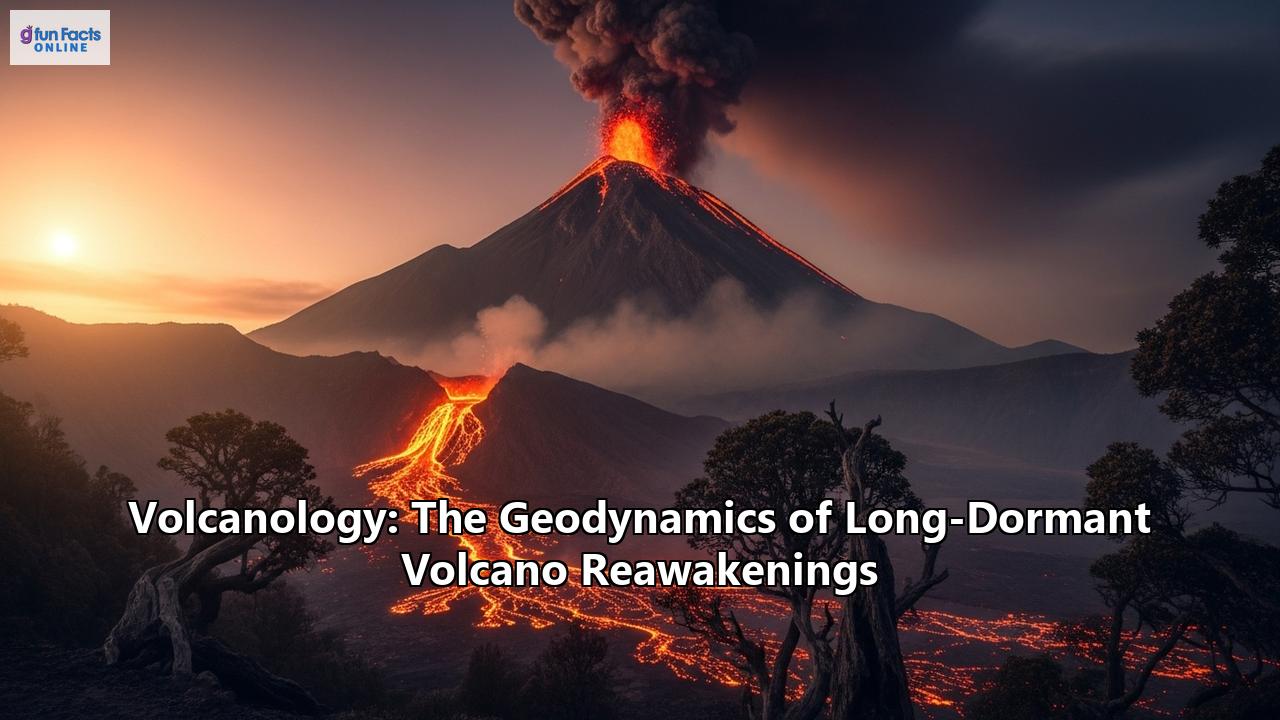
An uneasy slumber broken by a fiery awakening—this is the dramatic story of long-dormant volcanoes. Scattered across the globe, these sleeping giants can lie quiet for centuries, even millennia, their slopes covered in lush vegetation and their peaks seemingly frozen in time. Yet, beneath this tranquil facade, the Earth's inner turmoil can set the stage for a violent return to life. The reawakening of a long-dormant volcano is a complex and awe-inspiring process, driven by the relentless forces of geodynamics. It is a field of intense study for volcanologists who strive to understand the triggers, read the subtle warning signs, and ultimately protect the millions of people living in the shadows of these magnificent and perilous mountains.
This article delves into the intricate world of volcanology to explore the geodynamics behind these reawakenings. We will journey into the heart of the Earth to understand the mechanisms that can stir a volcano from its long rest, examine the tell-tale signs that herald an impending eruption, and recount the dramatic stories of volcanoes that have spectacularly woken up, forever changing the landscapes and lives around them.
The Engine of Vulcanism: A Planet in Motion
To comprehend why a volcano reawakens, one must first understand why volcanoes exist. The Earth's crust is not a single, solid shell but is broken into massive pieces called tectonic plates. These plates are in constant, slow motion, driven by the heat and convection currents in the underlying mantle. It is at the boundaries of these plates, where they collide, pull apart, or slide past each other, that the vast majority of volcanic activity occurs.
- Convergent Boundaries: Where an oceanic plate collides with a continental plate, the denser oceanic plate subducts, or dives, beneath the continental plate. As the oceanic plate sinks deeper into the mantle, it heats up, and water trapped within its minerals is squeezed out. This water lowers the melting point of the overlying mantle rock, creating magma—a process known as flux melting. This buoyant, molten rock rises, collecting in magma chambers within the crust. If this magma finds a pathway to the surface, a volcano is born. The volcanoes of the Pacific Ring of Fire, including the Andes and the Cascade Range in North America, are prime examples of this process.
- Divergent Boundaries: Where tectonic plates pull apart, such as at mid-ocean ridges or in continental rift zones like the East African Rift, the reduction in pressure allows hot mantle rock to melt and rise. This often leads to less explosive, more fluid lava flows.
- Hotspots: Some volcanoes, like those that formed the Hawaiian Islands, are not located at plate boundaries. They are the result of "hotspots," where a plume of exceptionally hot mantle material rises from deep within the Earth, melting the crust above it.
A volcano's plumbing system consists of a magma chamber—a subterranean reservoir of molten rock—and a series of conduits that lead to a vent at the surface. It is the complex interplay of processes within this system that dictates whether a volcano is active, dormant, or extinct.
What Does "Long-Dormant" Truly Mean?
The classification of volcanoes can be complex and is not always straightforward. Generally, volcanologists use the following categories:
- Active: A volcano that is currently erupting or has erupted in recent recorded history and is expected to erupt again.
- Dormant: A volcano that is not currently erupting but is expected to do so in the future. These are often described as "sleeping" volcanoes. The timeframe for dormancy can be vast, ranging from decades to many thousands of years. The U.S. Geological Survey (USGS) defines a dormant volcano as one that isn't showing signs of unrest but could become active again.
- Extinct: A volcano that is not expected to erupt again because its magma supply has been cut off.
The line between dormant and extinct can be blurry. A volcano may be quiet for so long that it is considered extinct, only to surprise scientists and nearby populations with a sudden reawakening. Mount Pinatubo in the Philippines, for instance, was dormant for over 500 years before its cataclysmic eruption in 1991. Similarly, Mount St. Helens in the United States was quiet for 123 years before its dramatic 1980 eruption. This highlights a critical finding in modern volcanology: a long repose period is no guarantee of permanent inactivity.
The Geodynamic Triggers: Waking the Giant
A dormant volcano is not dead, merely resting. Deep beneath the surface, conditions can change, leading to a cascade of events that culminates in an eruption. The reawakening is a story of immense pressure, rising heat, and chemical reactions—a geodynamic drama unfolding miles underground.
The Primary Suspect: Magma Intrusion and Mixing
The most common trigger for the reawakening of a long-dormant volcano is a new intrusion of magma into its plumbing system. Recent research has revealed that many dormant volcanoes harbor persistent, large bodies of magma that are highly crystalline and too viscous to erupt. They are essentially solidified, waiting for a catalyst.
This catalyst often arrives in the form of a fresh batch of hotter, more primitive magma from deeper within the mantle. This process, known as magma mixing or mingling, is a potent trigger for several reasons:
- Reheating and Remobilization: The injection of hot, mafic (basaltic) magma into a cooler, more evolved (silicic) magma chamber acts like a furnace. It reheats the resident, near-solid magma, reducing its viscosity and making it more mobile. This remobilization can be a critical first step towards an eruption.
- Volatile Exsolution: The heat from the new magma can cause dissolved gases (volatiles) like water and carbon dioxide, which were trapped in the cooler magma, to come out of solution and form bubbles. This process, called exsolution, drastically increases the pressure inside the magma chamber, much like shaking a bottle of soda before opening it.
- Pressure Cooker Effect: The combination of added magma volume and the rapid expansion of gas bubbles can lead to a dramatic over-pressurization of the magma chamber. If this pressure exceeds the strength of the overlying rock, it can fracture the edifice, creating pathways for the magma to ascend to the surface and erupt.
Petrological evidence from numerous eruptions confirms the role of magma mixing. For example, the andesite lava from the Soufrière Hills volcano in Montserrat, which reawakened in 1995, contains mafic inclusions that show they were molten when incorporated, pointing to a recent injection of new magma that triggered the eruption. Similarly, many explosive eruptions, like those of Vesuvius and Pinatubo, are believed to have been triggered by this mechanism.
The Tectonic Nudge: Earthquakes and Stress Changes
Volcanoes and earthquakes are intimately linked, both being products of plate tectonics. While volcanic activity itself generates earthquakes, large tectonic earthquakes can also act as a trigger for volcanic reawakenings. The immense energy released during a major earthquake can alter the stress field in the crust surrounding a dormant volcano.
This can happen in a few ways:
- Unclamping the System: The shaking from seismic waves can dislodge a "plug" of hardened lava in the volcanic conduit or open new fractures, effectively removing a cap and allowing pressurized magma to escape.
- Squeezing the Magma Chamber: Changes in crustal stress can compress a magma chamber, increasing the pressure within and forcing magma upwards.
A striking recent example is the eruption of the Krasheninnikov Volcano on Russia's Kamchatka Peninsula. After lying dormant for approximately 600 years, it erupted in 2025, an event scientists believe was triggered by a massive magnitude-8.7 earthquake that occurred off the coast. This powerful seismic event likely caused the necessary stress changes to reactivate the dormant volcanic system.
The Role of Water: Hydrothermal Systems
Beneath many volcanoes lies a hydrothermal system, where groundwater percolates through the rock and is heated by the underlying magma. This creates a complex network of hot water and steam, which can manifest on the surface as hot springs, fumaroles (steam vents), and geysers. These systems play a crucial role in both signaling and influencing volcanic unrest.
Changes in a hydrothermal system can be a direct indicator of magma on the move. As new magma intrudes, it can heat the groundwater, causing an increase in the temperature of hot springs or a surge in steam and gas emissions from fumaroles. These are often among the earliest and most easily observable signs of a volcano's reawakening.
Furthermore, hydrothermal systems can contribute to the instability of a volcano. The hot, often acidic fluids can alter the surrounding rock, weakening it over time. This can make the volcanic edifice more susceptible to collapse, which, as seen at Mount St. Helens, can be a catastrophic trigger for an eruption.
Reading the Signs: The Science of Volcano Monitoring
Because long-dormant volcanoes can reawaken, often with devastating consequences, a key focus of modern volcanology is monitoring. Scientists use a sophisticated array of tools to detect the subtle precursors that signal magma is stirring deep underground. These warnings can precede an eruption by days, weeks, or even years, providing a crucial window for preparation and evacuation.
Seismic Monitoring: Listening to the Earth's Tremors
The movement of magma is never silent. As it forces its way upward, it cracks rock, creating a variety of seismic signals that can be detected by seismometers.
- Volcanic Earthquakes: An increase in the frequency and intensity of small earthquakes is often the very first sign of unrest. These quakes are typically shallow and clustered beneath the volcano.
- Volcanic Tremor: Instead of distinct jolts, magma movement can also generate a continuous, humming-like vibration known as volcanic tremor. This signal is a strong indication that magma is flowing through the volcano's conduits.
- Low-Frequency Earthquakes: These quakes are associated with the pressurization of magma and fluids within the volcanic system and are often seen as a precursor to an eruption.
The 1980 eruption of Mount St. Helens was famously preceded by a two-month period of intense earthquake activity, starting with a magnitude 4.0 quake on March 20. Similarly, the 1991 Pinatubo eruption was heralded by thousands of small earthquakes in the months leading up to its climax.
Ground Deformation: A Swelling Giant
As magma accumulates in a shallow magma chamber, it pushes the overlying ground upward and outward, causing the volcano's surface to swell or "inflate." This deformation, though often imperceptible to the naked eye, can be precisely measured using modern geodetic techniques.
- GPS (Global Positioning System): Networks of permanent GPS stations can track changes in the position of points on a volcano's surface to within a few millimeters, providing a 3D picture of the deformation.
- Tiltmeters: These highly sensitive instruments, often installed in boreholes, measure minute changes in the slope or "tilt" of the ground.
- InSAR (Interferometric Synthetic Aperture Radar): This powerful satellite-based technique compares radar images of a volcano taken at different times to create a detailed map of ground movement over a wide area, with centimeter-scale accuracy. InSAR was instrumental in detecting a bulge at the Three Sisters volcanic complex in Oregon, indicating rising magma, and has become a vital tool for monitoring remote volcanoes.
One of the most dramatic examples of ground deformation was the infamous "bulge" on the north flank of Mount St. Helens, which grew outwards at a rate of five feet per day in the weeks before the eruption. This swelling was a clear sign that magma had intruded high into the volcano.
Gas Geochemistry: Sniffing for Clues
As magma rises closer to the surface, dissolved gases escape and vent into the atmosphere through fumaroles and the soil. Monitoring the composition and emission rate of these gases provides direct insights into the state of the magma below.
- Sulfur Dioxide (SO₂): This gas is a key indicator of fresh, unerupted magma. A sharp increase in SO₂ emissions is a strong sign that magma is nearing the surface. Instruments like COSPEC (Correlation Spectrometer) and DOAS (Differential Optical Absorption Spectroscopy) are used to measure SO₂ concentrations in volcanic plumes from the ground or air. Before the 1991 Pinatubo eruption, SO₂ emissions increased dramatically, from 500 tons per day in mid-May to 5,000 tons per day by early June.
- Carbon Dioxide (CO₂): CO₂ is typically released from magma at greater depths than SO₂. An increase in the ratio of CO₂ to SO₂ can indicate that a new batch of deep, gas-rich magma is rising.
- Other Clues: Changes in the chemical composition or temperature of gases from fumaroles, or in the water chemistry of hot springs and crater lakes, can also signal a change in the volcanic system.
Thermal Monitoring: Taking the Volcano's Temperature
A reawakening volcano often heats up. Thermal monitoring uses infrared technology to detect these temperature changes, which are invisible to the naked eye.
- Satellite Thermal Imaging: Satellites can measure the surface temperature of volcanoes over large areas, allowing scientists to detect new hot spots or an increase in the temperature of existing fumaroles.
- Aerial and Ground-Based Thermal Cameras: High-resolution thermal cameras mounted on aircraft, drones, or used on the ground can provide detailed maps of a volcano's heat output, revealing subtle changes that may precede an eruption.
Case Studies in Reawakening: Stories of Fire and Fury
The science of geodynamics and monitoring is brought into sharp focus by the dramatic real-world examples of long-dormant volcanoes that have stirred back to life. These events serve as crucial lessons, shaping our understanding of volcanic hazards and our ability to mitigate their impact.
Mount Pinatubo, Philippines (1991): A Wake-Up Call
After more than 500 years of slumber, Mount Pinatubo reawakened in 1991 in what would become the second-largest volcanic eruption of the 20th century. The eruption was preceded by a series of clear, escalating warning signs.
- The Precursors: The first stirrings came a year earlier, with a magnitude 7.8 earthquake in July 1990 about 60 miles from the volcano. Then, on April 2, 1991, steam explosions began, and scientists from the Philippine Institute of Volcanology and Seismology (PHIVOLCS) and the USGS rushed to install monitoring equipment. They detected hundreds of small earthquakes per day and a massive increase in sulfur dioxide emissions. By early June, a lava dome began to grow, a clear sign that magma was at the surface.
- The Eruption and Aftermath: Based on this data, scientists issued warnings that enabled the evacuation of tens of thousands of people. On June 15, the volcano exploded in a cataclysmic eruption, sending an ash column 22 miles high and unleashing devastating pyroclastic flows—searingly hot avalanches of ash, gas, and rock. The situation was tragically compounded by Typhoon Yunya, whose heavy rains mixed with the ash to create destructive lahars (volcanic mudflows) that buried villages and destroyed infrastructure. The eruption killed over 840 people, many from roofs collapsing under the weight of wet ash, but the timely evacuation is credited with saving at least 5,000 lives. The global impact was also significant, with the massive injection of sulfur dioxide into the stratosphere causing a temporary drop in global temperatures.
Mount St. Helens, USA (1980): The Lateral Blast
The 1980 eruption of Mount St. Helens in Washington State was a watershed moment in modern volcanology. After 123 years of dormancy, it reawakened with a sequence of events that culminated in a rare and devastating lateral blast.
- The Precursors: The warning signs began on March 20, 1980, with a magnitude 4.2 earthquake. Over the next two months, the mountain was shaken by thousands of quakes, and small steam-blast eruptions created a crater at the summit. The most ominous sign was the dramatic bulging of the volcano's north flank, which grew outward at an alarming rate, indicating a shallow intrusion of viscous magma.
- The Eruption and Aftermath: On the morning of May 18, a magnitude 5.1 earthquake triggered the largest landslide in recorded history, as the entire weakened north face of the volcano collapsed. This sudden "uncorking" of the magmatic system unleashed a massive lateral blast that traveled at over 300 mph, flattening forests for nearly 600 square kilometers. A vertical eruption column then rose 15 miles into the atmosphere, depositing ash across eleven states. The disaster claimed 57 lives and caused over a billion dollars in damages, but it also transformed volcano science, spurring huge advances in monitoring techniques and emergency response planning.
Soufrière Hills, Montserrat (1995-Present): A Long-Lived Crisis
The eruption of the Soufrière Hills volcano on the small Caribbean island of Montserrat began in 1995 and has provided a long-term case study in managing a protracted volcanic crisis. After centuries of dormancy (with some seismic swarms in preceding decades), the volcano stirred to life.
- The Precursors: The reawakening began with intense earthquake swarms in 1992, escalating in 1994. The eruption itself started on July 18, 1995, with steam and ash (phreatic) explosions. By November 1995, viscous andesitic magma reached the surface and began to form a lava dome.
- The Eruption and Aftermath: The eruption's signature became the steady growth of the lava dome, punctuated by terrifying collapses that generated pyroclastic flows. In June 1997, a major flow destroyed the island's airport and killed 19 people. Over time, the capital city of Plymouth was completely buried and abandoned. The eruption has rendered the southern half of the island uninhabitable, forcing the evacuation and permanent relocation of over two-thirds of the population. The crisis has had profound and lasting social and economic impacts, highlighting the immense challenge of long-term recovery in the face of an ongoing volcanic threat.
Chaitén, Chile (2008): The Unexpected Rhyolite Eruption
The 2008 eruption of Chaitén volcano was a major surprise. It had been dormant for over 9,000 years and was not being actively monitored. Its reawakening was rapid and provided the first opportunity to study a major rhyolitic eruption with modern technology.
- The Precursors: The warning was exceptionally short. The first precursory seismic activity was detected only about 36 hours before the eruption began on May 2, 2008.
- The Eruption and Aftermath: The eruption was explosive, sending an ash plume over 20 kilometers high. Lahars and floods subsequently inundated the nearby town of Chaitén, leading to the evacuation of its 4,000 residents. The Chilean government ultimately decided to permanently relocate the town. The event was a stark reminder that even volcanoes with very long dormancy periods can reawaken with little warning. It spurred the Chilean government to create a new national program to improve the monitoring of its many high-threat volcanoes.
Living with Sleeping Giants: Hazard Management and Societal Resilience
The reawakening of a long-dormant volcano is not just a geological event; it is a profound societal crisis. The threat extends far beyond the initial eruption, with long-term hazards like lahars and ashfall posing risks for years. Effective hazard management, therefore, requires a multi-faceted approach that integrates scientific monitoring, risk communication, evacuation planning, and long-term recovery strategies.
- The Crucial Role of Communication: Communicating volcanic risk is fraught with challenges, especially the uncertainty surrounding the timing and scale of a potential eruption. Scientists and public officials must convey complex information clearly and consistently to build trust and encourage preparedness. Strategies include using simple language, disseminating information through multiple channels including local media and social platforms, and preparing clear contingency plans.
- Evacuation and Emergency Planning: The successful evacuations at Pinatubo and Mount St. Helens demonstrate the life-saving importance of heeding scientific warnings and having well-defined emergency plans. However, the response to Mount St. Helens also highlighted shortcomings, such as difficulties in keeping sightseers out of the danger zone. These experiences have led to the development of more robust coordination plans between scientists, government agencies, and emergency responders.
- Long-Term Recovery and Resilience: As the case of Montserrat vividly illustrates, the aftermath of an eruption can be a prolonged crisis. Recovery involves not just rebuilding infrastructure but also addressing deep-seated social and economic challenges, such as housing insecurity, economic collapse, and the psychological trauma of displacement. The resilience of an affected community depends on long-term international aid, sustainable development planning, and empowering local leadership to navigate the uncertain future.
Conclusion: An Enduring Dance of Creation and Destruction
The reawakening of a long-dormant volcano is a powerful testament to the dynamic and ever-changing nature of our planet. Driven by the deep-seated forces of plate tectonics and magma generation, these events are a fundamental part of Earth's geological cycle. While they pose a significant hazard to human life and infrastructure, they are also a source of new land and fertile soils.
The journey into the geodynamics of these reawakenings reveals a complex interplay of heat, pressure, and chemistry. From the subtle injection of new magma deep below, to the tell-tale tremors and swelling of the ground above, scientists are becoming increasingly adept at interpreting the precursors to an eruption. The dramatic stories of Pinatubo, Mount St. Helens, and others serve as potent reminders of both the destructive power of these events and the remarkable success of science in forecasting them and saving lives.
Living in the shadow of these giants requires a profound respect for their power and a commitment to scientific monitoring and preparedness. As our understanding of volcanic processes continues to grow, so too does our ability to coexist with these magnificent, and sometimes terrifying, features of the natural world. The uneasy slumber of a dormant volcano will always command our attention, for its awakening is a visceral reminder of the restless energy that lies just beneath our feet.
Reference:
- https://www.coolgeography.co.uk/GCSE/Year11/Managing%20Hazards/Volcanoes/mount_pinatubo.htm
- http://www.andeangeology.cl/index.php/revista1/article/view/V36n1-a09/html
- https://www.google.com/search?q=time+in+MS
- https://eclipse23.com/blogs/eclipse-education/lessons-learned-from-the-mount-st-helens-eruption-of-1980
- https://blogs.worldbank.org/en/sustainablecities/how-stories-can-help-communicate-volcanic-risk-communities
- https://nora.nerc.ac.uk/id/eprint/511955/1/Geological%20Society%2C%20London%2C%20Memoirs-2014-Sword-Daniels-471-88.pdf
- https://borgenproject.org/montserrat-rebuilding-efforts/
- https://volcanofoundation.org/communication-during-a-volcanic-crisis/
- https://pubs.usgs.gov/pinatubo/mercado/
- https://www.google.com/search?q=time+in+Zambales,+PH
- https://www.slideshare.net/6thformmatt/chaitn-39767049
- https://www.frontiersin.org/research-topics/68664/effective-communication-of-volcanic-hazards-for-risk-mitigation-in-urban-areas
- https://volcanoes.usgs.gov/volcanic_ash/pinatubo_1991.html
- https://nehrpsearch.nist.gov/static/files/NSF/PB83127464.pdf
- https://pollution.sustainability-directory.com/area/volcanic-hazard-communication/resource/1/
- https://pubmed.ncbi.nlm.nih.gov/12974064/
- https://www.adrc.asia/publications/recovery_reports/pdf/Pinatubo.pdf
- https://www.naturalhazards.govt.nz/assets/Publications-Resources/Funded-Research-papers/3052-Becker-et-al-Volcano-Communication-Final-Report.pdf
- https://hazards.colorado.edu/uploads/workingpaper/wp43.pdf
- https://www.sciencedaily.com/releases/2009/05/090507195208.htm
- https://en.wikipedia.org/wiki/1991_eruption_of_Mount_Pinatubo
- https://bpb-us-e1.wpmucdn.com/wp.nyu.edu/dist/e/21986/files/2023/03/Nelia-Ekeji_Mitilgation-Brief_Volcanic-Eruption.pdf
- https://www.eagblog.org/news/chaiten-a-town-in-the-line-of-fire/