
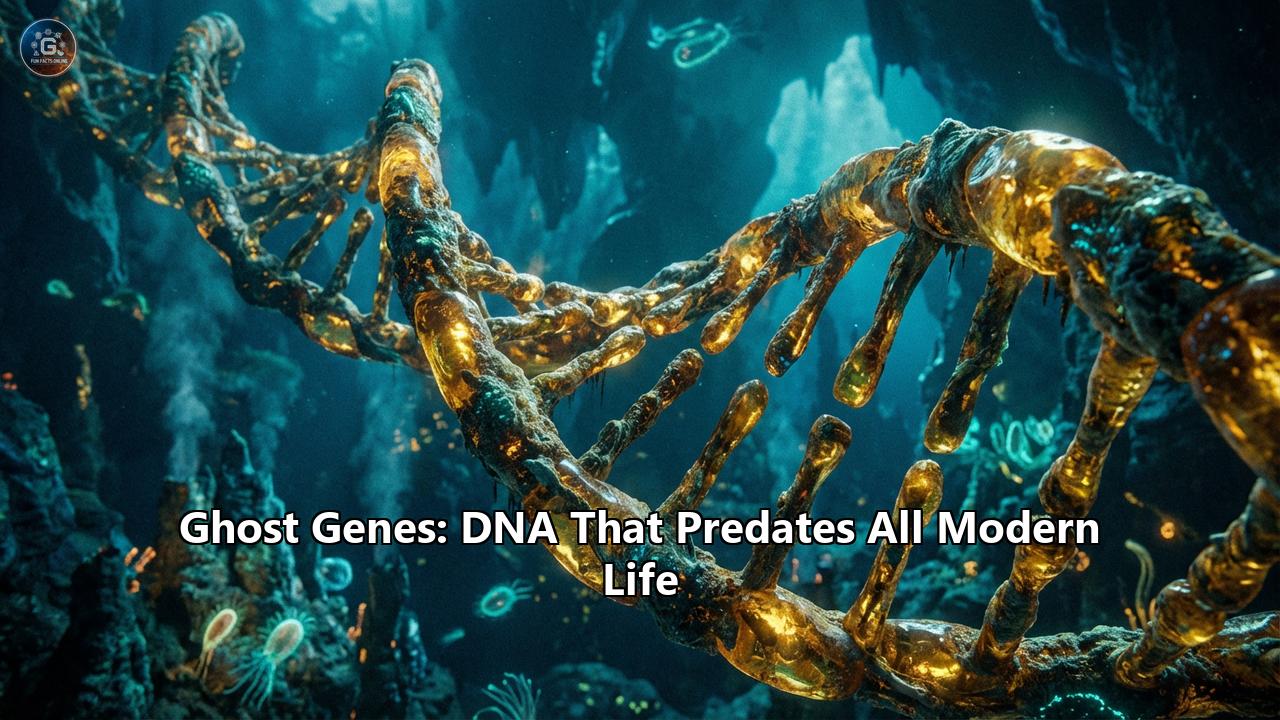
Deep in the architecture of your cells, buried beneath layers of evolutionary innovation and the shuffling of millennia, lies a code that should not exist. It is a sequence of nucleotides—adenine, cytosine, guanine, thymine—that spells out instructions for proteins that have not been synthesized on Earth for billions of years. These are the "Ghost Genes." They are the molecular echoes of a world that vanished long before the first dinosaur drew breath, before the continents settled into their current shapes, and perhaps, before the planet had fully cooled.
For decades, these sequences were invisible, dismissed as "junk DNA" or lost in the background noise of the genome. But in the last few years, a revolution in computational biology, driven by artificial intelligence and "ancestral sequence reconstruction" (ASR), has allowed scientists to do the impossible: wake the dead. We are no longer just reading the history of life; we are resurrecting it. From enzymes that thrived in an oxygen-free atmosphere 2.6 billion years ago to the theoretical reconstruction of the "First Universal Common Ancestor" (FUCA), we are now holding the genetic blueprints of the primordial Earth in our hands.
This article explores the chilling and fascinating reality of Ghost Genes: the DNA that predates all modern life, the methods we use to find it, and the profound implications of bringing these ancient biological machines back online in the 21st century.
Part I: The Lazarus Machines
The most tangible proof of ghost DNA comes not from fossils in the ground, but from the "living fossils" hidden in the code of bacteria. In a breakthrough that stunned the scientific community in the mid-2020s, researchers didn't just find an ancient gene; they rebuilt it and made it work.
The 2.6 Billion-Year-Old Scissors
The story begins with CRISPR. Most of the world knows CRISPR as the revolutionary gene-editing tool that earned a Nobel Prize. In nature, however, CRISPR is an immune system—a database of viral mugshots that bacteria use to recognize and chop up invading bacteriophages. It is an adaptive system, constantly updating itself. But like any language, it evolves. The CRISPR systems in modern E. coli are different from those in Streptococcus, and both are vastly different from their ancestors.
In a landmark study, researchers used powerful algorithms to compare the CRISPR-Cas proteins of hundreds of modern species. By tracing the family tree backwards, node by node, calculating the most likely amino acid at every position for a common ancestor, they arrived at a sequence that existed 2.6 billion years ago.
This wasn't just a simulation. They synthesized the DNA sequence, injected it into a modern bacterium, and waited. The result was electric. The ancient protein, dubbed a "Lazarus" enzyme, folded perfectly. It hunted down viruses. It cut DNA. But it did so with a blunt, versatile power that modern enzymes lack. Evolution has honed modern enzymes to be specialists; this ancient ghost was a generalist, a multi-tool designed for a chaotic, hostile world where threats were unpredictable.
The Oxygen Catastrophe Survival Kit
Why 2.6 billion years? The timing is no accident. This ghost gene dates back to the "Great Oxidation Event," the moment when cyanobacteria began pumping oxygen into the atmosphere, poisoning the anaerobic life that dominated the planet. The resurrection of this gene gives us a direct window into that apocalypse. The structural stability of the resurrected protein suggests it evolved in a hot, acidic environment, rapidly adapting as the Earth's chemistry began to rust.
We are not just looking at a chemical structure; we are looking at a survival strategy from the biggest mass extinction in history. This "ghost" is a witness to the moment Earth changed forever.
Part II: LUCA — The 4.2 Billion-Year-Old Phantom
If the 2.6 billion-year-old CRISPR is a ghost, then LUCA (the Last Universal Common Ancestor) is the primordial spirit from which all other ghosts descend.
For a long time, LUCA was a mathematical abstraction—the theoretical point where the branches of bacteria, archaea, and eukaryotes converge. But recent work in 2024 and 2025 has transformed LUCA from a concept into a concrete biological entity. By analyzing "universal paralogs"—genes that duplicated before the split of the major domains of life—scientists have triangulated the existence of LUCA to approximately 4.2 billion years ago.
The Fire-Eater
What was LUCA? It was not a simple, primitive blob. The reconstructed genome of LUCA suggests a complex, sophisticated organism. It possessed a genome of roughly 2.5 million base pairs, coding for about 2,600 proteins. It had a functioning immune system (a primitive precursor to the CRISPR system mentioned above). It had a membrane.
Most importantly, the ghost genes of LUCA tell us how it lived. It was an anaerobic acetogen. It lived in a world without oxygen, likely in the superheated, mineral-rich vents of a hydrothermal system. It "ate" hydrogen gas and carbon dioxide, knitting them together to make organic molecules, fueled by the geochemical energy of the Earth itself.
The reconstruction of LUCA's genome is akin to rebuilding a Roman city from the scattered dialects of modern Europe. We can see that it used a specific set of amino acids. We can see that it used a reverse gyrase enzyme—a hallmark of hyperthermophiles that live in boiling water. This "ghost" DNA tells us that life didn't tiptoe onto the stage; it stormed in, fully equipped to handle a hellscape.
The Code Before the Code
The most haunting implication of the LUCA reconstruction is that LUCA was already "modern." It used the same genetic code (DNA to RNA to Protein) that we use today. It used the same 20 amino acids. This implies that the true origin of these systems lies even deeper in the past, in a "Dark Age" of biology that we are only just beginning to penetrate.
Part III: Beyond the Veil — FUCA and the RNA World
If LUCA is the ancestor of all living things, FUCA (the First Universal Common Ancestor) is the ancestor of the system of life.
The ghost genes of FUCA are not found in any one organism but are embedded in the very logic of molecular biology. FUCA was likely not a cell, but a population of "progenotes"—primitive biological entities that existed in the RNA World. In this epoch, DNA did not yet exist. RNA was both the hard drive and the processor, storing information and catalyzing chemical reactions.
The Ribosome: The Oldest Machine
The ultimate ghost gene is the sequence for the ribosome, the cellular machine that builds proteins. The core of the ribosome is universally conserved across every living thing, from bacteria to blue whales. It is so similar that a ribosome from a human cell can, with some tweaking, function with parts from a bacterium.
By peeling back the layers of the ribosome's structure, scientists have identified an "accretion model" of evolution. The center of the ribosome is the oldest part—a small RNA knot that likely formed by chance in a warm tidal pool or a vent. Over millions of years, newer layers of RNA and protein were added on top, like the rings of a tree.
Deep in that central knot lies the "Ghost of the RNA World." It is a fossilized echo of a time when the genetic code was still in flux. Recent simulations suggest that the genetic code itself evolved from a simpler, binary code—classifying amino acids simply as "hydrophobic" or "hydrophilic"—before expanding to the 4-letter, 20-amino-acid system we know. We still carry this binary logic in the deep structure of our tRNA synthetases, the enzymes that interpret the genetic code. We are running software v10.0, but the kernel of v1.0 is still buried in the source code.
Part IV: The Viral Dark Matter
Not all ghost genes are our ancestors. Some are our conquerors.
The human genome is often described as a blueprint for a human. This is only partially true. At least 8% of your DNA is not human at all. It is viral. These are the Endogenous Retroviruses (ERVs)—the fossilized remains of ancient plagues that infected our ancestors millions of years ago.
The Enemy Within
When a retrovirus (like HIV) infects a cell, it pastes its own genetic code into the host's DNA. If this happens in a sperm or egg cell, that viral code can be passed down to the offspring. Over millions of years, these viral sequences mutate and lose their ability to make infectious particles. They become "ghosts"—trapped in the genome, carried forward through time.
But they are not always silent. Some of these ghost genes have been co-opted by our own evolution.
- Syncytin: This is the most famous example. Syncytin is a gene essential for the formation of the human placenta. It allows cells to fuse together to create the barrier between mother and fetus. But Syncytin is not a human gene. It is a viral envelope gene—the same gene a virus uses to fuse with a host cell to infect it. Millions of years ago, an ancient infection gave our mammalian ancestors the ability to give live birth. We domesticated a monster and used it to build the cradle of humanity.
- ARC: A gene called Arc is crucial for memory formation in the mammalian brain. It forms capsid-like structures that ferry genetic material between neurons. The Arc gene is derived from an ancient retrotransposon—a "jumping gene" with viral origins. It implies that our very ability to think and remember is powered by the repurposed machinery of an ancient brain virus.
The Shadow Virome
Beyond these domesticated ghosts, there is the "Viral Dark Matter." Metagenomic studies in 2024 and 2025 have revealed that up to 40% of the viral sequences found in human gut and environmental samples match nothing in known databases. These are orphan sequences, ghosts with no known family tree.
Some researchers believe these sequences might be remnants of extinct lineages of viruses that preyed on extinct lineages of life. They are the debris of a microscopic war that has been raging since the Hadean eon.
Part V: The Human Ghost Lineages
As we move closer to the present, the ghosts become more personal. We are not just carrying the DNA of ancient bacteria and viruses; we are carrying the DNA of people who no longer exist.
The Girl from the Cave
In 2010, the discovery of the Denisovans changed everything. A single finger bone in a Siberian cave yielded a genome that was neither Neanderthal nor Homo sapiens. It was a third branch of humanity. But the story didn't end there.
When geneticists analyzed the genomes of modern West African populations in 2020, and later with more advanced AI tools in 2025, they found a signal that didn't fit. About 2% to 19% of the genetic ancestry in these populations came from a "Ghost Population"—an archaic human species that split from our lineage around 650,000 years ago and interbred with the ancestors of West Africans as recently as 43,000 years ago.
We have no fossils of this Ghost Population. No skulls, no tools, no caves. The only evidence they ever existed is the sequence of letters hiding in the DNA of people living today. They are a "statistical species," inferred solely from the shadows they cast on our own genome.
Similarly, in Eurasia, AI models have detected a "third introgression" event—a dalliance with a human group that was a hybrid of Neanderthals and Denisovans, or perhaps a completely different lineage related to Homo erectus.
These ghost genes are not passive. Some of them influence our immune systems, our skin sensitivity to the sun, and our metabolism. We are hybrids, walking museums of extinct humanities.
Part VI: The Shadow Biosphere
The existence of these deep genomic ghosts raises a tantalizing question: if we can find the DNA of extinct life, could there be life on Earth today that is not related to us at all?
This is the hypothesis of the "Shadow Biosphere." The idea is that life may have emerged more than once on Earth. The "standard" life (LUCA's descendants) won the war for resources, covering the planet in DNA/RNA/Protein based organisms. But what if a second genesis survived in the margins?
The Mirror World
One possibility is "Mirror Life"—organisms that use biological molecules with the opposite "chirality" (handedness) of ours. All known life uses Left-handed amino acids and Right-handed sugars. A shadow biosphere might use Right-handed amino acids.
Our standard DNA sequencing tools would be blind to this. PCR and metagenomics rely on primers that target our kind of DNA. If a "weird" microbe existed in a hot spring or deep in the crust, using a different genetic polymer (perhaps PNA or TNA), we would look right through it. We would call it "mineral debris" or "background noise."
While we haven't found a Shadow Biosphere yet, the study of Ghost Genes is the training ground for finding it. The same ASR (Ancestral Sequence Reconstruction) techniques used to predict the genome of LUCA are being used to simulate what "alternative" genetic codes might look like, giving astrobiologists a template to search for "weird life" on Mars or Europa.
Part VII: Synthetic Futures
The resurrection of Ghost Genes is not just an academic exercise. It is the frontier of synthetic biology.
Paleobiotechnology
Modern enzymes are evolved for modern conditions—37°C, oxygenated atmosphere, low radiation. Ancient enzymes, however, evolved on a planet that was a cauldron of extremes. The 2.6 billion-year-old Cas proteins are more robust and less fussy than their modern descendants.
Biotech companies are now mining the "deep time" genomic record for industrial enzymes.
- Heat-Shock Proteins: Ancestral proteins from the hot Hadean ocean are being resurrected for use in high-temperature industrial manufacturing.
- Antiviral Defenses: By looking at how ancient bacteria fought off ancient viruses, we are finding new classes of antibiotics and gene-editing tools that modern resistance mechanisms have never encountered.
- Resurrecting Metabolism: There is a project underway to resurrect the entire metabolic pathway of LUCA—the Wood-Ljungdahl pathway—in a synthetic cell. The goal is to create a biological system that can fix carbon dioxide into plastic or fuel with the efficiency of the primordial Earth, bypassing the inefficiencies that billions of years of "evolutionary drift" introduced.
Part VIII: The Philosophical Weight
There is a profound humility in the study of Ghost Genes. It forces us to realize that the "modern" world is just a thin veneer over a deep, ancient substrate.
Every time your cells divide, they use a machine (the ribosome) that was invented before the continents existed. Every time you form a memory, you are using a repurposed virus. Every time you fight off a flu, your immune system is riffing on a tune that was first hummed by a microbe in a Hadean vent.
We are time travelers. We carry the history of the planet in every nucleus of every cell. The ghosts are not haunting us; they are us.
As AI continues to refine our ability to read the "dark matter" of the genome, we can expect to find more ghosts. We will find the genes of the "failed" experiments of evolution—the lineages that didn't make it. We will map the "dead ends" of the Tree of Life. And in doing so, we might finally understand not just where we came from, but how unlikely and fragile our existence really is.
The DNA of the past is not gone. It is just waiting for us to learn how to read it. And now that we can, the ghosts are finally speaking.
Reference:
- https://scitechdaily.com/scientists-found-a-way-to-study-life-before-its-first-known-ancestor/
- https://www.researchgate.net/publication/396127680_Before_LUCA_unearthing_the_chemical_roots_of_metabolism
- https://medium.com/arch-lab/unseen-realities-the-unauthorized-biography-of-the-shadow-biosphere-cb2f43d951f9
- https://en.wikipedia.org/wiki/Evolution
- https://orbi.uliege.be/bitstream/2268/325468/1/Richard-Gouy-th%C3%A8se-EN.pdf
- https://www.ucl.ac.uk/news/2024/aug/comment-how-we-reconstructed-ancestor-all-life-earth
- https://www.saganet.org/articles/luca-age-nature
- https://astrobiology.com/2025/01/the-nature-of-luca-the-last-universal-common-ancestor-and-its-impact-on-the-early-earth-system.html
- https://www.researchgate.net/publication/24206781_Signatures_of_a_Shadow_Biosphere
- https://en.wikipedia.org/wiki/First_universal_common_ancestor
- https://www.shortform.com/podcast/episode/stuff-you-should-know-2024-10-01-episode-summary-the-shadow-biosphere-is-there-other-life-on-earth
- https://www.sonycsl.co.jp/en/worldviews/the-n2-of-life/
- https://pmc.ncbi.nlm.nih.gov/articles/PMC11458799/
- https://www.scribd.com/document/988801456/The-Shadow-Biosphere-Life-Beyond-Sunlight