
The sun is an infinite fusion reactor in the sky, bombarding Earth with enough energy in a single hour to power our civilization for a year. Yet, for decades, our ability to capture this bounty has been throttled by a fundamental law of physics: the Shockley-Queisser limit. This theoretical ceiling dictates that conventional silicon solar cells can convert, at best, about 33% of incoming sunlight into electricity. The rest is lost, mostly as heat.
For half a century, we accepted this as the "speed limit" of solar energy. But recently, a quiet revolution has been brewing in the quantum realm. It doesn't involve building bigger panels or covering more deserts. Instead, it involves engineering the very heartbeat of a solar cell: the exciton.
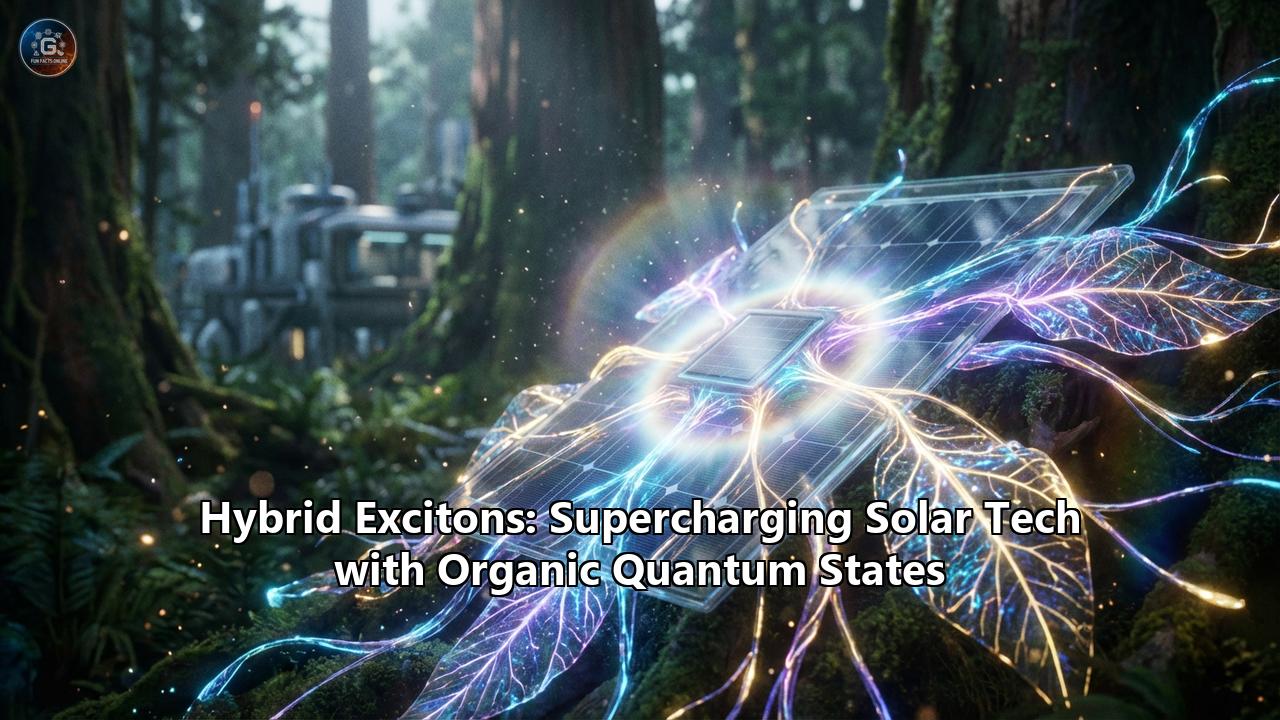
By marrying the flexibility of organic molecules with the raw power of inorganic semiconductors, scientists have unlocked a new state of matter—Hybrid Excitons. Combined with the "magic" of Organic Quantum States, this technology promises to shatter the old efficiency limits, turning what was once waste heat into usable electricity and ushering in a new era of hyper-efficient, next-generation solar technology.
The Silicon Ceiling: Why We Need a Quantum Leap
To understand why hybrid excitons are such a game-changer, we first need to look at the limitations of the incumbent king: Silicon.
In a standard silicon cell, a photon (light particle) strikes the material and knocks an electron loose, creating an "electron-hole pair." This pair is the exciton. The goal is to separate them before they snap back together (recombine).
- The Goldilocks Problem: Silicon is picky. If a photon has too little energy, it passes right through. If it has too much (like blue or UV light), the silicon absorbs it, but the extra energy is instantly wasted as heat vibration.
- The 1-to-1 Rule: No matter how energetic the photon is, it generally creates only one electron-hole pair. One unit of light in, one unit of current out.
This is where the 33% efficiency limit comes from. We are essentially throwing away the high-energy portion of the solar spectrum. We needed a material that could "multitask"—one that could handle high-energy photons more intelligently.
Enter the Hybrid: The Best of Both Worlds
Materials science has traditionally been divided into two camps:
- Inorganics (Silicon, Gallium Arsenide, 2D materials): These are the "highways." They are rigid, ordered, and excellent at transporting electrons quickly over long distances.
- Organics (Carbon-based polymers, small molecules): These are the "sponges." They are flexible, chemically tunable, and have unique quantum properties, but they are generally terrible at moving electricity efficiently.
For years, researchers tried to mix them, but the interface—the boundary where the two materials meet—was always a chaotic mess. Electrons would get stuck, or energy would be lost trying to jump the gap.
The Breakthrough: In late 2024 and throughout 2025, researchers (notably teams from universities in Germany and the US) utilized advanced "momentum microscopy" to reveal a stunning phenomenon. When you perfectly layer a single sheet of a 2D inorganic semiconductor (like Tungsten Diselenide, WSe2) with a specific organic coating, the excitons don't just sit on one side or the other.They hybridize.
A "Hybrid Exciton" is a quantum state where the electron resides in the inorganic layer (the highway) while its partner, the "hole," resides in the organic layer (the sponge). They remain bound together by quantum forces across the interface, moving as a single entity.
Why This Matters:
- Ultrafast Transfer: Energy moves between these layers in femtoseconds (quadrillionths of a second). This is faster than the time it takes for the energy to be lost as heat.
- Tunability: Because the organic layer can be chemically tweaked, we can "program" the solar cell to absorb specific wavelengths of light that silicon usually misses.
Organic Quantum States: The "Buy One, Get One Free" Effect
The most exotic capability of these hybrid systems comes from the "Organic Quantum States" mentioned in the title. This is where the physics gets truly weird—and incredibly profitable for energy generation.
In the quantum world of organic molecules, energy states come in "flavors," primarily Singlets and Triplets.
- Singlet State: The standard excited state created when light hits a molecule. Short-lived and bright.
- Triplet State: A "dark" state that is long-lived but usually hard to access directly with light.
The Magic of Singlet Fission
In specific organic materials (like pentacene or tetracene), a remarkable process called Singlet Fission occurs. When a high-energy blue photon hits the molecule, it creates a high-energy Singlet exciton. But instead of decaying, this Singlet splits itself into two Triplet excitons, each carrying half the energy.
In a standard solar cell, a blue photon gives you one electron.
In a Singlet Fission hybrid cell, a blue photon gives you two electrons.
This process effectively doubles the current generated from the high-energy part of the solar spectrum. By placing a Singlet Fission layer on top of a standard inorganic cell, we can boost the theoretical efficiency limit from ~33% to over 45%.
The "Dark" Energy Reservoir
For years, "Triplet" excitons were considered a nuisance. They were "dark" states—they didn't emit light and were hard to harvest. They would often trapped energy until it died out as heat.
The new hybrid architecture changes this. The inorganic 2D layer acts as a perfect "drain" for these dark states. The Hybrid Exciton state acts as a bridge, allowing the energy stored in these long-lived organic triplets to flow effortlessly into the inorganic semiconductor where it can be collected as electricity. We are essentially tapping into a reservoir of energy that was previously invisible to our solar panels.
From Lab to Fab: What Does This Look Like?
You might be picturing a standard blue silicon panel, and you wouldn't be entirely wrong. The first generation of this technology will likely be "tandem" cells—standard silicon wafers coated with a nanometer-thin layer of these organic-inorganic hybrids.
However, the future is far more radical:
- Transparent Solar Windows: Because hybrid excitons can be tuned to absorb only UV and Infrared light (letting visible light pass through), skyscrapers could become massive, invisible power plants.
- Flexible "Solar Skins": The organic component makes these materials bendable. Imagine coating electric cars in a "solar paint" that constantly recharges the battery using these high-efficiency quantum states.
- Low-Light Performance: The "dark" triplet states are incredibly long-lived. This means the charge carriers stick around longer, potentially allowing these panels to harvest energy more effectively in diffuse light, dawn, and dusk.
The Challenges Ahead
Despite the excitement, hurdles remain:
- The "Interface" Problem: Creating the perfect contact between organic and inorganic layers requires atomic precision. A single speck of dust or a molecular misalignment can kill the quantum state.
- Stability: Organic molecules are notorious for degrading under UV light and oxygen—the very things a solar panel faces daily. Engineers are currently developing "encapsulation" barriers to protect these delicate quantum states for 25+ years.
- Scalability: We can make these perfect hybrids in a vacuum chamber in a lab. Printing them by the square kilometer at a competitive cost is the next great engineering challenge.
Conclusion: The Quantum Era of Energy
We are standing on the precipice of a shift in how we generate power. For decades, we treated sunlight as a bulk commodity—dumping photons into silicon and hoping for the best.
Hybrid Excitons and Organic Quantum States represent a shift to precision energy engineering. By manipulating individual quantum states, splitting photons, and harnessing the unique dance of electrons at the atomic interface, we aren't just improving solar power; we are redefining its limits.
The sun has always been the ultimate power source. Now, thanks to the marriage of organic chemistry and quantum physics, we are finally building a bucket big enough—and smart enough—to catch it all.
Reference:
- https://pubs.acs.org/doi/10.1021/nl104202j
- https://spie.org/news/5985-beyond-the-shockley-queisser-limit-with-singlet-exciton-fission
- https://ph.qmul.ac.uk/sites/default/files/u75/Solar%20cells_environmental%20impact.pdf
- https://scitechdaily.com/new-quantum-hybrid-excitons-could-supercharge-solar-technology/
- https://www.spacedaily.com/reports/Hybrid_excitons_speed_ultrafast_energy_transfer_at_2D_organic_interface_999.html
- https://www.cam.ac.uk/research/news/hybrid-materials-could-smash-the-solar-efficiency-ceiling
- https://csmb.hu-berlin.de/hybrid-excitons/
- https://impactful.ninja/new-hybrid-quantum-particles-boost-solar-energy-potential/