
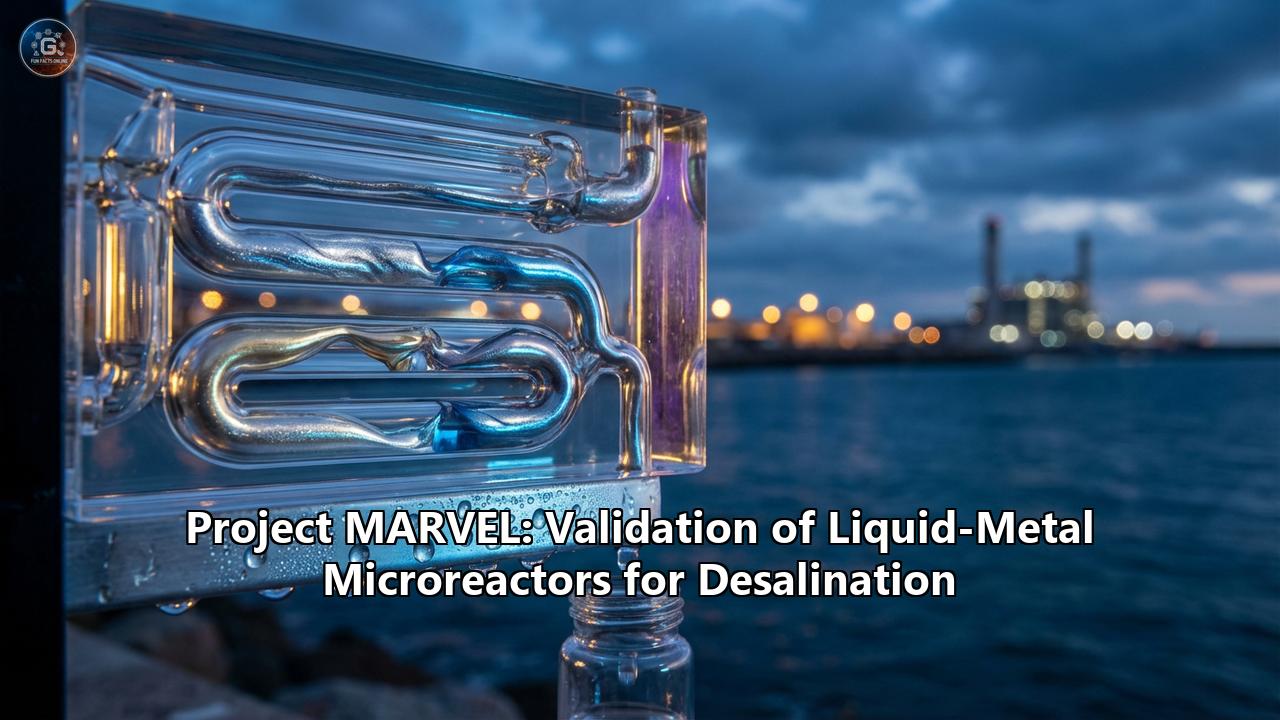
In the high desert of eastern Idaho, inside a facility that has stood silent witness to the atomic age for decades, a revolution is being assembled. It is not a towering concrete dome or a massive cooling tower that dominates the skyline. Instead, it is a machine small enough to fit in the back of a semi-truck, yet powerful enough to change the destiny of remote communities, water-starved nations, and the global energy industry.
This is Project MARVEL—the Microreactor Applications Research Validation and EvaLuation project.
Led by the U.S. Department of Energy’s (DOE) Idaho National Laboratory (INL), MARVEL is not just another experiment; it is the first new nuclear reactor to be built at INL in over four decades. More importantly, it is the vanguard of a new era: the age of the liquid-metal microreactor.
While the world debates the future of massive gigawatt-scale power plants, MARVEL is proving that good things come in small packages. By harnessing the unique thermal properties of a sodium-potassium (NaK) alloy coolant and pairing it with advanced desalination technology, MARVEL is poised to solve one of humanity’s most intractable problems: the scarcity of clean, fresh water.
This article delves deep into the heart of Project MARVEL. We will explore the cutting-edge physics behind its design, the "produced water" crisis it aims to solve for the oil and gas industry, the regulatory breakthroughs it is pioneering, and the future it promises for a thirsty planet.
Part I: The Genesis of MARVEL
The Microreactor Imperative
For the last half-century, the nuclear industry has been driven by a philosophy of "economies of scale." To make nuclear power cheap, the thinking went, you had to build it big. But this approach left behind a vast segment of the world's energy market. Remote Alaskan villages, island nations, military forward operating bases, and disaster relief zones rely on expensive, polluting diesel generators because a 1,000-megawatt nuclear plant is simply too large and complex for their needs.
Enter the microreactor. Defined as a reactor that generates less than 20 megawatts of thermal energy, these systems are "nuclear batteries"—factory-built, transportable, and designed to run for years without refueling.
However, a "chicken and egg" problem has stalled the industry. Commercial developers have brilliant designs on paper, but they lack the operational data to prove to regulators that these radical new designs are safe. They cannot get a license without data, but they cannot build a reactor to get that data without a license.
Project MARVEL was conceived to break this cycle. It is a DOE-authorized test bed, a rapid-prototyping project designed to be built quickly and cheaply to generate the validation data that private industry desperately needs.
The Return of the TREAT Facility
MARVEL is being constructed inside the Transient Reactor Test (TREAT) Facility at INL. TREAT is hallowed ground in nuclear engineering. Built in the late 1950s, it was designed to subject nuclear fuel to extreme bursts of power to see how it held up under accident conditions.
Choosing TREAT as the home for MARVEL was a masterstroke of logistical strategy. The facility already has the thick concrete shielding, the security perimeter, and the skilled workforce necessary to handle nuclear materials. By placing MARVEL inside an existing shielded pit at TREAT, the project team avoided hundreds of millions of dollars in new construction costs and shaved years off the timeline.
The timeline for MARVEL is blistering by nuclear standards.
- Design Finalization: Achieved 90% completion in late 2023.
- Fabrication: Major components, including the primary coolant system, began fabrication in early 2025.
- Assembly: On-site assembly kicks off in 2025.
- Fuel Loading & Criticality: Expected by 2027.
- Operations: Full testing scheduled for 2028–2030.
This speed is intentional. MARVEL is a demonstration of agility, proving that nuclear infrastructure can be deployed as rapidly as the renewable technologies it is meant to complement.
Part II: The Machine – Inside the Sodium-Potassium Core
To understand why MARVEL is special, one must look under the hood. Unlike the commercial reactors that power our cities, which use water under extreme pressure to cool the fuel, MARVEL uses a liquid metal: a eutectic alloy of sodium and potassium (NaK).
Why Liquid Metal?
Water is a good coolant, but it has a fatal flaw: it boils at $100^\circ$C. To keep it liquid at the $300^\circ$C temperatures needed for power generation, you must pressurize it to over 150 atmospheres. This requires massive, thick steel vessels and complex piping that can withstand explosive pressures.
NaK, on the other hand, is a liquid at room temperature (it looks like mercury but is much lighter) and does not boil until it reaches a scorching $785^\circ$C.
This physical property changes the entire safety paradigm. MARVEL operates at high temperatures (around $500-550^\circ$C) but at near-atmospheric pressure. The reactor vessel doesn't need to be a thick pressure cooker; it can be a simple, thin-walled stainless steel canister. If a leak were to occur, the coolant wouldn't explode into steam; it would simply leak out like oil from an engine.
The Heart of the System: Natural Circulation
The most elegant feature of MARVEL is its reliance on natural circulation.
In a traditional reactor, massive electric pumps force the coolant through the core. If those pumps fail (as they did at Fukushima), the reactor is in trouble. MARVEL has no primary pumps. None.
It relies on simple thermodynamics: hot fluid rises, and cold fluid sinks. As the uranium fuel heats the NaK, the liquid becomes lighter and floats up through the core. It travels to a heat exchanger where it gives up its energy, cools down, becomes heavier, and sinks back to the bottom to start the cycle again.
This "passive safety" system is immutable. You cannot "turn off" gravity. If the reactor loses all electrical power, the coolant keeps circulating naturally, removing decay heat and keeping the core safe indefinitely.
Key Technical Specs:- Thermal Output: 85 kW (roughly equivalent to the engine of a small car).
- Electrical Output: ~20 kW (enough to power a small street or a critical facility).
- Fuel: Uranium-Zirconium Hydride (U-ZrH), a "self-regulating" fuel used in research reactors worldwide (TRIGA type). As this fuel gets hotter, it naturally becomes less efficient at sustaining the chain reaction, acting as an automatic brake on power excursions.
- Coolant Loops: Four independent loops transfer heat from the core to the intermediate stage, ensuring redundancy.
The PCAT Validation
Before loading a single gram of uranium, INL engineers built a full-scale, electrically heated replica of the reactor called the Primary Coolant Apparatus Test (PCAT).
Running throughout 2024 and 2025, PCAT was critical. It proved that the natural circulation concept worked exactly as the computer models predicted. It also led to a crucial design pivot: the original plan to use Stirling engines (pistons driven by heat) for heat removal caused too much vibration. Thanks to PCAT testing, the team swapped to a more stable, radiator-like thermoelectric conversion system for the final design, ensuring the reactor would run whisper-quiet.
Part III: The "Produced Water" Revolution
While the physics of MARVEL are fascinating, the application is what makes it a game-changer. In December 2025, INL announced a landmark partnership that defines the commercial soul of this project.
The partners are Shepherd Power (a subsidiary of the oil and gas giant NOV) and ConocoPhillips. Their goal? To use MARVEL to solve the "produced water" crisis in the Permian Basin.
The Invisible Waste of the Oil Age
For every barrel of oil extracted from the ground in places like West Texas, producers also bring up 4 to 10 barrels of "produced water." This is not fresh water; it is a toxic, salty brine, laden with heavy metals, radioactive isotopes, and chemical residues.
Historically, oil companies have dealt with this water by injecting it back underground into deep disposal wells. But this practice has had unintended consequences. The sheer volume of injected water has lubricated ancient fault lines, causing a dramatic spike in earthquakes in regions that were previously geologically stable.
Regulators are cracking down. Injection limits are being tightened, and costs are skyrocketing. Simultaneously, these same regions are facing historic droughts. We are throwing away billions of gallons of water because it is too expensive to clean, while aquifers run dry.
The Nuclear Desalination Solution
Current desalination technologies, like Reverse Osmosis (RO), are energy hogs. Cleaning produced water—which can be five times saltier than the ocean—requires immense pressure and electricity. Doing this with diesel generators is too expensive and carbon-intensive.
This is where MARVEL steps in.
Nuclear desalination is the "killer app" for microreactors. The MARVEL system provides two things that desalination plants crave:
- Electricity: To run the high-pressure pumps.
- High-Grade Waste Heat: This is the secret weapon.
In a standard power plant, 60% of the energy is wasted as heat. MARVEL is designed to capture this heat. By coupling the reactor with a thermal desalination unit (like Multi-Effect Distillation or thermally-enhanced RO), the system can boil or separate the water much more efficiently than electricity alone.
The Economics:Shepherd Power and ConocoPhillips are targeting a treatment cost of $0.30 to $0.40 per barrel. If they can hit this target, they flip the economic model of the oil industry upside down. Instead of paying to dispose of wastewater, companies could turn a liability into an asset—fresh water for agriculture, hydrogen production, or municipal use.
This pilot program with MARVEL will be the first time in history that a modern microreactor is physically coupled to a produced water treatment facility to validate this synergy.
Part IV: The Regulatory Bridge
One of the most significant, yet invisible, contributions of Project MARVEL is its role as a regulatory icebreaker.
The United States has two pathways for nuclear reactors:
- NRC Licensing: The rigorous, expensive process for commercial power plants (10 CFR Part 50/52).
- DOE Authorization: A streamlined process for research reactors located on government sites, overseen by the DOE itself.
MARVEL is a DOE-authorized reactor. This allows INL to move fast and take calculated risks that a commercial startup could not afford. However, the data MARVEL generates is being collected in strict accordance with NRC Quality Assurance standards (NUREG-1537).
This strategy creates a "bridge." Commercial startups like Aalo Atomics (which is developing a larger 20 MW version inspired by MARVEL) can use the data from MARVEL's fuel performance, coolant chemistry, and natural circulation stability to validate their own computer codes.
When Aalo or Shepherd Power goes to the NRC to license their commercial fleets, they won't be handing over theoretical models. They will be handing over hard data from an operating liquid-metal reactor. This precedent—using a government test bed to de-risk commercial licensing—is akin to NASA testing rocket engines before SpaceX flies them. It significantly lowers the barrier to entry for new nuclear companies.
The Shepherd Power Model
Shepherd Power is particularly interesting because it represents a new kind of nuclear customer. They are not a utility company. They are an industrial service provider. Their business model is "Energy-as-a-Service."
They plan to own and operate fleets of microreactors, deploying them to oil fields, mines, or data centers. The customer (e.g., ConocoPhillips) doesn't buy the reactor; they just buy the heat and water it produces. This model removes the capital risk from the end-user and could be the key to mass adoption.
Part V: Beyond Desalination – The Global Future
While the immediate focus is on Texas oil fields, the implications of MARVEL’s success extend to every corner of the globe.
Water Security in the Global South
Consider the drought-stricken regions of North Africa and the Middle East. Nations like Jordan and Morocco are facing existential water crises. Large coastal desalination plants are energy-intensive and bind these nations to fluctuating fossil fuel prices.
A fleet of MARVEL-style microreactors could be deployed to coastal towns or inland brackish aquifers. Because these reactors are air-transportable and require refueling only once every 10-20 years, they provide energy sovereignty. A nation doesn't need a pipeline or a rail line to keep the power on; once the reactor is delivered, the energy is secured for a decade.
Disaster Relief and Defense
The U.S. military is a key observer of the MARVEL project. The Department of Defense's Project Pele is also developing a mobile microreactor. MARVEL complements this by validating the liquid-metal approach.
Imagine a hurricane strikes a Caribbean island, destroying the grid and contaminating the water supply. Today, we send diesel generators, which require a constant, vulnerable supply chain of fuel ships. In the future, a C-17 transport plane could land with a containerized microreactor. Within days, it could be producing megawatts of power and hundreds of thousands of gallons of clean water, running autonomously for the duration of the recovery.
The "Nuclear Battery" for Data Centers
A surprising new demand for microreactors is emerging from Silicon Valley. AI data centers are consuming power at an alarming rate. Tech giants are desperate for 24/7, carbon-free power that can be deployed on-site, bypassing the congested electrical grid.
The MARVEL design—compact, silent, and safe—is perfect for this. The "Shepherd Power" model of owning and operating the reactor on behalf of the customer applies perfectly to Amazon, Google, or Microsoft. The reliability of a NaK-cooled reactor, with its passive heat removal, offers the "five nines" (99.999%) uptime that the tech industry demands.
Part VI: Challenges and The Road Ahead
Despite the optimism, the road for MARVEL is not without potholes.
Supply Chain Fragility:The fabrication of the MARVEL coolant system by Carolina Fabricators is a success story, but it highlights a weakness. The U.S. supply chain for nuclear-grade components has atrophied. Rebuilding the industrial base to mass-produce these reactors—not just hand-build one test unit—is a monumental task.
Fuel Availability:MARVEL uses HALEU (High-Assay Low-Enriched Uranium) fuel. Currently, the commercial supply of HALEU is limited, with Russia historically being a major supplier. The U.S. is racing to build domestic enrichment capacity (via companies like Centrus Energy), but ensuring a steady supply for a future fleet of thousands of microreactors remains a strategic bottleneck.
Public Perception:While the engineering case for NaK safety is ironclad, the public remains wary of "liquid metal" and "nuclear" in the same sentence. The legacy of early sodium reactors (some of which had leak issues) must be overcome. MARVEL’s primary mission is not just technical validation, but social validation. Operating safely, transparently, and boringly for three years will do more to win public trust than any white paper ever could.
Conclusion: The Little Reactor That Could
Project MARVEL is small. It produces less power than a single diesel engine at a Walmart. Yet, its significance is colossal.
It represents a pivot in the philosophy of nuclear energy—from "cathedrals of power" to "appliances of utility." By validating the liquid-metal platform, MARVEL is opening the door to a future where nuclear energy is flexible, mobile, and intimately connected to the needs of industry and humanity.
The desalination pilot with Shepherd Power is the first glimpse of this future. It is a future where we stop fighting wars over oil and water, because we have the technology to treat one and synthesize the other.
As the snow falls on the Idaho desert and the technicians at the TREAT facility tighten the final bolts on the containment vessel, they are not just building a machine. They are building a prototype for a world of abundance.
The age of the nuclear battery has arrived, and it is starting with a MARVEL.
Reference:
- https://inl.gov/news-release/national-lab-south-carolina-company-partner-to-build-coolant-system-for-microreactor-demonstration/
- https://www.ans.org/news/2025-02-24/article-6791/fabrication-milestone-for-inls-marvel-microreactor/
- https://inldigitallibrary.inl.gov/sites/sti/sti/Sort_74969.pdf
- https://inldigitallibrary.inl.gov/sites/sti/sti/Sort_132605.pdf
- https://info.ornl.gov/sites/publications/Files/Pub120768.pdf
- https://medium.com/@mattloszak/aalo-atomics-to-commercialize-scaled-up-marvel-microreactor-54419867f4d3
- https://docs.txoga.org/files/4642-nuclear-permian-nick-morriss.pdf
- https://www.hoganlovells.com/en/publications/how-federal-agencies-are-exercising-reactor-authority-without-the-nrc-
- https://www.thecooldown.com/green-tech/marvel-project-coolant-system-nuclear-reactors/
- https://www.eurekalert.org/news-releases/1092957