
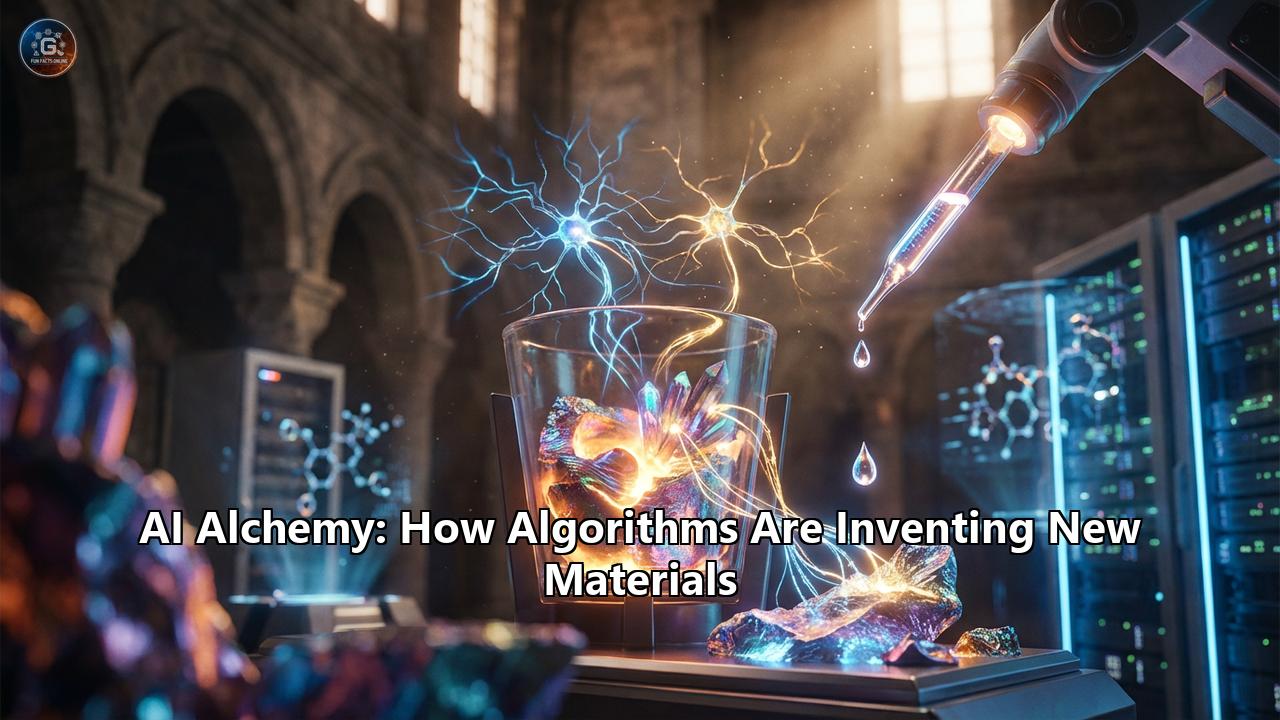
For centuries, alchemists toiled in smoke-filled laboratories, driven by a singular, obsessive dream: the transmutation of base matter into gold. They mixed mercury with sulfur, boiled lead with strange salts, and consulted mystic texts, hoping to stumble upon the Philosopher’s Stone—a legendary substance that could unlock the secrets of matter itself. They failed, of course. But in their failure, they laid the messy, trial-and-error foundations of modern chemistry.
Today, the smoke has cleared, and the laboratory has gone digital. The modern alchemist does not wear a robe or chant incantations. Instead, they wield algorithms. They work with neural networks that dream of crystal structures no human has ever seen. They command robotic arms that mix chemicals with the precision of a surgeon, twenty-four hours a day, without ever taking a coffee break.
We are witnessing the dawn of AI Alchemy. It is a revolution that promises to do what the ancients could not: transmute our understanding of the physical world to invent materials that are lighter, stronger, more conductive, and more sustainable than anything found in nature. From batteries that charge in minutes to sponges that suck carbon dioxide out of the sky, the algorithms are not just analyzing materials; they are inventing them.
This is the story of how artificial intelligence is rewriting the periodic table of possibilities.
Part I: The Edisonian Bottleneck
To understand the magnitude of this revolution, we must first understand the tyranny of the status quo. For the last century, materials science has largely followed the "Edisonian" method—named after Thomas Edison’s famous hunt for a lightbulb filament. Edison famously tested thousands of materials—from platinum to beard hair—before settling on carbonized bamboo.
This approach is effective, but it is brutally inefficient. It relies on intuition, luck, and brute force. A scientist might have a hunch that doping a ceramic with a bit of yttrium will make it a better superconductor. They mix the powder, bake it in a furnace, examine the result under a microscope, and test its resistance. If it fails, they tweak the ratio and try again. A single discovery can take decades. The journey from the lab bench to a commercial product often spans 15 to 20 years.
The problem is the sheer vastness of chemical space. If you take just a handful of elements from the periodic table and combine them in different ratios, the number of possible combinations exceeds the number of atoms in the observable universe. We have barely scratched the surface. Humans have experimentally identified roughly 20,000 stable inorganic crystals in all of history.
That was the limit. Until the machines woke up.
Part II: The Paradigm Shift—Inverse Design
The fundamental shift AI brings is a move from screening to inverse design.
In the traditional model, you take a material and ask, "What properties does this have?"
In the AI model, you ask, "I want a material with these properties—high conductivity, heat resistance, and no toxic cobalt. What is its chemical formula?"
This is a mathematical problem that is impossible for a human brain to solve backwards. But for a deep learning model, it is a pattern-matching game. By training on databases like the Materials Project—an open-source initiative that catalogs the properties of tens of thousands of known materials—AI models learn the hidden rules of chemistry. They learn how atomic radii, electron configurations, and crystal symmetries dictate a material's behavior.
Once the model "groks" these rules, it can hallucinate new structures. It creates candidates that don't exist yet, predicting their stability and properties in seconds, a task that would take a supercomputer weeks to simulate using traditional quantum mechanics equations (like Density Functional Theory, or DFT).
Part III: The Titans of Discovery
In late 2023 and early 2024, the world saw two massive demonstrations of this power, signaling that the era of AI materials science had truly arrived.
1. Google DeepMind and GNoME
The first shockwave came from Google DeepMind. The team behind AlphaFold (which solved the structure of proteins) turned their attention to inorganic crystals. They built a tool called GNoME (Graph Networks for Materials Exploration).
GNoME treats atoms and chemical bonds like a graph—a network of nodes and edges. It was trained on existing crystal data and then set loose to generate new stable structures. The results were staggering. In a single paper published in Nature, DeepMind announced that GNoME had discovered 2.2 million new crystals.
To put that in perspective, that is nearly 800 years' worth of human knowledge generated in a few weeks of computing time.
Of those 2.2 million, roughly 380,000 were predicted to be "thermodynamically stable," meaning they wouldn't just disintegrate immediately. These weren't just random jumbles of atoms; they included:
- 52,000 new layered compounds similar to graphene, potentially revolutionary for electronics.
- 528 new lithium-ion conductors, crucial for next-gen batteries.
Critics initially asked, "But are they real?" To prove it, an autonomous lab at Lawrence Berkeley National Laboratory (the A-Lab) successfully synthesized 41 of these new materials in just 17 days. The algorithms were not just dreaming; they were predicting reality.
2. Microsoft and the Azure Quantum Elements
While Google was mapping the broad universe of crystals, Microsoft focused on a sniper shot. Collaborating with the Pacific Northwest National Laboratory (PNNL), they utilized their Azure Quantum Elements platform to solve a specific, urgent problem: the lithium shortage.
Lithium is the "white gold" of the EV revolution, but mining it is expensive and environmentally taxing. The goal was to find a battery electrolyte that used significantly less lithium.
Microsoft’s AI screened 32 million potential candidates.
In the pre-AI era, this screening would have taken 20 years of supercomputing time.
The AI did it in 80 hours.
It narrowed the field to 500,000 candidates, then to 800, then to 18. PNNL scientists looked at the top 18, picked one that looked promising, and synthesized it. The result? A working battery material that used 70% less lithium by swapping it with sodium. From 32 million concepts to a working lightbulb in the lab took less than nine months.
Part IV: The Engines of Creation
How do these algorithms actually work? They aren't just looking up data in a spreadsheet. They are using advanced architectures that mimic the way nature works.
Graph Neural Networks (GNNs):Imagine a crystal structure. You have atoms (nodes) connected by bonds (edges). GNNs are excellent at understanding this topology. They look at a neighborhood of atoms—say, a lithium atom surrounded by six oxygen atoms—and learn how that local geometry affects the whole crystal's energy. GNoME uses this to predict "formation energy," effectively asking: If I put these atoms together, will they stay together, or will they fly apart?
Generative Diffusion Models:Similar to how AI art generators like Midjourney start with static noise and refine it into a picture of a cat, "MatterGen" models start with a cloud of random atoms and slowly nudge them into a structured crystal lattice that minimizes energy. You can "prompt" these models just like you prompt ChatGPT: "Generate a crystal structure that is stable, has a bandgap of 1.5 eV, and contains no toxic elements."
Self-Driving Laboratories (SDLs):This is where the digital meets the physical. An AI can predict a material, but someone has to make it. Enter the "Robochemist."
Labs like the A-Lab at Berkeley or the University of Toronto’s Acceleration Consortium are filled with robotic arms, automated furnaces, and liquid handling systems.
- The AI suggests a recipe.
- The robot mixes the powder.
- The robot bakes it.
- An X-ray machine scans the result.
- Crucially, if the experiment fails, the AI learns. It sees how it failed and adjusts the recipe for the next run. This "closed-loop" system allows the lab to iterate hundreds of times a day, learning from failure faster than any human could.
Part V: The New Material Age
So, what are we actually going to build with this technology? The applications are as broad as the physical world itself.
1. The Holy Grail of Batteries
We are desperate for better energy storage. Solid-state batteries (which replace flammable liquid electrolytes with solid stones) are the target. AI is hunting for solid electrolytes that conduct ions as fast as liquids but don't catch fire. We are looking for fluoride-ion batteries, magnesium batteries, and sodium batteries to end our reliance on conflict minerals like cobalt.
2. Carbon Capture Sponges
To fight climate change, we need to pull CO2 out of the air. The best materials for this are Metal-Organic Frameworks (MOFs). Think of MOFs as molecular sponges with incredibly high surface areas—a sugar-cube-sized chunk of MOF can have the surface area of a football field.
The number of possible MOF structures is effectively infinite. AI is currently scanning billions of these structures to find ones that specifically trap CO2 while letting oxygen and nitrogen pass, and—critically—don't disintegrate when they get wet (a common failing of early MOFs).
3. Superalloys and Extreme Environments
For hypersonic jets and fusion reactors, we need metals that remain strong at temperatures where steel would turn to soup. AI is designing "High Entropy Alloys"—chaotic mixes of five or six different elements that, paradoxically, create incredibly stable and heat-resistant metals.
4. Green Plastics
We are drowning in plastic waste. AI is designing polymers that are chemically programmed to self-destruct or depolymerize on command. These "vitrimers" behave like strong plastics during use but can be melted down and reformed endlessly like glass, solving the recycling deadlock.
Part VI: The "Synthesizability" Gap
Despite the hype, there is a massive elephant in the room. It is called the Synthesizability Gap.
GNoME can predict a crystal that is perfectly stable and has magical properties. But it doesn't tell you how to make it. Does it need to be baked at 1000°C? 2000°C? Does it need high pressure? Does it need a specific solvent?
Many AI-predicted materials are "metastable"—they can exist, but getting the atoms to arrange in that specific way is like trying to balance a pencil on its tip. It’s possible, but nature fights you.
This is the current frontier of research. We are moving from "Structure Prediction" to "Synthesis Prediction." New AI models are being trained not just on crystal structures, but on millions of text logs from failed experiments, learning to predict the recipe alongside the material. The goal is to give the robotic lab not just a picture of the destination, but a GPS map of how to get there.
Part VII: The Human Element
Will this replace scientists? Unlikely. But it will change them.
The "lab rat" era of pipetting liquids by hand is ending. The material scientist of 2030 will be a conductor of an orchestra. They will define the high-level goals ("Find me a non-toxic solar cell material"), critique the AI's suggestions, and troubleshoot the robotic platforms.
Creativity will shift from manual execution to high-level hypothesis generation. The AI is the engine, but the human is the steering wheel. We are moving from "artisanal science" to "industrialized discovery."
Conclusion: The Philosopher’s Stone
We are standing on the precipice of a Golden Age of Materials. For all of human history, we were limited to the materials we could find in the dirt or accidentally cook up in a kiln. We built the Bronze Age on bronze, the Iron Age on iron, and the Silicon Age on silicon.
The next age has no single name. It is the Age of Choice.
With AI, we are no longer scavengers of the periodic table. We are architects. We can design materials to fit our needs, rather than shrinking our needs to fit our materials. The algorithms have handed us the Philosopher’s Stone, and while it may not turn lead into gold, it is doing something far more valuable: it is turning data into the building blocks of a sustainable future.
The alchemy of the 21st century is here, and it is electric.
Reference:
- https://www.researchgate.net/publication/387494534_Powering_the_Future_How_AI_is_Revolutionizing_Battery_Technology_and_Energy_Sustainability
- https://www.marketsandmarkets.com/ResearchInsight/ai-impact-lithium-ion-battery-industry.asp
- https://www.monolithai.com/blog/ai-battery-development
- https://www.researchgate.net/publication/391663839_Generative_AI_in_Materials_Science_Accelerating_Discovery_Through_Inverse_Design
- https://www.youtube.com/watch?v=urnRKHSt-s4
- https://medium.com/@shibilahammad/how-ai-is-supercharging-materials-science-inside-deepminds-breakthrough-materials-discovery-a4515395be88
- https://www.theregister.com/2024/04/11/google_deepmind_material_study/
- https://www.sentisight.ai/ai-materials-discovery-gnome-changes-science/
- https://deepmind.google/blog/millions-of-new-materials-discovered-with-deep-learning/
- https://www.latitudemedia.com/news/armed-with-ai-microsoft-found-a-new-battery-material-in-just-two-weeks/
- https://www.forbes.com/sites/moorinsights/2024/01/25/microsoft-uses-ai-and-hpc-to-analyze-32-million-new-materials/
- https://azure.microsoft.com/en-us/blog/quantum/2024/01/09/unlocking-a-new-era-for-scientific-discovery-with-ai-how-microsofts-ai-screened-over-32-million-candidates-to-find-a-better-battery/
- https://news.microsoft.com/source/features/innovation/how-ai-and-hpc-are-speeding-up-scientific-discovery/
- https://www.innovationnewsnetwork.com/ai-breakthrough-discovers-exciting-new-battery-material/41673/
- https://www.microsoft.com/en-us/research/blog/mattergen-a-new-paradigm-of-materials-design-with-generative-ai/
- https://yenra.com/ai20/materials-science-research/
- https://ifp.org/scaling-materials-discovery-with-self-driving-labs/
- https://www.mercatus.org/research/policy-briefs/future-materials-science-ai-automation-and-policy-strategies
- https://www.forbes.com/sites/chuckbrooks/2026/02/01/emerging-technology-convergence-will-shape-our-future/
- https://www.engineering.org.cn/engi/EN/10.1016/j.eng.2024.07.008