
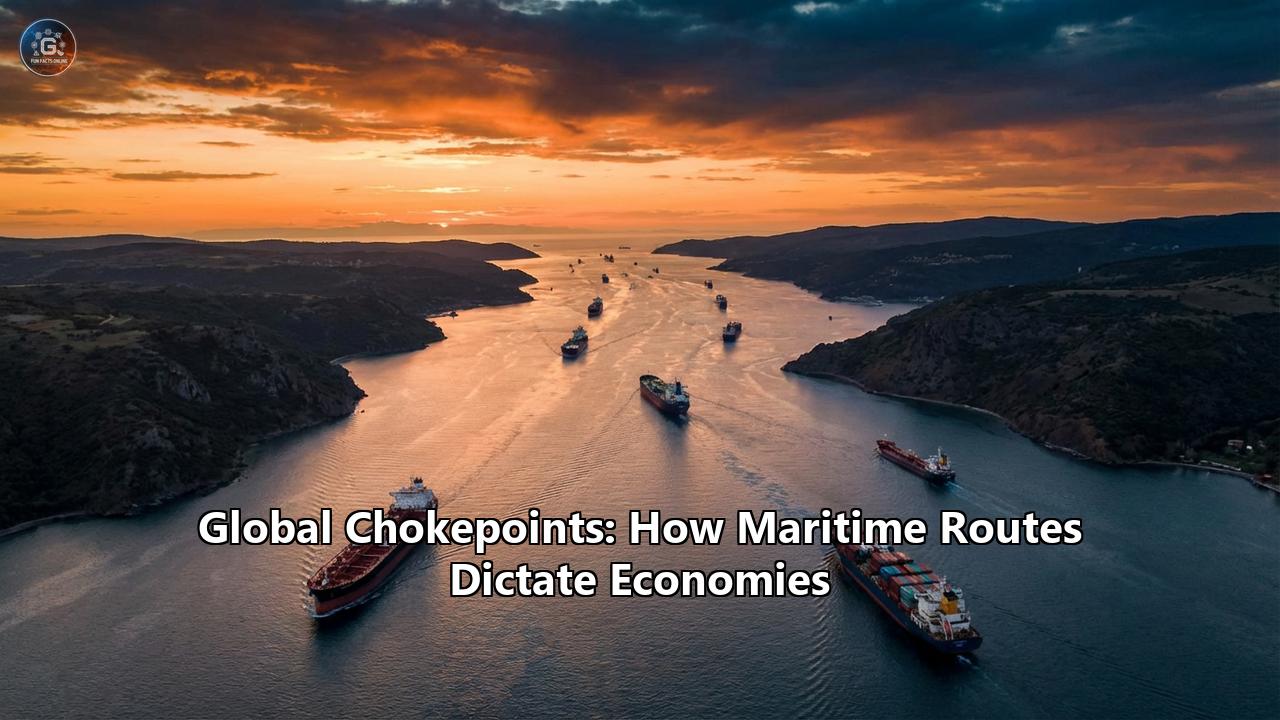
The vast, seemingly boundless expanse of the world’s oceans provides an illusion of infinite freedom for international trade. Yet, beneath the surface of this borderless blue frontier lies a rigid, delicate, and deeply constrained network of nautical highways. The modern global economy—a $100 trillion behemoth driving everything from the microchips in our smartphones to the fuel in our cars and the grain on our tables—does not move freely. It is entirely dependent on a handful of narrow, congested, and increasingly volatile geographic bottlenecks known as maritime chokepoints.
If the oceans are the circulatory system of global commerce, these chokepoints are the vital arteries. When they flow freely, the world humms along in a state of synchronized harmony, with "just-in-time" supply chains delivering goods with quiet efficiency. But when they constrict—whether by the brute force of geopolitics, the unpredictable wrath of climate change, or the catastrophic failure of a single vessel—the resulting economic thrombosis can send shockwaves across continents.
As we navigate through the mid-2020s, the fragility of these maritime corridors has never been more painfully apparent. We have entered an era where localized disruptions rapidly metastasize into global crises. To understand how maritime routes dictate global economies, we must embark on a journey through the most critical geographic pinch-points on Earth, examining the forces threatening them and the staggering economic stakes involved.
The Strait of Hormuz: The Ultimate Energy Trigger
No waterway commands the immediate attention of global financial markets quite like the Strait of Hormuz. Shaped like an inverted V between the southern coast of Iran and the northern tip of Oman and the United Arab Emirates, this passage connects the Persian Gulf to the Gulf of Oman and the Arabian Sea. At its narrowest, the strait is just 21 miles wide, yet its shipping lanes—restricted to just two miles wide in either direction—are the most critical petroleum chokepoints on the planet.
Roughly 20% of the world’s global oil supply, amounting to approximately 18 to 20 million barrels per day, flows through this narrow channel, alongside a quarter of the world's liquefied natural gas (LNG). For decades, the Strait has been viewed as a geopolitical tripwire. In early 2026, the world witnessed exactly what happens when that tripwire is triggered.
Following severe military escalations between the United States, Israel, and Iran, the Strait of Hormuz experienced a near-total collapse in commercial shipping traffic. As retaliatory strikes echoed across the region and warnings from the Islamic Revolutionary Guard Corps blanketed radio frequencies, shipping traffic through the strait plummeted by over 80% in a matter of days. The crisis was not necessarily a physical blockade of ships linked arm-in-arm, but a "de facto" closure driven by astronomical risk. Major shipping lines like Maersk and Hapag-Lloyd suspended operations, while war-risk insurance premiums soared to levels that made transit economically radioactive.
The immediate economic impact was staggering. With almost 10% of the world's Very Large Crude Carrier (VLCC) fleet suddenly trapped inside the Middle East Gulf or refusing to enter, oil prices spiked violently. Over 170 container ships were caught in the logistical crossfire, leaving an estimated 450,000 TEU (twenty-foot equivalent units) of cargo stranded.
When Hormuz sneezes, the global economy catches a cold. An extended disruption in this single 21-mile corridor acts as an immediate tax on global growth. Spiking crude prices directly translate to higher transportation costs, soaring inflation at the consumer level, and the looming threat of industrial recession. Furthermore, the 2026 crisis illuminated a stark reality: despite decades of investment in alternative pipelines and green energy transitions, the world remains terrifyingly reliant on a waterway flanked by active conflict zones.
The Red Sea and Bab el-Mandeb: The Geopolitical Quagmire
Thousands of miles to the west, another critical artery has been bleeding the global economy dry since late 2023. The Bab el-Mandeb Strait—the "Gate of Tears"—is a 20-mile-wide channel separating Djibouti and Yemen. It acts as the southern entrance to the Red Sea and, by extension, the Suez Canal. Historically, this route handled 12% to 15% of all global maritime trade, serving as the ultimate shortcut between European markets and Asian manufacturing hubs.
However, the Red Sea corridor has transformed from a marvel of commercial efficiency into a treacherous gauntlet. Sustained attacks by Houthi militants in Yemen, leveraging sophisticated drones and anti-ship missiles, effectively broke the back of regular commercial transit through the Suez Canal. By 2025 and into 2026, traffic through the Bab el-Mandeb had plummeted to just 35-40% of its pre-crisis volumes.
The economic and logistical fallout of this specific chokepoint failure provides a masterclass in global supply chain economics. Shipping companies were left with a stark choice: run the gauntlet and risk crew lives and multi-million-dollar hulls, or reroute vessels around the Cape of Good Hope at the southern tip of Africa. The vast majority chose the latter.
This detour is mathematically punishing. Rerouting around Africa adds approximately 3,500 to 4,000 nautical miles to a standard Asia-to-Europe voyage, extending transit times by 10 to 14 days. The ripple effects of this geographic detour are profound:
- Fuel Consumption and Environmental Impact: Large container vessels (15,000+ TEU) require an additional 800 to 1,300 tons of fuel to make the African journey. At current fuel prices, this adds $1 million to $1.5 million in costs per single voyage. Environmentally, the Red Sea crisis has been a disaster, with the extended routes increasing shipping-related CO2 emissions by an estimated 40%, directly conflicting with global climate goals.
- Freight Rates and Inflation: In 2025, freight costs on critical Asia-Europe routes quadrupled at their peak and eventually stabilized at levels far above pre-crisis benchmarks.
- The Death of Just-In-Time Manufacturing: For decades, European industries relied on perfectly timed deliveries of Asian components. The extra two weeks of transit obliterated these schedules. Automotive plants faced stalled production lines, and retailers were forced to tie up massive amounts of capital in "safety stock" inventory to hedge against delivery unpredictability.
The Red Sea disruption serves as a potent reminder that maritime trade relies on geopolitical stability. Without it, the world must revert to the 19th-century trade routes of the pre-Suez era, taking on 19th-century costs and delays.
The Panama Canal: When Climate Change Strangles Commerce
While the Middle East grapples with the fires of conflict, the Western Hemisphere’s most vital chokepoint has been fighting a different existential threat: water scarcity. The Panama Canal, an engineering marvel that manages 5% of global maritime trade and links the Atlantic and Pacific oceans, relies entirely on a delicate freshwater ecosystem. Unlike the sea-level Suez Canal, the Panama Canal utilizes a system of locks that lift ships 85 feet above sea level into Gatun Lake. Each transit requires roughly 50 million gallons of freshwater, which is eventually flushed out to sea.
In 2023 and 2024, an unprecedented El Niño-driven drought brought the canal to its knees. Gatun Lake’s water levels dropped to historic lows, forcing the Panama Canal Authority (ACP) to take draconian measures. Pre-drought, the canal handled around 36 to 40 ships a day. During the peak of the crisis, that number was slashed to as low as 18 to 22 daily transits. Furthermore, maximum draft limits were reduced from 50 feet to 44 feet, meaning the ships that were allowed to pass had to do so carrying significantly less cargo.
The economic gridlock was immediate. Desperate shipping lines paid upwards of $500,000 in special slot auctions just to secure priority passage. Many bulk carriers and LNG tankers, effectively boxed out by prioritizing container ships, were forced to navigate around the treacherous tip of South America via Cape Horn or shift entirely to longer Suez routes (which were simultaneously under attack). The drought triggered a 20% to 30% surge in freight rates across key Asia-US East Coast trade lanes, which rely heavily on the canal.
By the 2025 fiscal year, the canal saw a much-needed recovery. Heavy rainfall replenished Gatun Lake, allowing the ACP to rebound to over 13,400 transits for the year, ending the immediate bottleneck. However, the crisis permanently altered the shipping industry’s perception of the Americas' primary trade artery. It proved that climate change is no longer a distant theoretical threat to global logistics, but a clear and present danger capable of halting billions of dollars in trade. In response, Panama is embarking on a massive, $8 billion, multi-year water management initiative, including the planned construction of the Indio River dam by the 2030s. Until then, every dry season brings a renewed sense of anxiety to global supply chain managers.
The Strait of Malacca: Asia’s Lifeline and the "Malacca Dilemma"
Moving eastward, we find the undisputed king of maritime chokepoints by sheer volume: the Strait of Malacca. A 550-mile-long funnel nestled between the Malay Peninsula and the Indonesian island of Sumatra, this strait links the Indian Ocean with the South China Sea and the wider Pacific. It is the shortest and most direct route connecting the Middle Eastern oil fields and European markets to the hyper-industrialized economies of East Asia.
The statistics surrounding the Strait of Malacca defy comprehension. Over 94,000 vessels traverse its waters annually, making it the busiest ocean trade route on Earth. Roughly 25% to 30% of all global seaborne trade by volume passes through this corridor, representing an astonishing $2.8 to $3.5 trillion in cargo value every single year. Furthermore, it handles over 20 million barrels of oil per day and roughly 35-40% of the world's LNG trade.
Unlike the canals, Malacca cannot dry up, but it has a different vulnerability: its geography. At the Phillips Channel in the Singapore Strait, the waterway narrows to just 1.5 nautical miles. This makes it a notorious hotspot for collisions, groundings, and historically, piracy. Though multinational patrols have suppressed violent piracy, opportunistic armed robberies against bulk carriers remain a persistent operational headache.
However, the true weight of the Strait of Malacca is geopolitical. This narrow stretch of water is the focal point of the so-called "Malacca Dilemma"—a term used to describe China's acute strategic vulnerability. Approximately 80% of China’s oil imports transit the Strait of Malacca. The Chinese economy, the second largest in the world, is entirely dependent on the uninterrupted flow of tankers through a chokepoint it does not physically control. The nightmare scenario for Beijing—and by extension, the global economy—is a naval blockade of the strait during a theoretical geopolitical conflict. Such an event would starve East Asia of energy, triggering factory shutdowns, plunging industrial output by an estimated 15% to 25%, and inflicting $5 to $8 billion in global economic damages daily.
The critical nature of Malacca has triggered a frantic race for alternatives. China has poured billions into its Belt and Road Initiative, financing overland pipelines through Myanmar and Pakistan, and developing the port of Gwadar in the Arabian Sea, all in a desperate bid to bypass the Malacca bottleneck. Yet, math remains the ultimate dictator; the sheer volume of raw materials and finished goods required by Asia ensures that the Strait of Malacca will remain the irreplaceable anchor of Eastern commerce.
The Turkish Straits and The Black Sea: The Breadbasket’s Gateway
When discussing maritime chokepoints, the focus typically drifts toward oil and consumer electronics. But when we look at the Turkish Straits—comprising the Bosporus and the Dardanelles—the cargo is often measured in calories and human survival.
The Turkish Straits serve as the sole maritime outlet connecting the Black Sea to the Mediterranean. Governed by the 1936 Montreux Convention, these waterways are exclusively under Turkish control. At its tightest bend, the Bosporus narrows to an incredibly claustrophobic 700 meters, snaking directly through the heart of Istanbul—a dense metropolis of over 15 million people. Operating a 300-meter-long supertanker through this winding corridor, battling sharp turns, heavy civilian ferry traffic, and treacherous cross-currents, is one of the most perilous feats in commercial navigation.
Over 40,000 vessels, including roughly 10,000 tankers, transit the Bosporus annually. The Black Sea region is effectively the agricultural engine of the Eastern Hemisphere. Wheat, barley, corn, and vital fertilizers from Ukraine and Russia flow endlessly through the Turkish Straits to feed populations across Africa and the Middle East. When shipping in the Black Sea is disrupted, the consequences manifest not just in corporate boardrooms, but on the dinner tables of the world’s most vulnerable populations.
The Russia-Ukraine war abruptly transformed the Black Sea from a quiet transit basin into a heavily contested theater of naval and drone warfare. Blockades and the targeting of grain and oil hubs have forced global agricultural markets into chaotic realignments. Furthermore, the straits themselves are vulnerable to environmental disruptions. In the summer of 2025, severe forest fires forced Turkish authorities to entirely suspend shipping traffic through the Dardanelles multiple times to allow amphibious firefighting aircraft to operate safely. This closure bottled up millions of barrels of oil and agricultural exports, proving yet again that a localized natural disaster can instantly sever a global artery.
The Macro-Economic Domino Effect
The collective strain on these five major chokepoints—Hormuz, Bab el-Mandeb, Panama, Malacca, and the Turkish Straits—has birthed a new reality for the global economy: the era of compounding supply chain crises. In previous decades, an incident at a chokepoint was treated as an isolated anomaly (such as the grounding of the Ever Given in the Suez Canal in 2021). Today, disruptions are simultaneous and overlapping.
The economic cost of this fragility is ultimately borne by the consumer. According to recent data from the UN Conference on Trade and Development (UNCTAD), the combination of rerouting vessels away from Panama and the Red Sea drastically increased global vessel demand and squeezed available shipping capacity. Because ships are spending weeks longer at sea, fewer ships are available to pick up new cargo. This synthetic scarcity drives up container freight rates.
UNCTAD projections indicate that sustained friction at these maritime chokepoints contributes tangibly to global inflation, with estimates suggesting global consumer prices could rise by an additional 0.6% purely due to shipping costs. The burden, however, is not shared equally. Small Island Developing States (SIDS) and Least Developed Countries (LDCs), which rely almost exclusively on maritime imports for basic survival, face the harshest impacts. In these vulnerable economies, consumer prices are modeled to climb by nearly 1%, with processed food prices spiking even higher, directly threatening food security.
Furthermore, chokepoint instability creates massive congestion at major transshipment hubs. As schedules are destroyed, ships arrive at ports like Singapore and Mediterranean hubs completely out of sequence, resulting in massive maritime traffic jams. Ships are forced to idle offshore, burning fuel, emitting greenhouse gases, and bleeding money while waiting for berth space.
Adapting to the New Normal: The Future of Maritime Logistics
The realization that global maritime routes are critically vulnerable has triggered a paradigm shift in how international trade is structured. The "just-in-time" supply chain—a hyper-efficient, hyper-fragile model championed over the last thirty years—is quietly being replaced by a "just-in-case" methodology.
Corporations and governments are no longer relying solely on the hope that ships will arrive on time. Strategies like nearshoring and friendshoring are gaining massive traction. Companies are actively migrating manufacturing bases closer to their end consumers—moving operations from East Asia to Mexico or Eastern Europe—to bypass the Pacific, the Panama Canal, and the Red Sea altogether.
Simultaneously, the maritime industry is turning to advanced technology. Major shipping alliances are deploying artificial intelligence and predictive analytics to optimize routes dynamically in real-time, factoring in geopolitical risk, port congestion, and weather patterns.
There is also a growing, albeit controversial, focus on new frontiers, most notably the Arctic. As global temperatures rise and polar ice recedes, the Northern Sea Route (NSR) along Russia's Arctic coast is opening up. The NSR offers a transit between Asia and Europe that is substantially shorter than the Suez Canal route. However, it remains a harsh, poorly mapped environment lacking basic search-and-rescue infrastructure, and relies heavily on Russian icebreakers, presenting a new web of geopolitical complexities.
The Illusion of the Open Ocean
We live on a blue planet, but the water that connects us is bound by invisible chains. The global economy is a spectacular, sprawling network, but it is ultimately beholden to the physical constraints of geography. A drought in Central America, a missile strike in the Middle East, a wildfire in Turkey, or a diplomatic breakdown in East Asia can all trigger the exact same result: empty shelves, surging fuel prices, and economic stagnation.
As we look toward the remainder of the 21st century, it is vividly clear that the health of the global economy will not just be dictated by central bank interest rates, stock market valuations, or technological innovation. It will be dictated, as it has been for centuries, by the ability of a steel hull to safely navigate a narrow strip of water. The maritime chokepoints are the gatekeepers of modern civilization, and the world must learn to navigate their perilous waters with far more resilience, foresight, and respect for their immense power.
Reference:
- https://www.cbsnews.com/news/strait-of-hormuz-iran-oil-prices-us/
- https://www.lloydslist.com/LL1156485/Strait-of-Hormuz-transits-collapse-as-shipping%E2%80%99s-risk-appetite-is-tested
- https://en.wikipedia.org/wiki/2026_Strait_of_Hormuz_crisis
- https://ciltuk.org.uk/news/hormuz-closure-triggers-global-supply-chain-shock-as-oil-shipping-and-air-cargo-disrupted/
- https://www.kpler.com/blog/us-iran-conflict-strait-of-hormuz-crisis-reshapes-global-oil-markets
- https://jtcenergyinsights.com/4-turkish-straits-bosphorus-and-dardanelles/
- https://www.globalpanorama.org/en/2026/01/the-new-black-sea-security-architecture-from-forgotten-periphery-to-europes-strategic-hinge-mehmet-ogutcu-sanford-henry/
- https://bisi.org.uk/reports/montreux-convention-bosphorus-strait-and-the-making-of-naval-power-in-the-black-sea
- https://andamanpartners.com/2025/10/the-worlds-trade-choke-points-six-narrow-straits-that-move-the-global-economy/
- https://www.spglobal.com/energy/en/news-research/latest-news/crude-oil/081125-turkish-forest-fires-suspend-shipping-through-dardanelles-strait