
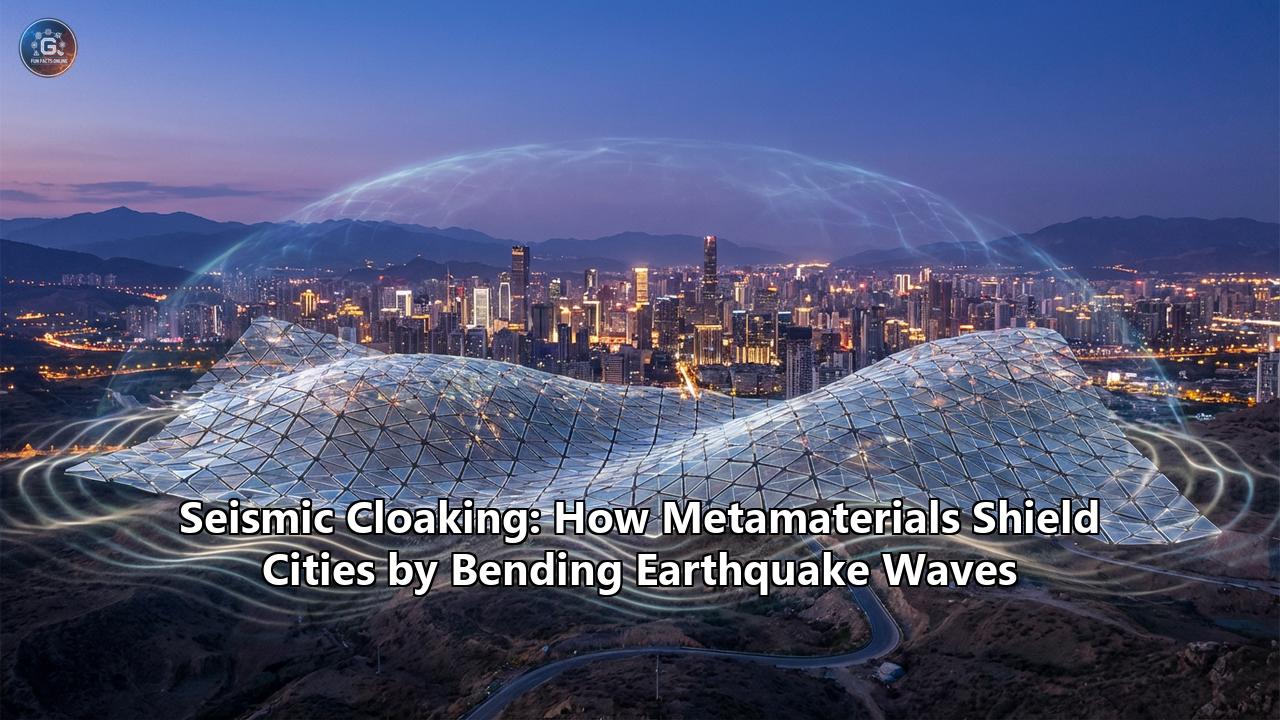
In the annals of civil engineering, the history of earthquake protection has been a singular, unyielding narrative of resistance. For millennia, from the timber pagodas of Japan to the base-isolated skyscrapers of San Francisco, the strategy has remained fundamentally unchanged: bracing against the blow. We build stronger, more flexible, and more massive structures, designing them to absorb, dampen, and survive the violent shaking of the Earth’s crust. We accept the earthquake as an inevitable, immovable force, a hammer that will strike, and we strive only to be a sturdy enough anvil.
But what if we didn’t have to take the hit?
What if, instead of reinforcing a building to withstand a seismic wave, we could command the wave to simply ignore the building? What if we could reach into the fundamental physics of the Earth’s crust and grab the earthquake by its kinetic lapels, bending it, twisting it, and guiding it harmlessly around a city like water flowing around a stone in a stream?
This is not the premise of a science fiction novel, nor is it the idle daydream of a futurologist. It is the burgeoning, rigorous, and mind-bending field of Seismic Cloaking. It is a discipline that sits at the jagged intersection of geophysics, advanced mathematics, and material science, driven by a technology that has already revolutionized optics: Metamaterials. By engineering the very soil beneath our feet into complex, artificial lattices, scientists are proving that we can render massive infrastructure invisible to the destructive power of earthquakes.
The paradigm is shifting. We are moving from the age of resistance to the age of avoidance. We are learning how to make the ground itself an intelligent shield.
Part I: The Physics of the Impossible
To understand how one hides a nuclear power plant from an earthquake, one must first understand how one hides a mouse from a laser beam. The journey of seismic cloaking begins not with rock and soil, but with light and glass.
For centuries, our control over waves—whether light, sound, or ocean swells—was dictated by the natural properties of materials. A lens focuses light because glass is denser than air, slowing the light beams and bending them according to the curvature of the lens. This is governed by the refractive index, a number that nature rigidly assigns to every substance. Air is approximately 1.0; water is 1.33; diamond is 2.42. In nature, this index is always positive. Light enters a material and bends inward, towards the normal.
But in the late 1960s, a Soviet physicist named Victor Veselago asked a question that seemed to violate common sense: What if a material had a negative refractive index?
In a material with a negative index, light wouldn't bend inward; it would bend backward. It would twist in a way that natural laws seem to forbid. If you placed a straw in a glass of "negative water," the straw wouldn't look bent; it would look broken and reversed. Veselago’s mathematics were sound, but the materials didn’t exist. They were theoretical ghosts.
Fast forward to the early 2000s. Sir John Pendry at Imperial College London realized that while we couldn't find these materials in nature, we could build them. By creating microscopic structures—tiny copper rings and wires arranged in precise lattices—we could trick electromagnetic waves into behaving as if they were moving through a negative-index material. These were Metamaterials. They derived their properties not from their chemical composition, but from their structure.
Pendry proposed the ultimate application: an Invisibility Cloak.
By carefully grading the refractive index of a metamaterial shell, one could bend light waves smoothly around an object, causing them to recombine on the other side as if they had traveled through empty space. To an observer looking at the object, it wouldn't just be black or transparent; it would be gone. The light would flow around it like water around a smooth pebble, leaving no reflection and no shadow.
The world was captivated by the optical implications. But a small group of mathematicians and geophysicists saw something else. They saw that the equations governing light (Maxwell’s equations) shared a deep, structural similarity with the equations governing elastic waves in the earth (Navier-Stokes and elastodynamic equations).
If you could bend a light wave around a cup, they reasoned, why couldn't you bend a seismic wave around a city?
Part II: The Hammer of the Earth
To appreciate the audacity of this idea, we must confront the enemy itself: the seismic wave.
When a fault line slips, it releases megatons of energy in a fraction of a second. This energy doesn't travel as a single pulse; it fractures into a chaotic symphony of waves, each with its own personality and destructive potential.
First come the P-waves (Primary waves). These are compressional waves, pushing and pulling the ground like a slinky. They are fast, arriving first, often sounding like a sonic boom or a truck hitting the building. They are startling, but rarely the killers.
Next are the S-waves (Secondary waves). These are shear waves, shaking the ground side-to-side or up-and-down. They move slower than P-waves but carry more energy. They are the ones that crack drywall and topple bookshelves.
But the true destroyers, the waves that flatten cities and crumble bridges, are the Surface Waves: the Rayleigh and Love waves.
Rayleigh waves are monsters. They roll the ground like an ocean swell. A patch of soil experiencing a Rayleigh wave moves in a retrograde ellipse—up, backward, down, and forward. This rolling motion is devastating to buildings, which are designed to support vertical loads (gravity) but are terrible at surviving the tilting, twisting heave of a ground roll. Love waves are equally vicious, shearing the ground horizontally, slicing foundations apart.
These surface waves trap the earthquake's energy in the top few kilometers of the Earth's crust, refusing to let it dissipate deep underground. They travel long distances with little attenuation. When an earthquake in Mexico City destroys buildings hundreds of miles away, it is the surface waves doing the work.
The challenge of cloaking against these waves is one of scale. Light waves are microscopic; their wavelengths are measured in nanometers. To cloak an object from light, your metamaterial structures must be nanoscopic. But seismic waves are giants. Their wavelengths can be hundreds of meters, even kilometers long.
To build a seismic cloak, you don't need nanotechnology. You need megatechnology. You need to structure the Earth itself.
Part III: The French Experiment
The transition from theory to reality began in earnest in 2012, in the foothills of the French Alps. A team led by Sébastien Guenneau from the Institut Fresnel and Stéphane Brûlé from the geoengineering firm Ménard decided to attempt the world’s first large-scale seismic cloaking experiment.
They didn't try to hide a city. They didn't even try to hide a building. They went to a flat field of alluvial basin soil near Grenoble to see if they could hide a "zone of silence."
The team used a massive vibrating crane to act as an artificial earthquake source, pounding the ground at a frequency of 50 Hertz—a hum that generates surface Rayleigh waves. To "cloak" a specific area from these waves, they didn't use exotic metals or sci-fi lasers. They used a drill.
They bored a series of vertical holes into the clay soil. These weren't random holes; they were arranged in a specific, precise lattice, like the atoms in a crystal. There were three rows of boreholes, creating a semi-circle barrier. The physics at play here is known as Bragg Scattering.
In a crystal, atoms are spaced out at regular intervals. When X-rays hit the crystal, they bounce off the atoms. If the spacing of the atoms matches the wavelength of the X-rays, the bouncing waves interfere with each other destructively. The waves cancel out. This creates a "band gap"—a range of frequencies that simply cannot pass through the crystal.
Guenneau and Brûlé realized that by drilling holes in the ground, they were creating a Phononic Crystal. The holes acted as "atoms" of air in a "matrix" of soil. The drastic difference in density between the stiff soil and the empty air caused the seismic waves to scatter.
When they turned on the vibrating source, the sensors told a remarkable story. As the Rayleigh waves raced across the field, they hit the borehole barrier and stopped. They were reflected backward. Behind the curtain of holes, the sensors registered a dramatic drop in energy. The ground was barely moving.
It was the first proof of concept. You could stop an earthquake with nothing but empty space, provided that space was arranged with mathematical precision.
But this was just a shield (a reflector), not a cloak. A true cloak doesn't just reflect energy (which would doom the buildings in front of the cloak); it guides the energy around the protected zone.
The team returned to the drawing board to design the Geo-Cloak. This design involves concentric rings of buried materials—concrete, plastic, or soil with different densities. By varying the density of the rings, you can create a gradient of refractive index.
Imagine a seismic wave approaching a nuclear reactor surrounded by these rings. As the wave hits the outer ring, the soil properties accelerate it, bending it slightly. As it moves deeper, the changing density bends it further. The wave curves, skirting the edge of the reactor, hugging the perimeter, and then recombining on the other side to continue its path. The reactor sits in a calm eye of the storm, untouched.
Part IV: The Seismic Forest
While drilling thousands of boreholes is effective, it is also expensive and ecologically invasive. Is there a way to build a metamaterial that is also… beautiful?
Enter the Seismic Forest.
In 2016, researchers turned their eyes to the pine forests of the Landes region in France. They suspected that trees might act as natural metamaterials. A tree, physically speaking, is a vertical resonator. It is a heavy mass (the trunk and branches) connected to the ground by a spring (the roots and soil flexibility).
When a seismic wave hits a forest, the ground shakes. This shaking energy transfers into the trees, causing them to sway. If the frequency of the earthquake matches the natural resonant frequency of the trees, a phenomenon called Local Resonance occurs.
The trees begin to vibrate violently, absorbing the energy from the ground. They become "energy sinks." But even more fascinating is the collective effect. If the trees are arranged in a dense, periodic lattice (as many planted forests are), they begin to couple with one another. The wave energy is passed from tree to tree, converted from horizontal ground motion into the vertical swaying of the trunks.
The result is a Band Gap. The forest forbids the passage of seismic waves at certain frequencies.
The METAFORET experiment tested this hypothesis. They deployed hundreds of seismic sensors in a dense pine forest and generated artificial vibrations. The results were stunning. The forest significantly attenuated the Rayleigh waves. The trees were "eating" the earthquake.
This opens up a revolutionary possibility for urban planning. We could protect cities not with concrete walls, but with "metamaterial parks." A grid of trees, specifically selected for their height and mass to resonate at the dangerous frequencies of local faults, could be planted around critical infrastructure.
Imagine a ring of giant Redwoods or engineered timber structures around a hospital. To the eye, it is a park. To a seismometer, it is an impenetrable barrier.
However, trees have limitations. They only resonate at specific frequencies (usually higher frequencies than the massive, slow rolls of a mega-quake). To stop the "big one," you would need trees that are 100 meters tall and weigh thousands of tons.
This led to the concept of the Metawedge.
If trees are too small, we can reshape the topography itself. By cutting the ground into a series of wedges or steps—like a giant amphitheater or a series of hills—we can convert surface waves into "body waves." When a Rayleigh wave hits a complex surface topography, it can be tricked into diving deep into the earth, transforming into a bulk shear wave that travels harmlessly downward, away from surface structures.
We could landscape our protection. A golf course with precisely undulating hills could theoretically shield the neighborhood behind it.
Part V: The Engineering of Invisibility
The theory is solid. The small-scale experiments work. Why, then, are we not currently wrapping San Francisco in boreholes?
The transition from a field test to a city-scale shield faces monumental engineering hurdles, primarily driven by the tyranny of wavelength.
Earthquakes are low-frequency events. A dangerous seismic wave might oscillate at 0.1 to 10 Hertz. A 1 Hertz wave traveling through granite moves at several kilometers per second, meaning its wavelength is several kilometers long.
To cloak an object, your metamaterial structure usually needs to be on the same order of magnitude as the wavelength. To stop a 2-kilometer-long wave, you need a cloak that is kilometers thick. You cannot simply drill a few holes; you would need to modify the geology of an entire district.
Furthermore, real soil is messy. In the idealized world of physics papers, the ground is an "elastic half-space"—a uniform block of material. In reality, the ground is a chaotic lasagna of clay, sand, water tables, granite bedrock, and old landfill. Each layer has a different speed of sound. Each layer interacts differently with the waves.
A cloak designed for dry sand might fail catastrophically if it rains and the soil becomes saturated mud. The non-linearity of soil is a nightmare for metamaterial design. If the ground shakes hard enough, soil turns into a liquid (liquefaction). A borehole cloak in liquefied soil would simply collapse.
Then there is the moral and legal dilemma of Redirection.
If you place a rigid concrete wall in a river, the water doesn't disappear; it speeds up and flows harder around the edges. Similarly, if you cloak a nuclear power plant, you are diverting that seismic energy somewhere else.
Imagine a city planner installs a seismic cloak around the financial district. The earthquake hits. The waves are smoothly guided around the skyscrapers, leaving the banks untouched. But where does that energy go? It recombines behind the cloak. It might focus. It could potentially amplify the shaking in the poorer residential neighborhoods bordering the financial district.
You have not destroyed the earthquake; you have merely exported it to your neighbors.
This "shadow zone" or "caustic" effect is the Achilles' heel of passive cloaking. To solve it, engineers are looking at Damping Metamaterials. Instead of just bending the wave, these structures would use internal friction or viscous fluid dampers to convert the seismic energy into heat.
Imagine a buried array of massive concrete cylinders. Inside each cylinder is a heavy lead ball suspended in a vat of thick, viscous fluid. When the wave hits, the cylinders shake, the balls lag behind, and the fluid drag sucks the kinetic energy out of the ground. The wave isn't just diverted; it is exhausted. It dies a frictional death before it exits the cloak.
Part VI: The City as a Metamaterial
Perhaps the most elegant solution is to stop thinking of the cloak as something separate from the city. What if the city is the cloak?
Skyscrapers are essentially giant resonators. They are massive pendulums stuck in the ground. When an earthquake hits, a skyscraper doesn't just ride the wave; it interacts with it. It pushes back against the soil.
This phenomenon is known as Site-City Interaction. For decades, seismologists treated it as a nuisance. But metamaterial physics suggests we can weaponize it.
If we coordinate the construction of a city, we can turn the skyline into a seismic shield. Imagine a master plan where buildings are not placed randomly, but in a precise lattice. The height and stiffness of the buildings are regulated so that they act as a "meta-forest."
The outer ring of the city could consist of shorter, stiffer buildings designed to resonate at high frequencies. The next ring contains slightly taller buildings. As the wave penetrates the urban jungle, the buildings absorb the energy, damping the ground motion. By the time the wave reaches the historic city center, it has been drained of its power.
This is the concept of the Seismic Urban Shield. It requires a level of centralized planning that is politically difficult (telling a developer they must build a 20-story tower exactly here to act as a damper), but the engineering logic is sound.
We are already seeing the precursors to this. The META-WT experiment utilized a wind farm as a metamaterial. Wind turbines are tall, heavy resonators. Researchers found that a field of wind turbines, arranged properly, creates a seismic band gap. We could surround cities with rings of wind turbines that generate clean energy while simultaneously acting as a seismic fortress.
Part VII: The Future – Seismic Computers and Smart Soil
As we look 20 or 50 years into the future, the field of seismic metamaterials is heading toward even stranger horizons.
Researchers are currently exploring Active Cloaking. Passive cloaks (holes, trees) are static; they cannot adapt. An active cloak would consist of sensors and actuators buried in the perimeter of a site.
When the sensors detect an incoming P-wave (which travels faster than the destructive surface waves), they send a signal to the actuators. The actuators fire, generating a "counter-wave"—a precise inverse of the incoming earthquake. This is exactly how noise-canceling headphones work, but applied to the geology of the Earth. The counter-wave collides with the earthquake wave, and they cancel each other out, leaving silence.
This requires immense energy and incredibly fast processing, but it eliminates the problem of "diverting" the wave to neighbors. You are essentially fighting fire with fire, neutralizing the earthquake thermodynamically.
Even more esoteric is the concept of the Seismic Computer.
If we can control seismic waves with the precision of light in a microchip, can we use them to process information? Scientists have proposed using ambient seismic noise—the constant hum of traffic, ocean waves, and industrial machinery—as a power source. By building logic gates out of metamaterial structures in the crust, we could theoretically build a computer that runs on the Earth's vibrations.
This "geo-computation" could be used to monitor the health of the Earth itself, a self-powered brain buried in the crust that listens for fault slips and adjusts the active cloaking actuators automatically.
Part VIII: Conclusion
The journey of seismic cloaking is a testament to the power of analogy in science. By looking at the Earth through the lens of optics, we have discovered that the terrifying chaos of an earthquake is not an untamable beast, but a wave—and waves can be mastered.
We are still in the early dawn of this technology. We are currently at the stage where the Wright brothers were at Kitty Hawk—short, tentative hops proving that the impossible is merely difficult. The cost of drilling millions of boreholes or planting specific forests is high. The risk of unintended consequences is real.
But the potential is civilizational.
For the first time in history, we are discussing the protection of cities not in terms of how much damage they can survive, but in terms of avoiding the damage entirely. We are envisioning a world where a magnitude 8.0 earthquake strikes, and the needle on the seismometer in the city center barely quivers.
We are envisioning the Invisible City.
The ground beneath us is no longer just a foundation; it is a canvas. And with the chisel of mathematics and the hammer of engineering, we are preparing to sculpt the very waves of the Earth. The earthquake of the future may still roar, but if we are smart enough, and bold enough, there will be no one there to hear it.
Deep Dive: The Mechanics of the Invisible
To truly grasp the magnitude of this innovation, we must delve deeper into the specific mechanisms that make "invisibility" possible in the elastic realm. It is not magic; it is the rigorous application of Transformation Elastodynamics.
1. The Mathematical contortion
The core mathematical tool is coordinate transformation. Imagine drawing a grid on a sheet of rubber. This grid represents the space through which a wave travels. Now, imagine poking a hole in the center of the rubber sheet and stretching it outwards to create a hole. The grid lines curve around the hole.
In the physical world, we cannot stretch space (unless we are near a black hole). But we can change the properties of the material occupying that space to mimic the effect of stretching it. By altering the density ($\rho$) and the elastic moduli ($\lambda$ and $\mu$) of the soil at every point to match the distorted grid lines, we compel the wave to follow the curved path.
The equation governing this is the elastodynamic wave equation. In a standard isotropic medium (like uniform clay), the equation is symmetric. In a cloaking medium, the material must become anisotropic. This means the soil must be stiffer in one direction than another.
Achieving this anisotropy in the field is the great challenge. You cannot easily buy "anisotropic dirt." However, layering is the solution. By alternating thin vertical layers of stiff concrete and soft rubber (or stiff soil and soft soil), you create a composite material that behaves like a fluid in one direction and a solid in another. This "meta-fluid" behavior allows the wave to slide around the object without scattering, slipping past like oil.
2. The Resonant Metamaterial vs. The Bragg Metamaterial
We have discussed two main types of shields, but distinguishing them is crucial for future applications.
Bragg Scattering relies on periodicity. It works best when the wavelength is comparable to the spacing of the holes/piles.- Pros: Broadband reflection. Very effective for high frequencies.
- Cons: Requires massive structures for low frequencies (earthquakes). To stop a 10Hz wave, you might need piles spaced 100 meters apart, covering kilometers.
- Pros: Sub-wavelength manipulation. You can stop a very long wave with a relatively small structure, provided the resonance is tuned correctly. A 10-meter tall resonator could theoretically affect a 100-meter long wave.
- Cons: Narrow bandwidth. A resonator only works at its specific frequency. If the earthquake shifts frequency, the shield fails.
The "Holy Grail" of seismic cloaking is a Hybrid System. Imagine a barrier of boreholes (Bragg) where inside each borehole is a suspended heavy resonator (LRM). This would create a "super-bandgap," blocking a wide range of frequencies while keeping the physical footprint of the shield manageable.
3. The Problem of Mode Conversion
One of the trickiest aspects of elastodynamics is that solids support two types of waves (P and S), and they like to mix. When a P-wave hits a boundary, it splits into a reflected P-wave, a reflected S-wave, a refracted P-wave, and a refracted S-wave.
This "mode conversion" makes cloaking infinitely harder than in optics (where light is just light). If you build a cloak that works perfectly for S-waves, the incoming P-waves might hit it, convert into S-waves inside the cloak, and destroy the building anyway.
Advanced seismic metamaterials are now being designed with Pentamode structures. These are liquids that act like solids, or solids that act like liquids. They have a bulk modulus (resistance to compression) but near-zero shear modulus (resistance to twisting). A pentamode cloak could theoretically strip the shear component out of an earthquake, turning the destructive shaking into a harmless hydrostatic pressure squeeze, which buildings can easily withstand.
Case Studies in Potential Application
A. The Nuclear CitadelNuclear power plants are the prime candidates for early adoption. They are high-value, high-risk, and occupy a small footprint. A "moat" of seismic metamaterials could be constructed during the excavation phase.
- Design: A 50-meter deep trench surrounding the reactor, filled with a lattice of steel-concrete composite pillars.
- Function: Filters out horizontal shear waves (S-waves) and surface Rayleigh waves.
- Cost: High, but negligible compared to the cost of a meltdown.
How do we protect the Colosseum in Rome or the Parthenon in Athens? We cannot retrofit them with base isolators without destroying their foundations.
- Solution: Non-invasive seismic cloaking buried in the surrounding parkland. A stealthy intervention.
- Design: A "Seismic Forest" of stone columns or statues buried or placed artistically around the site, tuned to the frequency of the local basin.
Gas and oil pipelines are vulnerable to fault crossings.
- Solution: A "flexible cloak." Instead of a rigid barrier, the soil around the pipeline is reinforced with soft, periodic inclusions (geofoam) that guide the fault rupture energy away from the pipe, allowing the ground to slip without snapping the steel.
The Road Ahead: 2030 and Beyond
As we move toward the next decade, the research is scaling up. The European Union and various Asian nations, particularly those on the Ring of Fire like Japan and Indonesia, are funding larger consortiums.
We are seeing the rise of 3D Printed Soil. Using construction-scale 3D printers, engineers can now deposit layers of soil and concrete with precise geometric patterns, building metamaterial properties directly into the foundation of new developments.
We are also seeing the integration of AI in Design. The geometry required to cloak a complex shape from a chaotic earthquake source is too difficult for human calculation. Machine learning algorithms are now evolving metamaterial designs, creating strange, organic-looking lattices that work better than simple circles or squares.
The ultimate vision is a Seismic-Proof Earth. It is a lofty, almost arrogant goal. But in a world where urbanization is crowding billions of people into seismic zones, "retreat" is not an option. We must stand our ground. And if we can't make the ground stop moving, we will simply teach it to move around us.
Seismic cloaking is more than a technology; it is a new relationship with our planet. It is the realization that the solid earth is not a static stage, but a dynamic medium—a fluid of rock and wave that we can learn to navigate, steer, and ultimately, tame. The invisible shield is coming, and it will change the way we live on this shaking world forever.
Reference:
- https://www.youtube.com/watch?v=iNugreoNuo0
- https://physicsworld.com/a/seismic-cloak-could-minimize-earthquake-damage/
- https://www.researchgate.net/publication/399977181_Advancing_infrastructure_resilience_through_seismic_metamaterials_Current_insights_and_future_prospects
- https://www.zmescience.com/science/geology/earthquake-invisibility-cloak-protect-12052014/
- https://www.ll.mit.edu/r-d/projects/seismic-metamaterial-cloaking-protect-infrastructure
- https://www.researchgate.net/publication/348605157_Past_present_and_future_of_seismic_metamaterials_experiments_on_soil_dynamics_cloaking_large_scale_analogue_computer_and_space-time_modulations
- https://en.wikipedia.org/wiki/Seismic_metamaterial
- https://www.youtube.com/watch?v=v2nPGfZN9Fo
- https://www.taylorfrancis.com/chapters/edit/10.1201/9781032713229-11/metamaterial-seismic-design-aman-thakur-arpan-gupta-sandip-kumar-saha
- https://www.mdpi.com/journal/applsci/special_issues/Acoustic_Metamaterials_and_Acoustic_Foams
- https://www.cambridge.org/core/books/abs/seismic-ray-theory/elastodynamic-equation-and-its-simple-solutions/2C16A7B944786B6B440A2D8DEB0C3FB2