
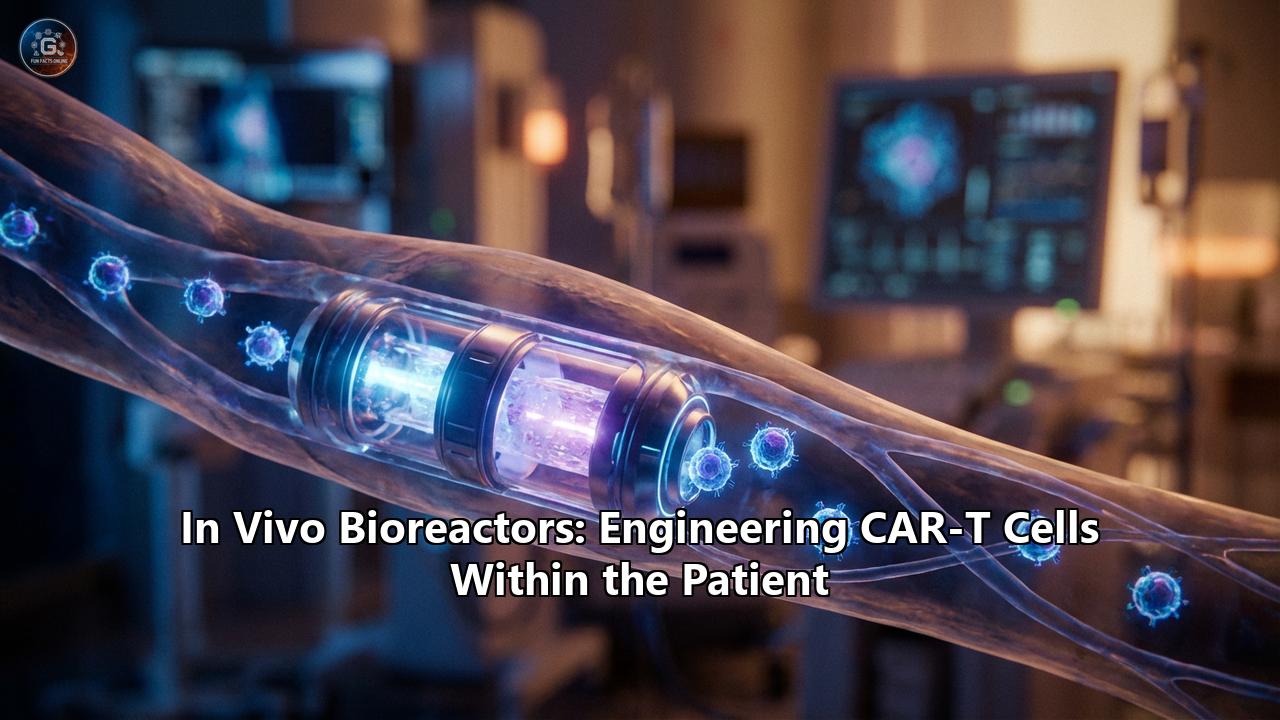
The year 2025 marked a definitive turning point in the history of medicine, often described by oncologists as the moment the "factory" moved inside the body. For over a decade, Chimeric Antigen Receptor (CAR) T-cell therapy had been hailed as a "living drug"—a miraculous, albeit cumbersome, process where a patient's immune cells were harvested, frozen, shipped to a laboratory, genetically reprogrammed to fight cancer, multiplied, and then shipped back for re-infusion. It was a logistical marvel, but one plagued by exorbitant costs, month-long wait times, and a manufacturing failure rate that left too many patients behind.
Enter the era of In Vivo Bioreactors.
As of early 2026, the paradigm has shifted. We are no longer just manufacturing drugs; we are engineering the patient’s own body to become the manufacturing facility. This approach, known as in vivo CAR-T cell generation, bypasses the need for external laboratories entirely. By injecting a smart delivery vehicle—a viral vector or a lipid nanoparticle—directly into the bloodstream, we can seek out specific immune cells, reprogram them on the fly, and unleash them against tumors or autoimmune diseases.
This article explores the mechanisms, the breakthroughs of late 2025, the key players like Umoja, Capstan, and Kelonia, and the profound implications of turning the human body into its own cure.
The "Vein-to-Vein" Bottleneck
To understand the revolution, one must understand the limitation of the status quo. "Ex vivo" (outside the body) CAR-T therapy, while effective, is resource-intensive.
- Time: The "vein-to-vein" time—the interval between harvesting cells and re-infusing them—can range from 3 to 6 weeks. For a patient with rapidly progressing lymphoma or leukemia, this delay can be fatal.
- Cost: With price tags often exceeding $400,000 per dose, the therapy is financially toxic to healthcare systems.
- Accessibility: It requires specialized centers, limiting access to major academic hospitals in wealthy nations.
- Cellular Exhaustion: The process of expanding T-cells in a plastic dish often leaves them "exhausted" or senescent before they even enter the patient's body to fight the cancer.
The Technology: How to Engineer Cells Inside a Human
The core challenge of in vivo engineering is specificity. How do you inject a genetic modification tool into the blood and ensure it only modifies T-cells, and not heart, liver, or brain cells? The answer lies in two competing technologies that dominated the 2025 landscape: Viral Vectors and Lipid Nanoparticles (LNPs).
1. The Viral Vector: The "Trojan Horse"
Companies like Umoja Biopharma and Kelonia Therapeutics utilize engineered lentiviral vectors.
- Mechanism: These viruses are stripped of their ability to replicate but retain their ability to insert genetic material into a cell’s DNA. The outer surface of the virus is "pseudotyped" or modified with specific proteins (binders) that only latch onto receptors found on T-cells, such as CD3 or CD8.
- The Process: Once injected, the virus ignores other tissues, binds to a T-cell, enters it, and permanently integrates the CAR gene into the T-cell's genome. The T-cell then expresses the CAR on its surface and begins to multiply.
- Advantage: This creates a permanent, self-replicating army of CAR-T cells. A single shot can theoretically provide lifelong protection (immune surveillance).
2. The Lipid Nanoparticle (LNP): The "Stealth Messenger"
Companies like Capstan Therapeutics use a non-viral approach, leveraging the same technology that powered the COVID-19 mRNA vaccines, but with a twist.
- Mechanism: They use targeted Lipid Nanoparticles (tLNPs). These are microscopic fat bubbles containing mRNA instructions for the CAR. The surface of the LNP is decorated with antibodies that target T-cells.
- The Process: The LNP fuses with a T-cell and releases the mRNA. The cell's machinery reads the mRNA and produces the CAR protein for a few days.
- Advantage: Safety and control. Because mRNA degrades, the CAR-T cells are temporary. This "transient" expression reduces the risk of long-term side effects like B-cell aplasia (permanent loss of B-cells) or oncogenesis (the vector causing cancer). It allows for "tunable" therapy—if the patient needs more, you give another dose.
The 2025/2026 Clinical Landscape: The Race is On
While 2024 was the year of preclinical promise, 2025 was the year of clinical reality. Several major players moved from mouse models to human trials, generating data that electrified the hematology community.
Kelonia Therapeutics: The "Dark Horse" Delivers
Perhaps the most stunning update of late 2025 came from Kelonia Therapeutics. At the American Society of Hematology (ASH) meeting in December 2025, Kelonia presented "late-breaking" data from their Phase 1 trial of KLN-1010.
- The Drug: An in vivo gene therapy using a lentiviral vector to generate anti-BCMA CAR-T cells for Multiple Myeloma.
- The Results: In the first cohort of patients, KLN-1010 achieved a 100% Minimal Residual Disease (MRD) negative response. This means that after a single injection, no trace of cancer could be found in the bone marrow of these heavily pre-treated patients.
- Safety: Remarkably, the treatment showed a favorable safety profile with no Grade 3 or higher Cytokine Release Syndrome (CRS) or neurotoxicity—a common and dangerous side effect of traditional CAR-T.
- Significance: This was the "proof of principle" the world was waiting for. It demonstrated that you could safely reprogram cells inside a human to wipe out cancer without chemotherapy conditioning or hospitalizing the patient for weeks.
Umoja Biopharma: The Fast-Tracked Contender
Seattle-based Umoja Biopharma solidified its position as a leader with its VivoVec™ platform.
- Milestones: In September 2025, the FDA granted Fast Track designation to their lead candidate, UB-VV111, for relapsed/refractory Large B-cell Lymphoma (LBCL).
- The Trial: By late 2025, Umoja had initiated patient dosing. Their approach is unique because it not only delivers the CAR gene but also a "rapamycin-activated cytokine receptor." This allows doctors to give the patient a simple pill (rapamycin) to boost the number of CAR-T cells inside the body on command, solving the problem of cells dying out too quickly.
- Funding: Their confidence was bolstered by a massive $100 million Series C financing round in January 2025, signaling strong investor belief in the in vivo future.
Capstan Therapeutics: The Autoimmune Pioneer
While others focused on cancer, Capstan Therapeutics took their tLNP technology into a new frontier: autoimmune diseases.
- The Logic: In diseases like Lupus or Myasthenia Gravis, B-cells attack the patient's own body. Traditional CAR-T is too toxic for these chronic conditions. Capstan's transient mRNA approach offers a "reset button"—wiping out the bad B-cells temporarily to let the immune system reboot.
- Status: In mid-2025, Capstan launched a Phase 1 trial of CPTX2309 in healthy volunteers first to prove safety. This conservative approach highlights the novelty of their platform—using mRNA to engineer cells in vivo is technically a new class of drug. Preclinical data presented in late 2024 showed deep B-cell depletion in primates, setting the stage for efficacy trials in lupus patients in 2026.
Ensoma: The Multilineage Dream
Ensoma is taking a different angle by targeting Hematopoietic Stem Cells (HSCs)—the "mother" cells in the bone marrow.- The Concept: Instead of just engineering T-cells, Ensoma’s Engeno™ platform modifies stem cells to produce all types of engineered immune cells—T-cells, Natural Killer (NK) cells, and Macrophages (CAR-M).
- Application: This is particularly promising for solid tumors, where T-cells alone often fail. Engineered macrophages can penetrate the dense "fortress" of a solid tumor and eat it from the inside. Ensoma announced plans to enter the clinic in the second half of 2025, targeting solid tumors that have largely resisted traditional CAR-T.
Beyond Logistics: The Biological Advantage
The shift to in vivo is not just about convenience; it is about better biology.
- "Younger" Cells: Ex vivo manufacturing forces T-cells to divide millions of times in a dish, artificially aging them. In vivo engineering modifies "fresh" T-cells inside the body, preserving their "stemness" and potency. These younger cells are more aggressive and persistent in killing cancer.
- No Lymphodepletion: Traditional CAR-T requires patients to undergo "lymphodepletion" (harsh chemotherapy) to make room for the new cells. In vivo therapies like Kelonia’s and Capstan’s have shown efficacy without this toxic step, preserving the patient's native immune system and reducing susceptibility to infections.
- The "Off-Switch": With mRNA platforms (Capstan), the therapy naturally fades away. If a patient experiences severe toxicity, doctors can simply stop treatment, and the CAR-T cells will disappear within days. This safety valve is impossible with traditional "living drugs" that persist for years.
The Challenges Ahead
Despite the excitement, the path is not without peril.
- Off-Target Effects: The nightmare scenario for in vivo gene editing is "transduction of the wrong cell." If the vector accidentally engineers a tumor cell instead of a T-cell, it could theoretically make the cancer resistant to therapy. While 2025 data suggests high specificity (targeting CD3/CD8), long-term safety monitoring is required to ensure no germline (reproductive cell) transmission occurs.
- The "Black Box" of Dosing: In a lab, you know exactly how many CAR-T cells you are putting into a patient. In vivo, you inject a vector, and the patient's body produces the cells. The number of cells produced can vary wildly between patients based on their immune health. Umoja’s rapamycin-boost system is one attempt to control this variable.
- Cytokine Release: Even without expanding cells outside the body, the rapid activation of T-cells inside the patient can still cause Cytokine Release Syndrome (CRS). However, early trials (Kelonia) suggest this may be milder than ex vivo therapy because the expansion happens more gradually.
Conclusion: The End of the "Cell Therapy" Era?
We are witnessing a semantic and scientific shift. We are moving away from "Cell Therapy" (where the cell is the product) to "Gene Therapy" (where the vector is the product).
By 2030, the complex, expensive clean rooms used to manufacture Kymriah or Yescarta may look like the mainframe computers of the 1970s—relics of a pioneering but inefficient era. The future of immunotherapy sits in a standard pharmacy freezer: a vial, ready to inject, capable of turning a patient's own blood into a precision bioreactor.
As we move through 2026, the results from Kelonia, Umoja, and Capstan will determine if this promise holds. But if the data from late 2025 is any indication, the factory has successfully been relocated. It is now within us.
Reference:
- https://trialstat.com/2025/06/capstan-therapeutics-announces-initiation-of-phase-1-trial-of-lead-in-vivo-car-t-therapy-cptx2309-for-treating-autoimmune-disease/
- https://www.biospace.com/press-releases/capstan-therapeutics-presents-preclinical-data-on-lead-in-vivo-car-t-candidate-cptx2309-at-american-college-of-rheumatology-acr-convergence-2024
- https://trial.medpath.com/drug/a981d8ce5f7d8e54/cptx-2309
- https://synapse.patsnap.com/blog/capstan-therapeutics-presents-preclinical-findings-on-car-t-candidate-cptx2309
- https://clinicaltrials.gov/study/NCT06917742
- https://keloniatx.com/kelonia-therapeutics-presents-first-in-human-data-from-phase-1-inmmycar-study-of-kln-1010-in-vivo-bcma-car-t-therapy-at-the-american-society-of-hematology-ash-2025-annual-meeting/
- https://trialstat.com/2025/12/kelonia-therapeutics-announces-late-breaking-oral-presentation-of-first-in-human-data-from-in-vivo-bcma-car-t-therapy-at-the-american-society-of-hematology-ash-2025-annual-meeting/
- https://www.umoja-biopharma.com/violator_item/selected-news/
- https://www.oncologynewscentral.com/drugs/info/oncology-drugs-fast-tracked-by-the-fda-in-october-2025