
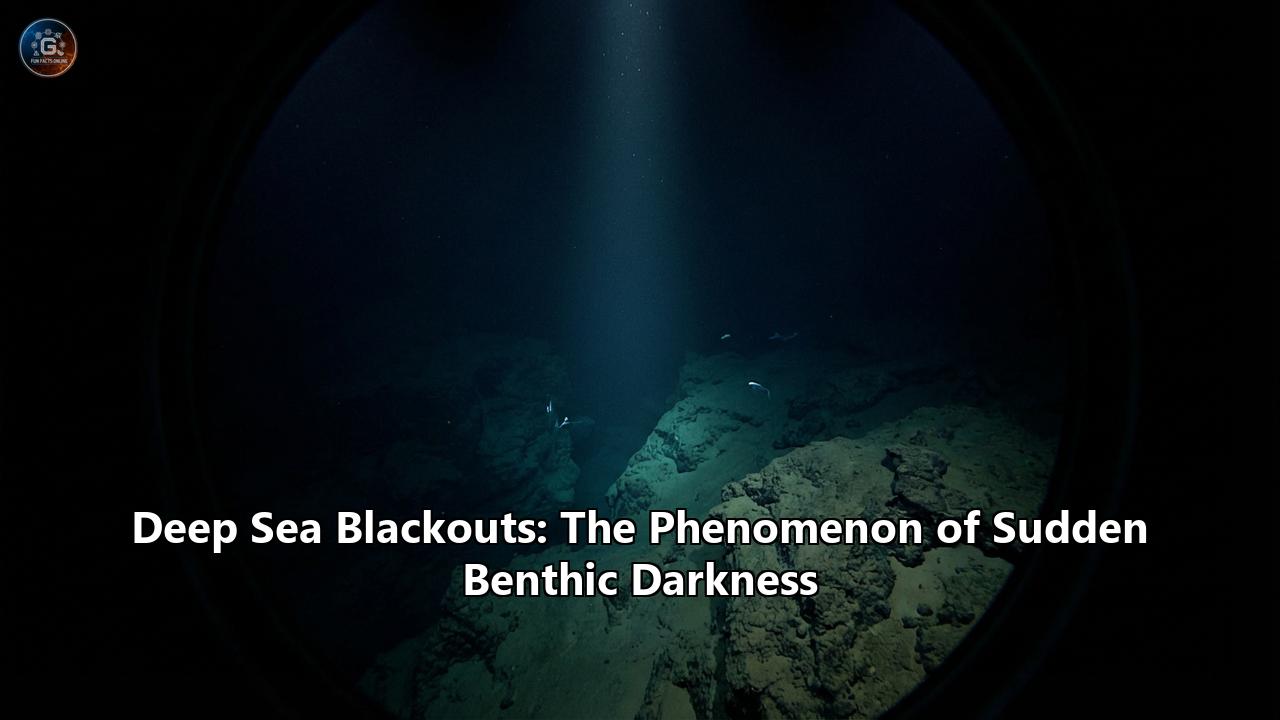
Introduction: The Darkness Within the Dark
To the uninitiated, the deep ocean is a monolith of eternal night. We imagine the abyss as a static void—a place where the sun’s reach failed eons ago, leaving behind a cold, unchanging blackness that has persisted since the oceans first formed. We assume that once you pass the mesopelagic twilight zone, "darkness" is an absolute value, a constant that cannot be increased.
We are wrong.
Oceanographers and deep-sea ecologists have begun to identify and categorize a terrifying and dynamic phenomenon known as the "Deep Sea Blackout." This is not merely the absence of sunlight, which is the baseline state of the abyss. A Deep Sea Blackout is an event—a sudden, chaotic, and often violent reduction in visibility and environmental stability that plunges the benthic (seafloor) ecosystem into a state of sensory deprivation so profound it threatens the survival of life itself.
These events are the deep-sea equivalent of a blinding blizzard or a suffocating dust storm. They can be triggered by massive geological upheavals, rogue "abyssal storms" generated by surface eddies, or, increasingly, by the mechanical claws of human industry. When a blackout strikes, the delicate "living lights" of bioluminescence—the primary language of the deep—are snuffed out by choking clouds of sediment. The water itself thickens. Navigation becomes impossible. And, as recent discoveries suggest, the very production of oxygen on the seafloor may be halted, leading to a chemical suffocation that matches the visual one.
This article explores the phenomenon of Sudden Benthic Darkness in its entirety. We will journey through the physics of turbidity currents that move faster than highway traffic, witness the disruption of the "Dark Oxygen" batteries that power the abyss, and analyze the existential threat posed by the looming era of deep-sea mining.
Welcome to the true dark.
Chapter 1: The Physics of the Void
To understand a blackout, one must first understand the "normal" state of deep-sea visibility. In the clear waters of the open ocean, far below the photic zone, water is exceptionally transparent. While there is no sunlight, the water column is often crystal clear. A submersible's spotlight can cut through the darkness for hundreds of meters, revealing the "marine snow"—the gentle, endless drift of organic detritus from the surface.
This clarity is vital. It allows the faint, blue-green flashes of bioluminescence to travel remarkable distances. A lanternfish seeking a mate, or a viperfish luring prey, relies on this optical transparency. The deep sea is not dead silence; it is a visual cacophony of signals, warnings, and lures, playing out in a medium that supports the transmission of light.
A Deep Sea Blackout occurs when this transparency collapses. It is defined scientifically as a rapid, high-intensity increase in turbidity—the cloudiness of a fluid caused by large numbers of individual particles.
The Nepheloid Layer
The primary mechanic of a blackout involves the "nepheloid layer." This is a layer of water near the ocean floor that contains significant amounts of suspended sediment. In calm conditions, this layer might be only a few meters thick and relatively tenuous. During a blackout event, however, the nepheloid layer explodes upwards.
Imagine a dust storm on Mars, but occurring under 500 atmospheres of pressure. Fine-grained clays, silts, and the skeletal remains of microscopic organisms (radiolarians and diatoms) are whipped into a frenzy. Because these particles are so fine, they do not settle quickly. A "silt-out" in the deep sea does not clear in minutes like a splash of sand in a shallow reef; it can persist for days, weeks, or even months, creating a "wandering cloud" of blindness that drifts with the abyssal currents.
Optical Attenuation
In a blackout, the "attenuation coefficient" of the water spikes. Light photons—whether from a submersible’s LED array or a squid’s photophore—are scattered and absorbed by the suspended particles. The result is a "fog of war." A predator that could once spot the silhouette of prey from 50 meters away is suddenly blind beyond the tip of its nose. The complex visual ecology of the deep ocean dissolves into confusion.
Chapter 2: The Storms Below
For decades, we believed the deep ocean floor was a place of stillness. We were mistaken. The abyss has its own weather, and its storms are titans.
Benthic Storms
The term "Benthic Storm" or "Abyssal Storm" refers to episodes where bottom current speeds accelerate dramatically, often exceeding 25 to 50 centimeters per second. While this sounds slow compared to a surface hurricane, in the fluid dynamics of the deep sea, it is a gale-force event. These storms are often driven by surface energy that translates downward—massive eddies from the Gulf Stream or the Antarctic Circumpolar Current that spin off and reach all the way to the bottom, thousands of meters below.
When these eddies hit the seafloor, they scour the sediment. They strip away the "fluff layer"—the loose, nutrient-rich detritus that has settled over months—and eject it into the water column.
A study in the Nova Scotian Rise revealed that these storms can suspend sediment up to 100 meters above the seafloor. The result is a towering wall of mud that travels across the abyssal plain. For the organisms living there—fragile glass sponges, sea pens, and xenophyophores—it is a cataclysm. They are not just blinded; they are sandblasted.
The Grand Banks Event: The Megastorm
The most famous and destructive historical example of a deep-sea blackout occurred on November 18, 1929. A magnitude 7.2 earthquake struck the Grand Banks off the coast of Newfoundland. While the quake shook the land, the real devastation happened underwater.
The tremor triggered a submarine landslide of unimaginable scale. It wasn't just rocks falling; it was a turbidity current—a fluid avalanche of sediment and water that behaves like a distinct, heavy liquid. This current roared down the continental slope at speeds estimated between 60 and 100 kilometers per hour (approx. 40-60 mph).
We know the speed precisely because the turbidity current snapped transatlantic telegraph cables one by one. It severed 12 cables in sequence, allowing scientists to clock its velocity as it tore across the ocean floor.
The "blackout" caused by this event was absolute. The current carried an estimated 175 cubic kilometers of mud and sand. To visualize this, imagine a block of solid earth 1 kilometer wide, 1 kilometer tall, and 175 kilometers long, pulverized and mixed into the water. This massive cloud didn't just break cables; it buried thousands of square kilometers of the abyssal plain instantly, suffocating every living thing in its path and leaving a suspension of silt that likely took years to fully clear.
Chapter 3: Marine Darkwaves
While benthic storms haunt the abyss, a related phenomenon known as "Marine Darkwaves" affects the coastal oceans, bridging the gap between our world and the deep.
Identified and named in research published as recently as 2024 and 2025, a Marine Darkwave is a coastal blackout event. These are periods where water clarity in coastal ecosystems (like kelp forests or coral reefs) drops to near-zero levels due to a combination of storm runoff, algal blooms, and resuspended sediment.
The Photosynthetic Crisis
In the deep sea, life doesn't rely on sunlight. But in the coastal benthic zones, "darkwaves" are deadly because they steal the energy source of the ecosystem. Kelp forests and seagrass meadows require light. When a darkwave hits—perhaps triggered by a cyclone like Cyclone Gabrielle in New Zealand—the bottom of the ocean is plunged into premature night.
If the darkwave lasts for days, the plants survive. If it lasts for months, the ecosystem collapses. Photosynthesis halts. The kelp begins to rot. The fish that rely on the visual complexity of the forest are left exposed or blinded. These events serve as a warning: the stability of ocean light is fragile, and when it is disrupted, the consequences cascade up the food chain.
Chapter 4: The Bioluminescent Fog
The most alien and tragic aspect of a Deep Sea Blackout is its effect on communication. In the bathypelagic and abyssal zones, 75% to 90% of biomass is bioluminescent. Light is speech. Light is survival.
The Masking Effect
When a sediment plume rises—whether from a benthic storm or a mining crawler—it acts as a scattering medium. In clear water, a bioluminescent flash is a sharp point of data. In turbid water, that flash becomes a diffuse, glowing blur.
Consider the Anglerfish. It relies on a glowing esca (lure) to attract prey in the void. In a blackout scenario, the range of that lure is drastically reduced. Worse, the suspended particles in the water might reflect the light back at the anglerfish, illuminating it rather than the lure, revealing the predator to its prey or its own predators.
The "Burglar Alarm" Malfunction
Many deep-sea creatures, like the Atolla jellyfish, use a "burglar alarm" defense. When attacked, they pulse with a frenetic, strobing blue light. The evolutionary goal is to attract a larger predator to eat the thing attacking them.
In a sediment blackout, this defense fails. The strobe light is swallowed by the mud cloud. The scream for help goes unanswered.
Clogging the Living Filters
The biological impact goes beyond light. Many deep-sea organisms are filter feeders. Glass sponges, crinoids, and deep-sea corals rely on the passive drift of food particles.
A Deep Sea Blackout changes the menu from "food" to "rock."
- Deep-Sea Corals: These ancient organisms, some thousands of years old, have delicate polyps designed to catch microscopic plankton. When a heavy sediment plume hits, the polyps are overwhelmed by non-nutritious silt. To survive, the coral must expend precious energy secreting mucus to slough off the mud. If the blackout lasts too long, the coral exhausts its energy reserves and suffocates under the weight of the settling dust.
- The Jellyfish Crisis: Recent studies (circa 2023-2025) on the helmet jellyfish (Periphylla periphylla) exposed to mining-like sediment plumes showed that the particles damage their delicate tissues. The jellyfish are forced to produce excess mucus, a metabolic tax that can lead to starvation or increased susceptibility to bacterial infection.
Chapter 5: The Oxygen Blackout
Perhaps the most startling discovery in recent deep-sea science—and one that reframes the danger of blackouts entirely—is the phenomenon of "Dark Oxygen."
For centuries, biology held a central dogma: Oxygen is produced by photosynthesis (sunlight + plants) and consumed by respiration. Therefore, the deep sea must be an oxygen consumer, relying entirely on cold, oxygen-rich currents sinking from the polar surfaces to breathe.
In 2024, this dogma was shattered.
The Abyssal Batteries
Scientists studying the Clarion-Clipperton Zone (CCZ)—a vast abyssal plain in the Pacific targeted for mining—found that oxygen levels on the seafloor were increasing in the dark, without any phytoplankton.
The source? Polymetallic Nodules.
These potato-sized rocks, rich in manganese, nickel, and cobalt, are effectively natural batteries. They sit on the seafloor, and the difference in electric potential between the metal layers can generate a voltage of up to 0.95 volts. This is enough to trigger seawater electrolysis—splitting H2O molecules into Hydrogen and Oxygen.
This "Dark Oxygen" may be critical for the survival of the benthic organisms living in these stagnant depths. It is a localized life-support system.
The Chemical Short-Circuit
A Deep Sea Blackout poses a catastrophic threat to this process. If a sediment plume buries these nodules, the reaction stops. The "batteries" are insulated by a layer of inert mud.
Furthermore, if the nodules are harvested (mined), the source of oxygen is removed permanently. But even the exploration and disturbance of the sediment could create a "smothering" effect, turning off the oxygen production across vast acreages of the seafloor. We are not just blinding the deep sea; we may be cutting off its air supply.
Chapter 6: The Artificial Abyss – Deep Sea Mining
The natural phenomena of benthic storms and turbidity currents are rare, episodic events. Nature has a rhythm, and even catastrophes like the Grand Banks landslide happen on geological timescales.
But we are entering the Anthropocene of the Abyss. The rise of Deep Sea Mining (DSM) threatens to institutionalize the "Blackout" as a permanent state of the ocean floor.
The Mechanized Plume
Mining vehicles are designed to crawl across the abyssal plain, vacuuming up polymetallic nodules. The process is inherently dirty.
- The Collector Plume: As the vehicle harvests nodules, it disturbs the top 10–15 centimeters of sediment. This creates a dense, heavy cloud that hugs the seafloor—a man-made turbidity current.
- The Midwater Plume: The nodules are pumped up a riser pipe to a surface ship, cleaned, and the waste sediment is pumped back down. Depending on where this discharge happens (surface, midwater, or near-bottom), it creates a second "blackout zone" in the water column.
The Scale of Darkness
Unlike a storm that passes in days, a mining operation would run 24/7 for 30 years. A single mining contract could cover 75,000 square kilometers. The sediment plumes generated would not stay within the mining lines; they would drift.
Models suggest these plumes could travel dozens or hundreds of kilometers. A "faint" plume—invisible to the naked eye but optically dense enough to disrupt bioluminescence—could blanket an area the size of Europe.
The "Silt-Out" Hazard for Explorers
For the human pilots and ROV operators venturing into these depths, "blackouts" are a terrifying occupational hazard.
In deep-sea diving and ROV operations, a silt-out occurs when the thrusters of the vehicle accidentally kick up the bottom.
- Zero Visibility: Instantly, the high-definition feeds turn into a wall of brown or gray. The powerful LED lights of the ROV reflect off the particles (backscatter), creating a blinding white wall similar to driving with high beams in a blizzard.
- Loss of Orientation: In the featureless abyss, visual landmarks are rare. If an ROV pilot loses visual contact with the seafloor due to a silt-out, they can easily become disoriented, risking entanglement in their own tether or collision with rock walls.
- The "Wait and Pray": Unlike smoke, which rises, deep-sea silt hangs. An ROV pilot caught in a severe silt-out often has only one choice: all stop. They must hover in the blindness, sometimes for hours, waiting for the current to carry the cloud away. In a mining scenario, the cloud might never clear.
Chapter 7: Ecological Cascade – When the Lights Go Out
What happens when you impose a blackout on an ecosystem adapted to eternal stability?
1. The Starvation of the BenthosThe "food web" of the deep sea relies on the detection of "food falls"—dead whales, fish, or patches of organic matter. Scavengers like hagfish and amphipods rely on scent, but also on visual cues and the bioluminescence of bacterial colonies rotting the meat. A sediment blanket masks these cues. Scavengers starve. The recycling engine of the ocean slows down.
2. The Reproductive CollapseMany deep-sea species are rare. Finding a mate in a billion cubic kilometers of water is a statistical nightmare. They rely on specific light signals—flash patterns unique to their species.
If the water is turbid, the signal range drops. If a male lanternfish cannot see the female's signal from 10 meters away, he misses her. If this happens across a population, reproductive rates plummet. This is the Allee Effect: once a population density drops below a certain threshold (or effectively drops because they can't find each other), the species spirals toward extinction.
3. The Rise of the "Dust-Breathers"Nature abhors a vacuum. If we darken the deep sea, we will select for organisms that can survive the dark and the dirt. We may see a shift toward dominance by simple, hardy scavengers—nematodes and certain worms—while the complex, fragile, and beautiful life forms (the corals, the jellies, the finned octopuses) vanish. We are engineering a uglier, simpler ocean.
Chapter 8: The Future Forecast
The phenomenon of Deep Sea Blackouts is poised to become one of the defining environmental challenges of the 21st century.
Climate Change and Benthic StormsAs the surface oceans warm, the energy in the atmosphere intensifies. This energy is transferred to the ocean currents. Oceanographers predict that "eddy kinetic energy" will increase. This means stronger, more frequent eddies spinning off the Gulf Stream and the Antarctic currents.
We should expect more natural benthic storms. The "weather" of the deep sea will get worse. We may see more events like the Grand Banks disaster—submarine landslides triggered not by quakes, but by destabilized, warming methane hydrates or shifting current loads.
The Regulation of DarknessThe International Seabed Authority (ISA) is currently debating the "Mining Code." A central point of contention is the regulation of sediment plumes.
How dark is too dark?
Scientists are pushing for "plume thresholds"—limits on how much turbidity a mining operation can create. But measuring this in the deep sea is incredibly difficult. And as we've learned from "Dark Oxygen," the damage might happen at levels we can't even see.
Conclusion: The Fragility of the Eternal Night
We used to think of the deep sea as robust because it was harsh. We assumed that anything living under 4,000 meters of water, in freezing cold, must be tough as nails.
But the opposite is true. Deep-sea life is adapted to stability. It has evolved in a world that hasn't changed its background conditions for millions of years. It is an ecosystem of old growth—ancient corals, slow-growing sponges, fish that live for centuries.
A Deep Sea Blackout violates the fundamental rule of this realm. It introduces chaos into a system built on order.
Whether it is the violent scouring of a benthic storm, the smothering blanket of a turbidity current, or the relentless gray fog of a mining plume, these events represent a tearing of the fabric of the deep ocean. We are learning that the dark is not empty. It is full of light, full of oxygen, and full of life.
And if we are not careful, we are about to turn the lights out for good.
Appendix: Case Studies in Darkness
*Case Study A: The Deepwater Horizon "Dirty Blizzard"
While not a traditional sediment blackout, the 2010 oil spill created a "marine snow" of toxic oil and dispersants. This "dirty blizzard" settled on the deep-sea corals of the Gulf of Mexico. The effect was identical to a sediment blackout: the corals were smothered. Colonies that had lived for 600 years died in weeks, covered in a brown flocculent sludge. It was a grim preview of what mining plumes could achieve.
Case Study B: The Alvin Silt-Out
In the early days of deep-sea exploration, the submersible Alvin was exploring a canyon wall. The pilot drifted too close to a sediment overhang. The thruster wash triggered a mini-avalanche. The submersible was instantly enveloped. The pilot, relying on instruments, had to ascend blindly for 500 meters before breaking out of the cloud. The event highlighted the terrifying persistence of deep-sea turbidity; the cloud didn't dissipate—it just hung there, a solid object made of water and dust.
Case Study C: The Atacama Trench "Darkness"In 2024, researchers named a new species of amphipod found in the Atacama Trench Dulcibella camanchaca. "Camanchaca" refers to the dense fog banks that roll off the Chilean coast. The name is poetic but apt—this creature lives in the ultimate blackout of the hadal zone (8,000+ meters), a place where the pressure is so high that the water itself becomes more viscous, and the darkness is a physical weight. Even here, however, these creatures are sensitive to the "rain" of sediment from above, connecting their survival to the clarity of the waters miles overhead.
(End of Article)*
Reference:
- https://www.earth.com/news/deep-sea-mining-forms-dust-clouds-that-devastate-marine-life/
- https://tsunami.ioc.unesco.org/en/18-november-1929
- https://www.earthmagazine.org/article/benchmarks-november-18-1929-turbidity-currents-snap-trans-atlantic-cables/
- https://osdp-psdo.canada.ca/dp/en/search/metadata/NRCAN-GEOSCAN-1-126590
- https://www.youtube.com/watch?v=bGc1Z-BxKXY
- https://deep-sea-conservation.org/oxygen-production-polymetallic-noduces-deepsea/
- https://wiki.ubc.ca/Course:EOSC270/2021/Under_the_Sea:_the_issue_with_Deep-Sea_Mining
- https://m-mtoday.com/news/deep-sea-mining-sparks-fierce-debate-over-dark-oxygen-discovery/
- https://deep-sea-conservation.org/key-threats/
- https://tos.org/oceanography/article/deep-sea-predator-prey-dynamics-revealed-by-biologging-and-edna-analysis
- https://fse.studenttheses.ub.rug.nl/29503/1/mMB_2023_MessoraA.pdf
- https://ajsonline.org/api/v1/articles/58377-estimated-size-of-the-grand-banks-newfoundland-turbidity-current.pdf