
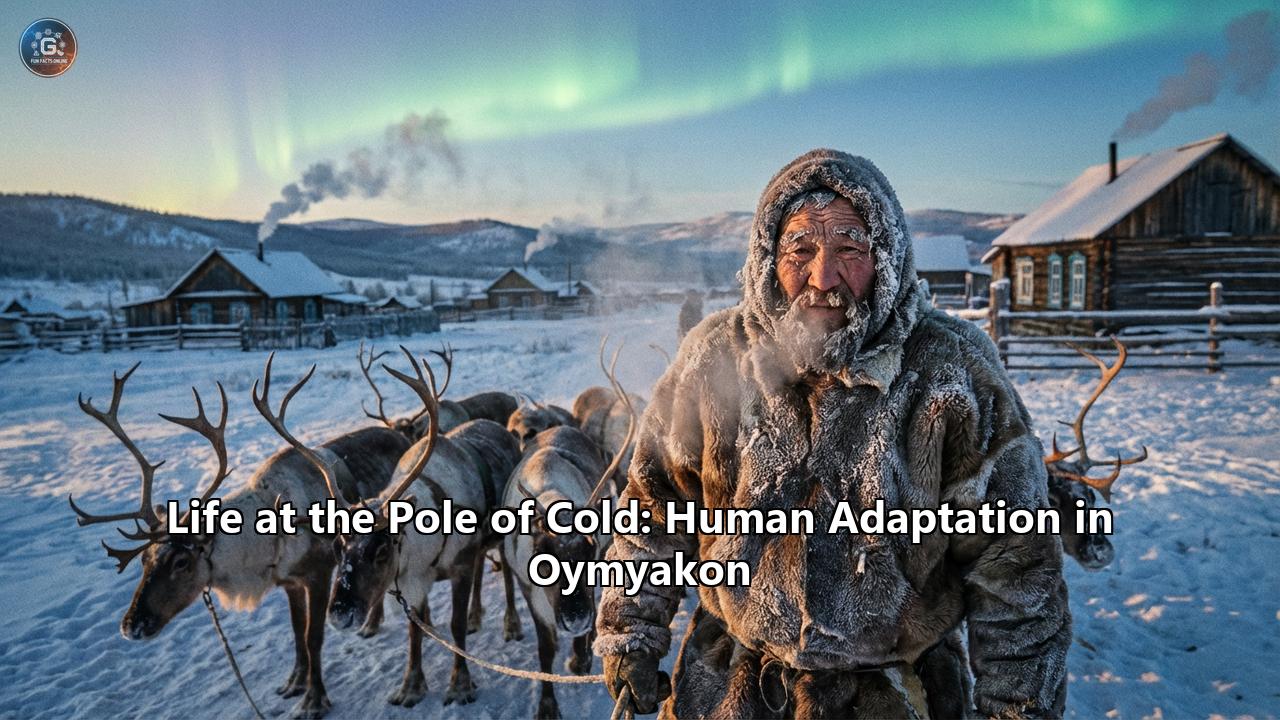
The air here doesn’t just chill you; it speaks. At minus 50 degrees Celsius, a phenomenon known to the locals as the "Whisper of Stars" begins. It is the sound of your own breath freezing instantly as it leaves your lips, a soft, crystalline rustling like grain pouring from a sack. At minus 60, the spit you spit hits the ground as a solid pebble of ice. And at minus 70—a temperature etched into the memory of this valley—birds are said to freeze mid-flight, falling from the sky like stones.
Welcome to Oymyakon, Russia, the "Pole of Cold." This remote outpost in the heart of Siberia’s Sakha Republic is the coldest permanently inhabited settlement on Earth. It is a place where the mercury in a standard thermometer solidifies, where steel becomes brittle enough to shatter like glass, and where the simple act of survival is a daily, heroic triumph of human will.
To the 500 or so souls who call this frozen valley home, these impossible conditions are simply "Tuesday." They are the keepers of a life so extreme that it defies the logic of the modern world, a testament to the stubborn, beautiful resilience of the human species. This is their story—a journey into the deep freeze, where history is paved with bones, horses hibernate while standing, and the frost is a living, breathing god.
I. The Geography of the Deep Freeze
To understand Oymyakon, one must first understand the geography that conspires to freeze it. The village sits just a few hundred miles south of the Arctic Circle, deep within the vastness of Yakutia (officially the Sakha Republic), a region so large that if it were an independent country, it would be the eighth largest in the world—roughly the size of India.
But it is not just the latitude that creates this deep freeze; it is the terrain. Oymyakon is nestled in a bowl-shaped valley, surrounded by the Oymyakon Plateau and the Verkhoyansk Range. This topography creates a perfect trap for cold air. In winter, heavy, dense pools of freezing air sink into the valley and get stuck, unable to escape over the mountain ridges. As the long polar nights set in—darkness reigning for up to 21 hours a day in December—the earth radiates its heat away into the black sky, and the cold intensifies, stacking up in the valley floor like invisible layers of lead.
This phenomenon is responsible for the record that puts Oymyakon on the map. On February 6, 1933, the local weather station recorded a temperature of -67.7°C (-89.9°F). This stands as the officially recognized lowest temperature ever recorded in a permanently inhabited location. There are whisperings and old Soviet records of a temperature of -71.2°C (-96.2°F) recorded in 1924, a number that is emblazoned on the village’s "Pole of Cold" monument, though meteorologists debate its validity. Regardless of the decimal points, the reality is the same: this is the coldest place where people live, work, and raise children.
The name "Oymyakon" itself offers an ironic twist. In the Even language—the tongue of the indigenous reindeer herders who first roamed these lands—it translates to "unfrozen water." It refers to a thermal spring nearby that, miraculously, stays liquid even in the depths of winter. For centuries, this spring was a life-saving oasis for herders and their animals, a warm heart in a frozen body. Today, that spring is the reason the village exists at all.
II. The Road of Bones
Getting to Oymyakon is an odyssey in itself, a journey that peels back the layers of Russia’s dark history. The primary artery connecting the outside world to this frozen frontier is the Kolyma Highway, known grimly as the "Road of Bones."
Stretching over 2,000 kilometers from the port city of Magadan to Yakutsk, the road cuts through the taiga, crossing mountain ranges and frozen rivers. It was built between the 1930s and 1950s by the prisoners of Stalin’s Gulag system. Hundreds of thousands of political dissidents, intellectuals, criminals, and "enemies of the state" were sent to the Sevvostlag labor camps to mine gold and build infrastructure in conditions that were essentially a death sentence.
The laborers worked with pickaxes and wheelbarrows in temperatures that froze their lungs. When a prisoner died of exhaustion, starvation, or exposure, the permafrost—ground frozen as hard as concrete for hundreds of meters down—made digging a grave impossible. Instead, the bodies were often interred directly into the roadbed, their bones becoming part of the foundation. Every kilometer of the Kolyma Highway is a mass grave.
Today, driving the Road of Bones is a haunting experience. The landscape is staggeringly beautiful—endless forests of Dahurian larch (the only pine tree that sheds its needles to survive the winter) coated in rime ice, snow-capped peaks glowing pink in the brief twilight, and vast, silent emptiness. But the history is palpable. Remnants of old Gulag camps still rot in the woods, their barbed wire and watchtowers slowly being swallowed by the snow.
For the residents of Oymyakon, this road is their lifeline. It brings in the coal that keeps them from freezing and the food that keeps them from starving. In winter, the road is actually in its best condition. The mud and gravel freeze solid, creating a smooth, high-speed surface. The rivers, including the mighty Lena and Aldan, become massive ice highways, allowing trucks to drive directly over the water. It is in summer, when the top layer of permafrost thaws, that the road becomes a treacherous quagmire of mud, swallowing vehicles whole and turning the journey into a multi-day ordeal.
III. Life on Stilts: The Village Architecture
Arriving in Oymyakon, the first thing you notice is the smoke. It hangs low over the village, a thick, grey blanket trapped by the thermal inversion. Every house, every building, every garage is pumping exhaust into the air, a visual testament to the constant burning of coal and wood required to keep life going.
The architecture here is dictated entirely by the permafrost. You cannot dig a foundation into ground that is frozen solid. If you built a heated house directly on the ground, the heat would eventually thaw the permafrost beneath, turning the soil into unstable slurry and causing the house to collapse. To prevent this, every structure in Oymyakon is built on stilts, elevated a meter or more above the ground. This air gap keeps the frozen earth frozen, ensuring stability.
The houses themselves are modest, wooden structures, but they are engineered for survival. Windows are triple-glazed to prevent heat loss. Doorways are protected by "airlocks"—a small, unheated antechamber where you shed your outer layers before entering the main house. This prevents the warm air from rushing out and the cold air from rushing in, which would instantly create a fog of condensation and ice inside the home.
Inside, the houses are sweltering. Locals keep their interiors at a tropical 25°C to 30°C (77°F - 86°F), creating a temperature differential of nearly 100 degrees between the inside and the outside. It is a shock to the system every time you step out the door.
But the most striking architectural feature of Oymyakon is what is missing: indoor plumbing.
Digging trenches for sewage pipes is impossible in the permafrost. Even if you could dig them, the pipes would freeze and burst within hours. As a result, almost every home in Oymyakon relies on an outhouse. Yes, even at -60°C, if you need to use the bathroom, you must bundle up, run outside, and do your business as quickly as humanly possible in an unheated wooden shack. It is a unifying hardship of life here, a humble reminder of nature’s dominance.
Water is another logistical puzzle. You cannot pump it from the ground. Instead, "water" is delivered in the form of ice. Trucks travel to the river, cut massive blocks of crystal-clear ice, and deliver them to households. These blocks are stacked outside the homes like firewood. When water is needed, a chunk is brought inside, placed in a special barrel near the stove, and melted. This meltwater is incredibly pure, but it lacks minerals, leading some locals to worry about mineral deficiencies in their diet.
IV. The Carnivore’s Diet and the Cabinet of Furs
In a land where the ground is frozen for eight months of the year, agriculture is nonexistent. You cannot grow wheat, you cannot grow vegetables, and you certainly cannot grow fruit. The diet in Oymyakon is, by necessity, almost entirely carnivorous.
The staples of the Yakut diet are meat and dairy. Reindeer meat, horse meat, and fish from the rivers form the holy trinity of sustenance. But it is how they eat it that is unique.
The most famous dish is Stroganina. It is a delicacy of raw, long-sliced frozen fish (usually broad whitefish or muksun). The fish is caught through holes in the ice and freezes instantly upon hitting the air. To serve it, thin shavings are sliced from the frozen carcass with a sharp Yakut knife. The curls of fish are dipped in a mixture of salt and pepper and eaten frozen. It melts in your mouth like a savory sorbet, rich in fat and vitamins. Locals swear by it as a way to warm up, claiming the high omega-3 content acts as antifreeze for the blood.
Horse meat is equally prized. The Yakutian horse (more on this biological marvel later) produces meat that is rich in nutrients. Horse blood is used to make blood sausages, and horse liver is often eaten raw and frozen. It sounds intense to the Western palate, but this diet is perfectly adapted to the environment. The high fat content provides the massive caloric energy required to keep the body warm. A resident of Oymyakon might burn 3,000 to 4,000 calories a day just by existing in the cold.
Vegetables and fruits are rare luxuries, imported from thousands of miles away at great cost. Yet, the locals do not suffer from scurvy. They derive their essential vitamins from the organ meats of the animals and from wild berries—cranberries, lingonberries, and cloudberries—gathered in the brief, frantic summer and frozen for the winter.
Clothing is another matter of survival. While modern synthetic parkas are popular in many cold climates, in Oymyakon, fur is still king. "Synthetics crack," a local might tell you. "Fur lives."
A traditional Yakut winter outfit is a heavy investment, often costing more than a car. It consists of reindeer fur boots (called unty), which are sewn from the skin of the reindeer’s leg (the camus), where the fur is toughest and most water-repellent. These boots are lined with felt and can withstand temperatures that would turn plastic boots into shards. Coats are made of wolf, fox, or heavy sheepskin. Hats are made of sable or arctic fox, with long ear flaps.
When fully dressed, a local looks like a spherical, walking haystack. The layers are so thick that movement is restricted, giving everyone a distinctive, waddling gait. But fashion here is not about silhouette; it is about keeping your blood liquid.
V. The Human Engine: Physiology and Psychology
Does living in the Pole of Cold change you biologically? Some scientists think so.
Research into the indigenous Yakut people has hinted at physiological adaptations similar to those found in other circumpolar groups like the Inuit. The "polar T3 syndrome" is a phenomenon where thyroid hormone levels are elevated to boost the basal metabolic rate. Essentially, the bodies of people native to this region run "hotter," burning fuel faster to maintain core temperature.
There are also studies suggesting a unique lipid profile in the blood of indigenous Siberians, allowing them to metabolize fats more efficiently. It’s a necessary evolution for a population that consumes bowls of melted butter and frozen horse fat as comfort food.
Psychologically, the adaptation is just as profound. There is a stoicism in Oymyakon that is hard to describe. Panic is a death sentence here. If your car breaks down on the highway at -50°C, you don't scream; you act. You burn the tires to stay warm. You flag down the next truck. You know that everyone on the road is a brother-in-arms. In this part of the world, it is a criminal offense to pass a stranded vehicle without stopping. The "Code of the North" is absolute: today it is him, tomorrow it could be you.
But there is also joy. The cold is not just an enemy; it is a playground. Schools in Oymyakon remain open until the temperature hits -52°C for primary students. For older students, classes continue until -55°C. That means at -50°C, while the rest of the world would be in a state of emergency, the children of Oymyakon are walking to school.
And when the temperature finally drops below the cutoff? It’s a "Snow Day." But instead of staying inside, the kids often rush outdoors to play. The paradox of the "cold day off" is seeing the streets filled with children playing hockey or sliding down ice hills in temperatures that would freeze a cup of coffee before you could drink it.
VI. Nature’s Miracles: The Yakutian Horse
If humans are stubborn for living here, the animals are miraculous. The star of the Oymyakon ecosystem is the Yakutian Horse.
Standing only about 150 cm tall, these horses look like ponies, with thick necks, short legs, and heavy, shaggy coats that can be 10 cm long. But do not let their cute appearance fool you. These are the toughest equines on the planet.
Unlike the cows, which are kept in heated barns (and even wear custom-made fur "bras" to protect their udders from frostbite when they go out to drink), the Yakutian horses live outside all year round. They do not have stables. They sleep in the snow at -60°C.
How is this possible? A 2015 study published in PNAS revealed a stunning genetic secret. The Yakutian horse is not a prehistoric remnant; it descends from domestic horses brought to the region by the Yakut people only about 800 years ago. In that blink of evolutionary time, they developed profound adaptations.
They have a "standing hibernation" ability. In the deepest winter, they can lower their metabolic rate and core body temperature to conserve energy, a state of torpor rarely seen in large mammals. Their bodies become compact to reduce surface area. Their hair grows dense and traps air like a down jacket. They have evolved to dig through a meter of snow with their hooves to find the frozen grass beneath, a practice called tebenevka.
They are the engine of the Yakut culture, providing transport, meat, and milk. In the summer, they are milked to make kumis, a fermented mare’s milk drink that is the champagne of the steppes.
VII. The Whisper of the Stars: Daily Life in the Dark
A typical winter day in Oymyakon starts in darkness. The sun might rise at 10:00 AM and set at 2:00 PM. The "day" is a brief, twilight-colored interlude.
7:00 AM: The alarm rings. The first task is checking the thermometer. If it’s warmer than -50°C, it’s a "good" day. The man of the house might go out to check the car. The Car Dilemma: Owning a car in Oymyakon is a nightmare. If you leave a car engine off outside for more than 20 minutes, the oil turns into jelly, the battery dies, and the engine block can crack. Once a car is frozen, it might not start again until spring.To combat this, most cars are kept in heated garages. If you don't have a garage, you have two choices:
- Never turn the engine off. From October to April, some cars run 24/7. You leave it idling while you shop, while you visit friends, and even while you sleep (if you have a secure yard).
- The Flamethrower Method. If a car must be turned off, bringing it back to life involves lighting a fire under the oil pan or using a specialized industrial heater to thaw the fluids. It is a dangerous, time-consuming ritual.
Driving itself is surreal. At -50°C, the rubber tires harden. For the first few kilometers, the tires are square, clunking along the road until the friction warms them up enough to become round again. The exhaust from the car doesn't dissipate; it hangs in a thick, white fog behind the vehicle, sometimes obliterating visibility entirely.
12:00 PM: Lunch. The village is quiet. The "ice fog" often descends, a thick mist of ice crystals that limits visibility to 10 meters. People walk briskly, heads down. You don't stop to chat. If you wear glasses, the metal frames can stick to your skin, peeling off a layer of flesh if you pull them away too quickly. The ink in your pen freezes. Your smartphone battery dies in 3 minutes. Modern Tech Woes: The smartphone age has reached Oymyakon, but it fights a losing battle. Lithium-ion batteries rely on chemical reactions that slow down drastically in the cold. Locals keep their phones in inside pockets, close to their body heat, and use wired headphones to take calls, keeping the device buried in their coat. A common sight is a person frantically trying to warm their phone between their palms to send a text before the screen goes black. 4:00 PM: Darkness has returned. The cattle are brought back into the barns. The school day ends. Families gather in their overheated homes. Dinner is heavy—meat soup, potatoes, bread. The evening is for socializing, but mostly indoors. 8:00 PM: The silence is absolute. The snow here is so dry and cold that it doesn't pack; it squeaks. Walking on it sounds like crunching Styrofoam. Under the aurora borealis, which frequently dances green and purple overhead, the village looks like a settlement on another planet.VIII. The Lord of Cold: Culture and Myth
Oymyakon embraces its identity. They do not hide from the cold; they worship it.
The central figure of their modern folklore is Chyskhaan, the Lord of Cold. He is a semi-mythical creature, half-man, half-bull. According to legend, the Bull of Winter emerges from the Arctic Ocean in autumn. As his horns grow, the cold intensifies. The first horn grows in late December, marking the deepening frost. The second horn grows in January, marking the peak cold. As spring approaches, the horns fall off, the head falls off, and the bull melts, returning to the ocean.
Chyskhaan is depicted as an older man in elaborate blue robes with massive horns on his hat. He has his own residence in a cave inside a frozen hill near the village of Tomtor (close to Oymyakon). This cave, a former museum of permafrost, is coated in natural ice crystals the size of dinner plates.
Every year, in late March, the Pole of Cold Festival is held. It is a surreal celebration. Tourists and locals gather on the frozen river. There are reindeer sled races, traditional wrestling, and ice fishing competitions. Chyskhaan "meets" Santa Claus (often flown in from Lapland) and Ded Moroz (the Russian Father Christmas) to officially pass the baton of the seasons.
The festival is a display of Yakut spiritualism. The Yakuts follow a blend of Orthodox Christianity and ancient Tengrism (shamanism). They believe that nature is alive. You do not conquer the land; you negotiate with it.
A vital ritual is "feeding the fire." Before a meal, or when arriving at a new place, a Yakut will offer a small piece of food or a splash of vodka to the fire. It is an offering to the spirits, a request for warmth and protection. In Oymyakon, where fire is the only thing standing between life and death, this ritual is performed with deep solemnity.
IX. Tourism: The Certificate of Madness
In recent years, Oymyakon has become a bucket-list destination for "extreme tourists." Travel agencies in Yakutsk offer multi-day expeditions to the village.
The journey is not cheap (often costing thousands of dollars) and not comfortable. It involves a two-day drive on the Road of Bones in a modified Toyota Land Cruiser (the vehicle of choice for its reliability), sleeping in homestays, and using the dreaded outhouses.
But the rewards are bragging rights unlike any other.
Visitors are given an official "Certificate of the Pole of Cold," signed by the local administrator, stating the temperature on the day of their visit.
Tourist activities include:
- The Wet T-Shirt Test: Running outside in a t-shirt at -50°C for a photo op. (Dangerous, but popular).
- The Boiling Water Trick: Throwing a pot of boiling water into the air. The water instantly vaporizes and turns into a cloud of ice crystals, creating a stunning, fireworks-like effect.
- The Banana Hammer: Freezing a banana until it is hard enough to hammer a nail into a plank of wood.
- Swimming in the "Unfrozen" River: Some brave souls take a dip in the thermal spring. The air is -60°C, the water is +2°C. The water feels like a hot bath by comparison, but the moment you step out, your hair turns into a helmet of ice, and your swimsuit freezes to your skin.
Despite the fun, the danger is real. Tour guides are hyper-vigilant. Frostbite can set in on exposed skin in less than a minute. A numb nose or a white patch on the cheek is an immediate emergency.
X. The Future of the Deep Freeze
Even Oymyakon is not immune to the changing world. Climate change is hitting Siberia harder than almost anywhere else. The winters are getting shorter and "warmer." The record of -67.7°C has not been threatened in decades. In recent years, temperatures "only" reaching -50°C or -55°C have been common.
For the rest of the world, this sounds like a relief. For Oymyakon, it is a crisis.
The permafrost is thawing. This causes the ground to shift. Roads buckle, house stilts sink, and ancient bacteria trapped in the ice are released. The "Road of Bones" turns into an impassable swamp for longer periods each year.
Furthermore, the "warmer" winters wreak havoc on the animals. If it rains in winter instead of snows, the water creates an ice crust over the snow. The horses and reindeer cannot punch through the ice to get to the grass below, leading to mass starvation events.
The village also faces a demographic crisis. Young people, connected to the world via the internet, are seeing a life beyond the ice. They see indoor plumbing, cinemas, and universities in Yakutsk or Moscow. The population is slowly shrinking as the youth leave for easier climes.
Conclusion
Yet, Oymyakon remains.
It stands as a monument to human adaptability. It is a place where a school bus driver wraps his engine in a blanket like a sleeping child; where a cow wears a fur bra; where a grave is dug with fire.
Life here is stripped down to its essentials. There is no room for the superfluous. You value your neighbor because they might save your life tomorrow. You value your house because it is your spaceship in a vacuum. You value the sun because its absence is so long.
To visit Oymyakon is to step into a time capsule, or perhaps a glimpse of a post-apocalyptic future where survival is the only currency. But amidst the white silence, the frozen fog, and the biting cold, there is a warmth that defies the thermometer. It is the warmth of a cup of hot tea offered by a stranger, the warmth of a wood stove roaring against the night, and the warmth of a people who have looked at the harshest face of nature and decided to smile back.
They are the people of the Pole of Cold, and they are the warmest people on Earth.
Reference:
- https://takefantasticadventures.com/oymyakon-russia/
- https://onestep4ward.com/oymyakon-tour-coldest-place-on-earth/
- https://bestmarkets.ro/en/blog/pamantul-nevazut/oymyakon-rusia-ger-extrem.html
- https://sibexpeditions.com/oymyakon/
- https://discoveryrussia.com/tour/490/
- https://www.russiadiscovery.com/tours/yakutia-the-pole-of-cold-festival/
- https://discoveryrussia.com/tour/490/day_from_city/3582/
- https://gooutandserve.wordpress.com/2019/01/07/visiting-oymyakon-coldest-place-earth/
- https://www.exploreshareinspire.com/2018/01/oymyakon-travel-hotel-images-russia.html
- https://www.vice.com/en/article/how-to-budget-travel-to-the-coldest-town-on-earth/
- https://www.baikalnatu.re/document/a95d41ba57670001c51b1c939c1c074a/1052272
- https://www.nationalgeographic.com/adventure/article/life-is-a-chilling-challenge-in-subzero-siberia
- https://www.baikalnature.com/tours/210