
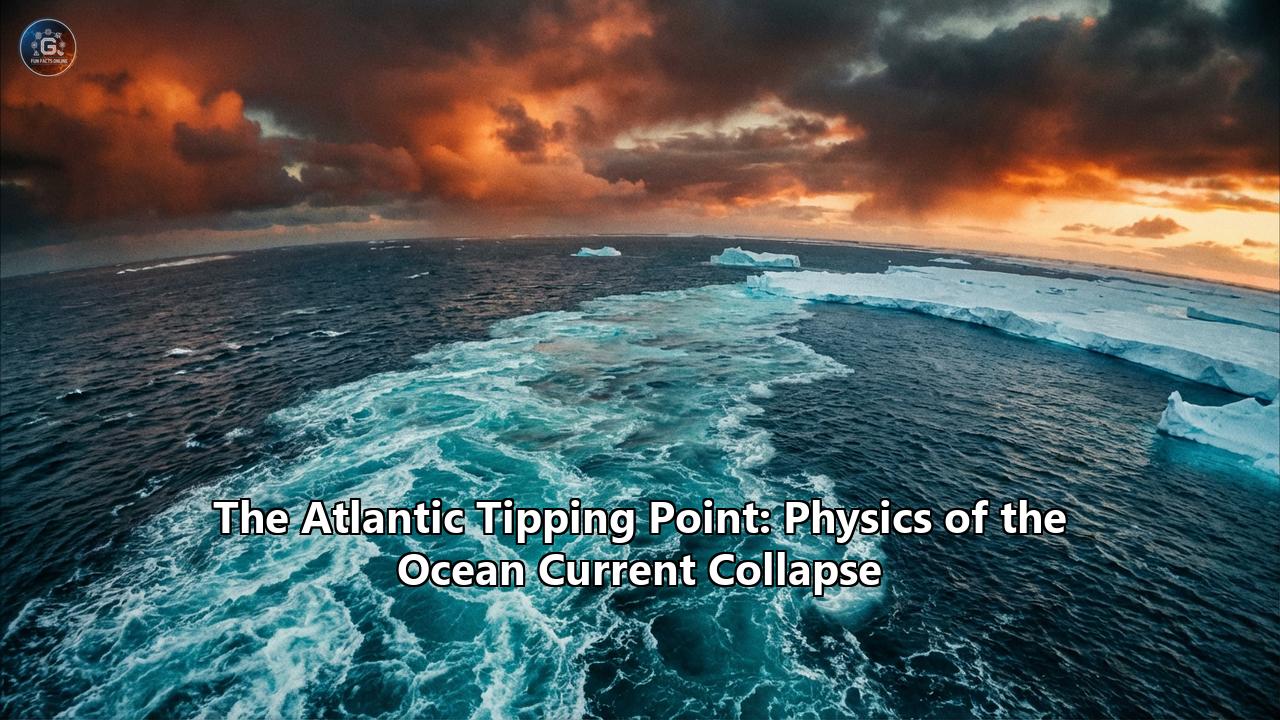
The Atlantic Ocean has a heartbeat. For thousands of years, a colossal rhythmic pulse of warm, salty water has pumped north from the tropics, delivering the heat that keeps Europe from freezing and regulating rainfall patterns across half the globe. It is the Atlantic Meridional Overturning Circulation (AMOC), a planetary engine that moves more than 15 million cubic meters of water per second—dwarfing the flow of all the world's rivers combined.
For decades, this heartbeat has been taken for granted, a constant in our Holocene stability. But in the quiet hum of supercomputers at Utrecht University and the frantic scribbles of oceanographers in Copenhagen, a terrifying consensus is emerging: the heartbeat is becoming irregular. The physics of the ocean suggests we are not merely facing a gradual slowdown, but racing toward a cliff edge—a mathematical singularity known as a "bifurcation point" where the current doesn't just weaken; it collapses.
The Engine of the World
To understand the collapse, one must first understand the machine. The AMOC is often described as a conveyor belt, but it is more accurately a heat pump. It operates on a simple principle of physics: thermohaline circulation.
The engine’s "cylinders" are located in the frigid waters of the North Atlantic, specifically in the Labrador and Nordic Seas. Here, warm, salty water arriving from the tropics via the Gulf Stream meets the icy Arctic air. As the water cools, it contracts and becomes denser. Simultaneously, evaporation in the subtropics has left this water exceptionally salty, further increasing its density.
When this cold, salty water becomes denser than the water below it, it sinks—violently and voluminously—plunging two to three kilometers to the ocean floor. This sinking, or "deep water formation," is the piston stroke of the engine. It pulls more warm surface water northward to replace it, sustaining the current. The sunken water then flows slowly southward along the abyss, eventually resurfacing in the Southern Ocean and Pacific to complete the millennia-long cycle.
This circulation is the reason Liverpool, England, is mild while Goose Bay, Canada—at the same latitude—is sub-arctic. It transports a staggering 1.25 petawatts of heat northward, equivalent to 50 times the energy consumption of the entire human species.
The Physics of the Tipping Point: The Stommel Box Model
The terrifying nature of the AMOC is that it is not a linear system. You cannot simply turn the dial down by 10% and expect a 10% cooling. It is a bistable system, meaning it has two distinct equilibrium states: "On" (strong circulation, today's climate) and "Off" (weak or reversed circulation, a colder, radically different climate).
This behavior was first described mathematically by oceanographer Henry Stommel in 1961. He created a simple theoretical framework known as the Stommel Box Model. Imagine two boxes of water: one at the equator (warm, salty) and one at the pole (cold, fresh).
The circulation is a battle between two opposing forces:
- Thermal Driving: The temperature difference tries to speed up the current (cold water sinks, pulling warm water north).
- Haline Braking: The freshwater input (rain and ice melt) at the poles tries to slow it down (fresh water is light and refuses to sink).
In the "On" state, the current is fast enough to bring salty water from the tropics to the poles faster than the rain and ice melt can dilute it. The saltiness maintains the density, the sinking continues, and the current sustains itself. This is a self-reinforcing loop.
However, if you add too much freshwater to the North Atlantic—say, from the melting Greenland Ice Sheet—the water becomes too light to sink. The current slows. Here is the critical feedback loop: as the current slows, it brings less salty water from the tropics. This makes the northern water even fresher, which slows the current further, which brings up even less salt.
This is the Salt-Advection Feedback. Once this vicious cycle dominates, the system doesn't just slow down; it crashes. It crosses a "saddle-node bifurcation," a point of no return where the "On" state simply ceases to exist mathematically. The system must abruptly jump to the "Off" state.
Crucially, because of hysteresis, you cannot simply reverse the process. Even if the freshwater input stops, the current won't restart because the salt transport required to kickstart the engine is gone. The "Off" state is just as stable as the "On" state. We would be stuck.
The Warning Signs: The Cold Blob and the 34°S Signal
For years, the "tipping point" was theoretical—a ghost in the equations. But in 2024 and 2025, observational data began to align with the theory in chilling ways.
The first symptom is the "Cold Blob" (or warming hole). While the entire planet overheats due to global warming, there is one patch of the ocean south of Greenland that is cooling. This is not a fluke; it is the fingerprint of a slowing AMOC. As the conveyor belt slows, it carries less heat north, leaving this specific patch of ocean colder than the rest.
But the most damning evidence came from a breakthrough study by researchers at Utrecht University in 2024. For decades, climate models (GCMs) had a "positive bias"—they were too stable. They predicted a slowdown, but rarely a collapse. The Utrecht team identified why: these models didn't account correctly for the freshwater budget at the southern tip of Africa.
They introduced a new physics-based early warning signal: the freshwater transport at 34° South ($F_{ovS}$).
Think of the Atlantic as a bathtub. The current (AMOC) flows in from the south and out the north. The key question is: does the current import freshwater or export it?
- If the AMOC imports freshwater (positive $F_{ovS}$), the system is stable. If the current slows, it brings in less freshwater, making the Atlantic saltier and denser, which speeds the current back up. (Negative feedback).
- If the AMOC exports freshwater (negative $F_{ovS}$), the system is unstable. If the current slows, it exports less freshwater (leaving the Atlantic fresher), which reduces density and slows the current further. (Positive feedback).
The Utrecht study confirmed that in the real world, unlike in many flawed models, $F_{ovS}$ is negative. The Atlantic Meridional Overturning Circulation is currently acting as a salt-importing mechanism. It is in the bistable, tipping-prone regime. The study simulated this physics and found that once the tipping point is crossed, the collapse is not a centuries-long decline—it is a cliff. The breakdown occurs over mere decades.
The Collapse: A Global Catastrophe
What happens when the engine stops? The consequences are not limited to "a slightly colder London." The physics of the atmosphere and ocean are deeply intertwined.
1. The European Deep FreezeWithout the 1.25 petawatts of heat, the temperature in Northwestern Europe would plummet. Models predict a drop of 10°C to 30°C in winter temperatures. London would acquire the climate of Svalbard; Scandinavia would become largely uninhabitable. This cooling would occur despite global warming. The "masking" effect of the AMOC collapse would overpower the greenhouse effect locally, plunging Europe into a localized ice age scenario while the rest of the world burns.
2. Dynamic Sea Level RiseThe AMOC doesn't just move heat; it shapes the ocean surface. Due to the Earth's rotation (the Coriolis effect), the swift northward flow of the Gulf Stream pulls water away from the American East Coast, essentially "leaning" the ocean against Europe. If the current stops, this slope collapses. Water would slosh back toward North America. The US East Coast, from New York to Miami, would face a sudden, "dynamic" sea level rise of up to 0.5 to 1 meter. This is in addition to the rise from melting ice. Coastal cities would be inundated not by a storm, but by the physics of a stationary ocean.
3. The Tropical Rain Belt ShiftThe Northern Hemisphere would cool, while the Southern Hemisphere, no longer exporting its heat north, would warm ("the bipolar seesaw"). This thermal imbalance would force the Intertropical Convergence Zone (ITCZ)—the rain belt that circles the planet—to shift southward.
- The West African Monsoon would fail, causing total agricultural collapse in the Sahel.
- The Indian Monsoon would weaken, threatening the food supply of over a billion people.
- The Amazon Rainforest, deprived of its seasonal rains, would face a tipping point of its own, likely turning into a savannah and releasing massive amounts of carbon.
The deep ocean breathes through the AMOC. The sinking water carries oxygen from the surface to the abyss. If the pump stops, the deep Atlantic loses its oxygen supply. This would trigger mass extinctions of deep-sea life and could lead to the proliferation of anaerobic bacteria, which produce hydrogen sulfide—a gas toxic to marine life and humans alike.
The Timeline: 2025, 2050, or 2100?
When will the cliff edge be reached? This is the subject of fierce scientific debate.
Until recently, the Intergovernmental Panel on Climate Change (IPCC) stated that a full collapse before 2100 was "very unlikely." However, recent statistical analyses have shattered this confidence. A controversial but statistically robust 2023 study by Peter and Susanne Ditlevsen predicted a collapse could happen as early as 2025, with a central estimate around 2057.
The Utrecht physics-based study (2024) did not give a specific year but confirmed we are "on course" for tipping. It validated the Ditlevsen statistical warnings with hard physical mechanisms. The distance to the tipping point depends on the rate of freshwater influx—and Greenland is melting faster than expected.
The Point of No Return
The scariest aspect of the physics of AMOC collapse is the silence before the noise. In a complex non-linear system, the state often shows "critical slowing down" before a bifurcation. The variability increases; the system wobbles like a spinning top losing momentum. We are seeing these wobbles now in the salinity data and the erratic behavior of the Gulf Stream.
We are standing on the precipice of a planetary phase shift. We are not just changing the weather; we are breaking the engine that creates it. The physics is clear: the salt-advection feedback loop is primed, the freshwater valve is open, and the warning lights—from the Southern Ocean to the North Atlantic—are blinking red. The question is no longer if the physics allows for a collapse, but when the accumulation of fresh water will finally overweight the scale, bringing the great Atlantic heat pump to a grinding, silent halt.
Reference:
- https://www.iflscience.com/the-atlantics-major-circulation-current-is-en-route-to-collapse-says-new-study-72883
- https://www.pik-potsdam.de/~stefan/Publications/Journals/r96.pdf
- https://www.permalogica.com/post/physics-based-early-warning-signal-shows-that-atlantic-meridional-overturning-circulation-amoc-is
- https://os.copernicus.org/articles/20/549/2024/
- https://pmc.ncbi.nlm.nih.gov/articles/PMC10857529/
- https://www.frontiersin.org/journals/marine-science/articles/10.3389/fmars.2022.830821/full
- https://arxiv.org/pdf/2308.01688
- https://www.ehn.org/climate-simulation-raises-alarm-over-potential-ocean-circulation-collapse
- https://skepticalscience.com/print.php?n=5871