
The Roman legions are often remembered for the glitter of their armor, the discipline of their shield walls, and the brutal efficiency of the gladius. But the true secret to Rome’s conquest of the known world wasn't just in how they fought; it was in how they slept.
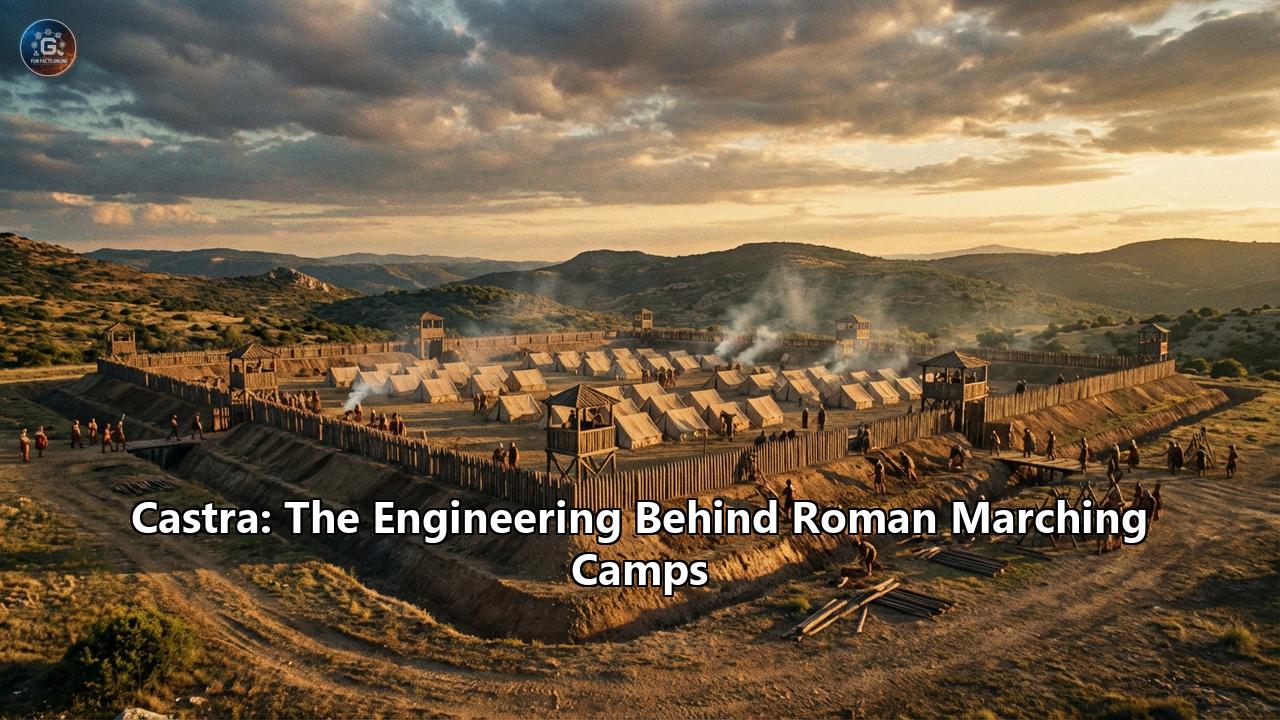
Every single night, whether deep in the forests of Germania, the deserts of Syria, or the damp highlands of Scotland, a Roman legion on the march would construct a fortified city from scratch. In a matter of hours, thousands of men would transform a patch of wilderness into an impregnable fortress, complete with streets, drainage, defensive walls, and a strictly regimented address system. This was the Castra Aestiva—the summer marching camp.
It was said that a Roman enemy might defeat the legion in battle, but they would break their teeth on the legion's camp. This is the story of the engineering marvel that allowed Rome to project power further and faster than any civilization before it.
I. The Philosophy of the Shovel: Engineering as a Weapon
To the Roman military mind, engineering was not a support function; it was a combat arm. The Jewish historian Josephus, observing the Roman war machine in the 1st century AD, noted that the Romans did not wait for battle to commence to build walls. Instead, "they do not pass the night in a place that is not fortified."
The strategic philosophy was threefold:
- Security: A fortified camp meant the army could never be surprised at night. It guaranteed the soldiers a restful sleep, untroubled by the fear of ambush, which kept morale and physical stamina high.
- Offensive Base: The camp was not just a retreat; it was a forward operating base. It served as a secure depot for baggage, supplies, and wounded, allowing the fighting men to deploy into battle unencumbered.
- Psychological Warfare: For a barbarian host to watch a Roman army arrive, and within hours see a formidable geometric fortress rise from the earth, was demoralizing. It signaled that the Romans were not just visiting; they were taking ownership of the land itself.
The marching camp turned a hostile territory into Roman soil, one square mile at a time. It was the physical manifestation of Order imposed upon Chaos.
II. The Science of Site Selection: The Mensors and the Groma
Long before the main column of the legion arrived at the night’s destination, a vanguard of specialists had already done the most critical work. These were the mensores (measurers) and gromatici (surveyors), led often by a tribune or a senior centurion.
Their first task was site selection. A perfect site required a "Goldilocks" combination of features:
- Terrain: Ideally a gentle slope (for drainage) on high ground (for defense and visibility).
- Resources: Proximity to wood (for construction and fuel), water (a legion drank thousands of gallons a day), and forage (for the baggage animals).
- Safety: The site could not be overlooked by higher ground where an enemy could rain missiles, nor could it be near dense cover that might hide an ambush.
The Groma: The Instrument of Order
Once the site was chosen, the gromatici employed the groma, the standard Roman surveying instrument. It consisted of a vertical staff supporting a horizontal cross with plumb lines hanging from each of the four ends. By sighting along these plumb lines, the surveyor could lay out perfectly straight lines and right angles.
The process began by marking the locus gromaticus, the center point of the camp. From this single point, the entire city would unfurl. The surveyors would drive a stake (the decumanus) into the ground and measure out the two main axes:
- Via Praetoria: The axis pointing toward the enemy.
- Via Principalis: The axis running perpendicular to the Praetoria, spanning the width of the camp.
Using colored flags—red for the commander, white for the tribunes—the surveyors marked out the exact location of every tent, street, and gate. By the time the tired infantrymen trudged into view, the "city" was already mapped on the grass. Every soldier knew exactly where his tent belonged relative to the flags. There was no confusion, no shouting for directions. A legion of 5,000 men could dissolve into their assigned sectors in minutes.
III. The Anatomy of Defense: Fossa, Agger, and Vallum
The genius of the Roman camp lay in its standardized defenses. A soldier transferred from Hadrian’s Wall in Britannia to the Parthian frontier in the East would find the camp layout exactly the same. This uniformity bred efficiency.
The defensive perimeter consisted of three integrated components, built simultaneously by the legionaries.
1. The Fossa (The Ditch)
The first line of defense was the ditch. Soldiers used their pickaxes (dolabra) and shovels to dig a V-shaped trench.
- Dimensions: Typically 3 feet deep and 5 feet wide for a temporary camp, though often larger in hostile territory.
- The Ankle Breaker: The bottom of the trench often featured a square channel (a "cleaning slot"), which also served to twist the ankle of anyone foolish enough to jump into it.
- Spoil: The earth excavated from the ditch was not thrown away; it was thrown inward to create the rampart.
2. The Agger (The Rampart)
The excavated soil was piled up on the inner side of the ditch to form the agger.
- Construction: To prevent the earth from slumping, the base was often reinforced with turf blocks cut like bricks, or with timber logs if available.
- Height: The combination of the ditch's depth and the rampart's height created a vertical differential of 6 to 8 feet, a formidable obstacle for an attacker trying to fight uphill.
3. The Vallum (The Palisade)
The crowning glory of the defenses was the wooden palisade. Unlike medieval armies that might cut down trees on site, the Roman legionary carried his own wall with him.
- The Pila Muralia: Each soldier carried two pila muralia (wall stakes) effectively as part of his marching kit. These were sturdy oak stakes, double-pointed and narrowed in the middle to form a "waist."
- The Interlocking Wall: When the soldiers reached the rampart, they planted these stakes into the soft earth of the agger. The stakes were tied together at the "waist" with ropes or leather thongs. The double points meant that even if an enemy pulled a stake out, they couldn't easily use it as a weapon, and the interlocking design meant you couldn't pull one stake out without dismantling the whole section.
Defending the Gates
The camp typically had four gates (one on each side). These were the weak points, so Roman engineers developed specific defensive geometries for them:
- The Titulus: A short, detached stretch of ditch and rampart dug a few yards in front of the gate. It forced a charging enemy to swerve around it, exposing their unshielded right side to the defenders on the wall.
- The Clavicula: An extension of the rampart that curved inward or outward, forcing attackers to enter the gate at an angle, again disrupting their momentum and shield wall.
IV. The Construction Assembly Line
The speed of construction was the stuff of legend. Ancient sources suggest a full marching camp could be completed in 3 to 5 hours. This was achieved through a massive, coordinated assembly line.
As soon as the legion arrived, they did not rest. They stacked their armor and weapons (except for a dagger) and pulled out their construction tools.
- The Guard: About 20% of the force remained fully armed, standing guard at the perimeter to protect the workers.
- The Diggers: The bulk of the infantry began digging the ditch.
- The Shapers: Others packed the earth into the rampart.
- The Carpenters: Specialists worked on the gates and the commander's tribunal.
The Roman soldier was half-warrior, half-construction worker. His kit included:
- The Dolabra: The most famous tool—a combination pickaxe and mattock. The axe side cut through roots; the pick side broke up hard clay. It was so effective it was often used as a weapon in emergencies.
- The Batillum: An iron shovel for moving loose earth.
- Turf Cutters: Crescent-shaped blades used to slice standardized blocks of sod for wall facing.
- Baskets: Wicker baskets were used to haul earth from the ditch to the rampart.
The result was a hive of activity. Thousands of men working in silence or to the rhythm of whistles, moving tons of earth before the sun set.
V. Inside the Leather City: Life and Logistics
Once the walls were up, the "city" inside came alive. The interior was a grid of tents (papilio), organized by cohort and century.
The Intervallum
Between the rampart and the first row of tents was a clear space of about 60 meters called the intervallum. This served two vital purposes:
- Range Safety: It kept the soldiers' tents out of range of enemy arrows or javelins thrown over the wall.
- Deployment Zone: In the event of a night attack, the troops would rush to the intervallum to form up before mounting the ramparts, ensuring they didn't stumble over tents in the dark.
The Contubernium
The basic unit of life was the contubernium (tent group). Eight men shared a leather tent. The tent was roughly 10 feet by 10 feet.
- Sleeping Arrangements: Six men would sleep while two were on watch.
- The Mule: The "ninth recruit" of the group was the mule, which carried the heavy leather tent, the millstone for grinding grain, and the cooking pot.
The Principia (Headquarters)
At the intersection of the main streets lay the heart of the camp:
- The Praetorium: The commander's large tent.
- The Tribunal: An earth mound where the general could address the troops.
- The Auguratorium: A space for taking auspices (religious omens).
- The Standards: The legion's eagle (aquila) and other standards were kept here in a makeshift shrine. They were the soul of the legion and were guarded day and night.
Sanitation
Romans were obsessed with hygiene. Even in a temporary camp, latrines were dug on the outskirts (usually near the lowest point of the slope for drainage) and downstream from the water source. The strict regulation of waste prevented dysentery, the great killer of ancient armies.
VI. Historical Evolution: Polybius vs. Hyginus
Archaeologists and historians track the evolution of the camp through two main sources.
- The Polybian Camp (c. 150 BC): Described by the Greek historian Polybius, this Republican-era camp was square. It reflected a militia army organized by property class (Hastati, Principes, Triarii). It was spacious and focused on the Consul’s tent.
- The Hyginian Camp (c. 2nd Century AD): Described in the text De Munitionibus Castrorum (attributed to "Pseudo-Hyginus"), this Imperial-era camp was rectangular with rounded corners (often called "playing-card shape"). This layout was more compressed and efficient, reflecting the professionalized legions of the Empire. It optimized space for the auxiliary troops (archers, cavalry) that had become crucial to Roman warfare.
VII. The Legacy: From Canvas to Stone
The most remarkable thing about Roman marching camps is that many didn't stay temporary. Rome’s strategy was "advance, fortify, consolidate."
If a general decided to winter in a location, the leather tents were replaced by timber barracks. If the frontier stabilized, the timber was replaced by stone. The ditch became a moat; the palisade became a curtain wall.
- Modern Cities: Many great cities of Europe began as Roman marching camps. The suffix "-chester" or "-caster" in English place names (Manchester, Lancaster, Chester) comes from the Latin castra.
- Vienna, Strasbourg, Cologne: All sit on the footprints of legionary camps. The grid of the Roman camp became the grid of the medieval city, which became the street plan of the modern metropolis.
Conclusion
The Roman marching camp was more than a defense; it was a machine. It converted human labor into safety and strategic dominance. It allowed the Romans to march into the unknown, carrying their civilization on their backs. When the sun set over the barbarian wilderness, the Roman soldier did not sleep in the wild. He slept in Rome—or at least, a perfectly engineered facsimile of it—protected by a wall he had built with his own hands.
In the end, Rome didn't just conquer the world with the sword; they conquered it with the shovel.
Reference:
- https://imperiumromanum.pl/en/roman-army/roman-camp/
- https://www.youtube.com/watch?v=Je4KKu3Ikq4
- https://www.warhistoryonline.com/ancient-history/roman-military-camp-one-established-run-left-behind.html
- https://www.thearchaeologist.org/blog/roman-castra-how-legionaries-built-and-lived-in-their-fortresses
- https://www.youtube.com/watch?v=5UH2fGnMPmk
- https://warfarehistorynetwork.com/article/roman-marching-camps-an-essential-element-in-romes-empire-building/
- https://en.wikipedia.org/wiki/Castra
- https://x-legio.com/en/wiki/castrum
- https://www.unrv.com/military/castrum.php
- http://thehistorymanatlarge.blogspot.com/2010/04/roman-army-fortified-camps.html
- https://www.youtube.com/watch?v=MOQcsCb27KQ
- https://www.youtube.com/watch?v=cSh59-RhF0M
- https://d34w7g4gy10iej.cloudfront.net/pubs/pdf_66470.pdf
- https://www.roman-britain.co.uk/place-type/camp/
- https://www.mikeanderson.biz/2011/12/roman-field-camp-construction-and.html
- https://www.heritagedaily.com/2026/01/early-roman-marching-camps-confirm-3rd-century-advances-in-germania/156757