
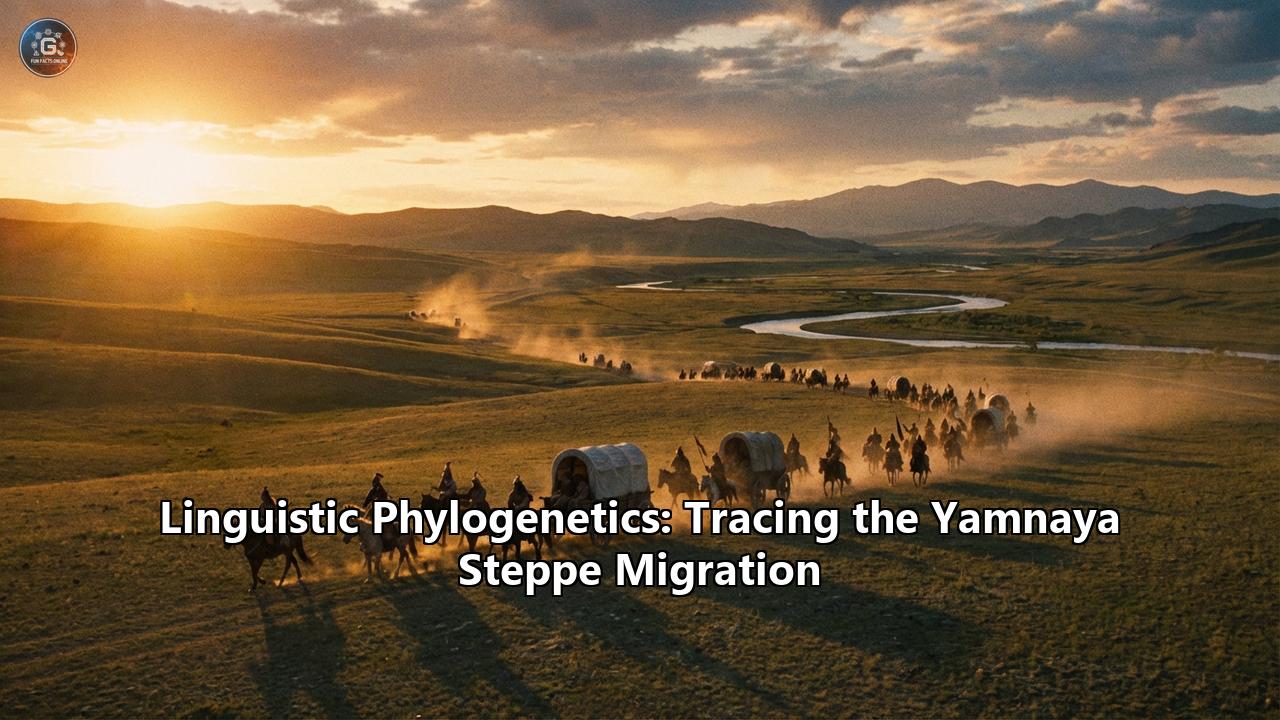
The question of where the Indo-European languages—a family that includes English, Spanish, Russian, Hindi, and Persian—originated was, for nearly two centuries, the "Holy Grail" of historical linguistics. Since Sir William Jones first famously declared in 1786 that Sanskrit, Greek, and Latin must have "sprung from some common source, which, perhaps, no longer exists," scholars have fought a bitter intellectual war over the location of this homeland and the identity of the people who spoke the mother tongue, Proto-Indo-European (PIE).
For decades, the debate was deadlocked between two dominant theories: the "Steppe Hypothesis," championed by archaeologists like Marija Gimbutas and David Anthony, which placed the homeland in the Pontic-Caspian steppes north of the Black Sea; and the "Anatolian Hypothesis," proposed by Colin Renfrew, which argued for a much older origin among the early farmers of Turkey. Arguments were waged with pottery shards and comparative grammar, but definitive proof remained elusive.
Then came the revolution. The last decade, and specifically the watershed years of 2024 and 2025, witnessed a collision of two disparate fields: ancient DNA (paleogenomics) and linguistic phylogenetics. This synthesis has not only broken the deadlock but has painted a picture of human prehistory more dynamic, violent, and mobile than anyone dared imagine. At the center of this storm is the Yamnaya culture—a society of nomadic pastoralists who, we now know, genetically and linguistically reshaped the world.
This is the story of how algorithms designed to track viruses and genes were repurposed to track words, and how they, combined with the DNA of long-dead kings, traced the footsteps of the Yamnaya across the Eurasian continent.
Part I: The Mathematics of Babel
To understand the solution, one must first understand the new tools that forged it. Traditional historical linguistics relies on the "Comparative Method"—a painstaking manual reconstruction of ancestral words based on regular sound changes (like Grimm’s Law). While brilliantly effective, it struggles with timing. It can tell you that languages are related, but it is notoriously bad at telling you when they split.
Linguistic phylogenetics changed the game by treating language like a biological organism. Just as DNA mutates at a reasonably predictable rate (the "molecular clock"), words in a language are replaced over time. By compiling massive databases of "cognates"—words that share a common origin, like "mother" (English), "mutter" (German), "madre" (Spanish), and "matr" (Sanskrit)—and applying Bayesian inference models, researchers could generate "trees" of language evolution with statistical probabilities attached to every branch and date.
Bayesian phylogenetics allows researchers to input "priors"—constraints based on known historical events (like the date of the earliest Old Irish texts or the fall of the Hittite Empire)—and run millions of simulations to find the most likely evolutionary tree. When these models were first applied in the early 2000s, they often yielded controversial results, sometimes supporting the older Anatolian dates. But as the models were refined to account for "rate variation" (the fact that some languages change faster than others) and "borrowing" (when languages swap words), the dates began to align with a younger, Bronze Age timeframe.
In 2023, a landmark study by the Max Planck Institute for Evolutionary Anthropology utilized an unprecedented dataset of core vocabulary from 161 Indo-European languages. The result was a "hybrid tree" that finally bridged the gap. It suggested the ultimate root of the family lay south of the Caucasus around 8,100 years ago, but—and this is the crucial pivot—it showed a massive, secondary radiation around 5,000 to 7,000 years ago branching directly from the Steppe.
This linguistic signal was a perfect lock-and-key fit for the genetic data that was simultaneously emerging from Harvard Medical School and the University of Copenhagen. The algorithms were predicting a massive explosion of lineages in the Early Bronze Age, right when archaeologists saw the rise of the Yamnaya.
Part II: The Steppe Lords
Who were the Yamnaya? Before 2015, they were known only to specialists as the "Pit Grave" culture (from the Russian Yamna, meaning "pit"). They appeared on the Pontic-Caspian steppe (modern-day Ukraine and southern Russia) around 3300 BCE.
Archaeologically, they represented a seismic shift in human behavior. Unlike the settled farmers of "Old Europe" who lived in large, dense towns and worshiped female figurines, the Yamnaya were mobile. They had domesticated the horse (though initially for meat and milk, and later for riding) and, most importantly, they had adopted the wheel. The heavy, solid-wheeled ox-wagon allowed them to take their herds of cattle and sheep deep into the open steppe, exploiting the vast grasslands that settled farmers couldn't touch.
They were a patriarchy, obsessed with lineage and war. Their burials—the kurgans—were massive earthen mounds raised over the graves of elite males, often buried with weapons and, occasionally, wagons. They were taller and more robust than the European farmers they would soon replace.
For years, the "Kurgan Hypothesis" argued that these people were the speakers of Proto-Indo-European. The linguistic reconstruction of PIE supports this vivid picture. The vocabulary of PIE, reconstructed by linguists, is full of words for "wagon," "axle," "wheel," "horse," "wool," and "herding." It lacks, notably, words for lowland, warm-climate crops that would be expected if they came from the Fertile Crescent.
But the "smoking gun" arrived in 2015, when David Reich’s lab at Harvard published a study that shocked the world. They sequenced the genomes of Corded Ware skeletons from central Germany (c. 2500 BCE) and found that 75% of their ancestry was derived from the Yamnaya. In a blink of evolutionary time, the genetic map of Europe had been wiped clean and repainted. The Yamnaya hadn't just migrated; they had swamped the continent.
Part III: The 2025 Breakthrough: The Anatolian Puzzle
Despite the triumph of the Steppe Hypothesis in explaining European languages (like Germanic, Italic, and Celtic) and Asian languages (Indo-Iranian), there was a nagging, catastrophic hole in the theory: Anatolia.
The Anatolian branch of Indo-European, represented famously by the Hittites who ruled Bronze Age Turkey, is the oldest and most divergent branch of the family. If the Yamnaya were the source of all Indo-European languages, the Hittites should have carried Yamnaya DNA.
They didn't.
Ancient DNA samples from Bronze Age Anatolia showed zero steppe ancestry. This fact kept the rival "Anatolian Hypothesis" alive and fueled skeptics who argued that if the oldest branch wasn't from the Steppe, the Steppe couldn't be the homeland.
The resolution to this paradox came in late 2024 and was solidified in early 2025 with the identification of a "Ghost Population" now known as the Caucasus-Lower Volga (CLV) people.
Geneticists and linguists, working in tandem, realized that the Yamnaya themselves were a mixture. They were formed from the merger of Eastern European Hunter-Gatherers (EHG) and a population from the Caucasus (CHG). The 2025 studies pinpointed a specific Eneolithic population living between the Volga River and the Caucasus Mountains around 4500 BCE—the CLV group.
The phylogenetic models finally clicked into place with the genetics. The narrative is now understood as follows:
- The Root (4500–4000 BCE): The CLV population spoke "Pre-Proto-Indo-European."
- The Split: Around 4200 BCE, this population fissioned. One group moved south, crossing the Caucasus Mountains into Anatolia. These people carried the linguistic ancestor of Hittite but before the genetic formation of the Yamnaya proper. This explains why Hittites speak an Indo-European language but lack the characteristic "Steppe" genetic signature that formed later.
- The Formation: The remaining CLV population on the steppe mixed with northern hunter-gatherers, forming the classic "Yamnaya" genetic cluster and the "Late Proto-Indo-European" language.
- The Explosion (3000 BCE): This Yamnaya group, armed with wagons and a new social organization, expanded explosively East and West, becoming the ancestors of everything from Celtic to Sanskrit.
This "Indo-Anatolian" solution satisfied both the geneticists (who saw no Yamnaya blood in Hittites) and the phylogenetics (which required Anatolian to split off centuries before the other branches).
Part IV: The Westward Vector: Corded Ware and the Birth of Europe
Tracing the phylogenetics westward, we enter the realm of the "Corded Ware" culture. This archaeological horizon, named for its cord-impressed pottery, swept across Northern Europe starting around 2900 BCE.
Linguistic phylogenetics identifies this moment as the splintering of the "Northwest Indo-European" branch. The bayesian trees show a rapid divergence—a "starburst" pattern—dating exactly to this period. This branch would eventually fracture into Germanic, Celtic, Italic, and Balto-Slavic.
The Germanic Case Study:The relationship between the Yamnaya and the Germanic languages is one of the most direct. The Corded Ware culture in Scandinavia merged with the local Funnelbeaker culture to produce the "Battle Axe Culture." Linguistically, this correlates with "Pre-Proto-Germanic." The phylogenetic timing is impeccable. The separation of Germanic from the Balto-Slavic branch is calculated by Bayesian models to have occurred roughly around 2500 BCE, consistent with the archaeological dissolution of the Corded Ware horizon into regional groups.
Interestingly, linguistic evidence preserves the trauma of this encounter. The Germanic languages contain a substrate of non-Indo-European words—terms for sea life, local flora, and social rank—that don't fit the PIE model. This suggests that while the Yamnaya migrants (who were predominantly male, according to Y-chromosome analysis) married into local European populations, they imposed their language, which then absorbed elements of the local tongue—a process known as creolization.
The Italo-Celtic Controversy:For years, linguists debated whether Italic (ancestor of Latin) and Celtic formed a single "Italo-Celtic" clade. The new phylogenetic trees, bolstered by the 2025 data, overwhelmingly support this. They suggest a single movement of people up the Danube valley (the Bell Beaker phenomenon), which carried the dialects that would become Welsh and Latin. The Bell Beaker people, genetically, were Yamnaya descendants who had pushed all the way to Britain and Spain. The "Beaker phenomenon" in Britain was particularly total; ancient DNA shows a 90% population replacement in Britain around 2400 BCE. The builders of Stonehenge were replaced by the speakers of Proto-Celtic almost overnight.
Part V: The Eastward Vector: Chariots and the Aryan Migration
While the ox-wagon drove the expansion into Europe, it was the chariot that drove the expansion into Asia.
The eastern wing of the Yamnaya expansion evolved into the Sintashta culture (c. 2100 BCE) near the Ural Mountains. This is where linguistic phylogenetics and engineering history intersect most spectacularly. The Sintashta people are universally identified as the speakers of Proto-Indo-Iranian.
They were the first to bend wood into spoked wheels, creating the light war chariot. This invention is linguistically encoded; the Sanskrit word for "axle," "wheel," and "chariot" (ratha) have direct cognates in the oldest Iranian texts (Avestan).
The Bayesian dates for the split of Indo-Iranian from the main trunk align perfectly with the birth of the Sintashta culture (c. 2200 BCE). From this industrial hub in the Urals, where they mined copper on an industrial scale, they expanded south.
The BMAC Interaction:As these "Aryans" (a self-designation found in both the Vedas and the Avesta) moved south, they encountered the sophisticated, urban civilization of the Bactria-Margiana Archaeological Complex (BMAC) in Central Asia. Genetic studies show that the Sintashta people mixed with the BMAC population, but only slightly. Linguistically, however, this was a major event. Proto-Indo-Iranian borrowed a specific set of words from the BMAC language—words for irrigation, bricks, and camels—before splitting into Iranian and Indo-Aryan.
The Indo-Aryan branch then crossed the Hindu Kush into the Punjab. The Rigveda, the oldest Sanskrit text, describes this world of chariots, cattle raids, and fortified places (purs). For a long time, Indian nationalist interpretations argued for an indigenous origin of Sanskrit (the "Out of India" theory). However, the 2024/2025 phylogenetic and genetic data have rendered this untenable. The "Steppe Ancestry" in South Asia appears strictly in the Bronze Age (post-1500 BCE) and is highest in the priestly Brahmin caste, who were the custodians of the Sanskrit texts. The phylogenetic tree of Indo-Aryan languages is rooted unequivocally in the Sintashta branch of the Yamnaya family tree.
Part VI: The Lonely Branches: Tocharian and Greek
Linguistic phylogenetics has also solved the riddles of the "outlier" languages.
Tocharian:In the early 20th century, manuscripts were discovered in the Tarim Basin of western China written in an unknown Indo-European language. Named "Tocharian," it was baffling because it was a "Centum" language (like Celtic and Germanic, sounding "hard") located deep in "Satem" territory (like Slavic and Indo-Iranian, sounding "soft").
Phylogenetics places Tocharian as the second oldest branch to split, after Anatolian. The Afanasievo culture, a Yamnaya offshoot that migrated thousands of kilometers east to the Altai Mountains around 3300 BCE, is now identified as the Proto-Tocharian community. They became isolated from the main steppe interactions, preserving archaic linguistic features that were lost in the central dialects. They were the "lost legion" of the Yamnaya expansion.
Greek and Armenian:The "Southern Arc" hypothesis, refined in 2025, sheds light on Greek and Armenian. These languages share a "Graeco-Aryan" distinctiveness in some models. The current consensus suggests a movement from the Steppe, down through the Balkans (for Greek) and across the Caucasus (for Armenian), but at a later date than the Anatolian split. The "Yamnaya signal" in Mycenaean Greeks is present but diluted, suggesting they entered a densely populated region and mixed heavily with the Minoan-like locals, creating the hybrid civilization of Classical Greece.
Part VII: The Mechanism of Dominance
Why did these languages win? Why do 3.5 billion people today speak a daughter of the Yamnaya tongue?
It wasn't just violence, though the "genomic violence" of the Corded Ware replacement is undeniable. It was a package of social and technological dominance.
- Mobility: The wagon and horse allowed them to manage larger herds and move resources faster than sedentary farmers.
- Dairying: Geneticists found that the Yamnaya had a higher frequency of lactase persistence (tolerance) alleles, or at least a culture heavily reliant on dairy, providing a portable, renewable calorie source.
- Patron-Client Systems: David Anthony argues that PIE contains vocabulary implying a system of "guest-host" relationships and feasting obligations. This social structure allowed them to incorporate conquered populations as "clients," spreading the language as a status marker. To get ahead in Bronze Age Europe, you had to speak the language of the guys with the big herds and the bronze axes.
Part VIII: Conclusion: The New Human History
The synthesis of linguistic phylogenetics and ancient DNA has done more than just map a language family; it has fundamentally altered our view of human history. We are not the static descendants of people who have lived on the same land for eternity. We are the products of massive, dynamic, and often brutal migrations.
The Yamnaya were not a "superior" race, as 19th-century racialists wrongly imagined, but they were a highly adapted one. They were a keystone culture that unlocked the energy of the steppe. By marrying the Bayesian probability of language change with the hard certainty of carbon-dated genomes, we have traced them from the Volga to the Atlantic and the Ganges.
In 2026, we can look at a diagram of the Indo-European family tree not as a dry academic sketch, but as a map of human movement. Every fork in the tree is a group of families packing up their wagons, lighting a fire, and deciding to cross the next river range. The ghosts of the Steppe are no longer silent; they speak in the words we use every day. When you say "mother," "water," "two," or "three," you are breathing life into the echoes of a language spoken by nomads on the Russian steppe 5,000 years ago. The mystery is solved, but the wonder remains.
Reference:
- http://benedante.blogspot.com/2019/07/david-anthony-horse-wheel-and-language.html
- https://www.razibkhan.com/p/we-are-what-we-speak-indo-european
- https://www.goodreads.com/book/show/1831667.The_Horse_the_Wheel_and_Language
- https://hms.harvard.edu/news/ancient-dna-study-identifies-originators-indo-european-language-family
- https://en.wikipedia.org/wiki/Indo-European_migrations