
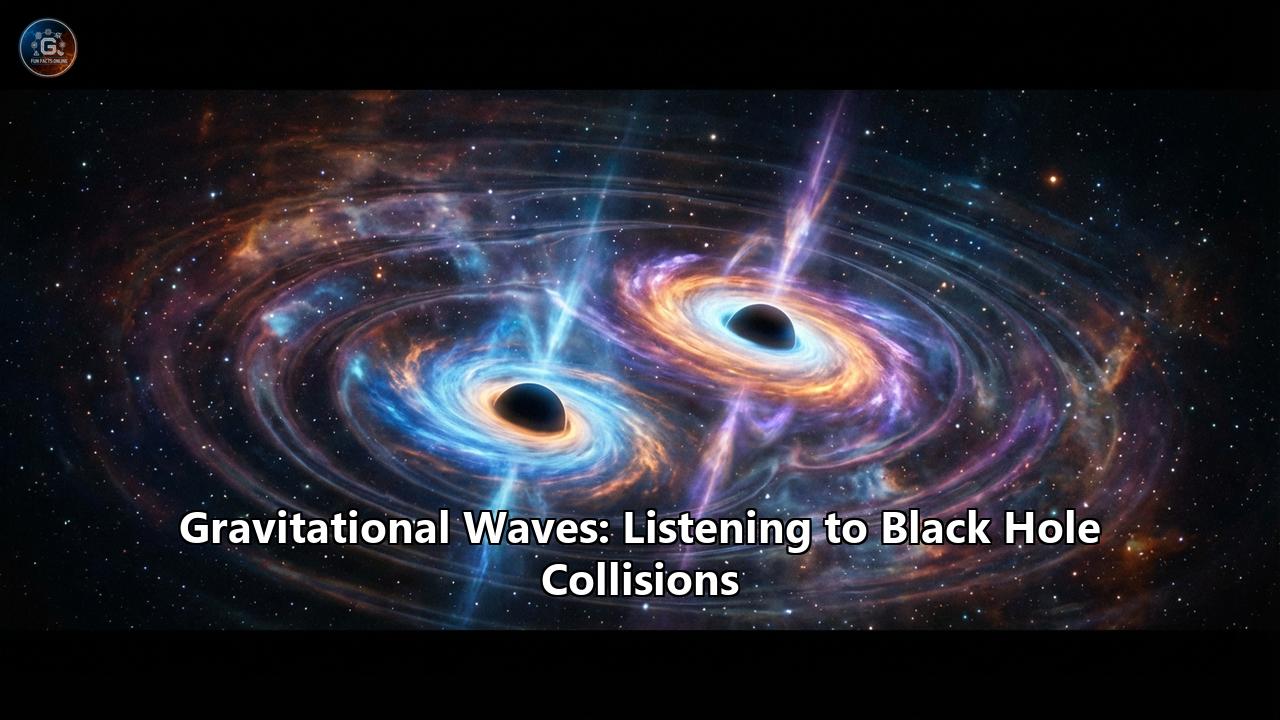
The universe has always been a silent movie. For millennia, humanity has looked up at the night sky, observing the cosmos through the medium of light. We have built larger telescopes to gather more photons, expanding our vision from the visible spectrum to radio waves, X-rays, and gamma rays. Yet, for all this technological prowess, we remained deaf to the sounds of the universe. We could see the violent deaths of stars and the swirling hearts of galaxies, but we could not hear the fabric of space itself crashing together.
That changed forever on September 14, 2015. On that day, a new sense was added to the human experience. We did not use ears, but rather arguably the most sensitive machine ever built by human hands: the Laser Interferometer Gravitational-Wave Observatory (LIGO). For the first time, we detected a signal not made of light, but of gravity. It was a chirp—a fleeting, oscillating ripple in the curvature of spacetime caused by the cataclysmic collision of two black holes 1.3 billion light-years away.
This article explores the monumental science of gravitational waves. It is a journey from the abstract mathematics of Albert Einstein to the practical engineering of detecting displacements smaller than a proton, and finally to the "dark" universe of black hole mergers that we are now, for the first time, beginning to map.
Part I: The Ripples of Spacetime
To understand gravitational waves, one must first unlearn the Newtonian view of gravity. Isaac Newton described gravity as a force: an invisible tether that instantaneously connected two masses. If the Sun were to vanish suddenly, Newton’s equations implied that Earth would immediately fly off into the void.
Albert Einstein, in 1915, proposed a radical alternative with his General Theory of Relativity. He reimagined gravity not as a force, but as geometry. Space and time, he argued, are fused into a four-dimensional fabric called spacetime. Massive objects like the Sun and the Earth curve this fabric, much like a bowling ball resting on a trampoline. Earth doesn't orbit the Sun because of a mysterious tether; it simply follows the straightest possible path (a geodesic) through the curved environment the Sun creates.
The Prediction
One specific consequence of this theory was the prediction of gravitational waves. Einstein realized that if a massive object accelerates, it should create disturbances in the curvature of spacetime that propagate outward at the speed of light. Think of a boat moving through a lake; it leaves a wake of water waves behind it. Similarly, two black holes spiraling around each other generate a wake of spacetime ripples—gravitational waves.
However, Einstein was skeptical that these waves could ever be detected. Space is incredibly stiff; it takes a cataclysmic amount of energy to create even a microscopic ripple. A wave generated by a binary star system would, by the time it reached Earth, distort our planet by less than the width of an atomic nucleus. For decades, the subject was relegated to the fringes of theoretical physics, debated by theorists who weren't even sure if the waves carried real energy.
The Indirect Proof: Hulse and Taylor
The first cracks in the skepticism appeared in 1974. Astronomers Russell Hulse and Joseph Taylor discovered a binary pulsar system (PSR B1913+16). These were two neutron stars—city-sized remnants of dead stars, incredibly dense—orbiting each other. One was a pulsar, sweeping a beam of radio waves across Earth like a cosmic lighthouse.
By timing these radio pulses with extreme precision, Hulse and Taylor found that the stars were spiraling closer together. The orbit was shrinking by exactly the amount predicted by General Relativity if the system were losing energy by radiating gravitational waves. This was the "smoking gun," albeit an indirect one. The waves were real, and they carried energy. But catching them directly would require a detector of unimaginable sensitivity.
Part II: The Most Precise Ruler in History
How do you measure a ripple in space? If a gravitational wave passes through you, it stretches space in one direction and squeezes it in the perpendicular direction. If you were floating in space, you would be made taller and thinner, then shorter and wider, in a rhythmic cycle.
The catch is that the wave stretches everything, including any ruler you might use to measure the change. To detect this, scientists turned to the only thing that remains constant in a distorted spacetime: the speed of light.
The Michelson Interferometer
LIGO uses a device called a Michelson interferometer. The design is elegantly simple in principle but terrifyingly complex in execution. A laser beam is split into two halves. One half travels down a 4-kilometer long tube (Arm A), and the other travels down a perpendicular 4-kilometer tube (Arm B). At the end of each arm, a mirror reflects the light back to the start.
When the two beams return, they recombine. The system is calibrated so that the light waves from the two arms cancel each other out—a phenomenon called destructive interference. In a perfect, quiet state, no light reaches the detector. The instrument is dark.
When a gravitational wave passes, it distorts the Earth (and the detector). One arm is stretched slightly, and the other is squeezed. The light in the stretched arm now has to travel a farther distance and takes longer to return. The light in the squeezed arm returns sooner. The two beams are no longer perfectly aligned to cancel each other out. They slip out of phase, and a flicker of light hits the detector. That flicker is the signal.
The Scale of the Challenge
The engineering required to make this work is staggering. The change in length LIGO looks for is on the order of $10^{-18}$ meters. To visualize this: if the arm of the detector were the distance to the nearest star (Proxima Centauri), the change in length would be the width of a human hair. On the 4-kilometer scale of the actual detector, they are measuring a change 10,000 times smaller than the nucleus of an atom.
To achieve this, the mirrors (test masses) effectively hang in a free fall, suspended by fused silica fibers to isolate them from the vibrating Earth. The lasers are the purest light sources ever created. The vacuum tubes are the second-largest vacuum chambers in the world (surpassed only by the Large Hadron Collider).
Scientists have to contend with "noise" from everywhere. A truck driving on a highway miles away, ocean waves crashing on a distant shore, the thermal vibration of the atoms in the mirror coatings, and even the quantum flickering of the laser photons themselves—all create noise that drowns out the signal. The success of LIGO is not just in detecting the wave; it is in quieting the rest of the world to listen to the whisper of the universe.
Part III: The Anatomy of a Black Hole Collision
The signals LIGO detects are not random noise; they have a specific shape, a "waveform," that tells the story of the source's life and death. When two black holes collide, the process occurs in three distinct acts: the Inspiral, the Merger, and the Ringdown.
Act 1: The Inspiral
For millions or billions of years, two black holes orbit each other. As they circle, they emit gravitational waves, which carry away orbital energy. This loss of energy causes them to fall closer together, which in turn makes them orbit faster, which generates stronger and higher-frequency waves. This is a runaway process.
By the time LIGO can hear them, they are spinning around each other hundreds of times per second. The signal appears as a low hum that rises in pitch and volume—a "chirp." From the rate at which this chirp accelerates (the "frequency derivative"), astrophysicists can determine the masses of the two black holes. Heavier black holes chirp at lower tones (bass), while lighter ones chirp at higher pitches (soprano).
Act 2: The Merger
This is the crescendo. The two event horizons—the points of no return—touch. In a fraction of a second, the two singularities plunge into one another. This is the most violent event known to physics.
In the case of GW150914 (the first detection), two black holes with 36 and 29 times the mass of the Sun collided. The resulting single black hole had a mass of 62 solar masses. Basic arithmetic (36 + 29 = 65) shows that 3 solar masses are missing.
Where did that mass go? It was converted directly into energy in the form of gravitational waves, according to Einstein's famous equation $E=mc^2$. That conversion happened in less than two-tenths of a second. For that brief moment, the power output of this single event was greater than the combined light of every star in the observable universe.
Act 3: The Ringdown
After the violence of the merger, the newly formed black hole is not a perfect sphere. It is distorted, lumpy, and vibrating. Like a struck bell, it "rings" to shed these imperfections.
This phase is called the ringdown. The black hole emits a final, dying tone of gravitational radiation as it settles into a stable, quiet state (a Kerr black hole). The frequency and decay rate of this ringdown are dictated entirely by the final mass and spin of the new black hole. This is where scientists can test the "No-Hair Theorem," which states that a black hole has no features (hair) other than mass, spin, and charge. If the ringdown contained frequencies that didn't match the predictions for a Kerr black hole, it would be evidence of new physics or a violation of General Relativity. So far, Einstein remains undefeated.
Part IV: The Black Hole Zoo and Population Statistics
Before 2015, we only knew of stellar-mass black holes indirectly, by observing X-rays emitted as they devoured companion stars. These "X-ray binaries" were all relatively light—between 5 and 15 times the mass of the Sun.
LIGO opened a window onto a hidden population. The very first detection (36 and 29 solar masses) was a shock. It proved that "heavy" stellar black holes exist, which implies they formed from massive stars that didn't lose much mass before collapsing. This suggests these stars formed in environments with low "metallicity" (fewer elements heavier than helium), likely in the early universe or dwarf galaxies.
The Mass Gap
One of the major mysteries in astrophysics is the "Mass Gap." We see neutron stars up to about 2.1 solar masses. We see black holes starting at about 5 solar masses. Between 2.5 and 5 solar masses, there seemed to be a desert.
Gravitational wave astronomy has begun to fill this desert. In August 2019, LIGO detected an event (GW190814) involving a 23-solar-mass black hole merging with a mysterious object of 2.6 solar masses. Was it the heaviest neutron star ever seen, or the lightest black hole? We still aren't certain, but it proves that objects in the gap do exist, challenging our models of how stars die.
Intermediate-Mass Black Holes
Astronomers have long known about small black holes (stellar mass) and giant ones (supermassive black holes at galaxy centers, millions of times the sun's mass). But the "missing link"—Intermediate-Mass Black Holes (IMBHs), ranging from 100 to 100,000 solar masses—had been elusive.
In May 2019, LIGO detected GW190521. Two black holes (85 and 66 solar masses) collided to create a 142-solar-mass remnant. This remnant is the first definitive detection of an IMBH. Furthermore, the 85-solar-mass progenitor shouldn't exist according to standard stellar physics (due to "pair-instability supernovae" which blow stars apart completely). This suggests this black hole might have been the result of a previous merger—a "second-generation" black hole. We are seeing a hierarchical family tree of mergers.
Part V: Matched Filtering – How We Listen
Detecting these signals is not as simple as putting a microphone to the cosmos. The "sound" of a gravitational wave is buried under mountains of noise. The strain amplitude is often smaller than the background vibration of the instrument itself.
To find the signal, data analysts use a technique called Matched Filtering. It is the mathematical equivalent of looking for a specific face in a massive, noisy crowd.
Scientists calculate hundreds of thousands of theoretical "templates"—simulations of what a wave would look like for every possible combination of black hole masses and spins. They then slide these templates over the raw data stream. If a section of data mathematically correlates with a template (i.e., the peaks and troughs align), it produces a spike in the "signal-to-noise ratio."
This requires immense computing power. The templates must account for General Relativity's complex equations, including the precession of orbits (where the plane of the orbit wobbles like a top) and the eccentricity of the approach. When a match is found in both the Hanford (Washington) and Livingston (Louisiana) detectors—and now the Virgo detector in Italy and KAGRA in Japan—it is flagged as a candidate event.
Part VI: Cosmology and Standard Sirens
Gravitational waves are not just about black holes; they are a new ruler for the universe itself.
One of the biggest crises in modern cosmology is the "Hubble Tension." We have two ways to measure the expansion rate of the universe (the Hubble Constant). One method involves looking at the early universe (Cosmic Microwave Background) and extrapolating forward. The other involves looking at the local universe (Supernovae) and measuring distance. The two methods disagree by about 9%, a statistically significant gap that suggests we might be misunderstanding the physics of the universe.
Gravitational waves offer a third way, a "tie-breaker."
When binary neutron stars merge, they emit gravitational waves and light (a kilonova). The gravitational wave tells us the distance to the source directly (based on how loud the signal is). This is absolute; it doesn't rely on the "cosmic distance ladder" of candles and variable stars. The light from the host galaxy tells us the redshift (how fast it's moving away).
Dividing the recession velocity by the distance gives us the Hubble Constant. This method uses "Standard Sirens." The first such event, GW170817, gave a measurement right in the middle of the two conflicting values. As we detect more of these multimessenger events, we may finally resolve the Hubble Tension and determine the true age and expansion rate of our cosmos.
Part VII: The Future – Einstein Telescope and LISA
We are currently in the era of "Advanced LIGO" and "Advanced Virgo." But we are only scratching the surface.
The Einstein Telescope (ET)
Europe is planning the Einstein Telescope, a third-generation underground observatory. Unlike LIGO's L-shape, ET will be a triangle with 10-kilometer arms. Being underground reduces seismic noise, and cryogenic cooling will reduce thermal noise. ET will be so sensitive it could hear every stellar-mass black hole merger in the observable universe. It will take us from seeing "events" to hearing the continuous "popcorn crackle" of the cosmos.
LISA (Laser Interferometer Space Antenna)
On Earth, we can only hear high-pitched "treble" waves (10 Hz to 1000 Hz). The low-frequency "bass" notes are drowned out by the Earth's own seismic rumbling. To hear the bass, we must go to space.
LISA, a mission by ESA and NASA planned for the mid-2030s, will consist of three spacecraft flying in a triangle millions of kilometers apart. They will fire lasers at each other to detect waves with periods of minutes to hours.
LISA will detect the collisions of Supermassive Black Holes. These are the monsters at the centers of galaxies, weighing millions of suns. When galaxies merge, their central black holes spiral together. LISA will hear these events years before they merge, allowing us to watch the evolution of galaxy structures. It will also be able to detect small black holes falling into supermassive ones (EMRIs - Extreme Mass Ratio Inspirals), tracing the complex geometry of spacetime around a giant black hole with exquisite precision.
Conclusion: A New Era of Astronomy
In 1609, Galileo Galilei pointed a telescope at the sky and discovered that Jupiter had moons. That moment fundamentally changed our place in the universe. It showed us that we were not the center of everything.
The detection of GW150914 was our Galileo moment for gravity. We have opened a new window—or rather, a new ear—to the universe. We are no longer limited to the light that is blocked by dust or absorbed by gas. Gravity passes through everything. It brings us news from the darkest, densest, and most violent corners of reality.
We are listening to the drums of spacetime. We have heard the death spiral of black holes, the collision of neutron stars creating the gold in our jewelry, and the tremors of the invisible universe. As our detectors become more sensitive, we may eventually hear the "primordial background"—the gravitational echo of the Big Bang itself.
The silent movie is over. The universe is playing a symphony, and for the first time in history, we are part of the audience.
Reference:
- https://www.techexplorist.com/gravitational-wave-detection-tests-einsteins-theory-gravity/102038/
- https://www.et-gw.eu/
- https://www.mdpi.com/2075-4434/10/4/90
- https://www.forbes.com/sites/startswithabang/2020/03/20/new-ligo-events-demolish-the-idea-of-a-mass-gap-between-neutron-stars-and-black-holes/
- https://eprints.soton.ac.uk/457942/1/GW_BH_QNMs.pdf
- https://imprs-lectures.aei.mpg.de/potsdam-2019/wp-content/uploads/sites/2/2020/01/IMPRSStatsforGWLecture8.pdf
- https://arxiv.org/html/2505.11033v2
- https://pubs.aip.org/aapt/ajp/article/93/3/272/3335815/An-undergraduate-lab-experiment-on-matched
- https://indico.global/event/524/contributions/15095/attachments/4411/6863/AshleyChraya_CASST.pdf
- https://www.ligo.caltech.edu/news/ligo20200623
- https://en.wikipedia.org/wiki/Matched_filter
- https://academic.oup.com/mnras/article/528/2/3249/7513767
- https://arxiv.org/abs/2601.04774
- https://www.researchgate.net/publication/386792338_A_gravitational-wave_standard_siren_measurement_of_the_Hubble_constant
- https://cosmicexplorer.org/