
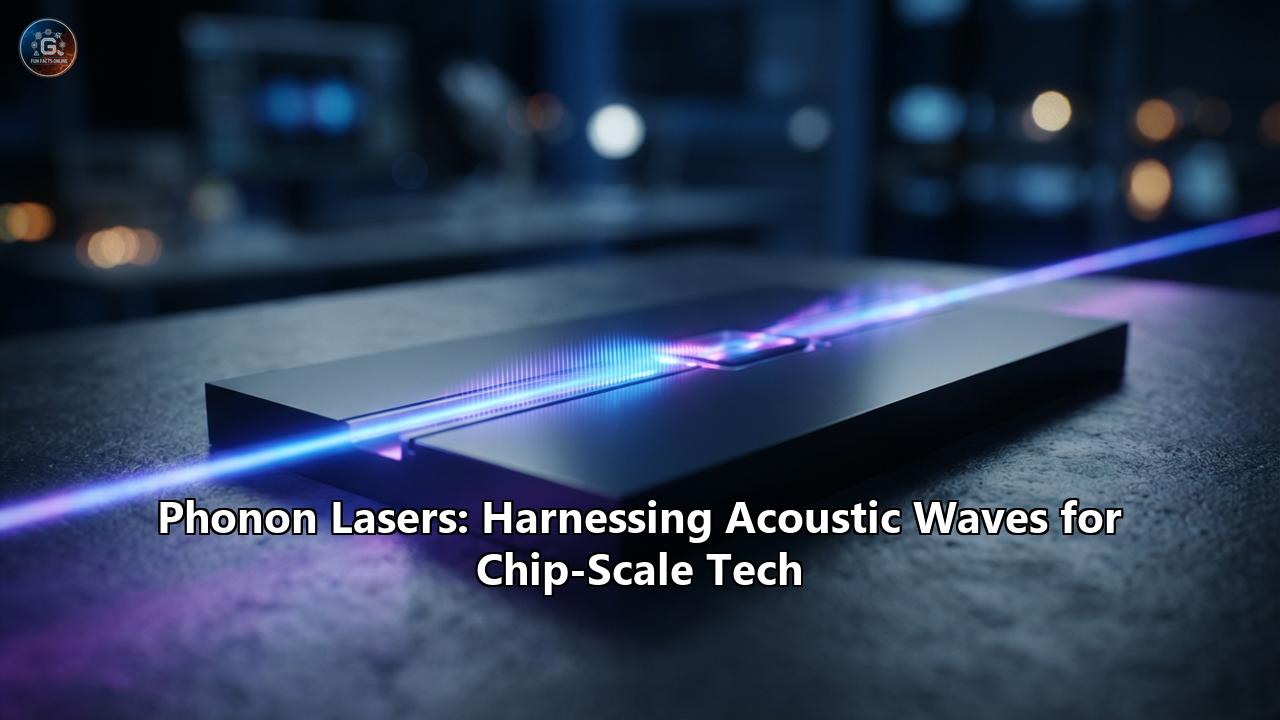
Imagine holding a smartphone that never overheats, processes data at blistering speeds, and connects seamlessly to a 6G network using a fraction of the battery power required today. Now imagine that the secret behind this device isn't a new type of microchip, but a microscopic, tightly controlled "earthquake" vibrating silently within its silicon heart.
For the past sixty years, the optical laser has been the undisputed king of modern technology. From scanning groceries and reading DVDs to performing delicate eye surgeries and transmitting the internet across fiber-optic cables, the controlled beam of light—the photon—has built the modern world. But we are currently witnessing the dawn of a new technological epoch. The 21st century is giving rise to a new kind of beam, one not made of light, but of sound. Welcome to the era of the Phonon Laser, or the SASER (Sound Amplification by Stimulated Emission of Radiation).
By harnessing coherent acoustic waves on a chip-scale level, engineers and physicists are bypassing the physical limits of traditional electronics and photonics. From revolutionizing quantum computing and shrinking wireless communication hardware, to peering inside living cells without destroying them, the phonon laser is poised to become the foundational technology of the next fifty years.
The Physics of the SASER: Why Sound Beats Light at the Microscale
To understand why a phonon laser is such a monumental leap forward, we must first understand the fundamental differences between a photon (a quantum of light) and a phonon (a quantum of mechanical vibration or sound).
In a traditional optical laser, energy is pumped into a medium (like a crystal or a gas), exciting the electrons within its atoms. When these electrons return to their resting state, they release energy in the form of photons. Through stimulated emission, these photons bounce back and forth between mirrors, coaxing other atoms to release identical photons until a highly organized, coherent beam of light emerges.
The concept of the SASER is almost as old as the optical laser itself. Shortly after Theodore Maiman fired the first ruby laser in 1960, physicists hypothesized that the exact same principles could be applied to acoustic waves. However, building a practical saser faced a massive thermodynamic hurdle: heat. Pumping energy into a system to excite mechanical vibrations inevitably creates chaotic thermal noise. Separating a pure, coherent sound wave from the random jiggling of heated atoms proved incredibly difficult.
But why go through the trouble of building a laser made of sound in the first place? The answer lies in wavelength compression.
Sound waves travel roughly 100,000 times slower than light waves. Because of this massive disparity in speed, a sound wave at a specific frequency has a dramatically shorter wavelength than a light wave at that exact same frequency. Consider a standard Wi-Fi signal operating at 2.4 GHz. As an electromagnetic radio wave, its wavelength is roughly 12.5 centimeters—meaning the antennas and components designed to interact with it must be relatively large. However, if you convert that 2.4 GHz signal into a mechanical sound wave traveling through a dense medium like silicon, its wavelength shrinks from 12.5 centimeters to a mere few micrometers.
This extreme spatial compression is the killer feature of phononics. It allows engineers to manipulate high-frequency information and build devices that are thousands of times smaller than their photonic or electromagnetic counterparts. Until recently, the problem was that generating these high-frequency acoustic waves required bulky, passive components that drained power. That all changed with the advent of the single-chip solid-state phonon laser.
The 2026 Breakthrough: An "Earthquake on a Chip"
In early 2026, a consortium of researchers from the University of Colorado Boulder, the University of Arizona, and Sandia National Laboratories—led by scientists like Matt Eichenfield and Alexander Wendt—shattered previous limitations by unveiling an electrically injected, solid-state surface acoustic wave (SAW) phonon laser.
Described playfully as an "earthquake on a chip," this device represents the holy grail of phononics: a compact, single-chip system that generates highly controlled, coherent mechanical vibrations without the need for an external radio-frequency (RF) drive.
Prior to this breakthrough, producing surface acoustic waves on a chip was an inefficient, multi-step process. In modern smartphones, multiple chips are used to convert incoming radio signals from a cell tower into tiny mechanical vibrations. These SAWs act as physical filters, sifting out unwanted electromagnetic noise before converting the signal back into an electrical format the phone's processor can understand. While effective, these passive components act like tollbooths, eating up signal strength and battery life while taking up precious physical real estate on the motherboard. Furthermore, traditional SAW filters struggle to operate efficiently at the ultra-high frequencies required by emerging 5G and 6G networks, often topping out around 4 GHz.
The 2026 solid-state phonon laser changes the paradigm entirely. Instead of a passive filter that relies on external RF sources, the researchers created an active device that directly amplifies the acoustic signal. Built on a footprint of less than 0.15 square millimeters, the device consists of stacked, ultrathin layers of advanced materials.
At the base lies a standard silicon wafer. On top of that is a layer of Lithium Niobate (LiNbO3), a highly piezoelectric material capable of translating electrical voltage into mechanical strain. Finally, a thin layer of Indium Gallium Arsenide (InGaAs), a specialized semiconductor, acts as the "gain medium".
Here is how the magic happens: A direct electrical current (DC)—just simple battery power—is applied to the chip. As the electricity flows through the Indium Gallium Arsenide, the electrons interact directly with the mechanical vibrations rippling across the surface of the underlying Lithium Niobate. Through this electron-phonon interaction, the microscopic vibrations are amplified, bouncing back and forth within an acoustic resonator exactly like light bouncing between mirrors in an optical laser.
The result is a self-sustaining, perfectly coherent beam of sound—a phonon laser outputting at 1 GHz, with millihertz linewidths and the potential to scale effortlessly into the tens or even hundreds of gigahertz. "This phonon laser was the last domino standing that we needed to knock down," noted Eichenfield. "Now we can literally make every component that you need for a radio on one chip using the same kind of technology".
Rewiring the Wireless World: The Path to 6G and the IoT
The implications of this chip-scale phonon laser for the telecommunications industry are staggering. As the world demands ever-faster data rates, the spectrum of usable radio frequencies is becoming incredibly crowded. To achieve the bandwidth promised by 6G and hyperscale AI networks, devices must operate at higher frequencies while simultaneously distinguishing between tightly packed data channels.
Because the phonon laser emits such a pure, coherent acoustic tone, it acts as an incredibly sharp filter. It allows for tighter packing of communication channels without signal bleed. Furthermore, by subtly altering the voltage applied to the chip, the frequency of the phonon laser can be tuned dynamically.
In practical terms, this means the dozens of specialized, passive RF filters currently crammed into your smartphone could be replaced by a single, dynamically tunable phonon laser chip. This "phononic integrated circuit" could seamlessly switch between managing Wi-Fi, GPS, 5G, and Bluetooth frequencies on the fly. By eliminating the need to constantly convert signals across multiple lossy components, devices will become drastically smaller, dramatically faster, and vastly more energy-efficient.
Seeing the Invisible: Phonon Microscopy and Medical Marvels
While the telecommunications sector scrambles to commercialize SAW phonon lasers, the medical and biological fields are preparing for an imaging revolution.
Today, visualizing the microscopic building blocks of life relies on two primary tools: optical microscopes and electron microscopes. Optical microscopes are limited by the "diffraction limit of light"—they physically cannot resolve structures smaller than half the wavelength of visible light (roughly 200 nanometers). Electron microscopes can see much smaller, down to the atomic level, but they are incredibly destructive, requiring samples to be frozen, coated in metal, or blasted with high-energy radiation, which kills living cells in the process.
Enter phonon microscopy. Remember that a sound wave at gigahertz frequencies has a wavelength comparable to ultraviolet light. However, sound interacts with matter fundamentally differently than light does. While light interactions are governed by a material's chemistry and refractive index, sound interacts with a material's mechanical properties—its stiffness, its density, its elasticity, and its internal friction.
A highly focused beam from a phonon laser can probe the internal architecture of a living cell without damaging it. By measuring how the coherent acoustic waves scatter and reflect off internal cellular structures, scientists can generate high-resolution, three-dimensional maps of a cell's mechanical landscape. This could allow oncologists to identify cancer cells not by their chemical markers, but by their physical stiffness—as malignant cells often exhibit different mechanical elasticities than healthy ones.
Furthermore, the integration of phonon lasers onto microchips paves the way for advanced "Lab-on-a-Chip" diagnostics. A single, inexpensive, disposable silicon chip could use an integrated phonon laser to create an "acoustic tweezer"—a focused field of sound that can physically trap, move, and sort individual red blood cells or bacteria in a fluid sample based entirely on their density. Simultaneously, an acoustic microscope on the same chip could image the trapped cells in real-time.
Probing the Quantum Void: Optomechanics and Levitated Nanoparticles
While the solid-state SAW laser is driving industrial excitement, another profoundly different type of phonon laser is pushing the absolute boundaries of fundamental physics: the levitated optomechanical phonon laser.
To explore the quantum realm, physicists have created systems where light (photons) and mechanical motion (phonons) are inexorably linked. In laboratories at the University of Rochester, the Rochester Institute of Technology (RIT), and the National University of Defense Technology, researchers have demonstrated mesoscopic phonon lasers that exist not on a silicon wafer, but suspended in a vacuum.
Imagine a tiny glass bead—a silica nanosphere—measuring just 100 nanometers across. Using an optical tweezer (a highly focused laser beam), scientists trap this bead, levitating it in a pure vacuum chamber. Naturally, even in a vacuum, the bead vibrates slightly due to residual thermal energy.
By continuously measuring the bead's microscopic position with a secondary laser and applying a precise electronic feedback loop, researchers can manipulate these vibrations. They can either dynamically cool the bead—damping its motion until it reaches its quantum ground state, hovering near absolute zero—or they can amplify its motion. When the optical gain overcomes the natural damping of the vacuum, the bead's random thermal jiggling suddenly synchronizes. It begins oscillating in a perfect, high-amplitude sine wave. The physical, levitating bead itself becomes the phonon laser.
Recent breakthroughs in this field have been nothing short of miraculous. In 2023, research published in Nature Physics by Guangzong Xiao, Hui Jing, and their colleagues demonstrated a nonlinear mechanical harmonic phonon laser using active levitated optomechanics. By introducing optical gain, they achieved a three-order-of-magnitude enhancement in the power spectrum of the fundamental mode, extending the photon lifetime to over 1 microsecond and pushing the phonon laser into the nonlinear regime.
These levitating systems are not designed for your next smartphone; they are the ultimate sensors. Because the nanosphere is floating in a vacuum, completely disconnected from the physical friction of the world, it is unimaginably sensitive to its environment. A passing gravitational wave, a minute fluctuation in the electromagnetic vacuum, or the gravitational pull of a microscopic mass passing nearby is enough to disturb the bead's perfect, coherent rhythm. Levitated phonon lasers are currently being refined to test the very limits of quantum mechanics and could serve as ultra-precise metrology instruments for detecting dark matter or measuring the elusive forces of quantum gravity.
The Phonon Laser and Quantum Computing
The quantum computing industry is also closely monitoring the rise of the phonon laser. Quantum computers, which rely on qubits to perform calculations at speeds unattainable by classical supercomputers, are notoriously fragile. The quantum states of these qubits (superposition and entanglement) are easily destroyed by environmental noise, a process known as decoherence.
Currently, quantum information is often processed using solid-state qubits (like superconducting circuits) and transmitted using "flying qubits" (photons traveling through fiber optics). However, translating the quantum state from a stationary microwave qubit to an optical photon is incredibly difficult due to the vast difference in their energy scales and frequencies.
Phonons offer the perfect middleman. Because optomechanical crystals can confine both photons and phonons to the exact same wavelength-scale volume, they create an environment where light and sound can swap quantum information seamlessly. Researchers have successfully demonstrated photon-phonon quantum cloning and entanglement within these systems. A coherent phonon state—essentially a quantum phonon laser—can be used as an acoustic "quantum memory," storing delicate quantum information in the form of a mechanical vibration before passing it along to an optical network.
In the realm of trapped-ion quantum computing, researchers are using mixed-species dual-ion systems and single-ion setups to generate stable phonon laser states entirely within the quantum regime. By manipulating the energy levels of suspended ions with external driving fields, physicists have observed quantum synchronization and entanglement dynamics driven entirely by coherent phonons. This provides a fundamentally new theoretical and experimental framework for understanding quantum nonlinear dynamics, moving beyond traditional van der Pol oscillators and opening new avenues for quantum error correction and data storage.
Beyond the Microscale: Acoustic Frequency Combs and Deep-Sea Exploration
While chip-scale and nano-scale phonon lasers dominate the realms of electronics and quantum physics, the principles of coherent sound amplification are also being scaled up to solve macroscopic challenges, particularly in marine environments.
In 2026, researchers achieved a massive breakthrough in the generation of "acoustic frequency combs" driven by phonon lasers. An optical frequency comb—a technology that won the Nobel Prize in Physics—is a spectrum of light consisting of equidistant, distinct frequencies, much like the teeth of a comb. These combs act as ultra-precise rulers for measuring light. The acoustic equivalent organizes mechanical vibrations or sound waves into a similar, evenly spaced series.
By utilizing an ultra-thin silicon nitride membrane (acting as a mechanical drum) placed inside an optical cavity, researchers used laser light to exert radiation pressure on the membrane, creating a phonon-laser frequency comb containing an astonishing 6,000 "teeth". This comb boasts a tunable spacing ranging from 10 Hz all the way to 100 kHz, covering the entire low-frequency audible and ultrasonic regions.
The applications for this macroscopic phonon laser technology are vast, most notably in deep-water sonar and marine conservation. Traditional sonar systems blast the ocean with massive, blunt pulses of sound to map the sea floor or detect submarines. These chaotic acoustic bursts are highly disruptive, often causing devastating acoustic trauma to marine mammals like whales and dolphins.
A sonar system powered by a phonon laser and an acoustic frequency comb offers a radical, environmentally conscious alternative. Because the sound waves produced are flawlessly coherent and perfectly structured, they can be utilized at significantly lower overall intensities. The coherent nature of the phonon laser allows the sonar to differentiate between the intricate, artificial geometry of a sunken shipwreck and natural underwater rock formations with unprecedented high-resolution 3D modeling. The generation of high-order harmonics via nonlinear phonon lasers drastically improves the detection capabilities at extreme depths without adding a cacophony of destructive noise to the fragile oceanic ecosystem. It is a technological leap that promises to unveil the hidden mysteries of the deep ocean—from lost historical artifacts to tracking underwater oil infrastructure—while protecting the life that inhabits it.
A Silent Revolution
The optical laser began as a scientific curiosity—a "solution looking for a problem"—and ended up rewriting the fabric of human civilization. The phonon laser is currently standing at that exact same precipice. The physics have been proven, the thermodynamic hurdles have been cleared, and the first practical, chip-scale engines have been successfully built and demonstrated.
We are moving toward a future defined by phononic integrated circuits. Imagine a single piece of silicon where computation is handled by electrons, long-distance communication is executed by photons, and the critical tasks of sensing, filtering, signal processing, and memory storage are performed flawlessly by phonons.
From the silent, microscopic "earthquakes" powering the 6G wireless networks of tomorrow, to the levitating glass spheres probing the darkest corners of the quantum void, to the gentle acoustic beams mapping the ocean floor, the mastery of coherent sound is set to reshape our world. The 20th century was undeniably the age of the photon. As we look toward the future of chip-scale tech, quantum mechanics, and beyond, it is becoming increasingly clear: the 21st century will be the age of the phonon.
Reference:
- https://www.electronicsforu.com/news/phonon-laser-enabling-single-chip-wireless-processing
- https://www.livescience.com/technology/electronics/earthquake-on-a-chip-could-speed-up-smartphones-thanks-to-phonon-laser-invention
- https://www.youtube.com/watch?v=LaOfYgMGQOk
- https://www.livescience.com/3705-sasers-sound-based-lasers-invented.html
- https://en.wikipedia.org/wiki/Sound_amplification_by_stimulated_emission_of_radiation
- https://www.foatorres.com/saser-phonon-laser/
- https://www.youtube.com/watch?v=kbr_6K1e4hI
- https://www.photonics.com/Articles/SAW-Phonon-Laser-Could-Make-Wireless-Devices/a71871
- https://validate.perfdrive.com/?ssa=2874f4b0-6bef-2ec7-8fae-cedd383815ba&ssb=68020240152&ssc=https%3A%2F%2Fopg.optica.org&ssi=0d40818d-d3hy-3019-f1a5-3abd0a05ab6d&ssk=botmanager_support@radware.com&ssm=59327098967121809134438221425730&ssn=dc962425b55abf4e0cc66b95aef262ed1c50e360cd71-f580-8a5c-72ea65&sso=661b25c-78f2-67e00c457f9158d6eb370f949fe2fe7c3204a50e15b4b269&ssp=91367929141772825955177287457422452&ssq=35571495932337528849459322863330980404086&ssr=MTgwLjE4OC4xNzQuMjg=&sst=python-requests%2F2.32.3&ssv=&ssw=
- https://www.securities.io/phonon-laser-earthquake-chip-saw/
- https://www.sciencedaily.com/releases/2026/01/260116035319.htm
- https://www.photonics.com/Articles/New-Phonon-Laser-Could-Be-Applied-to/a64624
- https://english.nudt.edu.cn/nav/Research/Frontier/dd55996afaf5466f82b38bb880f1d252.htm
- https://www.youtube.com/watch?v=eXL_DJ1vIjA
- https://www.researchgate.net/figure/Optomechanical-phononic-quantum-computing-A-Single-optical-cavity-blue-with-one_fig14_276126968
- https://arxiv.org/abs/2302.05643
- https://arxiv.org/pdf/2603.01585
- https://spie.org/news/phonon-lasers-unlock-ultrabroadband-acoustic-frequency-combs
- https://medium.com/@graham.wallington/phonon-lasers-seeing-with-sound-c71edd5bbddc