
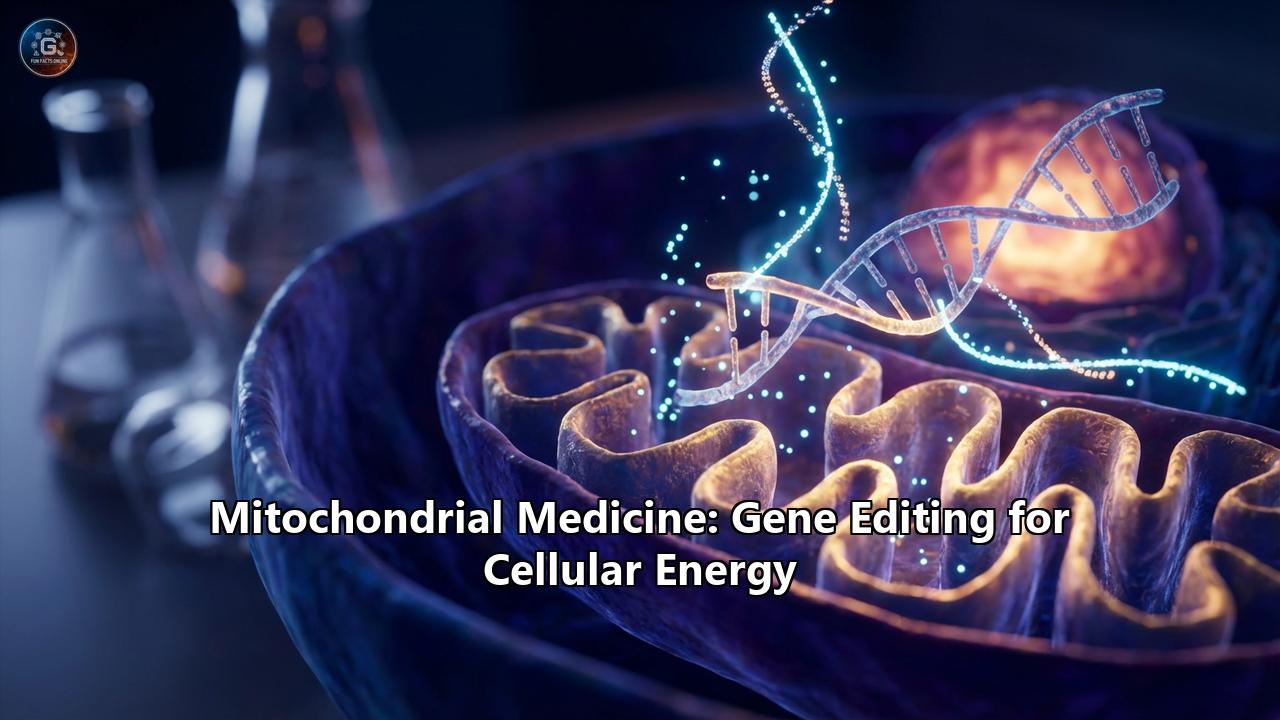
The human body is an electric machine. Every heartbeat, every synaptic fire in the brain, and every muscle contraction relies on a constant stream of adenosine triphosphate (ATP)—the chemical currency of energy. This currency is minted in the mitochondria, the "power plants" of our cells. For decades, medicine viewed these organelles merely as batteries: when they failed, the machine stopped. But a revolution is underway. We are moving from simply observing mitochondrial failure to actively repairing it at the genetic level. This is the dawn of Mitochondrial Medicine, a field where gene editing is rewriting the future of cellular energy.
The Hidden Genome: Why Mitochondria Matter
To understand the magnitude of this medical breakthrough, one must first understand the unique biology of the mitochondrion. Unlike any other organelle, mitochondria possess their own DNA (mtDNA). This is a relic of their evolutionary past; billion of years ago, mitochondria were free-living bacteria that were engulfed by a larger host cell. Instead of being digested, they formed a symbiotic relationship, providing energy in exchange for protection.
This ancient pact left us with two separate genomes. The nuclear genome, housing 20,000+ genes, dictates most of our traits. But the tiny mitochondrial genome, a circular loop of just 16,569 base pairs containing 37 genes, is equally critical. It encodes 13 essential proteins for the electron transport chain—the machinery that actually produces energy.
When mutations strike this small genome, the consequences are catastrophic. Diseases like Leber’s Hereditary Optic Neuropathy (LHON), MELAS (Mitochondrial Encephalomyopathy, Lactic Acidosis, and Stroke-like episodes), and Leigh Syndrome effectively shut down the body’s power grid. Organs with high energy demands—the brain, heart, and muscles—fail first. For years, these conditions were untreatable because standard gene therapy tools could not reach the protected fortress of the mitochondrion.
The Great Barrier: Why CRISPR Failed (At First)
The 21st century brought CRISPR-Cas9, a "molecular scissor" that revolutionized biology. It seemed like the perfect tool to fix genetic errors. However, for mitochondrial biologists, CRISPR was a non-starter.
The problem lies in biology's strictest border control: the mitochondrial double membrane. This membrane is highly selective, designed to keep foreign genetic material out. CRISPR functions as a complex of a protein (Cas9) and a guide RNA. While scientists could engineer the Cas9 protein to enter the mitochondria, they could not figure out how to import the guide RNA. Without the map (RNA), the scissors (Cas9) were useless.
For nearly a decade, mitochondrial gene editing was considered "impossible" with standard tools. The field needed a different approach—one that didn't rely on RNA.
The Breakthrough: "RNA-Free" Editors
The solution came from revisiting older technologies and merging them with new discoveries. If RNA couldn't cross the border, scientists realized they needed fully protein-based editors that carried their own targeting instructions.
1. The First Generation: Molecular Assassins (MitoTALENs and ZFNs)
The first success didn't come from repairing genes, but from destroying them. Mitochondrial diseases are unique because of heteroplasmy. A single cell contains hundreds of mitochondria, and each mitochondrion holds multiple copies of DNA. In a sick patient, mutant mtDNA coexists with healthy mtDNA.
Scientists engineered protein-based tools called MitoZFNs (Zinc Finger Nucleases) and MitoTALENs (Transcription Activator-Like Effector Nucleases). These proteins could be programmed to recognize only the mutant DNA sequence and cut it. Once cut, the mitochondrion destroys the damaged DNA. The cell, sensing a drop in DNA levels, signals the remaining healthy DNA to replicate. The result? A shift in the ratio. The bad DNA is depleted, the good DNA takes over, and cellular energy is restored.
In 2018, this approach successfully treated mitochondrial disease in mice, proving that we could manipulate the mitochondrial genome in a living mammal.
2. The Second Generation: Precision Base Editing (DddA)
While destroying mutant DNA works, it has a limit: if a patient has too much mutant DNA (e.g., 90% or 100%), destroying it would wipe out the cell's entire energy grid. We needed a way to fix the mutation, converting it back to the healthy sequence.
In 2020, a team at the Broad Institute led by David Liu and Vamsi Mootha shattered the dogma. They discovered a peculiar bacterial toxin called DddA (double-stranded DNA deaminase toxin A). Unlike other enzymes that need DNA to be ripped open (single-stranded) to work, DddA could operate on double-stranded DNA—the natural state of mtDNA.
They split this toxin into two inactive halves and attached them to TALE proteins (protein-based GPS). Only when both halves landed on the specific target DNA sequence would they reassemble and perform a chemical reaction: changing a Cytosine (C) to a Thymine (T). This was the first "Mitochondrial Base Editor" (DdCBE). It allowed scientists to correct point mutations without cutting the DNA, a far safer and more precise method.
3. The Frontier: TALEDs and A-to-G Editing
The innovation didn't stop there. In 2022, researchers in South Korea developed TALEDs (Transcription Activator-Like Effector-linked Deaminases). By combining the DddA technology with an engineered enzyme (TadA8e), they achieved the ability to convert Adenine (A) to Guanine (G). This was a massive leap, as it meant that nearly all types of pathogenic point mutations in the mitochondria could theoretically be targeted and corrected.
From Bench to Bedside: The Clinical Race
We are no longer just in the realm of petri dishes. The race to bring these therapies to humans is accelerating, with 2025 marking a pivotal year for clinical translation.
- Precision BioSciences & PBGENE-PMM: This is currently one of the most watched programs. They are developing an in vivo gene editing therapy (PBGENE-PMM) for Primary Mitochondrial Myopathy caused by the m.3243 mutation. Using their proprietary ARCUS platform (a distinct type of nuclease enzyme), they aim to eliminate the mutant genome. They expect to file for clinical trials (IND/CTA) in 2025, potentially making this the first direct mitochondrial gene editing therapy in humans.
- Case Study: The "Lombard/Moraes" Breakthrough: In early 2025, a landmark study published in Science Translational Medicine by researchers at the University of Miami (Moraes et al.) demonstrated the correction of a mitochondrial mutation in patient-derived cells and mouse hearts using a base editor delivered via virus-like particles (VLPs). This proved that we can not only edit the DNA but effectively deliver the editor to the heart—a notoriously difficult organ to target.
The Ethical Dilemma: Editing vs. Replacement
Mitochondrial medicine sits at a complex ethical intersection. Before gene editing, the only way to prevent a mother from passing a mitochondrial disease to her child was Mitochondrial Replacement Therapy (MRT), often called "Three-Parent Baby" technology. This involves taking the nucleus of the mother's egg and placing it into a donor egg (with healthy mitochondria) that has had its nucleus removed.
While MRT is legal in the UK and Australia, it remains controversial and restricted in many places because it modifies the germline—changes are passed down to future generations.
Mitochondrial Gene Editing offers a different ethical proposition.- Somatic Editing: If we treat an adult patient's heart or muscles (somatic cells), the changes are not passed to offspring. This is ethically similar to a kidney transplant or standard drug therapy and faces fewer regulatory hurdles.
- Germline Editing: If we use base editors on embryos to correct the mutation rather than replace the mitochondria, we re-enter the debate of "designer babies." However, proponents argue that fixing a typo in a gene is more "natural" than swapping the entire organelle with a donor's.
The Future: "Mito-Prime" and Beyond
The trajectory of mitochondrial medicine suggests a move toward total control over cellular energy.
- Mitochondrial Prime Editing: While currently limited by RNA delivery, researchers are exploring "peptide-assisted" RNA transport to bring the versatility of Prime Editing (which can insert or delete whole DNA chunks) to the mitochondria.
- Energy-Boosting Therapies: Beyond curing rare diseases, this technology has implications for aging. Mitochondrial dysfunction is a hallmark of aging, Alzheimer’s, and Parkinson’s. In the future, "rejuvenation" therapies might involve editing mtDNA to restore youthful efficiency to the electron transport chain, potentially delaying the onset of age-related frailty.
Conclusion
Mitochondrial medicine has transformed from a field of palliative care—managing symptoms with vitamins—to a field of curative intent. By overcoming the biological barrier of the mitochondrial membrane, we have unlocked the ability to edit the source code of life's energy. As we move through 2025, we are witnessing the first steps of a journey that could eliminate an entire class of incurable genetic diseases and perhaps, one day, recharge the human lifespan itself.
Reference:
- https://www.news-medical.net/news/20250512/Mitochondrial-DNA-editing-offers-new-hope-for-neurodegenerative-disease-treatment.aspx
- https://www.biopharmadive.com/news/pretzel-therapeutics-mitochondria-series-a-launch/631567/
- https://singularityhub.com/2025/02/03/scientists-target-incurable-mitochondrial-diseases-with-new-gene-editing-tools/
- https://pmc.ncbi.nlm.nih.gov/articles/PMC10056815/
- https://frontlinegenomics.com/back-to-basics-base-and-prime-editing/
- https://pubmed.ncbi.nlm.nih.gov/32641830/
- https://www.researchgate.net/publication/313924905_Mitochondrial_Modification_Techniques_and_Ethical_Issues
- https://www.mdpi.com/2077-0383/6/3/25
- https://www.geg-tech.com/blog/targeted-a-to-g-base-editing-in-human-mitochondrial-dna-with-programmable-deaminases-cell/
- https://www.biocompare.com/Life-Science-News/611126-Engineered-TALEDs-Improve-Targeted-Base-Editing-of-Mitochondrial-DNA/
- https://www.researchgate.net/publication/361794659_Prime_time_for_base_editing_in_the_mitochondria
- https://pubmed.ncbi.nlm.nih.gov/35472302/
- https://uk.investing.com/news/stock-market-news/precision-biosciences-reports-breakthrough-in-mitochondrial-dna-editing-93CH-3389782
- https://academic.oup.com/bmb/article/115/1/173/260760