
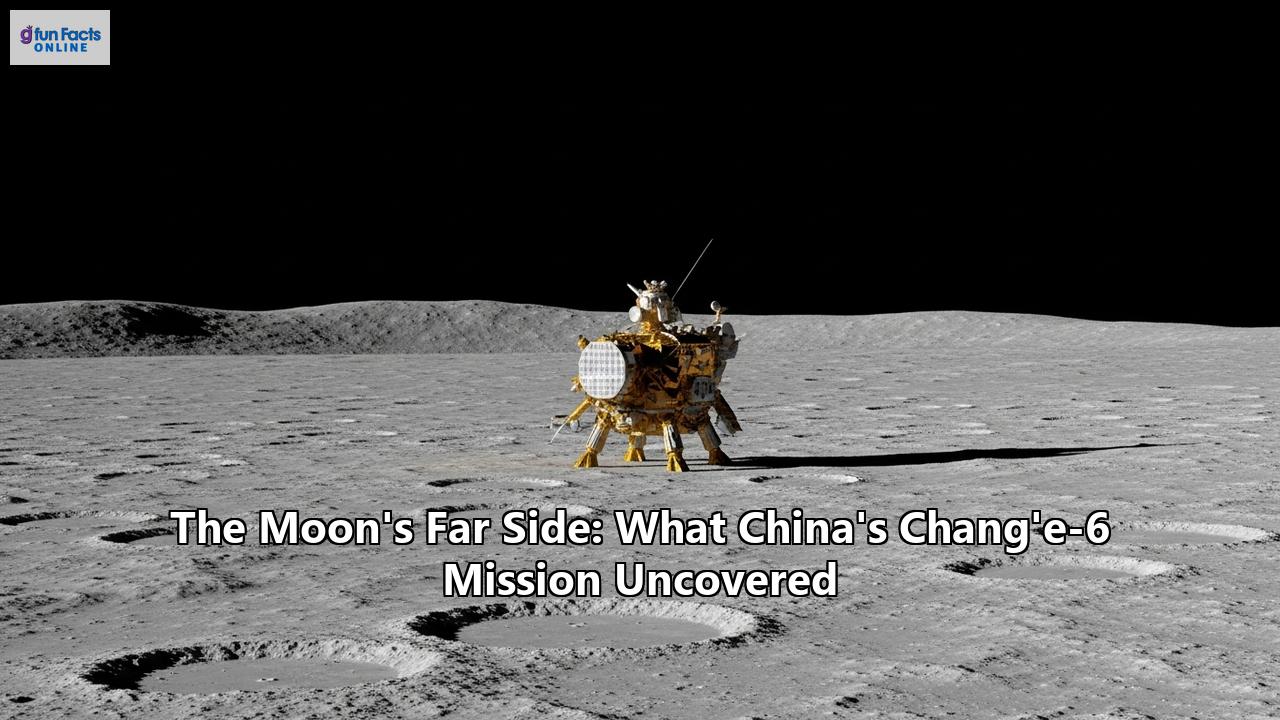
An enduring veil of mystery has long shrouded the Moon's far side. Perpetually turned away from Earth, this hemisphere remained a realm of pure speculation until the dawn of the space age. Early glimpses revealed a landscape starkly different from the familiar face of the Moon, a world more rugged, more ancient, and profoundly more enigmatic. Now, China's audacious Chang'e-6 mission has returned with the first-ever samples from this hidden territory, unlocking a treasure trove of secrets that are reshaping our understanding of the Moon's violent birth, its lopsided evolution, and the very history of our solar system.
Launched on May 3, 2024, and returning to Earth on June 25, 2024, the 53-day mission was a staggering feat of engineering and a triumph of scientific ambition. It successfully landed in the colossal South Pole-Aitken (SPA) Basin, a place scientists have dreamed of visiting for decades, and brought back 1,935.3 grams (4.26 pounds) of precious lunar soil and rock. These samples, the first to be analyzed, have already yielded groundbreaking discoveries, revealing a history of prolonged volcanism, a fluctuating magnetic field, and a surprising dryness in the lunar mantle that helps explain one of our celestial neighbor's most profound dichotomies.
This is the story of what the Chang'e-6 mission uncovered, a tale of solving deep cosmic mysteries by venturing into the unknown, touching down on a truly alien landscape, and returning with answers that promise to rewrite the book on our Moon.
The Enduring Mystery of the Moon's Two Faces
For as long as humanity has gazed at the night sky, we have seen only one side of the Moon. Due to a phenomenon called tidal locking, the Moon's rotation period is the same as its orbital period around Earth, meaning one hemisphere is permanently locked in our view, while the other remains hidden. This "far side" is often mistakenly called the "dark side," but it receives just as much sunlight as the near side. Its true darkness was in our ignorance.
When the Soviet Union's Luna 3 probe swung around the Moon in 1959 and transmitted the first grainy images of the far side, scientists were stunned. The vast, dark plains of volcanic rock, known as maria (Latin for "seas"), that dominate the near side were almost entirely absent. Instead, the far side was a heavily cratered, rugged expanse of highlands. The Moon was shockingly two-faced.
This dichotomy presented a fundamental puzzle in planetary science. Why would one side of the same celestial body be so dramatically different from the other? The crust on the far side was found to be significantly thicker and its composition distinct, with fewer heat-producing radioactive elements like potassium, thorium, and uranium. These elements are key ingredients for volcanism, as their decay generates heat that can melt rock. Their concentration on the near side, in a geological province known as the Procellarum KREEP Terrane (KREEP stands for potassium, rare-earth elements, and phosphorus), seemed to explain the near side's extensive volcanic activity.
But why were these elements distributed so unevenly? One leading theory, bolstered by data from NASA's GRAIL mission, suggests that the gravitational pull of the early Earth played a crucial role. In the aftermath of the "Giant Impact" – the cataclysmic collision between a Mars-sized object and the proto-Earth that is believed to have formed the Moon – our natural satellite was a molten ball of rock. As it cooled, Earth's immense gravity may have pulled on the cooling crust, causing the side facing us to become thinner. This tidal deformation would have made it easier for the magma ocean's last dregs, rich in those heat-producing KREEP elements, to concentrate on the thinner near side, setting the stage for its distinct volcanic future. The Chang'e-6 mission was designed to seek ground truth for these and other theories by directly sampling the ancient crust of the far side.
The Target: A Scientific Treasure Chest Called South Pole-Aitken Basin
The destination for this historic mission was no random crater. Chang'e-6 targeted the South Pole-Aitken (SPA) Basin, a feature of almost mythical status among planetary scientists. It is, simply put, the largest, deepest, and oldest confirmed impact crater in the entire solar system. Spanning a staggering 2,500 kilometers (about 1,600 miles) in diameter and plunging to depths of over 8 kilometers (5 miles), the SPA basin is a gaping wound from the Moon's infancy.
The scientific rationale for targeting SPA is threefold, corresponding to its unique characteristics:
- It is the Largest: The SPA basin is a "mega basin," an impact feature so enormous that its scale is comparable to the planetary body on which it sits. Such impacts are poorly understood but are known to have shaped worlds across the solar system, from Mars to Pluto. Studying SPA provides an accessible, real-world laboratory to understand the physics of these colossal events.
- It is the Deepest: The titanic impact that created the basin billions of years ago would have been an event of unimaginable violence. It would have blasted through the Moon's entire crust, which is thinner here than anywhere else on the Moon, and dredged up material from the lunar mantle. For decades, scientists have dreamed of obtaining a piece of the Moon's mantle, as it holds the fundamental chemical blueprint of the Moon's interior. The samples from Chang'e-6 offered the tantalizing possibility of finally analyzing this primordial material.
- It is the Oldest: The age of the SPA basin is a critical anchor point for the timeline of the entire solar system. Scientists believe that the early solar system went through a period of intense violence known as the "Late Heavy Bombardment," a firestorm of asteroid and comet impacts that pummeled the inner planets between about 4.1 and 3.8 billion years ago. Determining the precise age of the SPA impact, believed to predate this, provides a "golden spike" in the lunar timeline, allowing scientists to calibrate the ages of other surfaces on the Moon and across the solar system based on crater counts. This, in turn, helps answer fundamental questions about when the inner solar system became stable enough for life to emerge on Earth.
Chang'e-6 landed within the Apollo basin, a 500-kilometer-wide crater nestled inside the northeastern expanse of the larger SPA basin. This location was chosen because it is believed to contain both volcanic lava flows that erupted long after the main impact and, crucially, ejecta from the original SPA-forming collision, potentially including that coveted mantle material.
The Mission: An Audacious 53-Day Journey
The Chang'e-6 mission was a complex, multi-stage ballet of precision engineering, showcasing China's rapidly advancing capabilities in deep space exploration. The 8,200 kg spacecraft consisted of four main modules: an orbiter, a lander, an ascender, and a return capsule.
The Descent and Landing: After launching on a Long March 5 rocket and entering lunar orbit, the lander-ascender combination separated from the orbiter on June 1, 2024. It then began its autonomous descent to the lunar surface. Landing on the far side is inherently more difficult than the near side, not only due to the communication blackout but also because the terrain is far more rugged and pockmarked with craters. To navigate this hazardous landscape, the lander was equipped with a sophisticated suite of sensors, including cameras, laser 3D scanners, and microwave sensors, to map the landing zone in real-time, identify hazards like large boulders or steep slopes, and select a safe touchdown spot. Sampling an Alien World: Once safely on the surface, the lander had a tight 48-hour window to complete its primary mission. It employed a two-pronged approach to sample collection. A robotic arm with a scoop collected rocks and soil from the surface, while a drill penetrated up to two meters to retrieve a core of subsurface material, offering a vertical slice of the region's geology. The process was carried out with remarkable symbolism; images sent back showed that the hole left by the drilling and scooping formed the shape of the Chinese character "中" (zhōng), the first character in the word for China (中国, Zhōngguó), a detail that went viral on Chinese social media. Before leaving, the lander also unfurled a small Chinese national flag, made from a special basalt fiber composite to withstand the harsh lunar environment. The Autonomous Ascent and Rendezvous: In what was perhaps the most technically demanding phase of the surface operations, the ascender vehicle, carrying the precious 1.9 kg sample canister, had to launch from atop the lander and reach lunar orbit entirely on its own. Without direct, real-time control from Earth, the ascent was fully autonomous, a feat requiring enhanced control systems and navigation. On June 6, the ascender successfully rendezvoused and docked with the orbiter service module circling the Moon. The sample container was robotically transferred to the Earth-return capsule, and the now-empty ascender was jettisoned. The Fiery Return: After waiting in lunar orbit for the optimal window, the service module fired its engines for the journey home. On June 25, just before reaching Earth, the return capsule separated and performed a "skip reentry," bouncing off the upper atmosphere once to bleed off speed before its final plunge and parachute-assisted landing in the grasslands of Inner Mongolia, China.A Bridge Across the Void: The Queqiao-2 Relay Satellite
None of the historic achievements on the far side would have been possible without a crucial piece of infrastructure already in place: the Queqiao-2 relay satellite. Launched in March 2024, weeks ahead of Chang'e-6, Queqiao-2 (meaning "Magpie Bridge 2," a name from Chinese mythology) is China's communications lifeline to the lunar far side.
The Moon itself blocks radio signals, making direct communication with the far side impossible from Earth. The first-generation Queqiao supported the Chang'e-4 mission from a halo orbit around a Lagrange point far beyond the Moon. For the more demanding sample return mission, the 1,200 kg Queqiao-2 was placed into a unique and highly stable "frozen orbit." This highly elliptical path brings it close to the Moon over the south polar region and then loops it far out, allowing it to maintain a simultaneous line of sight with both the Chang'e-6 landing site and ground stations on Earth for long periods. This stability requires minimal fuel for station-keeping, granting it a long operational life of at least eight years to support future missions like Chang'e-7 and Chang'e-8.
But Queqiao-2 is more than just a relay antenna. It is a sophisticated science platform in its own right, carrying three of its own instruments:
- An Extreme Ultraviolet Camera (EUC): To study Earth's plasmasphere and how the solar wind interacts with our planet's magnetic field.
- A Grid-based Energetic Neutral Atom imager (GENA): To image Earth's magnetotail, providing data to help protect satellites and space stations from space weather.
- The Lunar Orbit VLBI Experiment (LOVEX): Using its large 4.2-meter antenna in conjunction with radio telescopes on Earth to create a very long baseline interferometer, which can precisely track spacecraft in deep space and observe distant cosmic radio sources.
This dual-purpose capability highlights a key aspect of China's lunar strategy: each mission builds infrastructure for the next, creating a robust, multi-faceted presence in cislunar space.
International Science Onboard
In a significant display of international cooperation, the Chang'e-6 lander carried scientific instruments from Europe and a small satellite from Pakistan. This collaboration provides global scientists with a unique opportunity to conduct research on the lunar far side.
- DORN (Detection of Outgassing Radon) from France: Developed by France's national space agency, CNES, DORN was designed to study the Moon's tenuous "exosphere" by measuring radon gas. Radon, a radioactive gas, is continuously released from the lunar soil through the decay of uranium. By measuring its concentration and how it moves, scientists can learn about the transport of dust and other volatiles, including the migration of water molecules that could end up as ice in polar craters. DORN successfully operated during the cruise to the Moon, in lunar orbit, and on the surface, making the first-ever measurements of radon and its decay product, polonium, on the lunar surface.
- NILS (Negative Ions at the Lunar Surface) from Sweden and ESA: This was the first instrument ever designed specifically to detect negative ions on the lunar surface. The solar wind, a stream of charged particles from the Sun, constantly bombards the Moon. NILS's goal was to study how this interaction kicks negative ions off the lunar surface, providing new insights into the plasma environment at the Moon's surface.
- INRRI (INstrument for landing-Roving laser Retroreflector Investigations) from Italy: This small, passive device is a corner-cube retroreflector, essentially a sophisticated mirror. By reflecting laser beams sent from orbiters, INRRI will serve as the first high-precision positioning marker on the lunar far side. Over time, these measurements will help create an absolute control point, refining the lunar coordinate system, improving the navigation of future missions, and contributing to studies of the Moon's geodesy.
- ICUBE-Q from Pakistan: A small CubeSat developed by Pakistan's Institute of Space Technology, ICUBE-Q was deployed from the Chang'e-6 orbiter. Its mission was to image the lunar surface and test communication and navigation technologies, providing valuable experience for an emerging space nation.
First Whispers: What the Far Side Samples Have Revealed
Upon their return to Earth, the Chang'e-6 samples were carefully transferred to specialized laboratories for curation and analysis. China has established a detailed process for handling the precious cargo, dividing it into portions for permanent storage, backup storage, public exhibition, and scientific research. While detailed analysis will take years, the initial results, published with remarkable speed, have already sent ripples through the scientific community.
A series of studies from top Chinese research institutions have unveiled four major initial findings:
- A History of Prolonged and Recent Volcanism: Analysis of basalt (volcanic rock) fragments in the samples identified two distinct volcanic phases on the lunar far side, one occurring 4.2 billion years ago and another, much more recent, at 2.8 billion years ago. This reveals that volcanic activity on the far side persisted for at least 1.4 billion years, far longer than many theories had predicted and offering a more dynamic picture of the far side's thermal evolution.
- A Fluctuating Ancient Magnetic Field: The Moon today has no global magnetic field, but for a time in its distant past, a churning liquid core—a "dynamo"—generated one. By studying the paleomagnetic signatures locked in the 2.8-billion-year-old basalt, scientists found evidence of a surprisingly strong magnetic field at that time. This suggests the lunar dynamo didn't just fade away steadily; it likely fluctuated, possibly experiencing a rebound in strength, pointing to a more complex and episodic thermal history in the Moon's core.
- An Asymmetric and Drier Mantle: One of the most significant discoveries is that the mantle source of the far side volcanic rocks is significantly drier, with lower water content, than the mantle source of near-side basalts. This provides the first direct sample evidence for an uneven distribution of water and other volatile elements deep within the lunar interior, adding a crucial new dimension to the Moon's fundamental asymmetry.
- A Chemically "Ultra-Depleted" Mantle: The chemical composition of the far side basalt points to a mantle source that is "ultra-depleted" in certain incompatible elements. This could mean either the primordial lunar mantle was inherently different on the two sides, or that the colossal energy of the SPA impact event caused massive melting that effectively stripped these elements from the mantle in this region. This directly links the giant impact to the long-term geochemical evolution of the Moon's interior.
Furthermore, by analyzing specific rock fragments believed to be part of the original impact melt, scientists have been able to provide a definitive radiometric age for the South Pole-Aitken basin itself: 4.25 billion years old. This provides the critical anchor point—the "golden spike"—that planetary scientists have long sought to calibrate the history of the early solar system.
The Geopolitical Context: A New Era on the Moon
The success of Chang'e-6 cannot be viewed in a scientific vacuum. It is a profound statement of China's arrival as a top-tier space power and a key development in the unfolding geopolitics of the 21st century. While NASA's Artemis program aims to return humans to the Moon, with a coalition of dozens of signatory nations to its Artemis Accords, China is building a parallel, competing framework.
China, in partnership with Russia, is leading the development of the International Lunar Research Station (ILRS), a planned permanent robotic and eventually human-crewed base at the lunar south pole. More than a dozen nations have already signed on to the ILRS project, creating a clear alternative to the US-led bloc. The Chang'e program is the systematic, step-by-step execution of the technological and scientific roadmap toward this goal. Chang'e-7, planned for 2026, will be a comprehensive survey of the lunar south pole's resources, including the search for water ice. Chang'e-8, in 2028, will test technologies for in-situ resource utilization, such as 3D printing structures with lunar soil.
This new "space race" is different from the Cold War competition between the United States and the Soviet Union. The goal is not just to plant flags and leave footprints, but to establish a sustained, permanent presence, with a focus on strategic locations like the south pole, where resources like water ice may be abundant. Control over such resources could translate into significant scientific, economic, and strategic influence in the decades to come.
A New Moon, A New Understanding
The 1,935.3 grams of rock and dust that Chang'e-6 carried across the vastness of space are more than just geological specimens. They are Rosetta Stones for deciphering the Moon's deepest secrets. They have already confirmed that the far side's geological story is profoundly different from the near side's, shaped by the same primordial impact but sent down a divergent evolutionary path.
The initial findings paint a picture of a far side that was volcanically active for longer than we knew, with a core that sputtered and surged before it died. Its mantle was drier and chemically scoured by the ancient SPA impact, an event we can now confidently date, providing a new cornerstone for the history of all the planets.
The journey of Chang'e-6 has ended, but the journey of discovery it has enabled has just begun. As scientists from China and around the world begin the painstaking process of teasing out every secret held within these alien grains, they will be writing new chapters in the story of our Moon, our Earth, and our shared origins in the violent and beautiful history of the solar system. The far side is no longer hidden, and the Moon will never look the same again.
Reference:
- https://ntrs.nasa.gov/api/citations/20120012900/downloads/20120012900.pdf
- https://en.wikipedia.org/wiki/Chang%27e_6
- https://www.hou.usra.edu/meetings/endurance2023/pdf/3050.pdf
- https://www.eurekalert.org/news-releases/470759
- https://thediplomat.com/2025/07/chinas-steady-ascent-to-the-moon-how-beijing-is-rewriting-lunar-geopolitics/
- https://www.unoosa.org/documents/pdf/copuos/stsc/2023/TPs/tuesday-14feb-am/LIU_Yu-Progress_in_International_Cooperation_of_Chinas_Lunar_and_Deep_Space_Exploration77.pdf
- https://www.space.com/moon-far-side-mystery-may-be-solved.html
- https://www.skyatnightmagazine.com/space-science/south-pole-aitken-basin
- https://en.wikipedia.org/wiki/South_Pole%E2%80%93Aitken_basin
- https://time.com/archive/6613708/science-the-moons-far-side/
- https://timesofindia.indiatimes.com/science/nasa-study-reveals-why-the-moon-look-so-different-on-each-side/articleshow/121218887.cms
- https://www.titech.ac.jp/english/news/2020/047261
- https://www.hou.usra.edu/meetings/lpsc2025/pdf/2536.pdf
- http://surveygizmoresponseuploads.s3.amazonaws.com/fileuploads/623127/5489366/244-848949b99770b9053412261de6602585_JolliffBradleyL-1.pdf
- https://academic.oup.com/nsr/article/12/6/nwaf103/8088430
- https://science.nasa.gov/moon/lunar-craters/what-is-the-south-pole-aitken-basin/
- https://thediplomat.com/2024/05/chinas-change-6-moon-mission-is-a-game-changer/
- https://www.hou.usra.edu/meetings/lpsc2025/pdf/1405.pdf
- https://cnes.fr/en/projects/dorn
- https://aerospace.sg/chinas-change-6-set-to-bring-lunar-treasures-back-to-earth/
- https://english.www.gov.cn/news/202406/04/content_WS665e6865c6d0868f4e8e7d06.html
- https://www.globaltimes.cn/page/202406/1313576.shtml
- https://en.wikipedia.org/wiki/Queqiao-2
- https://nssdc.gsfc.nasa.gov/nmc/spacecraft/display.action?id=QUEQIAO-2
- https://moonvillageassociation.org/chinas-queqiao-2-relay-satellite-enters-lunar-orbit/
- https://www.planetary.org/space-missions/queqiao-2-chinas-bridge-for-lunar-exploration
- https://www.globaltimes.cn/page/202404/1310495.shtml
- http://english.cas.cn/newsroom/cas_media/202407/t20240710_672824.shtml
- https://www.irap.omp.eu/en/2024/07/the-french-dorn-instrument-successfully-completes-its-lunar-mission-aboard-the-change-6-lunar-probe/
- https://sathee.iitk.ac.in/gk/current-affair/07-03-2024/science/french-payload-aboard-change-6-successfully-completes-mission/
- https://www.globaltimes.cn/page/202407/1315273.shtml
- https://meetingorganizer.copernicus.org/EGU25/EGU25-14816.html?pdf
- https://www.supercluster.com/launches/chang-e-6
- https://nssdc.gsfc.nasa.gov/nmc/experiment/display.action?id=CHANG-E-6-04
- https://english.cas.cn/newsroom/news/202406/t20240625_665870.shtml
- https://www.space.com/china-moon-sample-handling-plans.html
- https://www.cnsa.gov.cn/english/n6465645/n6465648/c6811126/content.html
- http://en.people.cn/n3/2021/0121/c90000-9811591.html
- https://chinadigitaltimes.net/2024/06/chinas-lunar-exploration-program-delivers-milestone-sparks-geopolitical-anxiety-in-u-s/
- https://www.lowyinstitute.org/the-interpreter/china-s-mission-moon-rocks-geopolitics
- https://globalpolitics.in/view_cir_articles.php?url=Global%20Politics%20Explainer&recordNo=1387