
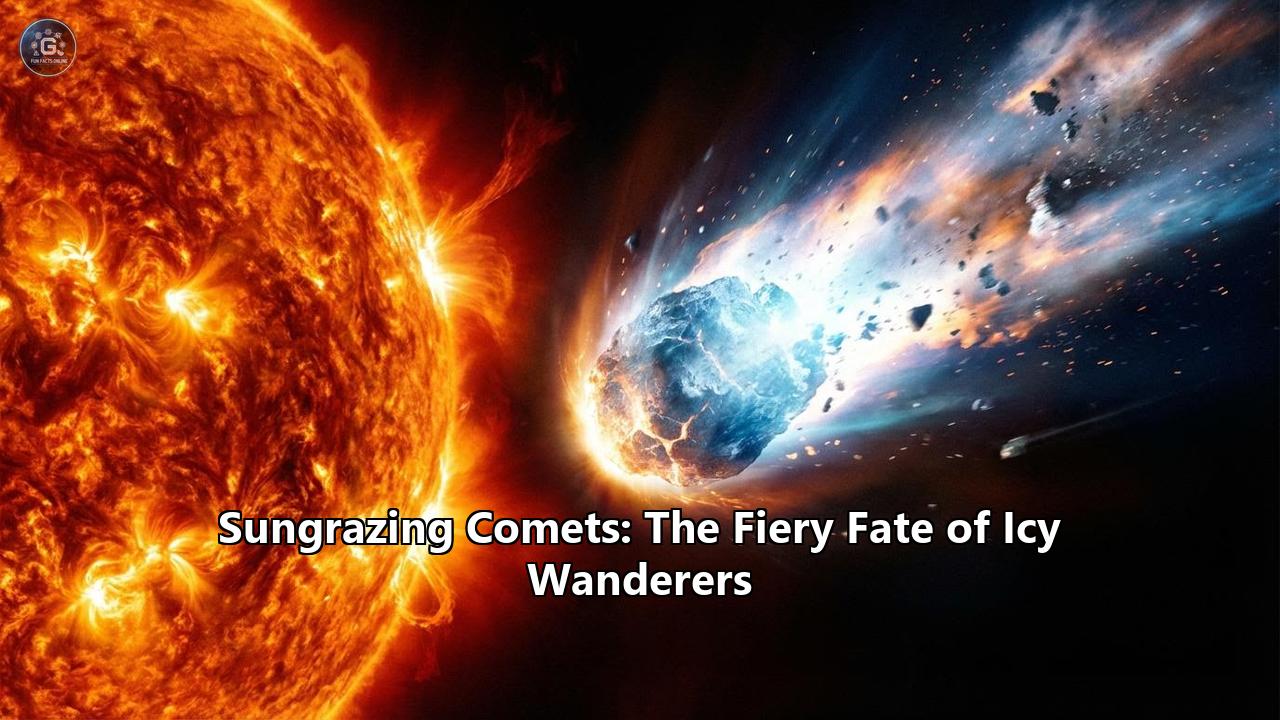
In the cold, dark, and silent expanses of the outer solar system, billions of ancient ice mountains drift through the void. These celestial bodies, born from the primordial nebula that forged our planetary neighborhood, are time capsules of ice, dust, and rock. For most of their existence, they remain frozen and invisible. But occasionally, a gravitational nudge from a passing star or a giant planet sends one of these icy wanderers plummeting inward. Its destination is not a gentle orbit, but a terrifying and spectacular death dive into the ultimate cosmic furnace: the Sun.
These doomed voyagers are known as "sungrazing comets." Their journey is a tale of extremes—a poetic contrast between the absolute zero of deep space and the millions of degrees of the solar corona. For astronomers and stargazers alike, the fiery fate of these comets provides not only a breathtaking visual spectacle but also a treasure trove of scientific data about the origins of our solar system and the hidden dynamics of our star.
The Anatomy of a Death Dive
To be classified as a sungrazer, a comet must possess an orbit that brings it perilously close to the Sun at perihelion—its point of closest approach. While an ordinary comet might swing by the Sun at a comfortable distance comparable to the orbit of Venus or Earth, a true sungrazer plunges within 850,000 miles (about 1.38 million kilometers) of the solar surface. Many come significantly closer, missing the Sun's blazing photosphere by a mere few thousand miles.
When an icy body enters this extreme environment, it is subjected to an onslaught of hostile forces. First is the intense solar radiation. As the comet crosses the inner solar system, the heat rapidly boils off its volatile compounds—water, carbon monoxide, and ammonia—creating a massive, glowing atmosphere known as a coma. By the time the comet reaches the sungrazing zone, the temperatures are so extreme that even the rocky and metallic components of the nucleus begin to vaporize.
Second is the physical bombardment. The comet must face the full brunt of the solar wind—a relentless stream of charged particles flowing outward from the Sun at millions of miles per hour. This intense radiation pressure and solar wind physical push sculpt the comet's evaporated material into magnificent, glowing tails that can stretch for millions of miles across the sky.
However, the ultimate killer of sungrazing comets is not just heat, but gravity. As the comet swings around the Sun, it experiences immense tidal forces. Because the front of the comet is slightly closer to the Sun than the back, the gravitational pull on the front is significantly stronger. For a loosely packed "dirty snowball" held together by its own weak gravity, this differential pull acts like a cosmic rack, stretching and shearing the nucleus. Under this immense stress, the comet will often fracture, shattering into dozens of smaller fragments in a process known as tidal disruption.
In this incredibly hostile environment, the vast majority of sungrazing comets do not survive. They are completely vaporized, their ancient material absorbed into the solar atmosphere. Yet, a rare few are massive enough to survive the inferno, emerging on the other side fractured, battered, but still glowing with defiant brilliance.
The Legacy of the Kreutz Dynasty
Sungrazing comets are not random, isolated anomalies. The overwhelming majority of them are part of a massive family tree, born from a single, catastrophic event in the distant past. In the late 1880s and 1890s, a German astronomer named Heinrich Kreutz made a fascinating discovery. He studied the orbits of several spectacular comets that had been observed over the centuries and noticed a striking pattern: many of them followed nearly identical orbital paths.
Kreutz realized that these comets were not unrelated objects; they were siblings. He hypothesized that they were all fragments of a single, massive "grandparent" comet that had broken apart centuries earlier during a previous pass by the Sun. In honor of his groundbreaking work, this family of comets was named the Kreutz sungrazers. Today, it is estimated that close to 85% of all known sungrazing comets belong to this orbital highway.
The original progenitor of the Kreutz group must have been a leviathan. Astronomers estimate that this parent comet could have been up to 100 kilometers (62 miles) across—comparable in size to the famous Comet Hale-Bopp. The exact identity of this grandparent comet remains a subject of intense historical and astronomical debate. Some historians and astronomers point to a spectacular comet observed by the Greek philosopher Aristotle and the historian Ephorus in 371 BC. Ephorus even recorded seeing the comet break into two distinct pieces, though modern astronomers view ancient uncorroborated accounts with a degree of skepticism.
More recent dynamical studies suggest that the progenitor likely underwent a "cascading fragmentation". Instead of shattering all at once, the massive comet likely broke into two super-fragments (perhaps the comet observed in 1106 AD). These large fragments then returned centuries later, breaking apart again and again at every subsequent perihelion. This ongoing cascade of destruction created two main subpopulations (Subgroup I and Subgroup II), filling the orbital path with thousands of smaller cometary shards.
The Great Comets: Historical Heavyweights
Throughout human history, whenever a major fragment of the Kreutz family arrived, it put on a show that stopped humanity in its tracks. Because they pass so close to the Sun, these large fragments are subjected to maximum heating, resulting in peak brightness levels that far outshine standard comets, and occasionally, even the Moon.
The Great March Comet of 1843:One of the most spectacular early records of a Kreutz sungrazer was the Great March Comet of 1843. As it rounded the Sun, it passed a mere 830,000 kilometers from the surface. It was so incredibly bright that it could be seen in broad daylight, standing mere degrees away from the glaring Sun. Its tail eventually stretched an astonishing 2 astronomical units (AU) in length—the longest cometary tail on record until the discovery of Comet Hyakutake in 1996.
The Great September Comet of 1882:A defining member of the Kreutz group, the Great September Comet of 1882, is arguably one of the most brilliant comets in recorded history. As it reached perihelion, it shone so brightly that casual witnesses could see it in the daytime sky just by blocking the Sun with their hands. The heat and tidal forces of the Sun were too much for the nucleus, and astronomers watched in awe through early telescopes as the comet's core broke into at least four distinct fragments.
Comet Ikeya-Seki (1965):The 20th century received its own spectacular Kreutz sungrazer, largely considered the brightest comet of the last thousand years. On a crisp September morning in 1965, the sky over Japan had just been swept clean by a passing typhoon. Two Japanese amateur astronomers, Kaoru Ikeya and Tsutomu Seki, independently discovered a faint, 8th-magnitude comet moving through the constellation Hydra.
Orbital calculations quickly revealed it was a Kreutz sungrazer. As it plummeted toward the Sun in October 1965, it brightened dramatically. By October 21, it reached its perihelion at a distance of just 1.2 million kilometers from the Sun's center (only 466,000 kilometers above the solar surface). Comet Ikeya-Seki achieved a staggering apparent magnitude of -10, making it clearly visible in broad daylight next to the Sun. Just like its 1882 predecessor, the immense solar tides took their toll; observers noted that the nucleus of Ikeya-Seki fractured into three separate pieces as it survived the perihelion passage, leaving behind a magnificent 60-degree-long tail that graced the morning sky for weeks. The primary fragment was calculated to have an orbital period of about 880 years, while the secondary fragment was pushed into a 1,110-year orbit.
The Survivors and the Vaporized:In more recent memory, Comet Lovejoy (C/2011 W3) stunned astronomers in December 2011. Also a Kreutz group member, it was the first sungrazer seen from the ground in over 40 years. Instruments tracked it plunging directly into the multi-million-degree solar corona. Most scientists assumed it would be completely vaporized. Miraculously, a fraction of Lovejoy's nucleus survived the passage, emerging on the other side without a tail (which had been stripped away) before generating a new, brilliant tail days later.
Conversely, Comet ISON (C/2012 S1), which arrived in 2013, was dynamically new—meaning it was making its first-ever trip from the distant Oort Cloud and was not part of the Kreutz family. Touted by the media as a potential "Comet of the Century," it passed just 1.2 million kilometers above the solar surface. Unlike Lovejoy, ISON could not withstand the immense thermal and tidal stresses; it completely disintegrated, leaving behind nothing but a V-shaped cloud of dust that quickly dispersed into the solar wind.
The Modern Comet Hunter: SOHO and the Citizen Science Revolution
For centuries, discovering a sungrazing comet was a matter of sheer luck. Because they approach from the direction of the Sun, they are mostly lost in the star's blinding glare, rendering them invisible to ground-based telescopes until they are exceedingly bright. Prior to the space age, only about a dozen sungrazing comets had ever been recorded.
This paradigm shifted entirely with the advent of space-based solar observatories. In 1979, the Solwind satellite began utilizing an instrument called a coronagraph—a specialized telescope that uses a solid disk to artificially eclipse the Sun, blocking its blinding light to reveal the much fainter outer atmosphere, or corona. Suddenly, astronomers could watch the immediate vicinity of the Sun. Solwind and the subsequent Solar Maximum Mission (SMM) discovered a handful of sungrazers, hinting at a hidden population of small comets.
But the true revolution began in December 1995 with the launch of the Solar and Heliospheric Observatory (SOHO), a joint mission by the European Space Agency (ESA) and NASA. SOHO was parked at the Lagrange 1 (L1) point, providing an uninterrupted view of the Sun. Its Large Angle and Spectrometric Coronagraph (LASCO) instrument became the ultimate comet-catching tool.
When SOHO launched, scientists expected it might serendipitously catch a few comets a year. They were entirely unprepared for what happened next. The LASCO images began revealing dozens, then hundreds, of tiny sungrazing comets. These were the miniature, house-sized shards of the Kreutz cascade—comets roughly 6 to 60 meters in diameter. Unlike the massive Ikeya-Seki or the Great Comet of 1882, these tiny fragments are entirely vaporized; they streak into the LASCO field of view, flare up briefly as they are annihilated by the Sun's heat, and are never seen again.
The sheer volume of data generated by SOHO was too much for the mission scientists to analyze alone. In the early 2000s, this led to the creation of the NASA-funded "Sungrazer Project," a pioneering citizen science initiative. The project allowed anyone with an internet connection to download near-real-time LASCO images and hunt for moving pixels that indicated a comet.
The response was staggering. Amateur astronomers, students, and space enthusiasts from all over the globe transformed into the most prolific comet hunters in human history. By March 2024, SOHO recorded an unimaginable milestone: its 5,000th comet discovery. This landmark comet was found by Hanjie Tan, a Ph.D. astronomy student in Prague, who had been participating in the Sungrazer Project since he was just 13 years old and had personally discovered over 200 comets through the program. To put this in perspective, SOHO has discovered more than half of all the comets ever documented by humanity, fundamentally changing our understanding of cometary populations.
Beyond the Kreutz Group: The Sporadic Swarms
While the Kreutz family dominates the sungrazing statistics, accounting for about 86% of SOHO's discoveries, they are not the only icy wanderers dancing with the Sun. Careful orbital analysis by astronomers like Brian Marsden revealed the existence of other, smaller families of near-Sun comets.
These include the Meyer group, the Marsden group, and the Kracht group. The Marsden and Kracht comets are technically "sunskirters" rather than true sungrazers, as they pass slightly further away, but their origins are equally fascinating. SOHO's 5,000th comet discovery actually belonged to the Marsden group.
Interestingly, dynamical studies suggest that the Marsden and Kracht groups are linked to a larger, complex web of celestial objects known as the Machholz Interplanetary Complex. This includes the short-period Comet 96P/Machholz—a bizarre, highly tilted comet with an unusual chemical composition that visits the Sun every 5.3 years. The complex also includes several meteor showers visible from Earth, such as the Daytime Arietids and the Southern Delta Aquariids. It is entirely possible that thousands of years ago, a massive interstellar or Oort Cloud object became trapped in the inner solar system, systematically breaking down over millennia to spawn Comet Machholz, the Marsden and Kracht comets, and rivers of meteoroidal debris.
Scientific Value: Why Sungrazers Matter
Watching a chunk of ice evaporate in a multi-million-degree corona is undoubtedly a visually stunning event, but for astrophysicists, sungrazers are incredibly valuable scientific tools. They act as "free" space probes, plunging into regions of the solar atmosphere where no human-made spacecraft—not even the heavily shielded Parker Solar Probe—dare to fly directly.
Probing the Solar Corona:As a sungrazer enters the lower corona, its vaporizing tail interacts violently with the solar magnetic fields and the solar wind. By tracking the ripples, bends, and sheer off the comet's tail in coronagraph images, scientists can map the invisible magnetic topography of the Sun's atmosphere. Comets serve as illuminating wind socks, revealing the complex, twisting nature of coronal mass ejections and solar wind streams.
Extreme Relativistic Physics:Because sungrazing comets approach so closely to the immense mass of the Sun, they move at blistering velocities, sometimes exceeding 300 miles per second (nearly 500 kilometers per second) at perihelion. In this extreme gravitational well, they become excellent natural laboratories for testing Albert Einstein's Theory of General Relativity.
One of the foundational proofs of General Relativity is the precession of Mercury's perihelion—the gradual shifting of its elliptical orbit due to the warping of spacetime near the Sun. Sungrazing comets, getting up to 60 times closer to the Sun than Mercury, experience a localized relativistic precession effect that is vastly more intense. While Mercury takes 15 years to accumulate a measurable precession, a sungrazing comet experiences significant relativistic shifting in a matter of hours. By precisely tracking the trajectories of the rare surviving sungrazers, astrophysicists can measure these gravitational warps, comparing relativistic effects against non-gravitational forces like mass loss and outgassing.
Solar System Archeology:Comets are the pristine leftovers of the protoplanetary disk that formed the planets 4.6 billion years ago. However, studying their deep interior composition is exceptionally difficult because their inner layers are buried beneath heavily irradiated crusts. A sungrazing death dive effectively acts as a cosmic dissection. As the intense heat peels the comet apart layer by layer, spectroscopy can analyze the elemental composition of the comet's deepest heart. It reveals the exact ratios of water, carbon, and complex organic molecules that were present at the dawn of the solar system.
The Future of Sungrazing Comets
As we look toward the future, the study of sungrazing comets is entering a new golden age. The Parker Solar Probe and the Solar Orbiter are currently flying closer to the Sun than any spacecraft before them, equipped with instruments that can measure the ambient dust and plasma environments directly. They are literally flying through the debris trails left behind by thousands of annihilated Kreutz comets, providing unprecedented in-situ measurements of comet dust.
Meanwhile, mathematical models of the cascading fragmentation of the Kreutz family predict that the arrival of these comets is not evenly distributed, but rather comes in distinct clusters. The Great Comets of 1843, 1882, and 1965 represent a dense cluster of major fragments from the 1106 breakup. Orbital dynamics suggest that we are currently inside a period of increased sungrazer activity, and astronomical models predict the arrival of another cluster of massive, potentially naked-eye sungrazing comets in the coming decades. The earliest members of this new wave could grace our skies very soon, potentially offering another daytime spectacle on par with Ikeya-Seki. Furthermore, new discoveries are constantly being tracked, such as the recently spotted Comet C/2026 A1 (MAPS), which is anticipated to make its own daring, close approach.
Ultimately, the story of sungrazing comets is a story of gravitational inevitability. These icy wanderers, having spent billions of years in the freezing, silent dark of the Oort Cloud, are drawn inward by the very star that gave them birth. Their fiery demise is a fleeting, brilliant testament to the dynamic, violent, and endlessly fascinating mechanics of our universe. Whether they survive their passage to journey back into the dark, or are swallowed whole by the solar inferno, their sacrifice grants humanity a deeper understanding of the cosmos we call home.
Reference:
- https://science.nasa.gov/science-research/heliophysics/esa-nasa-solar-observatory-discovers-its-5000th-comet/
- https://svs.gsfc.nasa.gov/11307/
- https://www.severe-weather.eu/recent-events/approaching-comet-ison-comet-of-the-century-well-2/
- https://www.britannica.com/topic/Comet-Ikeya-Seki
- https://www.esa.int/Science_Exploration/Space_Science/Sungrazer_comets
- https://earthsky.org/space/5000th-comet-discovery-soho/
- https://en.wikipedia.org/wiki/Kreutz_sungrazer
- https://pmc.ncbi.nlm.nih.gov/articles/PMC5454226/
- https://people.ast.cam.ac.uk/~jds/kreutz.htm
- https://ntrs.nasa.gov/citations/20210002194
- https://www.researchgate.net/publication/231054124_Fragmentation_Origin_of_Major_Sungrazing_Comets_C1970_K1_C1880_C1_and_C1843_D1
- https://www.rocketstem.org/2020/10/24/ice-and-stone-comet-of-week-44/
- https://en.wikipedia.org/wiki/Comet_Ikeya%E2%80%93Seki
- https://www.oxfordreference.com/display/10.1093/oi/authority.20110803095957386
- https://science.nasa.gov/learn/heat/resource/video-how-soho-discovered-5000-comets/
- https://www.discovermagazine.com/astronomers-spot-a-new-sungrazer-comet-could-it-be-bright-enough-to-see-in-daylight-this-spring-48669
- https://www.worldscientific.com/doi/pdf/10.1142/9789811269776_0192