
Beneath the shifting lacustrine terrain of modern-day Mexico City, enveloped by the ceaseless hum of a sprawling metropolis, the buried heart of the Aztec Empire continues to beat. For over a century, urban archaeology in the historic center of the Mexican capital has pulled back the veil of colonial and modern concrete to reveal the Sacred Precinct of Tenochtitlan. Here, at the ruins of the Templo Mayor—the epicenter of the Aztec universe—archaeologists have methodically unearthed the spectacular remnants of a civilization that viewed the cosmos as a delicate balance maintained through blood, tribute, and unwavering devotion.
Among the most breathtaking discoveries to emerge from these shadowy, subterranean excavations are the tepetlacalli—sacred volcanic-stone chests that served as time capsules of imperial ambition and religious fervor. Recent breakthroughs by the National Institute of Anthropology and History’s Templo Mayor Project (PTM) have brought these enigmatic stone boxes to the forefront of archaeological study. By deciphering the colossal ritual offerings hidden within them, researchers have pieced together a single, monumental ceremony orchestrated in the 15th century by one of Mesoamerica's most formidable rulers: Moctezuma I. The contents of these chests do not merely reflect the wealth of an empire; they offer a profound masterclass in Aztec statecraft, cosmological engineering, and the logistics of ancient power.
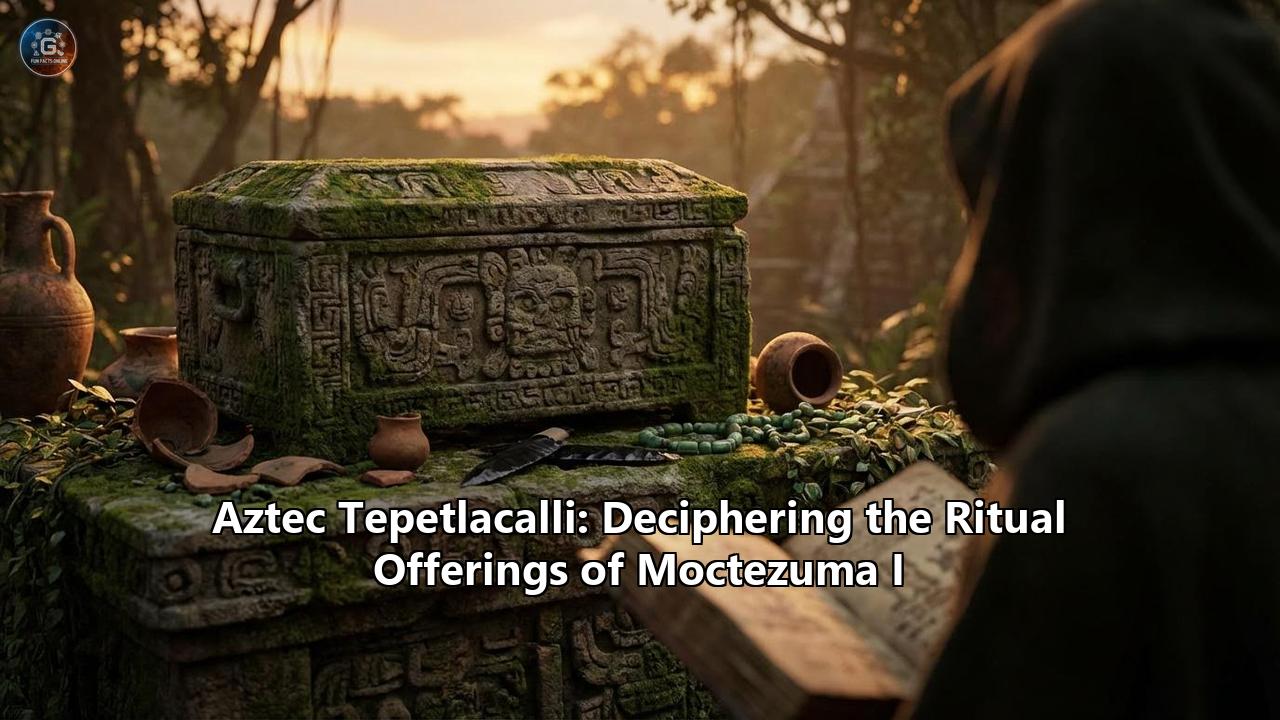
To truly understand the weight of these discoveries, one must first understand the vessels themselves. In the classical Nahuatl language, the term tepetlacalli is a compound of two words: tetl, meaning "stone," and petlacalli, which refers to a woven chest or box made of plant fibers (a petate) traditionally used to store a family's most precious belongings, such as fine cotton garments, precious feathers, or family heirlooms. When elevated to the realm of the divine and carved from unyielding volcanic andesite, the tepetlacalli became a "stone house" or "stone flask" designed for the gods.
These receptacles were highly sacred, often decorated on all sides—including the undersides and the inner lids—with intricate reliefs of deities, cosmological symbols, and date glyphs. They were the physical embodiment of the Aztec universe, acting as microcosms where the earthly realm and the divine interacted. Within the dark, sealed confines of a tepetlacalli, priests would meticulously arrange offerings meant to appease the deities of rain, agriculture, and war. They stored ritual implements for bloodletting, the ashes of deceased nobility, and the quintessential symbols of water and fertility.
By burying these heavy stone boxes beneath the monumental architecture of the Templo Mayor, the Aztec elite effectively planted seeds of power into the sacred earth, consecrating their temples and anchoring the spiritual forces necessary to keep the sun moving and the rains falling.
The architectural phase of the Templo Mayor that corresponds to the recently unearthed tepetlacalli is Stage IVa, a period perfectly aligned with the reign of Moctezuma I (1440–1469 CE). Often overshadowed in popular history by his tragic descendant Moctezuma II—who would later face Hernán Cortés—Moctezuma I, or Motēuczōmah Īlhuihcamīna, was the true architect of the Aztec golden age. His name translates poetically and fiercely to "He Becomes Angry Like a Lord" and "He Shoots Arrows at the Sky".
Prior to his rule, the Aztec dominion was largely confined to the Valley of Mexico. It was Moctezuma I who, alongside his legendary advisor Tlacaelel, aggressively expanded the borders of the Triple Alliance (Tenochtitlan, Texcoco, and Tlacopan). His military campaigns were relentless and highly organized, marching Aztec armies southward into the modern state of Guerrero and eastward to the Gulf Coast, a lush region the highland-dwelling Aztecs romantically referred to as the "Sea of the Sky".
This unprecedented territorial expansion brought an influx of exotic wealth into the capital: brilliant quetzal feathers, jade, raw rubber, cacao, and coastal seashells. But Moctezuma I was not merely a conqueror; he was a brilliant propagandist and a deeply religious sovereign. He understood that to solidify his empire, he needed to reflect this newfound global dominance in the architecture of his capital. He ordered massive expansions to the Templo Mayor, the dual-pyramid dedicated to Huitzilopochtli (the patron god of sun and war) and Tlaloc (the ancient god of rain and fertility). To inaugurate these monumental expansions, Moctezuma I commanded the gathering of treasures from the furthest reaches of his known world, to be entombed forever at the foot of his gods.
The true scale of Moctezuma I's ritual ambitions remained hidden for centuries. In the late 1970s, during the pioneering early days of the Templo Mayor Project founded by archaeologist Eduardo Matos Moctezuma, researchers unearthed two stone boxes—Offerings 18 and 19—on the western façade of the great pyramid. A little over a decade later, in 1991, Offering 97 was discovered on the northern side. These boxes contained an astonishing array of greenstone figurines and marine elements, but their asymmetric placement puzzled archaeologists. For decades, researchers hypothesized that corresponding deposits must exist on the eastern and southern edges of the temple to complete a cosmic, symmetrical pattern around the sacred edifice.
Nearly fifty years later, that hypothesis was dramatically validated. Under the direction of archaeologist Leonardo López Luján, recent excavation seasons in 2023 and early 2026 yielded Offerings 186, 187, and 189. Found deep beneath the platform of the temple's rear façade, these new tepetlacalli successfully "closed the circle".
Researchers quickly realized that all six deposits were not disparate, isolated events. They matched perfectly in date, material composition, and precise stratigraphy. Together, they represent a single, colossal ceremonial event—perhaps the largest ever documented in pre-Hispanic Mexico. The logistics required for this singular dedication are staggering to consider. The deposits were buried beneath monumental serpent-head sculptures and braziers weighing between 600 and 1,000 kilograms (1,300 to 2,200 pounds). To maneuver these massive basalt stones, the Aztecs would have deployed an army of laborers using complex systems of ropes, levers, and wooden rollers. Beneath the crushed weight of these serpents lay the stone boxes, quietly guarding a king's ransom of ritual goods.
When archaeologists carefully opened the thick, heavy lids of the tepetlacalli, they were greeted not by the classic, naturalistic art of the Aztec era, but by the abstract, geometric faces of ghosts from a much older world. Inside the six chests lay a total of 83 greenstone anthropomorphic figurines. Offering 186 alone contained 15 of these statues—14 male figures and one miniature female. The largest stood at 30 centimeters (nearly a foot) tall, while the smallest measured a mere 3 centimeters.
These figurines were carved from brilliant green metamorphic stone, a material inherently linked by Mesoamerican cultures to water, maize, and life-giving fertility. However, stylistic analysis immediately revealed that they were not crafted by Aztec artisans. They belonged to the Mezcala culture, an ancient civilization that thrived in the northern highlands of Guerrero. The Mezcala had reached their zenith during the Preclassic and Classic periods (between 700 BCE and 650 CE)—long before the city of Tenochtitlan was even a thought on the waters of Lake Texcoco.
When Moctezuma I's armies marched into Guerrero in the mid-15th century, the Mezcala civilization had been extinct for centuries. Yet, the Aztecs were fascinated by antiquity. They possessed a deep reverence for the civilizations that preceded them, viewing the ruins of the past as the sacred domains of ancestors and gods. Operating much like early archaeologists, the Aztecs systematically excavated ancient Mezcala sites, pillaging the greenstone statues. By the time Moctezuma's priests placed these figurines into the tepetlacalli, the statues were already true antiquities—relics over a thousand years old, repurposed as war booty to demonstrate the temporal and territorial supreme reach of the Aztec ruler.
But the Aztecs did not simply deposit the looted items; they ritually re-consecrated them. Within the damp, highly controlled environment of the stone boxes, conservators utilized natural fixatives and cotton swabs to stabilize surviving pigments on the greenstone faces. They discovered traces of red, white, and blue paint deliberately applied by Aztec priests to give the ancient Mezcala figures the distinctive "goggle-eyes" and fanged mouths of Tlaloc, the god of rain. This was a profound act of religious appropriation. By painting the ancient relics with the visage of their own deity, the Aztecs were subjugating the deep past to their present reality, visually tethering the ancient, earthly power of the Mezcala stones to the divine authority of Tenochtitlan.
If the greenstone Mezcala figurines represented the deep, subterranean earth, the second major component of the offerings represented the vast, life-giving waters. Inside the boxes, packed meticulously around the ancient statues, archaeologists found a breathtaking accumulation of marine elements. In Offering 186 alone, there were 1,942 different oceanic items; across the six related deposits, the number soared past 4,000.
These "malacological elements" included highly prized sea sand, vibrant marine corals, starfish, and an array of shells and snails from species such as Nerita scabricosta and Hexaplex brassica. Biological identification conducted by PTM biologist Belem Zúñiga Arellano revealed that the vast majority of these marine treasures did not originate from the nearby Pacific, but rather from the distant shores of the Atlantic Ocean (the Gulf Coast)—the very "Sea of the Sky" that Moctezuma I had so brutally and brilliantly conquered.
The presence of the shells in the heart of a landlocked, high-altitude mountain basin is an impressive indicator of the Aztec tribute system, but the condition of the shells revealed something far more extraordinary. Zúñiga Arellano and her team noted that many of the mollusks inside the tepetlacalli perfectly preserved their periostracum—the fragile, organic, outermost layer of a shell that normally decays and flakes away shortly after the animal's death. The pristine preservation of this delicate protein layer presents a staggering logistical implication: the Aztecs likely transported these mollusks alive.
To achieve this, specialized networks of imperial porters (tlameme) would have had to carry heavy ceramic vats filled with coastal saltwater, running in continuous relays from the sweltering shores of the Gulf of Mexico, up through the steep, freezing mountain passes of the Sierra Madre, and across the volcanic basin into the island city of Tenochtitlan. It was an astonishing feat of biological transport, moving delicate marine ecosystems over 200 miles inland simply to bury them forever in the dark.
Why go to such incredible, exhaustive lengths? To the Aztecs, shells were not merely pretty baubles; they were literal fragments of the primordial ocean, the watery underworld from which all life emerged. As Zúñiga Arellano eloquently stated, "Shells are the ocean's time capsules". In the highly symbolic language of Aztec ritual, filling a stone box with living marine elements, greenstone (the color of thriving crops), and rattlesnake-shaped earrings (representing lightning and the earth) was akin to creating a localized storm. By placing these elements at the base of the Templo Mayor, beneath the shrine of Tlaloc, Moctezuma I was essentially paying the universe in advance. He was providing the rain god with the purest essence of water, ensuring that in return, the skies over the Valley of Mexico would open, the maize would grow, and his empire would be spared from famine.
The unearthing of Moctezuma I’s tepetlacalli fundamentally shifts the modern perspective on the Aztec Empire. For centuries, post-conquest historical narratives, heavily influenced by Spanish chronicles, painted the Aztecs almost exclusively as a bloodthirsty warrior society obsessed with human sacrifice and apocalyptic warfare. While militarism and sacrifice were undeniably central to their worldview, the stone chests buried at the Templo Mayor reveal a much more complex, deeply sophisticated civilization.
They reveal a culture of master engineers capable of moving monolithic stones with precision. They reveal an empire with a logistical supply chain robust enough to transport live marine ecosystems across mountain ranges. They reveal a deeply philosophical society that pondered its place in the timeline of the universe, recognizing the value of thousand-year-old antiquities and utilizing them to bridge the gap between their ancestors and their present.
The six volcanic-stone boxes of Stage IVa stand as a testament to the geopolitical genius of Moctezuma I. In a single, ground-shaking ceremony, he took the spoils of his southern conquests (the Mezcala figurines) and the treasures of his eastern conquests (the Atlantic shells), bound them together with the cosmology of his capital, and sealed them beneath the bedrock of his most sacred temple. It was a three-dimensional map of his empire, folded neatly into cubic stone boxes.
As conservation work continues on the delicate pigments and ancient shells within the protective walls of the Templo Mayor Museum, these artifacts prepare to enter a new stage of their incredibly long lives. Once used in secret rituals by ancient Guerrero shamans, then seized by Aztec emperors to bargain with gods, and now carefully brushed free of dirt by 21st-century scientists, the contents of the tepetlacalli continue to captivate. They remain exactly what their creators intended them to be: unbreakable vessels of memory, whispering the epic, triumphant, and complex story of Tenochtitlan from the dark earth to the sunlit world above.
Reference:
- https://www.theartnewspaper.com/2026/03/16/aztec-ritual-offering-discovered-mexico-city-templo-mayor
- https://tellme.markk-hamburg.de/stories/41?locale=en
- https://greekreporter.com/2026/03/09/largest-aztec-ceremonial-offering-templo-mayor/
- https://allthatsinteresting.com/mezcala-stone-figures
- https://artsandculture.google.com/asset/fragment-of-a-stone-box-tepetlacalli/hAEJPFjWGK-HIA?hl=en
- https://markk-hamburg.de/en/objekte/lidded-box-decorated-with-reliefs-tepetlacalli/
- https://en.wikipedia.org/wiki/Stone_of_Motecuhzoma_I
- https://arkeonews.net/monumental-aztec-ceremony-unearthed-at-templo-mayor-new-discoveries-reveal-motecuhzomas-grand-offering/
- https://icmglt.org/behold-the-latest-treasures-unearthed-at-mexico-citys-templo-mayor/
- https://en.wikipedia.org/wiki/Moctezuma_I
- https://arkeonews.net/archaeologists-have-unearthed-a-stone-chest-containing-the-ritual-deposit-of-15-anthropomorphic-figurines/
- https://archaeologymag.com/2023/08/anthropomorphic-figurines-found-at-aztec-templo-mayor/
- http://www.thehistoryblog.com/archives/68161