
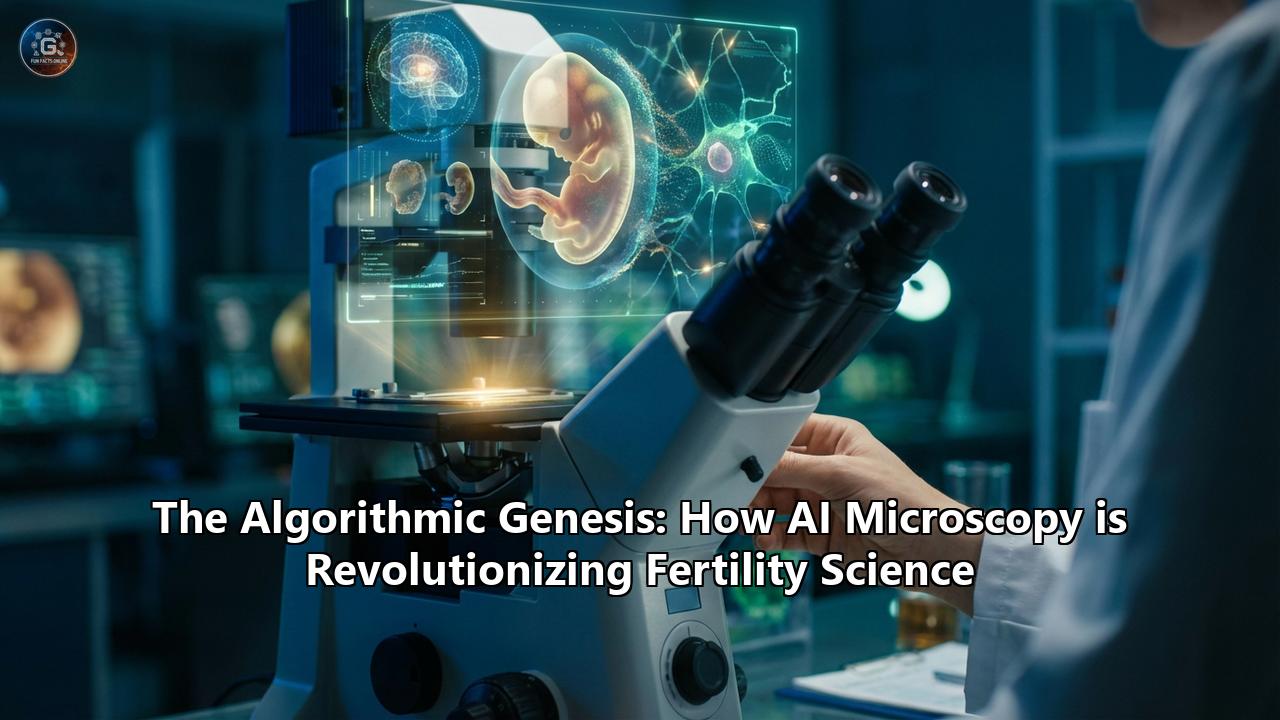
The biological dawn has broken, but this time, the sun is made of silicon.
For nearly five decades, the creation of life in a laboratory—In Vitro Fertilization (IVF)—was a discipline defined by human hands and human eyes. It was an art form, practiced by embryologists who squinted through microscopes in dim rooms, searching for the spark of life in a cluster of cells. They relied on intuition, experience, and the subjective grading of morphology: Is this cell round enough? Is it dividing on time? Does it look "beautiful"?
Yet, despite their best efforts, the "black box" of conception remained stubbornly opaque. For millions of hopeful parents, the process was a heart-wrenching lottery. Success rates hovered frustratingly around 30% per cycle. The emotional and financial toll was staggering. The question that haunted clinics worldwide was simple yet devastating: Why did that beautiful embryo fail, and why did the one we almost discarded become a healthy baby?
As we stand in 2026, that question is finally being answered. We have entered the era of Algorithmic Genesis.
The convergence of Artificial Intelligence (AI), Computer Vision, and Robotics has triggered the most significant paradigm shift in the history of reproductive medicine. We are no longer just looking at embryos; we are seeing through them. From deep learning algorithms that predict genetic health without a biopsy to robotic needles that hunt for rare sperm with superhuman speed, AI is not just assisting fertility science—it is rewriting it.
This is the comprehensive story of how the microscope became a mind, and how data is delivering the dream of parenthood.
Part I: The End of the "Beauty Contest"
The Limitations of the Human Eye
To understand the revolution, one must first understand the status quo that reigned until recently. For decades, embryo selection was essentially a beauty contest. Under the Gardner Grading System, embryologists assigned scores (like 4AA or 3BB) based on the visual appearance of the blastocyst—the embryo at day five or six of development. They looked at the expansion of the cavity, the cluster of cells that would become the fetus (Inner Cell Mass), and the cells that would become the placenta (Trophectoderm).
While effective to a degree, this method had a fatal flaw: subjectivity. A "4AA" embryo to one embryologist might be a "3AB" to another. Furthermore, a static snapshot taken at 8:00 AM tells you nothing about what the embryo did at 3:00 AM. Did it struggle to divide? Did it collapse and re-expand? These dynamic events, invisible to the human eye in a standard check, are often the difference between a live birth and a chemical pregnancy.
Human biology is messy, chaotic, and incredibly subtle. The human eye can distinguish reliable patterns, but it cannot process terabytes of pixel data to find correlations between a 5% difference in contraction speed and a metabolic deficit.
The machine, however, can.
The Rise of Computer Vision and Morphokinetics
The entry of AI into the IVF lab began with Time-Lapse Imaging (TLI). Instead of taking the embryo out of the incubator once a day to check on it (which exposes it to harmful changes in temperature and pH), clinics began using incubators with built-in cameras, such as the EmbryoScope. These cameras snapped a photo every 10 minutes, creating a movie of the embryo’s first days of life.
Suddenly, embryologists had thousands of images per embryo. It was too much data for a human to process effectively. Enter Deep Learning.
Companies like Fairtility (with their CHLOE system), AIVF (with EMA), and Vitrolife trained neural networks on millions of these time-lapse videos. They fed the AI the outcomes: This video resulted in a healthy baby; that one resulted in a miscarriage.
The AI began to "learn" patterns that no human had ever noticed. It discovered that the timing of specific cell divisions (morphokinetics) was predictive of success. It noticed that the texture of the cytoplasm or the synchronicity of the cell cycle held clues to the embryo’s energetic potential.
In 2025, studies utilizing systems like BELA (developed by Weill Cornell Medicine) demonstrated that AI could predict the chromosomal status (ploidy) of an embryo just by looking at the video—something previously thought impossible without an invasive biopsy. The AI wasn't just grading the embryo; it was reading its developmental diary.
Part II: The Non-Invasive Holy Grail
Beyond the Biopsy
One of the most physically intrusive parts of modern IVF is Preimplantation Genetic Testing for Aneuploidy (PGT-A). Traditionally, this involves using a laser to slice off a few cells from the trophectoderm of a developing embryo to test if it has the correct number of chromosomes (46). While generally safe, the biopsy stresses the embryo, requires expensive freezing (vitrification) while awaiting results, and adds thousands of dollars to the cost.
The dream has always been niPGT-A—Non-Invasive PGT-A. Can we know if an embryo is genetically normal without touching it?
In 2025 and 2026, the answer shifted from "maybe" to "yes."
Life Whisperer (the fertility arm of Presagen) spearheaded this movement with AI that analyzes a single static image to predict genetic integrity. But the field has gone even deeper, moving into Metabolic Imaging.New technologies utilizing hyperspectral microscopy and FLIM (Fluorescence Lifetime Imaging Microscopy) allow AI to analyze the metabolic fingerprint of the embryo. Every cell emits a faint, natural glow (autofluorescence) based on its metabolic state—specifically, the levels of cofactors like NADH and FAD.
Euploid (normal) embryos metabolize energy differently than aneuploid (abnormal) embryos. To the human eye, they look the same. To an AI analyzing the light spectrum of the culture media, the difference is stark.
Startups like Overture Life have commercialized systems that analyze the "spent culture media"—the liquid the embryo swims in. By detecting the specific cocktail of proteins and metabolites the embryo excretes, the AI can generate a "viability score" that correlates highly with genetic health. This is the "Smell Test" of the 21st century: the AI "smells" the chemical exhaust of the embryo to determine if it is healthy, all without a single laser cut.
Part III: The Male Factor Revolution
The AI Sperm Hunter
For decades, fertility was treated primarily as a "women’s issue." The male partner gave a sample, and if the count was low, the solution was simply to inject a single sperm into the egg (ICSI). But what happens when there is no sperm to be found?
In severe cases of Non-Obstructive Azoospermia (NOA), men produce almost no sperm. To find them, urologists perform a Micro-TESE surgery, extracting tissue from the testicles. Embryologists then spend hours, sometimes days, hunching over microscopes, shredding the tissue and scanning for a single viable sperm cell among millions of debris particles. It is exhausting, error-prone, and often unsuccessful due to human fatigue.
In late 2025, a team at Columbia University made headlines with the STAR system (Sperm Tracking and Recovery). This AI-driven tool acts as a "Sperm Hunter."
The system connects to a high-powered microscope and scans the sample in real-time. While a human might miss a twitching sperm tail hidden behind a clump of red blood cells, the AI does not. It processes the video feed instantly, flagging any movement that matches the kinetic signature of a sperm.
In a landmark case, the STAR system found viable sperm in a sample that human embryologists had declared "empty." That sperm resulted in a healthy pregnancy. Similarly, the SpermSearchAI tool developed in Australia reduced the time required to find sperm in biopsy tissue from 6 hours to less than 45 minutes, increasing the sperm retrieval rate significantly.
This is not just efficiency; for these couples, it is the difference between biological parenthood and the end of the road.
Part IV: The Robot Embryologist
Automation and the "Tapering of Hands"
Perhaps the most futuristic—and controversial—advancement is the removal of the human hand entirely.
In August 2025, the world witnessed the birth of the first "Robot-Born Babies." This feat was achieved by Conceivable Life Sciences in partnership with Columbia University. They built a robotic system capable of performing ICSI (Intracytoplasmic Sperm Injection).
In a traditional IVF lab, an embryologist uses a joystick to control a microscopic needle, catching a sperm and injecting it into an egg. It requires immense dexterity. A slight tremor, a bad angle, or too much pressure can kill the egg.
The robot, guided by AI, does not tremble. It uses computer vision to identify the egg, orient it perfectly to avoid damaging the spindle (the sensitive genetic machinery), select the best sperm, and inject it with micron-level precision.
This automation extends to Vitrification (freezing). Overture Life’s DaVitri system automates the freezing process. Freezing an embryo is a race against ice crystal formation. It involves moving the embryo through a series of cryoprotectant fluids at exact time intervals. Humans can vary in their timing; the robot is exact every time.
Why does this matter? Consistency.Currently, your IVF success depends heavily on which embryologist is on duty that day. Is it the senior director with 20 years of experience, or the junior trainee? Automation democratizes the quality of care. A robot in a rural clinic in Nebraska can perform the injection with the same precision as the world’s leading embryologist in New York City. This is the key to scaling IVF and eventually lowering the prohibitive costs that keep fertility treatment out of reach for millions.
Part V: The Data of Life
CHLOE, EMA, and the Digital Twin
The modern IVF clinic now runs on platforms like CHLOE (Fairtility) and EMA (AIVF). These are not just diagnostic tools; they are operating systems for the lab.
These platforms create a "Digital Twin" of the patient’s cycle. They integrate patient history (age, hormone levels) with the real-time imaging data of the embryos.
- Transparency: Historically, patients were told, "You have three good embryos." Now, CHLOE allows patients to log in and see the same data the embryologist sees. The AI highlights why it graded an embryo a certain way, circling the fragmentation or noting the symmetry. It builds trust in a process that often feels like magic.
- Ranking: The AI provides a ranked list of embryos for transfer. "Transfer Embryo #3 first; it has a 65% probability of implantation. Embryo #1 has only 40%." This decision support is vital. Transferring the wrong embryo first wastes a month of time and causes immense emotional pain. AI gets the best embryo to the uterus sooner.
Part VI: The Ethical Frontier
"Gattaca" vs. Reality
With great power comes the inevitable shadow of ethical concern. The capabilities of 2026 have reignited the debate over "Designer Babies," though the scientific reality is more nuanced than the science fiction.
The primary ethical friction point today is Polygenic Risk Scoring (PRS).
Traditional genetic testing looks for monogenic diseases—binary conditions like Cystic Fibrosis or Huntington’s Disease (you have it, or you don't).
PRS, however, uses AI to scan the embryo’s genome for complex traits influenced by thousands of genes: heart disease risk, diabetes risk, height, or even cognitive potential.
Startups offering "embryo health scores" based on PRS are multiplying. Parents are presented with a dashboard:
- Embryo A: High risk of Type 2 Diabetes, Average Height.
- Embryo B: Low risk of Diabetes, High risk of Schizophrenia.
Critics, such as bioethicists from Monash University, warn of a "slippery slope." Are we commodifying human life? Are we introducing a new form of eugenics where only the wealthy can afford "optimized" children? Furthermore, the science of PRS is still evolving; a high-risk score doesn't guarantee disease, yet parents might discard viable embryos based on probabilistic fears.
There is also the "Black Box" Problem. If an AI rejects an embryo, but the embryologist thinks it looks fine, who decides? If the AI was trained on data primarily from Caucasian patients, will it accurately score embryos from Asian or African donors? Ensuring Algorithmic Equity—that the AI works for all ethnicities—is the current battleground for developers.
Part VII: The Future Horizon
The Womb and Beyond
As we look toward 2030, the trajectory is clear. The "Art" of IVF is becoming the "Science" of Automated Genesis.
We are seeing the early stages of Gamete Rejuvenation. Companies like Uploid are using AI to identify the molecular markers of egg aging and developing therapies to reverse mitochondrial oxidation. If we can rejuvenate eggs, the strict biological clock that pressures women to conceive by 35 or 40 may finally be dismantled.
We are moving toward Ectogenesis (Artificial Wombs). While still in animal trials, the data gathering required to sustain a fetus outside the body is being laid down by the monitoring systems we use for embryos today.
Conclusion: The Human Heart of the Machine
It is easy to get lost in the cold precision of robotic needles and neural networks. But at its core, this technological revolution is deeply human.
Infertility is a disease of grief. It is the grief of the empty room, the negative test, the life put on hold. For every percentage point that AI improves success rates, thousands of couples are spared the trauma of another failed cycle. For every sperm found by the STAR system, a lineage that would have ended is allowed to continue.
The AI does not care about the baby. It cares about pixel textures and morphokinetic timings. But by caring about those things with superhuman attention, it allows the embryologists to care for the patient. It frees the human staff from the repetitive drudgery of cell counting, allowing them to focus on the complex clinical decisions and the emotional support that no machine can provide.
The Algorithmic Genesis is not about replacing the miracle of life. It is about clearing the fog so that the miracle can happen more often. In 2026, science has finally given us the eyes to see the spark before it fades, ensuring that more stories of struggle end in the cry of a newborn.
Reference:
- https://pmc.ncbi.nlm.nih.gov/articles/PMC10426717/
- https://babybloomivf.com/ai-technology-improving-ivf-success-2025/
- https://www.researchgate.net/publication/370793080_Ethical_Issues_of_Artificial_Intelligence_Assisted_Reproductive_Technologies
- https://www.seejph.com/index.php/seejph/article/view/5667
- https://www.researchgate.net/publication/388454599_Could_metabolic_imaging_and_artificial_intelligence_provide_a_novel_path_to_non-invasive_aneuploidy_assessments_A_certain_clinical_need
- https://www.youtube.com/watch?v=6mztsKJiKFU
- https://www.femtechworld.co.uk/news/fertility-news/2025-the-year-ivf-innovation-went-from-lab-to-life-fbc25/