
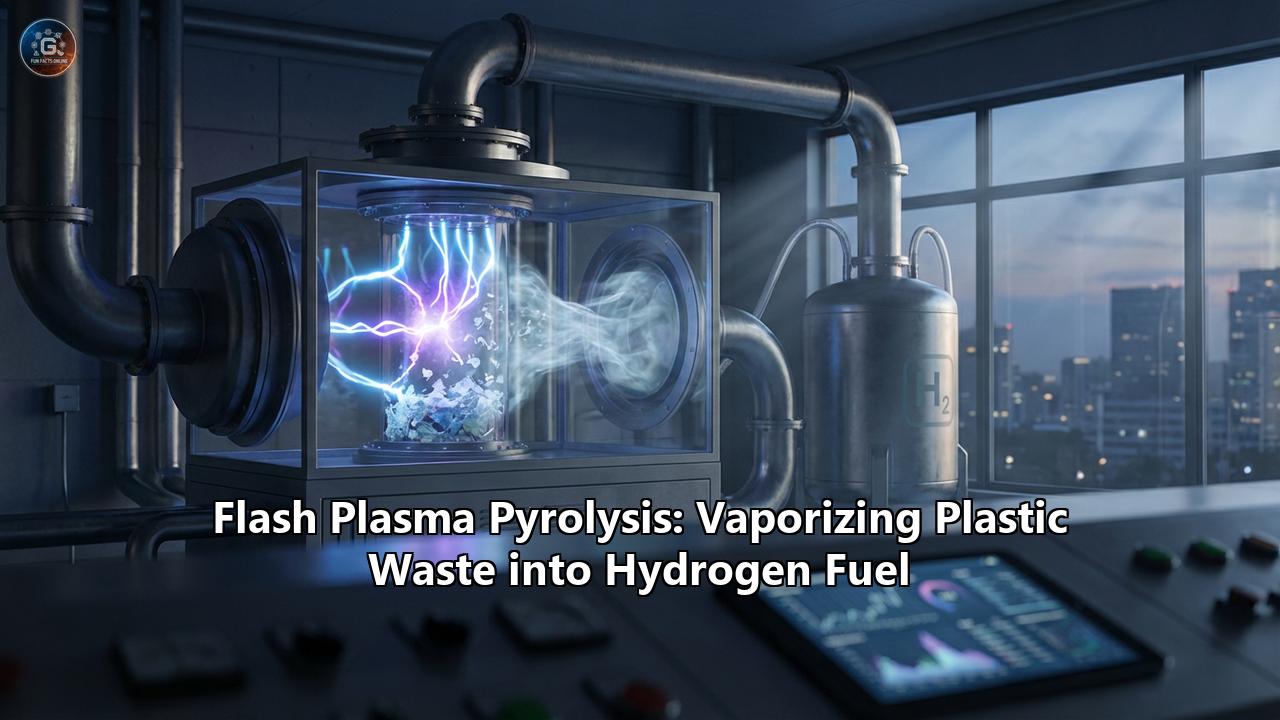
In the grand narrative of human industrialization, we have painted ourselves into a corner with two distinct colors: the grey of piling plastic waste and the black of carbon emissions. For decades, these two crises have run parallel, seemingly unconnected tracks of destruction. We drown in a sea of non-degradable polymers while simultaneously choking the atmosphere to fuel our hunger for energy. But deep in the laboratories of advanced materials science, a new form of alchemy has emerged—a violent, brilliant, and elegant process that promises to solve both problems in a single millisecond.
This is the story of Flash Plasma Pyrolysis, a technology that sounds like science fiction but is rapidly becoming science fact. It is the method of vaporizing the world’s most stubborn waste into the world’s cleanest fuel, all while producing a byproduct so valuable it could effectively make the energy free.
Part I: The Twin Titans of Crisis
To understand the magnitude of Flash Plasma Pyrolysis (FPP), one must first appreciate the scale of the enemies it fights.
The Plastic ParadoxSince the mid-20th century, humanity has produced over 8 billion tons of plastic. It is a miracle material—lightweight, durable, and sterile. But its greatest strength is its tragic flaw: it does not die. Polyethylene, polypropylene, and polystyrene act as immortal tombs for carbon atoms, trapping them in long, resilient chains that nature cannot digest. We recycle less than 9% of it. The rest sits in landfills, floats in the Pacific Garbage Patch, or breaks down into microplastics that have now been found in the deepest ocean trenches and human blood alike.
The Hydrogen HorizonOn the other side of the equation is the desperate race for clean energy. Hydrogen is the "Holy Grail"—a fuel that burns with the power of a rocket but emits only pure water. It is the key to decarbonizing heavy industries like steel, shipping, and aviation. Yet, the vast majority of hydrogen today is "Grey Hydrogen," stripped from natural gas in a dirty process that releases massive amounts of CO2. We need "Green Hydrogen" (made from water via electrolysis), but it is expensive and energy-intensive.
This is where the paradox lies: We are desperate for hydrogen, yet we are surrounded by mountains of waste that are 14% hydrogen by weight. Plastic is essentially solidified fossil fuel. We have been sitting on the world’s largest hydrogen reserve, disguised as trash.
The problem has always been how to unlock it without burning it.
Part II: Enter the Fourth State of Matter
Traditional methods of dealing with plastic are crude. Incineration burns it, releasing toxic fumes and CO2. Traditional pyrolysis cooks it slowly (like a pot roast) to melt it back into oil, which just perpetuates the fossil fuel cycle.
Flash Plasma Pyrolysis is different. It does not cook; it obliterates.
The Physics of the FlashAt the heart of this technology is plasma, the fourth state of matter. When you heat a gas enough, the electrons are ripped from their atoms, creating a soup of charged particles that conducts electricity and responds to magnetic fields. Plasma is the stuff of stars and lightning bolts.
In FPP, this state is induced not in a star, but in a reactor. The process operates on a timescale of milliseconds—a "flash." By subjecting plastic waste to temperatures exceeding 3,000 Kelvin (roughly 5,000°F or nearly half the temperature of the sun's surface), the technology bypasses the liquid and gas phases entirely for many components, stripping the molecules apart instantly.
This is not "burning" because there is no oxygen involved. In the absence of oxygen, the carbon and hydrogen atoms cannot form CO2 or water. Instead, they have an identity crisis. The long, tangled polymer chains of the plastic are shattered by the thermal shock. The hydrogen atoms, being light and flighty, break free and bond with each other to form H2 gas—pure hydrogen fuel.
The carbon atoms, suddenly abandoned by their hydrogen partners, are left with no choice but to bond with themselves. But because the heat is so intense and the cooling so rapid, they don't form the messy, amorphous soot associated with a chimney. Instead, they often snap into highly ordered, exotic structures.
Part III: The Two Paths of Lightning
While the concept of vaporizing plastic is the unifying theme, two distinct engineering breakthroughs have recently defined the field. They represent the two "flavors" of this new alchemy: the Electric Flash and the Hydrogen Torch.
1. The Electric Flash: Rice University’s Joule Heating
The most famous iteration of this concept comes from the lab of Professor James Tour at Rice University. Their method, known technically as Flash Joule Heating (FJH), is a masterclass in efficiency.
The process is shockingly simple:
- Preparation: Mixed plastic waste—unsorted, dirty, and washed up from the ocean—is ground into confetti-sized pieces.
- The Additive: A small amount of conductive material (like biochar or carbon black) is mixed in to ensure electricity can flow.
- The Jolt: A massive pulse of electricity is shot through the tube.
In less than 4 seconds, the resistance of the plastic generates extreme heat (Joule heating), spiking the temperature to 3,100 Kelvin. The plastic instantly sublimates.
The Economic Miracle: GrapheneWhat makes the Rice University method revolutionary is not just the hydrogen—it's the carbon. When the carbon atoms reassemble in this flash process, they form Turbostratic Graphene.
Graphene is the "wonder material" of the 21st century—a single layer of carbon atoms arranged in a honeycomb lattice. It is 200 times stronger than steel and more conductive than copper. Traditionally, making graphene is slow, expensive, and toxic, involving harsh chemicals and pristine graphite mines. It usually costs $60,000 to $200,000 per ton.
The Flash Joule method produces it from garbage.
This flips the economics of recycling on its head. In most recycling schemes, you pay to get rid of the waste. Here, the byproduct is so valuable that it subsidizes the hydrogen. As Dr. Tour’s team has noted, if you sell the graphene at just 5% of its current market value, the hydrogen produced effectively becomes free. You are no longer paying for energy; you are being paid to mine graphite from a landfill.
2. The Hydrogen Torch: KIMM’s Plasma Breakthrough
On the other side of the world, researchers at the Korea Institute of Machinery and Materials (KIMM) unveiled a massive leap forward in late 2025: the Hydrogen-Powered Plasma Torch.
While the Rice method uses direct electricity resistance, the Korean method uses a thermal plasma torch. But there is a twist. Traditional plasma torches use argon or nitrogen gas. The KIMM team developed a torch that uses hydrogen itself to create the plasma.
This creates a virtuous cycle. The torch shoots a jet of hydrogen plasma at 3,600°F into the reactor. The intense heat decomposes the plastic in 0.01 seconds. Because the plasma medium is hydrogen, it suppresses the formation of messy tars and soot that often clog other reactors.
The result is a stream of ultra-pure gases:
- Ethylene: The building block for new plastics (closing the loop).
- Hydrogen: More fuel for the torch or for export.
This method shines in its ability to handle "unsorted" waste. It doesn't care if the plastic is a soda bottle (PET), a milk jug (HDPE), or a grocery bag (LDPE). The plasma torch acts as a universal solvent, breaking them all down into their atomic legos.
Part IV: The Products of Pyrolysis
Let us look closer at what flows out of these reactors. The output is not just waste reduction; it is resource creation.
1. Pink Hydrogen (or Turquoise Hydrogen)The hydrogen produced by FPP is often categorized as "Turquoise Hydrogen" (produced from methane pyrolysis) or "Pink/Purple" (if nuclear power runs the plasma). Regardless of the color code, it is chemically identical to the hydrogen needed for fuel cells.
- Purity: Because the process happens at such high temperatures, impurities like sulfur or chlorine are easily separated or scrubbed. The Rice method reports purities exceeding 94% directly from the reactor, easy to purify to 99.999% for fuel cells.
- The Yield: Plastic is hydrogen-dense. Polyethylene is essentially a chain of CH2. Extracting that hydrogen yields vast amounts of energy. A single ton of plastic waste can theoretically yield enough hydrogen to power a fuel cell car for tens of thousands of miles.
If hydrogen saves the atmosphere, flash graphene saves the infrastructure.
The solid carbon byproduct of FPP is a dark powder. Under a microscope, it looks like crumpled sheets of paper. This "turbostratic" arrangement makes it soluble and easy to mix into other materials.
- Concrete: Adding just 0.1% of this flash graphene to concrete increases its compressive strength by 35%. This means we can use less concrete to build the same structures, massively reducing the carbon footprint of the construction industry (which is responsible for 8% of global CO2).
- Asphalt: Graphene-enhanced roads are more resistant to heat and cracking, doubling their lifespan.
- Batteries: This conductive carbon can be used in the anodes of next-gen batteries, replacing graphite mined in environmentally destructive ways.
Part V: The Environmental Calculus
Critics of waste-to-energy technologies often point to "hidden emissions." How does Flash Plasma Pyrolysis stack up?
The Energy Balance (EROI)Does it take more energy to make the plasma than you get out as hydrogen?
According to Life Cycle Assessments (LCA), the answer is a resounding no. Because the "flash" is so fast, the total energy input is low compared to keeping a furnace hot for hours (as in traditional pyrolysis).
- To process one ton of plastic waste via Flash Joule Heating consumes roughly 1-2 megawatt-hours of electricity.
- The hydrogen produced contains more chemical energy than the electricity consumed (assuming high efficiency).
- Crucially, if the electricity used to fire the flash comes from renewable sources (wind/solar), the entire process is carbon-neutral or even carbon-negative (if you consider the carbon sequestered in the graphene).
Standard "Grey Hydrogen" produces 10-12 tons of CO2 for every ton of hydrogen.
Electrolysis ("Green Hydrogen") produces 0 tons, but costs $5-$8/kg.
Flash Plasma Hydrogen produces roughly 1-2 tons of CO2 equivalent (mostly from the electricity source), but if that electricity is green, it drops to near zero.
However, unlike incineration, no carbon is burned. The carbon from the plastic does not go into the air as CO2; it goes into the bucket as graphene. It is solid-state carbon capture.
Part VI: The Road to Commercialization
The transition from a university lab to an industrial plant is the "Valley of Death" for new technologies. However, FPP is bridging that gap with speed.
Universal MatterJames Tour’s startup, Universal Matter, has already secured millions in funding and is building demonstration plants. Their focus is currently on the graphene (because it pays the bills), but the hydrogen capture is the inevitable second phase. They are proving that you don't need a billion-dollar refinery to do this; you can build modular units.
The Decentralized VisionThe ultimate vision for Flash Plasma Pyrolysis is not a massive, central smokestack. It is decentralization. Imagine a shipping container-sized unit behind a grocery store or a neighborhood recycling center.
- Trash goes in one end.
- Hydrogen comes out to refuel the neighborhood's delivery trucks.
- Graphene comes out to patch the neighborhood's potholes.
This eliminates the carbon-heavy logistics of trucking waste hundreds of miles to a landfill.
Part VII: Challenges and the Future
No technology is perfect. FPP faces hurdles:
- Feedstock Consistency: While KIMM’s torch handles mixed waste well, high PVC (polyvinyl chloride) content can create corrosive chlorine gas, requiring robust scrubbing systems.
- Energy Intensity: It requires a robust electrical grid. As we electrify everything, the demand on the grid is immense.
- Market Adoption: The construction industry is slow to change. Convincing regulators to allow graphene in standard building codes takes time.
Despite these challenges, the trajectory is clear. We cannot continue to bury 300 million tons of plastic a year. We cannot continue to burn fossil fuels for hydrogen. Flash Plasma Pyrolysis offers the rare "double win."
It reframes our perspective on waste. In the eyes of a plasma physicist, a discarded plastic bottle is not garbage; it is a solidified battery, a repository of hydrogen fuel and structural carbon waiting to be liberated.
As we move toward 2030 and 2050 climate goals, technologies like FPP will likely become the backbone of the Circular Economy. It is the closest we have come to the philosopher’s stone—transmuting the lead weight of our pollution into the gold of clean energy. The flash is not just a spark in a reactor; it is a beacon for a cleaner world.
Reference:
- https://news.rice.edu/news/2023/making-hydrogen-waste-plastic-could-pay-itself
- https://hydrogen-central.com/worlds-first-hydrogen-powered-plasma-torch-melts-plastic-waste-in-0-01-seconds/
- https://energynews.biz/rice-university-harvesting-hydrogen-and-graphene-from-plastic-waste/
- https://jmtour.com/rice-lab-turns-waste-into-valuable-graphene-in-a-flash/
- https://singularityhub.com/2023/10/08/how-flash-heating-plastic-waste-could-produce-green-hydrogen-and-graphene/
- https://www.energy-reporters.com/environment/plastic-waste-destroyed-at-3600-degrees-korean-scientists-create-hydrogen-plasma-torch-that-converts-unsorted-garbage-into-99-pure-chemicals-in-0-01-seconds/
- https://www.inciner8.com/plasma-pyrolysis-or-traditional-incineration
- https://kindle-tech.com/faqs/what-is-the-difference-between-flash-pyrolysis-and-fast-pyrolysis
- https://www.researchgate.net/publication/257725451_Development_of_Process_for_Disposal_of_Plastic_Waste_Using_Plasma_Pyrolysis_Technology_and_Option_for_Energy_Recovery
- https://www.researchgate.net/publication/344147702_Hydrogen_from_Waste_Plastics_by_Two-Stage_PyrolysisLow-Temperature_Plasma_Catalytic_Processing
- https://livrepository.liverpool.ac.uk/3151766/1/Plasma%20pyrolysis%20for%20a%20sustainable%20hydrogen%20economy20220330.pdf