
Chapter 1: The Leviathan Wakes
For millennia, they were the ghost stories of the high seas. Sailors whispered of "holes in the ocean" and walls of water that appeared without warning under clear blue skies—monsters of liquid glass that could snap a supertanker in two like a dry twig. Science dismissed them as tall tales, the drunken exaggerations of weary mariners. The mathematical models of the 20th century, based on the orderly Gaussian distribution of ocean swells, insisted that such waves were statistical impossibilities. A 30-meter wave was supposed to happen once every 10,000 years.
Then came New Year's Day, 1995.
At the Draupner oil platform in the North Sea, a laser sensor pointed down at the churning dark waters captured the impossible. Amidst a sea of 12-meter swells, a single behemoth rose up, towering 25.6 meters (84 feet) into the air. It was a "Rogue Wave"—the first scientifically confirmed evidence that the sailors were right. The Draupner wave shattered the old models. The ocean was not a predictable, orderly system; it was chaotic, nonlinear, and occasionally, murderous.
For thirty years, humanity struggled to predict these monsters. We built stronger ships and drilled deeper for data, but the "when" and "where" remained a terrifying roll of the dice. Until now.
Enter the Neptune Algorithm.
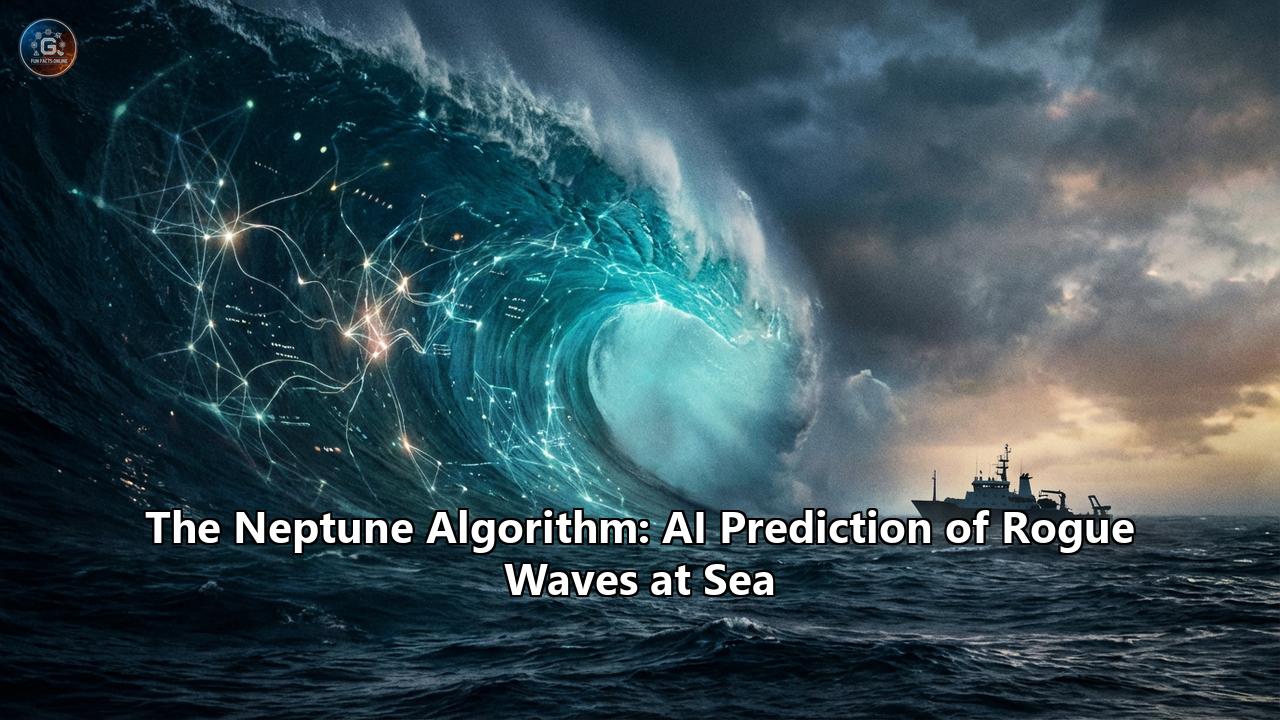
This is the story of how artificial intelligence, fed on a diet of over a billion waves and 700 years of aggregated time, finally cracked the code of the ocean’s deadliest phenomenon. It is a story of how a team of researchers from the University of Copenhagen and the University of Victoria used a new kind of AI to turn the chaotic fury of the sea into a solvable equation, promising a future where the Leviathan can no longer strike from the shadows.
Chapter 2: The Data of the Deep
To teach a computer how to spot a monster, you first have to show it where the monsters live. The foundation of the Neptune Algorithm (a thematic title for the groundbreaking work led by researchers like Dion Häfner and Johannes Gemmrich) lies not in a single "eureka" moment, but in a mountain of data that would drown a human analyst.
The data came from a vast network of ocean eyes. For decades, highly advanced buoys and cabled observatories—including the pioneering NEPTUNE observatory off the coast of the Pacific Northwest—have been silently recording the heartbeat of the ocean. These sensors measure wave height, crest length, and trough depth, 24 hours a day, 365 days a year.
Häfner and his team compiled a dataset of staggering proportions: 158 buoys scattered across the globe, continuously recording for years. When stitched together, this dataset represented an equivalent of 700 years of continuous ocean observation. Inside this digital ocean, they identified over 100,000 rogue waves—anomalies defined as being at least twice the significant wave height of the surrounding sea state.
The sheer volume of this data revealed a chilling truth: the "once in 10,000 years" theory was dead wrong. Rogue waves were happening every single day, somewhere in the vast, unmonitored expanses of the world’s oceans. The beast was not rare; it was just elusive.
Chapter 3: The Glass Box—How the AI Thinks
The brilliance of the new approach lies in the type of Artificial Intelligence used.
In the past decade, Deep Learning has dominated headlines. Deep Learning models are like "black boxes"—you feed them data, and they spit out a prediction, but they cannot tell you how they arrived at that answer. For a ship captain staring at a radar screen, "trust me, I'm an AI" is not a comforting explanation when deciding whether to alter course by 500 miles.
The researchers instead chose a method called Symbolic Regression.
Imagine a master mathematician who doesn't just memorize answers but derives the formula from scratch. Symbolic Regression analyzes the data and tries to build a mathematical equation that fits the patterns. It tests millions of combinations of variables—wave height, steepness, water depth, spectral bandwidth—until it finds the simplest, most elegant formula that explains the phenomenon.
The result is a "Glass Box" AI. It doesn't just output a probability; it outputs an equation. It tells the scientists why a rogue wave is forming.
This transparency led to a shock in the oceanographic community. For years, the prevailing theory was that rogue waves were born from "modulation instability" (also known as the Benjamin-Feir instability)—a complex, non-linear mechanism where waves "steal" energy from their neighbors to grow vertically.
The Neptune Algorithm’s equation said otherwise. It revealed that the primary culprit for most rogue waves was actually Linear Superposition.
It’s a concept known since the 1700s, but often overlooked in the hunt for more exotic explanations. Linear Superposition is essentially a "traffic accident" at sea. It happens when two or more different wave systems—say, a fast-moving swell from a distant storm and a slower, local wind-driven chop—cross paths at the exact wrong moment. Their crests stack on top of each other, and for a brief, violent window of time, they combine to form a wall of water.
The AI showed that this "bad luck" alignment was predictable. By monitoring the spectral bandwidth (the range of frequencies in the waves) and the directionality, the algorithm could calculate exactly when these systems would intersect to create a monster.
Chapter 4: The Watchful Eye
So, how does this translate to safety at sea?
Imagine a modern container ship, the MSC Goliath, steaming across the North Pacific. In the ship's bridge, the captain monitors a new display integrated into the Electronic Chart Display and Information System (ECDIS). This is the operational face of the Neptune technology.
Instead of just showing current weather, the system is pulling real-time data from the global buoy network and satellite altimetry readings. It processes this data through the symbolic regression equation derived by the AI.
12:00 PM: The sea state looks rough, but manageable. Significant wave height is 6 meters. 12:05 PM: The algorithm detects a shift in the spectral energy. A long-period swell from a storm off Japan is about to intersect with the local wind waves generated by a low-pressure system to the north. 12:06 PM: The system flags a "Red Zone" on the captain's chart—a 50-square-mile patch of ocean ten miles ahead. The probability of a rogue wave event in that sector spikes from 0.01% to 85%. 12:10 PM: The captain alters course five degrees to starboard. 12:45 PM: A buoy in the Red Zone records a 22-meter wave—a wall of water that would have smashed the Goliath’s bridge windows and swept containers overboard. The ship, safely five miles away, feels only a heavy roll.This is not science fiction. The University of Maryland, building on similar principles, has developed neural networks capable of predicting rogue waves 1 to 5 minutes in advance using direct buoy data. While 5 minutes sounds short, in the world of maritime operations, it is an eternity. It is enough time to batten down hatches, secure loose crew on deck, and turn the ship’s bow into the wave to ride it out safely rather than taking it broadside.
Chapter 5: Economic Tides
The implications of the Neptune Algorithm extend far beyond saving lives—though that is its noblest purpose. The economic ripples are massive.
The global shipping industry moves 90% of the world's trade. Every year, hundreds of millions of dollars are lost to "heavy weather damage." Containers are lost overboard (an average of 1,500 per year, with catastrophic years seeing far more), ships suffer structural fatigue, and insurance premiums skyrocket.
With reliable rogue wave prediction:
- Route Optimization: Ships can take more direct routes, avoiding only the specific pockets of danger rather than skirting entire oceans due to vague storm warnings. This saves fuel and reduces carbon emissions.
- Insurance and Liability: Marine insurance companies are already eyeing this tech. Ships equipped with "Neptune-certified" AI systems could see lower premiums, incentivizing the entire fleet to upgrade.
- Offshore Energy: Oil rigs and wind farms are sitting ducks. They cannot move. However, knowing a rogue wave is coming minutes in advance allows for "emergency shutdowns"—stopping delicate operations, locking cranes, and moving personnel to safe zones, potentially preventing disasters like the 1982 Ocean Ranger tragedy.
Chapter 6: The Future Horizon
The Neptune Algorithm is just the beginning. The next phase involves integrating this AI with the next generation of autonomous ships.
Rolls-Royce and other maritime giants are designing "ghost ships"—massive cargo vessels with no crew, piloted by AI. For these vessels, a rogue wave is the ultimate boss fight. Without a human captain to "feel" the sea, the ship relies entirely on sensors. A rogue wave prediction algorithm is the sensory cortex these ships need to survive.
Furthermore, climate change is heating up the oceans, adding more energy to the system. Recent studies suggest that extreme wave heights are increasing in the Southern Ocean and North Atlantic. The "100-year wave" might soon become the "10-year wave." As the ocean becomes more hostile, our reliance on AI to navigate it will shift from a luxury to a necessity.
Conclusion: Taming the God of the Sea
We will never truly conquer the ocean. It is too vast, too powerful, and too wild. But the Neptune Algorithm represents a fundamental shift in our relationship with it. We are moving from an era of superstition and fear to one of understanding and anticipation.
For the sailor looking out at the black horizon, the sea is no longer a chaotic roulette wheel. The monsters are still there, prowling the deep. But for the first time in history, we can see them coming.
And that makes all the difference.