
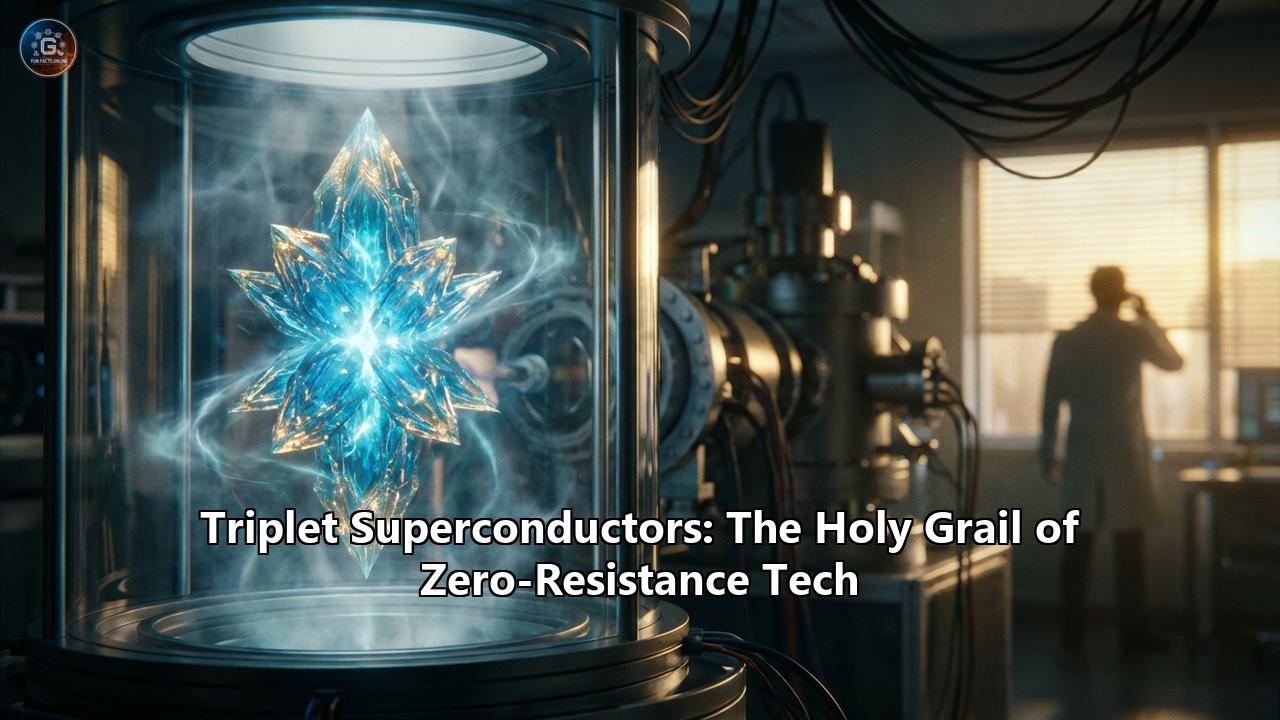
The world of condensed matter physics is currently witnessing a silent revolution—one that promises to fundamentally rewrite the rules of electronics, data processing, and quantum mechanics. For decades, scientists have chased materials that can conduct electricity without resistance, known as superconductors. But while conventional superconductors have already given us MRI machines, particle accelerators, and maglev trains, they have a critical limitation: they only transport electrical charge, not electron spin.
Enter the triplet superconductor—a rare, exotic, and historically elusive phase of matter that physicists often describe as the "holy grail" of solid-state physics. Unlike traditional superconducting materials, triplet superconductors can transmit both electrical current and spin current with absolute zero resistance. If effectively harnessed, this capability could pave the way for ultra-fast, energy-efficient spintronic devices and fault-tolerant topological quantum computers.
Following decades of agonizing theoretical proposals, retracted papers, and experimental heartbreak, the years 2025 and 2026 have delivered an avalanche of breakthroughs. From uranium-based heavy-fermion crystals surviving crushing magnetic fields to novel niobium-rhenium alloys operating at practical temperatures, the era of triplet superconductivity has finally arrived.
The Dance of the Electrons: Singlets vs. Triplets
To appreciate the sheer magnitude of a triplet superconductor, one must first understand how superconductivity works on a microscopic level.
At room temperature, electrons moving through a conducting wire behave like a chaotic crowd. They constantly collide with impurities and vibrating atoms in the crystal lattice, losing energy in the form of heat—a phenomenon we measure as electrical resistance. However, when certain materials are cooled below a critical temperature ($T_c$), the rules of quantum mechanics take over. According to the foundational BCS (Bardeen-Cooper-Schrieffer) theory, electrons begin to interact with the positively charged crystal lattice, pairing up into entities known as Cooper pairs.
Once paired, these electrons condense into a macroscopic quantum state, moving through the lattice in perfect unison without any collisions. Resistance drops perfectly to zero.
But Cooper pairs are strictly bound by the laws of quantum symmetry. Electrons are fermions, meaning they have a quantum spin of 1/2. When two electrons bind to form a Cooper pair, their spins must be accounted for.
In conventional superconductors (such as aluminum, lead, or niobium) and even in high-temperature cuprates, the electrons form a spin-singlet state. In this state, one electron spins "up" (+1/2) and the other spins "down" (-1/2). Their total spin cancels out exactly to zero ($S=0$). You can imagine them as two ice skaters holding hands, spinning in perfectly opposite directions. Because their net spin is zero, a singlet superconductor is utterly blind to spin information. Furthermore, if you expose a singlet superconductor to a strong external magnetic field, the field will try to force both electron spins to align in the same direction. The moment this happens, the Cooper pair is ripped apart, and superconductivity is instantly destroyed—a threshold known as the Pauli paramagnetic limit.
A spin-triplet superconductor breaks all these rules. In a triplet state, the two electrons in the Cooper pair align their spins in the same direction—both up, or both down, or a quantum superposition of the two. The total spin of the pair equals one ($S=1$). Furthermore, to satisfy the Pauli exclusion principle, the spatial wave function of the pair must have odd parity (an $L=1$ or $p$-wave state) rather than the even parity ($s$-wave or $d$-wave) seen in singlets.
Because the pairs already possess an internal magnetic orientation, triplet superconductors are extraordinarily resilient to external magnetic fields. More importantly, because the Cooper pairs carry a net spin, they can act as a frictionless conveyer belt for magnetic information.
Why Triplet Superconductors are the Holy Grail
The intense global race to find and verify triplet superconductors is driven by three world-changing technological applications:
1. Zero-Loss Superconducting Spintronics
Modern computer memory and hard drives rely on spintronics—technology that exploits the spin of electrons rather than just their charge to store and process information. However, traditional spintronics generate significant waste heat because moving spin-polarized electrons through normal metals still encounters electrical resistance.
Triplet superconductors solve this by carrying spin currents via frictionless Cooper pairs. As Professor Jacob Linder of the Norwegian University of Science and Technology (NTNU) recently explained, discovering a robust triplet superconductor means "we can now transport not only electrical currents but also spin currents with absolutely zero resistance". This opens the door to next-generation logic circuits and ultra-fast memory units that operate on virtually zero electrical power, circumventing the thermal limits that are currently halting Moore's Law.
2. Topological Quantum Computing and Majorana Fermions
Quantum computers promise to solve impossibly complex problems by utilizing qubits, which can exist in a superposition of states. The fatal flaw of current quantum computers is decoherence: qubits are ridiculously sensitive to environmental noise, causing them to lose their quantum information in fractions of a millisecond.
Triplet superconductors (specifically those with $p + ip$ pairing symmetry) are mathematically predicted to host a bizarre quasi-particle at their edges or inside magnetic vortices: the Majorana fermion. First hypothesized by Ettore Majorana in 1937, these particles are unique because they are their own antiparticles. In a topological quantum computer, information is stored not in a single vulnerable particle, but globally in the "braiding" of Majorana fermions. Because the information is distributed non-locally, local environmental noise cannot destroy the qubit. Triplet superconductors provide the native material platform required to birth Majorana fermions, offering a definitive pathway to commercially viable, fault-tolerant quantum computing.
3. Survival in Extreme Magnetic Environments
Conventional superconductors are utilized to generate the massive magnetic fields required in MRI machines and nuclear fusion reactors (like ITER). However, there is a hard limit to how much magnetic field a singlet superconductor can generate before its own field tears its Cooper pairs apart. Triplet superconductors, whose spin-aligned pairs comfortably coexist with magnetic fields, could theoretically push the boundaries of high-field electromagnets far beyond current physical limits, unlocking new frontiers in medical imaging and clean energy.
The Rise, Reign, and Re-evaluation of Strontium Ruthenate
The search for a true, ambient-pressure triplet superconductor has been fraught with scientific twists and turns. For over a quarter of a century, the leading candidate was strontium ruthenate (Sr₂RuO₄).
Discovered to be a superconductor in 1994, Sr₂RuO₄ has a crystal structure almost identical to high-temperature cuprate superconductors, yet it superconducts without any chemical doping. Early experimental data—particularly Nuclear Magnetic Resonance (NMR) Knight shift measurements—suggested that the electron spins remained unchanged as the material cooled past its transition temperature ($T_c$ of roughly 1.5 K), strongly indicating spin-triplet $p$-wave pairing. For 25 years, Sr₂RuO₄ was the poster child for triplet superconductivity, inspiring thousands of theoretical papers.
However, science is a continuously self-correcting discipline. As experimental techniques grew vastly more sophisticated in the 2020s, the $p$-wave theory began to crumble. Advanced NMR techniques utilized with extreme precision revealed that the Knight shift did actually drop when the material became superconducting, pointing back toward a singlet state.
In a massive blow to the traditional $p$-wave model, scientists at Cornell University utilized high-resolution resonant ultrasound spectroscopy, cooling the material down to 1 Kelvin. Measuring the speed of sound through the crystal with unprecedented accuracy, they found thermodynamic evidence suggesting Sr₂RuO₄ might actually be an entirely new type of superconductor altogether: a $g$-wave superconductor. A $g$-wave state is a complex two-component singlet state that requires high angular momentum, which had never been observed before.
The mystery deepened in late 2025. Researchers carefully applied massive shear strain to ultrathin crystals of strontium ruthenate to observe how its transition temperature reacted. A defining feature of the presumed two-component superconducting state is that it should be highly sensitive to shear strain. Yet, the researchers found that $T_c$ remained almost completely unchanged under severe distortion. This stunning result ruled out several complex two-component theories, setting strict limits on the material's nature and leaving scientists to grapple with a profound mystery. While strontium ruthenate may have lost its crown as the definitive triplet superconductor, its study birthed entirely new experimental physics techniques that laid the groundwork for the true champions.
Uranium Ditelluride (UTe₂): The High-Flying Heavyweight
As strontium ruthenate's triplet status faltered, a new titan emerged from the depths of the periodic table: Uranium ditelluride (UTe₂).
Discovered in 2019 to be a heavy-fermion superconductor with a $T_c$ of around 1.6 to 2.1 Kelvin, UTe₂ sent shockwaves through the physics community. It was hypothesized to be the paramagnetic end-member of a family of ferromagnetic superconductors (like UGe₂, URhGe, and UCoGe), materials where magnetism and superconductivity—normally sworn enemies—coexist on a microscopic scale.
UTe₂ immediately exhibited properties that shattered conventional singlet theories. The most glaring anomaly was its exceedingly large and anisotropic upper critical magnetic field. In 2024, researchers from the Dresden High Magnetic Field Laboratory subjected UTe₂ to pulsed magnetic fields. They found that at 1.6 Kelvin, the material maintained its superconductivity up to a staggering 73 Tesla. In conventional superconductors, the ratio of critical field strength (in Tesla) to transition temperature (in Kelvin) is roughly one to two. In UTe₂, that ratio reached an unprecedented 45. Such extreme resilience practically mandates a spin-triplet pairing mechanism, where the Cooper pair spins are aligned with the external field rather than ripped apart by it.
But the surprises didn't stop there. In January 2025, an astonishing paper published in the Proceedings of the National Academy of Sciences (PNAS) revealed a paradox. Researchers applying intense magnetic fields up to 70 Tesla discovered that instead of suppressing superconductivity, magnetic fields near 40 Tesla actually elevated the critical temperature of UTe₂ to approximately 2.4 K. This counterintuitive reentrant behavior—where extreme magnetism stabilizes and enhances the superconducting state—provided critical insights into the unique spin-fluctuation mechanisms driving UTe₂'s odd-parity pairing.
The ultimate "smoking gun" arrived shortly after in March 2025, also published in PNAS. Researchers utilized phase-sensitive measurements of the superconducting order parameter using the Josephson effect. By creating a junction between an ordinary $s$-wave superconductor (Indium) and UTe₂, they established a strict selection rule in the orientation dependence of the Josephson coupling. The results provided unambiguous, direct evidence that UTe₂ possesses an odd-parity pairing state of $B_{1u}$ symmetry near zero magnetic field. Furthermore, the study reported the apparent formation of Andreev surface bound states—a hallmark of topological superconductivity.
With these 2025 breakthroughs, UTe₂ cemented its status as the leading platform for natural spin-triplet superconductivity, opening realistic avenues for studying Majorana fermions.
The 2026 NbRe Breakthrough: A 7-Kelvin Miracle
While UTe₂ is a goldmine for fundamental physics, its practical technological applications are hindered by two factors: it requires temperatures near 1.6 Kelvin, and uranium is inherently radioactive, complicating commercial device manufacturing. The quantum tech industry needed a material that was easier to work with, safe to fabricate, and capable of operating at slightly higher temperatures.
In February 2026, a monumental announcement echoed from the Norwegian University of Science and Technology (NTNU). Professor Jacob Linder, working alongside experimental colleagues in Italy, published a landmark paper in Physical Review Letters titled "Unveiling Intrinsic Triplet Superconductivity in Noncentrosymmetric NbRe through Inverse Spin-Valve Effects".
The research team investigated Niobium-Rhenium (NbRe), a noncentrosymmetric metal alloy. Because its crystal lattice lacks inversion symmetry, the internal electric fields cause a strong spin-orbit coupling, which theoretical physicists had long suspected could mix singlet and triplet states.
Through highly advanced inverse spin-valve experiments, Linder's team demonstrated that NbRe naturally manifests intrinsic triplet superconductivity. Remarkably, the material exhibited these properties at temperatures approaching 7 Kelvin. While 7 K (-266 °C) might still seem frigid, in the cryogenic realm of exotic superconductors, it is exceptionally warm. Operating at 7 K allows researchers to utilize much cheaper, standard liquid helium cooling systems rather than complex and expensive dilution refrigerators required for milli-Kelvin temperatures.
"We think we may have observed a triplet superconductor," stated Linder, emphasizing that the ability of NbRe to transport spin currents with zero resistance positions it as a cornerstone for next-generation quantum and spintronic technology. If independent laboratories verify these results, NbRe will become the most commercially viable triplet superconductor known to science, dramatically accelerating the timeline for energy-efficient quantum computing.
Engineering the Impossible: Artificial Triplet Superconductors
Nature is notoriously stingy with intrinsic triplet superconductors. Therefore, engineers and material scientists have adopted a pragmatic approach: if we cannot easily find them, we will build them.
The field of Superconducting Spintronics has rapidly advanced by fabricating artificial metamaterials—specifically, superconductor/ferromagnet (SC/FM) heterostructures. Under normal circumstances, placing a superconductor in intimate contact with a ferromagnet is catastrophic; the strong internal exchange field of the magnet instantly tears the singlet Cooper pairs apart via the proximity effect.
However, scientists discovered that if they engineer a magnetically inhomogeneous interface between the two materials, something magical happens. The interface forces the singlet Cooper pairs to undergo a spin-mixing process, converting them into spin-aligned triplet Cooper pairs. Because these artificial triplet pairs have their spins aligned, they are immune to the ferromagnet's internal field and can propagate deep into the magnetic material.
Recent developments out of Imperial College London and IIT Madras showcased precisely this. Researchers successfully sandwiched a thin layer of chromium—a robust magnetic metal—between layers of magnetic iron and superconducting niobium. This incredibly precise nano-architecture facilitated the generation of spin-triplet supercurrents. By simply rotating an external magnetic field, the researchers could control the inherent magnetic anisotropy and modulate the flow of the spin-triplet currents at gigahertz frequencies—the exact operational speeds required for modern memory storage.
These hybrid devices mimic the behavior of intrinsic triplet superconductors, enabling the creation of zero-loss memory modules, $\pi$-Josephson junctions for phase qubits, and functional spintronic logic gates. By blending the mature manufacturing pipelines of conventional superconductors with ferromagnetic thin films, artificial SC/FM heterostructures are rapidly bridging the gap between theoretical physics and commercial computing hardware.
The True Spirit of Scientific Discovery
The triumph of discovering triplet superconductivity in materials like UTe₂ and NbRe stands in stark contrast to recent controversies that have plagued the field of condensed matter physics.
In recent years, the scientific community endured highly publicized, premature claims of room-temperature superconductivity. The most notorious was the saga of physicist Ranga Dias, whose claims of achieving ambient-temperature superconductivity in compressed hydrides (published in Nature) were fiercely contested. By late 2023, independent investigations revealed severe data manipulation and fabrication, leading to the retraction of multiple high-profile papers and Dias being stripped of his lab and students.
The painstaking progression of triplet superconductivity—from the decades-long meticulous scrutiny of strontium ruthenate, to the extreme magnetic testing of UTe₂, and the rigorously peer-reviewed inverse spin-valve data of NbRe—highlights how true science operates. It relies on reproducibility, harsh peer review, multiple independent measurement techniques (like ultrasound, NMR, and Josephson junctions), and the willingness to discard beloved theories when the data demands it.
The Quantum Horizon
As we progress through the mid-2020s, the realization of triplet superconductivity is no longer a distant theoretical pipe dream; it is an active, booming experimental reality.
Materials like Uranium ditelluride have completely shattered our understanding of magnetic resilience, surviving magnetic fields of 73 Tesla and proving that under the right quantum constraints, magnetism and superconductivity can be powerful allies rather than enemies. Meanwhile, NbRe has brought the operational temperature of triplet superconductors up to a highly practical 7 Kelvin, offering a tangible canvas for engineers to begin drafting the first blueprints of topological qubits and zero-loss spintronic microchips. Simultaneously, SC/FM heterostructures are proving that we can artificially synthesize these exotic states using materials we already know how to manufacture at scale.
The discovery and harness of triplet superconductors represents one of the most profound technological leaps of our generation. By unlocking the ability to transport electron spin with absolutely zero energy loss, we are standing at the threshold of ultra-fast computers that consume a fraction of the power of modern data centers, and quantum computers that are fundamentally protected against the noise of the outside world.
The long-sought holy grail of zero-resistance tech has finally been found, and it is spinning in perfect unison.
Reference:
- https://www.sciencedaily.com/releases/2026/02/260221000252.htm
- https://www.eurekalert.org/news-releases/1117229
- https://www.innolabs.ro/ai-lens/2026-02-21-triplet-superconductors-a-leap-toward-energy-efficient-quantum-computing
- https://www.azoquantum.com/Article.aspx?ArticleID=438
- https://arxiv.org/abs/2211.08625
- https://mgml.eu/news/2025/UTe2-PNAS
- https://www.pnas.org/doi/10.1073/pnas.2419734122
- https://bioengineer.org/physicists-discover-potential-key-breakthrough-for-quantum-computers/
- https://news.ssbcrack.com/scientists-edge-closer-to-discovering-triplet-superconductors-for-quantum-technology-advances/
- https://shaastramag.iitm.ac.in/news-brief/sight-spin-triplets
- https://iop.fnwi.uva.nl/cmp/docs/deVisser/2019/JPSJNC-16-2019-08.pdf
- https://scitechdaily.com/ute2-unleashes-new-superconductivity-secrets/
- https://www.robinson.msm.cam.ac.uk/research/superconducting-spintronics
- https://physics.cornell.edu/news/researchers-identify-new-type-superconductor
- https://en.wikipedia.org/wiki/Distrontium_ruthenate
- https://www.reddit.com/r/Physics/comments/p3gn47/an_unconventional_superconductor_isnt_so_odd/
- https://scitechdaily.com/a-30-year-superconductivity-mystery-just-took-a-sharp-turn/
- https://www.sciencenews.org/article/superconductor-room-temperature-scrutiny
- https://www.reddit.com/r/Physics/comments/1b9scl4/superconductivity_scandal_the_inside_story_of/