
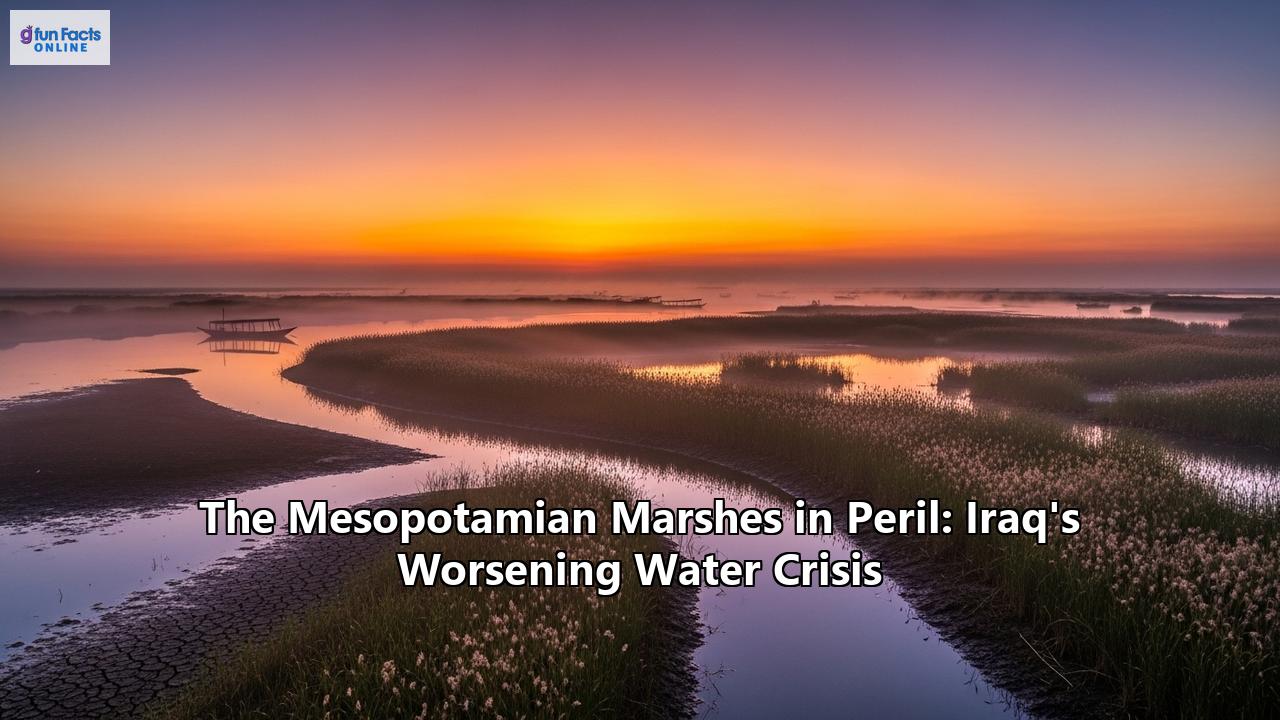
The Cradle of Civilization Runs Dry: Iraq's Mesopotamian Marshes in the Throes of a Catastrophic Water Crisis
In the heart of what was once the Fertile Crescent, a land etched in the annals of human history as the cradle of civilization, a profound tragedy is unfolding. The Mesopotamian Marshes, a vast and ancient wetland ecosystem in southern Iraq, often equated with the biblical Garden of Eden, are vanishing. This intricate lacework of waterways, reed beds, and lagoons, which for millennia nurtured the Sumerian civilization and the unique culture of the Marsh Arabs (Ma'dan), is now a parched and desolate landscape, a stark testament to a deepening water crisis that threatens to erase a priceless natural and human heritage forever.
Once sprawling over 20,000 square kilometers, a vibrant oasis teeming with life, the marshes have been reduced to a fraction of their former glory. The causes are a toxic confluence of man-made and environmental disasters: aggressive upstream damming by neighboring countries, the relentless march of climate change, the legacy of political vindictiveness, and a crippling inability within Iraq to manage its most precious resource. The result is an ecological collapse spiraling into a human catastrophe, displacing thousands of families and severing a bond between a people and their environment that has endured for over 5,000 years.
A World Lost: The Historical and Ecological Jewel of Mesopotamia
The significance of the Mesopotamian Marshes transcends their physical boundaries. For millennia, this was where the Tigris and Euphrates rivers converged, their seasonal floods creating a dynamic and incredibly productive wetland. This life-giving water created a biodiversity hotspot in the midst of an arid landscape, a critical stopover for millions of migratory birds on the flyway between Siberia and Africa, and a sanctuary for unique species like the Basra reed warbler and the Iraq babbler. The waters were rich with fish, which provided a primary source of protein, while the vast reed beds offered material for building everything from homes to the iconic arched guesthouses known as mudhifs.
It was in this environment of abundance that the Sumerian civilization flourished around 5000 BC. The fertile land supported agriculture, fishing, and trade, allowing great cities like Ur and Uruk to rise from the desert's edge. The Ma'dan, believed by many to be the descendants of these ancient Sumerians, developed a unique and harmonious way of life deeply intertwined with the marshes. They were a people of the water, navigating the labyrinthine channels in long, slender canoes (mashhoof), herding water buffalo that grazed on the reeds, and cultivating rice in the rich, silty soil. Their culture, traditions, and very identity were shaped by the ebb and flow of the waters that surrounded them.
The ecological functions of these wetlands were vital not just for the immediate area but for the entire region. The marshes acted as a giant natural filter, purifying water by trapping pollutants and sediments before they reached the Persian Gulf. They helped to moderate the local climate, mitigating the harsh desert heat, and played a crucial role in maintaining the coastal health of the Gulf, serving as essential spawning and nursery grounds for fish and shrimp.
The First Assault: A Tyrant's Wrath
The initial, catastrophic blow to the marshes was not an act of nature, but a deliberate political and military strategy. In the aftermath of the 1991 Gulf War, Saddam Hussein's Ba'athist regime, facing a Shia uprising in the south, sought to punish the Marsh Arabs, whom he accused of treason and sheltering rebels. His retribution was brutal and devastatingly effective: a massive engineering campaign to drain the lifeblood of the marshes.
A network of canals and embankments was constructed to divert the flow of the Tigris and Euphrates rivers away from the wetlands, channeling the water directly into the Persian Gulf. Canals bearing names like the "Saddam River" and "Loyalty to the Leader Channel" were carved through the landscape, systematically starving the delicate ecosystem. By the year 2000, the United Nations Environment Programme (UNEP) delivered a grim assessment: 90% of the Mesopotamian Marshes had been destroyed in what was described as one of the 20th century's greatest environmental disasters, comparable to the deforestation of the Amazon rainforest.
The ecological impact was immediate and catastrophic. The vibrant green wetlands turned into cracked, salt-encrusted desert. The destruction of habitats led to a massive loss of wildlife, with dozens of bird species designated as "at risk". The human cost was equally staggering. The drainage displaced an estimated 250,000 Marsh Arabs, forcing them from the lands their ancestors had inhabited for millennia. Their unique way of life, built around fishing, buffalo herding, and reed cultivation, was shattered. Many fled to other parts of Iraq or became refugees in neighboring Iran, their ancient culture on the verge of extinction.
A Fleeting Renaissance and a New Onslaught
The fall of Saddam Hussein's regime in 2003 brought a glimmer of hope. In a spontaneous act of restoration, returning Marsh Arabs, armed with basic tools, began dismantling the dikes and dams. Water began to flow back into the desiccated lands, and miraculously, life started to return. The restoration was remarkable in its speed; by 2006, aided by international organizations and a few years of good rainfall, about 58% of the original marshland had been re-inundated. The return of water spurred the regrowth of native reeds and saw the reappearance of fish and bird species. In 2016, in recognition of its unique natural and cultural value, the area, encompassing the marshes and the ancient Sumerian cities of Ur, Uruk, and Eridu, was designated a UNESCO World Heritage site.
However, this fragile recovery was to be short-lived. The marshes now face a new, more insidious, and complex set of threats that are pushing them back toward total collapse. This modern crisis is a three-headed hydra: relentless upstream water diversions, the accelerating impacts of climate change, and chronic mismanagement and neglect within Iraq itself.
The Dammed Rivers: A Chokehold from Upstream
Iraq is a downstream nation, critically dependent on the Tigris and Euphrates rivers, both of which originate in the mountains of Turkey. For decades, Turkey's massive Southeastern Anatolia Project (GAP), a vast network of 22 dams and 19 hydroelectric plants, has systematically reduced the volume of water reaching Iraq. Some estimates suggest that since the 1970s, these projects have cut Iraq's water supply from the two rivers by as much as 80%.
The completion of the Ilisu Dam on the Tigris River in 2020 has been a particularly devastating blow. The dam has the capacity to hold a significant portion of the Tigris's annual flow, giving Turkey near-total control over the water that is the lifeline for northern Iraq and a crucial feeder for the marshes. Since the Ilisu Dam came online, Iraq has been forced to request a minimum flow from Ankara on a month-to-month basis, leaving Iraqi farmers and water managers in a constant state of uncertainty. Studies have shown that the initial operation of the Ilisu Dam could reduce inflow to the Mosul Dam in Iraq by over 40%, and full operation could lead to a reduction of more than 70%.
Iran has compounded the problem by constructing its own dams and diversion tunnels on tributaries that feed the Tigris, such as the Sirwan (Diyala) and the Little Zab rivers. These projects redirect water for Iranian agriculture and hydropower, further diminishing the flow into Iraq. The Nawsud water tunnel, for example, has significantly diverted the Sirwan River, while the Kolsa dam has reportedly caused an 80% drop in the water levels of the Little Zab. In early 2025, an Iranian official openly called for controlling cross-border river flows to prioritize domestic needs, signaling a hardening stance that spells further disaster for Iraq.
This "water weaponization" is a geopolitical reality. Lacking binding international agreements on water sharing, Iraq is largely at the mercy of its upstream neighbors, who have leveraged their geographical advantage and Iraq's internal instability to prioritize their own water security.
The Fires of Climate Change
Compounding the crisis of diminished river flows is the escalating impact of global climate change. Iraq is one of the five most vulnerable countries in the world to its effects. The region is experiencing rising temperatures, reduced rainfall, and increasingly frequent and severe droughts. The drought that began in 2021 has been described as the worst in forty years, causing a massive reduction in the water available to replenish the rivers and marshes.
Higher temperatures, which could see a regular summer high of 56°C (133°F) in Basra by the 2060s—a temperature near the limit of human survivability—accelerate evaporation from remaining water bodies, further depleting the scarce resource. Future projections paint a grim picture, with scientists predicting a robust, long-term drying trend over Mesopotamia, characterized by a significant decrease in vital winter and spring precipitation in the river basins' headwaters. This trend threatens to make the current water shortages a permanent state of affairs.
A Crisis from Within: Pollution, Neglect, and a Thirsty Oil Industry
The final element of this perfect storm is found within Iraq's own borders. Decades of conflict have left the country's water infrastructure in a state of disrepair. Inefficient and outdated irrigation techniques, such as flood irrigation still used by a majority of farmers, lead to massive water wastage. Corruption and political infighting have stalled crucial infrastructure projects, like desalination plants in Basra, that could alleviate the crisis.
Pollution is rampant. Untreated sewage, agricultural runoff laden with fertilizers and pesticides, and industrial waste flow directly into the rivers, contaminating the already dwindling water supply. This toxic cocktail makes its way downstream to the marshes and the Shatt al-Arab waterway, with devastating consequences.
Adding a heavy burden to this strained system is the country's oil industry, the backbone of its economy. The super-giant oilfields of southern Iraq, including Majnoon and Halfaya, overlap with the protected marshlands. Oil extraction is a notoriously water-intensive process. Water is injected into wells to boost crude production, and this water is drawn directly from the already over-stretched rivers and marshes. It's estimated that pumping stations built for the oil industry in the region extract around 60,000 cubic meters of water every day—the equivalent of the daily consumption of a medium-sized city. A government report documented alarming concentrations of hydrocarbons and heavy metals in drinking water and the collapse of local agriculture due to pollution from oil extraction.
The Unraveling of a Civilization and an Ecosystem
The combined effect of these pressures has been an unmitigated disaster for the marshes and their people. The most immediate and visible impact is the shocking decline in water levels. Large swaths of the marshes have reverted to dry, cracked earth.
Salinity and Poisoned Waters: As freshwater from the rivers diminishes, the salt wedge from the Persian Gulf pushes further and further upstream into the Shatt al-Arab and the Hammar marsh. This has caused a dramatic spike in salinity. Water that once had salinity levels of 300-500 parts per million (ppm) now registers as high as 15,000 ppm in some areas. This hyper-saline water is toxic to the freshwater ecosystem. It kills the reeds that are the foundation of the ecosystem, poisons the fish, and is undrinkable for both humans and their livestock. Collapse of Livelihoods: The Ma'dan culture is on the brink of collapse. Fishing, once a mainstay of the local economy, has been decimated. Fishermen now report that the fish have all but disappeared, and their catch has dwindled from 50 kilograms a day to less than five. The iconic water buffalo, central to the Marsh Arab way of life for their milk, meat, and hides, are dying in droves, poisoned by the saline water or perishing from diseases exacerbated by their weakened state. Farmers have lost their herds and their only source of income. The loss of buffalo milk means the end of traditional dairy products like geymar, a thick clotted cream beloved in Iraqi cuisine. A Human Exodus: Faced with the death of their animals, the loss of their crops, and the poisoning of their water, the Marsh Arabs are once again being forced to flee. This time, they are environmental refugees. As of March 2023, reports indicated that over 12,000 families had been displaced across Iraq due to drought, with many coming from the marshlands. They move to the impoverished fringes of cities like Basra and Nasiriyah, abandoning a 5,000-year-old heritage to search for any work they can find, often living in poverty and losing their unique cultural identity. The traditional ecological knowledge held by the community, particularly by women, is being lost as they are disconnected from the marsh-dependent activities that defined their roles for generations. A Public Health Disaster: The water crisis has become a severe public health emergency, particularly in the southern city of Basra. The combination of high salinity, low river flows, and high concentrations of pollutants from sewage and industrial waste creates a toxic brew. In the summer of 2018, this culminated in a massive health crisis where at least 118,000 people were hospitalized with symptoms like diarrhea, vomiting, and skin rashes related to the contaminated water. Authorities have warned that the conditions are ripe for outbreaks of diseases like cholera. Residents receive untreated water laden with impurities, and toxicity levels are often so high the water is deemed unsuitable even for animals. Ecological Devastation: The biodiversity of the marshes is in freefall. The hypersaline conditions and lack of water have led to the disappearance of numerous freshwater plant and fish species. In their place, more salt-resistant marine species like crabs and shrimp are invading, fundamentally altering the ecosystem. The loss of vast reed beds and wetlands means the millions of migratory birds that relied on this crucial stopover now find their journey far more perilous. The potential extinction of species like the Basra reed-warbler, whose global population is almost entirely dependent on these marshes, is a very real possibility. The drying of the land also leads to desertification and an increase in the frequency and intensity of dust storms that plague Iraq.A Battle Against Time: Efforts to Save the Marshes
The fight to save the Mesopotamian Marshes is a daunting and multifaceted challenge, involving local communities, the Iraqi government, and international organizations. Yet, efforts are often fragmented, underfunded, and hampered by the sheer scale of the crisis and the complex political landscape.
Government and NGO Initiatives: The Iraqi Ministry of Water Resources has a dedicated body, the Center for Restoration of the Iraqi Marshlands and Wetlands (CRIMW), tasked with managing and rehydrating the marshes. NGOs like Nature Iraq have been instrumental, working on the ground since 2003, monitoring the ecosystem, and advocating for its protection. They have been pivotal in documenting the devastation and the subsequent, fragile recovery. In April 2024, the Iraqi government, in partnership with the International Union for Conservation of Nature (IUCN) and with funding from Sweden, launched a $5 million project aimed at sustainable water and agriculture management in the Basra marshes. However, such projects, while positive, often feel like placing a bandage on a gaping wound. Critics point to a consistent failure of governance, where large-scale projects are announced only when a crisis boils over and are frequently derailed by corruption and a lack of political will. International Recognition and its Limits: The designation of the marshes as a UNESCO World Heritage site in 2016 was a major victory for conservationists. It brought international attention to their plight and placed a responsibility on the Iraqi government to protect the site. UNESCO and other UN bodies have funded projects aimed at improving management and supporting the local culture. However, the power of such a designation is limited. UNESCO can raise awareness and encourage corrective action, but it cannot force upstream countries to release more water, nor can it solve Iraq's internal governance problems. Protecting a World Heritage site in a region plagued by instability, conflict, and a severe climate crisis remains an immense challenge. Geopolitical Deadlock: The core of the problem remains the lack of binding water-sharing agreements between Iraq, Turkey, and Iran. Iraq and Syria have signed agreements in the past, but these have often been non-binding or violated. Turkey has consistently refused to recognize the Tigris and Euphrates as international rivers, viewing them instead as a national resource. This has led to a political stalemate, where diplomatic efforts result in short-term promises of increased water flow during emergencies but fail to produce a long-term, equitable solution. Without a fundamental shift in regional hydro-politics that treats the river basin as a shared resource requiring cooperative management, any local restoration efforts in Iraq are ultimately at risk.A Vanishing Eden, A Bleak Future
The Mesopotamian Marshes are at a precipice. The forces arrayed against them—powerful upstream dams, a rapidly changing climate, and internal decay—are immense. The water that sustained one of humanity's oldest civilizations is disappearing, and with it, a unique cultural tapestry woven over five millennia. The quiet suffering of the Marsh Arabs, their displacement, and the slow death of their way of life is a profound human rights tragedy unfolding in the shadow of an ecological one.
Saving this 'Garden of Eden' requires more than just a few good rainy seasons or small-scale restoration projects. It demands a monumental effort on multiple fronts: binding and equitable international water treaties, a radical overhaul of Iraq's internal water management and infrastructure, a serious commitment to tackling pollution, and global action on the climate crisis that is fanning the flames of this disaster.
The story of the Mesopotamian Marshes is a stark warning of the fragility of even the most ancient and resilient ecosystems in the face of modern pressures. It is a story of a paradise lost once, partially regained, and now on the verge of being lost forever. Without urgent, concerted, and transformative action, the land between the two rivers will become a barren wasteland, and the haunting call of the Marsh Arabs' mashhoof will fade into an eternal, silent memory.
Reference:
- https://aknafalsawary.com/mesopotamian-marshes/
- https://whisperingdialogue.com/2023/04/15/the-mesopotamian-marshes/
- https://earthobservatory.nasa.gov/images/5795/the-mesopotamian-marshes
- https://www.history.com/articles/sumer
- https://crgreview.com/the-mesopotamian-marshes-a-case-study-of-an-ecology-in-peril/
- https://www.visapourlimage.com/en/festival/exhibitions/irak-les-arabes-des-marais
- https://reliefweb.int/report/iraq/forgotten-people-marsh-arabs-iraq
- https://arabcenterdc.org/resource/water-politics-in-the-tigris-euphrates-basin/
- https://www.files.ethz.ch/isn/18548/Iraqi_Marsh_Arabs.pdf
- https://www.tandfonline.com/doi/full/10.1002/ehs2.1207
- https://eoimages.gsfc.nasa.gov/images/imagerecords/1000/1716/meso2.pdf
- https://en.wikipedia.org/wiki/Mesopotamian_Marshes
- https://www.uodiyala.edu.iq/uploads/PDF%20ELIBRARY%20UODIYALA/EL34/Draft%20Report%20Biological%20Characteristics%20Mesopotamian%20Marshlands%20of%20Southern%20Iraq.pdf
- https://museodata.com/descargas/WorldHeritageUnderAttack.pdf
- https://en.wikipedia.org/wiki/Marsh_Arabs
- https://shafaq.com/en/society/Public-health-disaster-Basra-faces-worst-water-pollution-in-decades
- https://finsindia.org/geopolitics-of-water-conflict-in-west-asia-the-tigris-euphrates-basin.html
- https://www.mdpi.com/2073-4441/12/12/3334
- https://www.numberanalytics.com/blog/tigris-euphrates-water-politics-guide
- https://english.aawsat.com/home/article/1380001/toxic-mix-polluted-salty-water-iraq%E2%80%99s-basra
- https://www.chathamhouse.org/2025/08/iraqs-water-crisis-dammed-neighbours-failed-leaders
- https://savethetigris.org/impacts-of-ilisu-dam-in-iraq-a-lecture-at-the-marine-science-center-basra-university/
- https://www.researchgate.net/publication/371727594_The_impact_of_Ilisu_Dam_on_water_flow_toward_Iraq_and_identifying_the_optimal_operational_strategy_for_Mosul_Dam
- https://www.hrw.org/report/2019/07/22/basra-thirsty/iraqs-failure-manage-water-crisis
- https://climate-diplomacy.org/case-studies/turkey-syria-and-iraq-conflict-over-euphrates-tigris
- https://en.unesco.org/inclusivepolicylab/support-system/questions/what-are-biggest-challenges-unesco-faces-protecting-intangible-cultural
- https://eltahir.mit.edu/journal/uncertainty-in-future-projections-of-precipitation-decline-over-mesopotamia/
- https://dspace.mit.edu/bitstream/handle/1721.1/148545/1520-0442-JCLI-D-22-0268.1.pdf?sequence=2&isAllowed=y
- https://journals.ametsoc.org/view/journals/clim/36/4/JCLI-D-22-0268.1.xml
- https://reliefweb.int/report/iraq/basra-thirsty-iraq-s-failure-manage-water-crisis
- https://piahs.copernicus.org/articles/385/465/2024/piahs-385-465-2024.pdf
- https://www.researchgate.net/publication/348732664_Geopolitics_of_Water_Conflict_in_West_Asia_The_Tigris-_Euphrates_Basin
- https://www.clingendael.org/publication/water-governance-iraq
- https://www.cflac.org.cn/ArtExchange/201303/English/201403/t20140320_248782.htm
- https://funtimesmagazine.com/7-unesco-world-heritage-sites-under-threat-from-conflict-and-climate-change/