
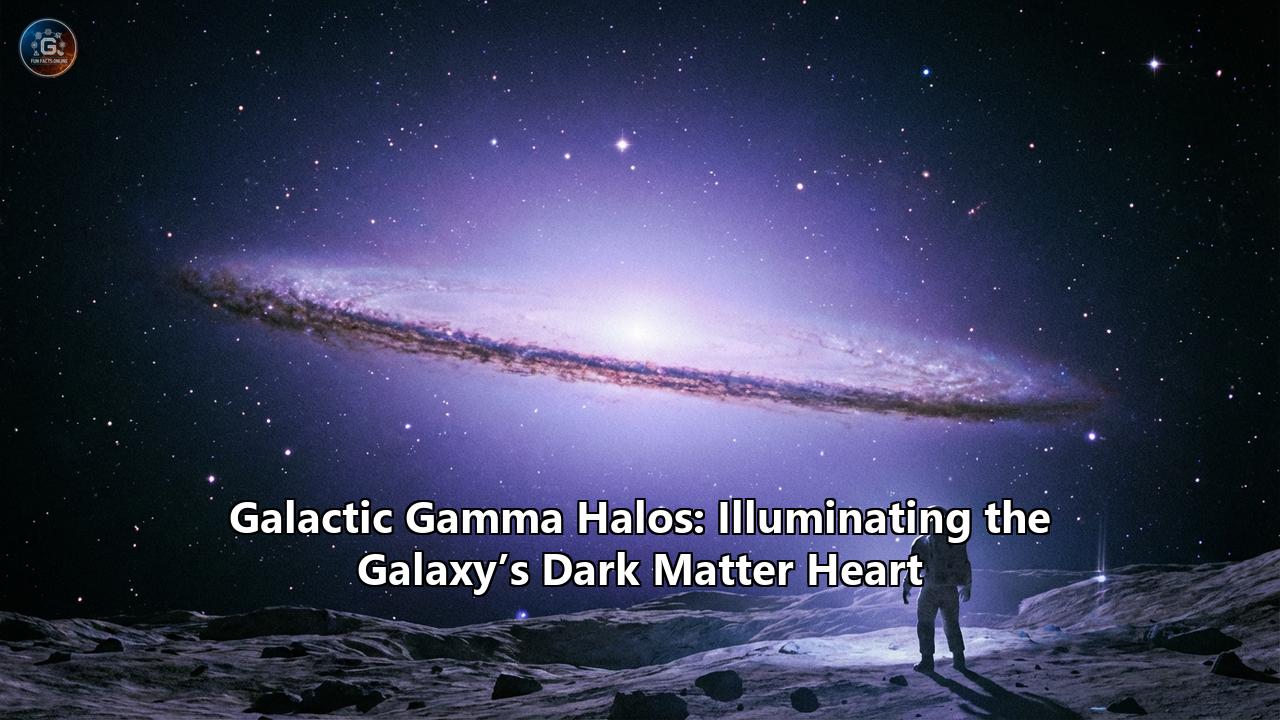
For nearly a century, astronomers have stared into the abyss of the cosmos and realized that the abyss is heavy. In the 1930s, Swiss astronomer Fritz Zwicky observed the Coma Cluster of galaxies and noted a disturbing discrepancy: the galaxies were moving too fast. The visible mass of the stars and gas was insufficient to hold the cluster together against the centrifugal force of its own rotation. Something invisible, massive, and omnipresent was acting as the gravitational glue. He called it dunkle Materie—dark matter.
Fast forward to late 2025, and the mystery of dark matter remains one of the most profound embarrassments in modern physics. We know it exists; we map its invisible scaffolding as it bends light and shapes the rotation curves of spiral galaxies. Yet, despite decades of searching with underground xenon tanks and particle colliders, we have never held a piece of it. It passes through us, silent and interacting only via gravity.
But the silence may finally be breaking. A groundbreaking study from the University of Tokyo, released in November 2025, has sent shockwaves through the astrophysical community. By analyzing fifteen years of data from NASA’s Fermi Gamma-ray Space Telescope, researchers have identified a faint, spherical "gamma-ray halo" enveloping the Milky Way—a glow that matches, with eerie precision, the predicted fingerprint of dark matter annihilation. Unlike previous signals that were easily dismissed as the work of noisy pulsars, this new halo is vast, smooth, and tuned to a specific energy frequency that whispers the secrets of a new particle.
This is the story of Galactic Gamma Halos: the faint, high-energy auras that surround galaxies, the controversy of their origins, and the possibility that we are finally seeing the light of the invisible universe.
Part I: The Milky Way’s Forbidden Light
To understand the magnitude of the recent discovery, one must first understand the instrument that made it possible. Launched in 2008, the Fermi Gamma-ray Space Telescope views the universe not in the soft glow of visible light, but in the violent, piercing radiation of gamma rays. These photons are the shrapnel of the cosmos, born from exploding stars, feeding black holes, and—theoretically—the death throes of dark matter.
The Galactic Center Excess: A False Start?For over a decade, the "Galactic Center Excess" (GCE) was the primary suspect in the hunt for dark matter. Fermi saw a bright knot of gamma rays right at the heart of the Milky Way, peaking at an energy of roughly 2 to 5 GeV (gigaelectronvolts). It was tantalizing. The center of the galaxy is where dark matter should be densest, and the signal looked like what you would expect if Weakly Interacting Massive Particles (WIMPs) were crashing into each other and annihilating.
However, skepticism quickly mounted. The galactic center is a messy, crowded downtown district of the cosmos, packed with supernova remnants and varying gas densities. More damningly, independent analyses suggested the GCE wasn't smooth like a cloud of gas or dark matter. Instead, it looked "clumpy" or grainy. This graininess pointed to a different culprit: Millisecond Pulsars (MSPs). These are the undead corpses of massive stars, spinning hundreds of times a second and spraying gamma rays like cosmic lighthouses. If thousands of unresolved pulsars lived in the galactic core, they could mimic a dark matter signal. The community was split, and the GCE became a battlefield of statistical models.
The 2025 Breakthrough: The 20 GeV HaloEnter Professor Tomonori Totani and his team. Instead of staring at the noisy, chaotic center of the galaxy, they looked outward. They examined the "halo" region—the vast, empty suburbs of the Milky Way, extending far above and below the galactic disk. Here, the noise of pulsars and exploding stars fades away, leaving a cleaner canvas.
Totani’s analysis revealed something that shouldn't be there. After meticulously subtracting the known background of cosmic rays interacting with interstellar gas (the "pion decay" signal) and the photon fields (Inverse Compton scattering), a residual signal remained. It wasn't a clump or a point. It was a smooth, spherical shell of radiation.
Crucially, this new signal peaked at a different energy: 20 GeV.
This shift in energy is significant. The 20 GeV peak implies a much heavier dark matter particle than the one proposed for the GCE. If this signal is from dark matter, the particle responsible would have a mass roughly 500 times that of a proton (around 500 GeV/c²).
The morphology—the shape of the signal—is the strongest evidence. Pulsars live in the galactic disk and the central bulge; they are stellar objects born from stars. They do not float in a giant, spherical sphere 50,000 light-years above the galaxy. Dark matter, however, does exactly that. According to the standard Cold Dark Matter (CDM) model, our galaxy sits inside a massive, spherical "halo" of dark matter. The gamma-ray signal Totani found traces this sphere perfectly.
Part II: The Physics of the Invisible
How does "dark" matter produce "light"? The term "dark" is a misnomer; it should really be called "transparent" matter because light passes right through it. However, the leading theory—the WIMP hypothesis—suggests that dark matter is its own antiparticle.
The Annihilation ScenarioImagine two WIMPs floating through the galactic halo. For billions of years, they pass each other like ghosts. But occasionally, in regions of sufficient density, they collide head-on. When they do, they annihilate, vanishing from the universe and releasing a burst of pure energy.
This energy doesn't usually manifest directly as gamma rays. Instead, the annihilation produces a shower of unstable standard particles—quarks (like bottom quarks, $b\bar{b}$), leptons (like tau leptons, $\tau^+\tau^-$), or massive bosons ($W^+W^-$). These particles are short-lived. They decay almost instantly into stable particles: protons, electrons, neutrinos, and gamma rays.
The gamma rays produced in this cascade have a specific "spectral shape"—a fingerprint. Unlike the power-law spectrum of cosmic rays (which just goes down smoothly as energy goes up), dark matter annihilation produces a "bump" in the data. The energy of this bump is directly related to the mass of the WIMP. The 20 GeV bump observed in the Totani study corresponds to the specific decay chain of a 500 GeV particle annihilating, likely into bottom quarks or W bosons.
Why 500 GeV?A 500 GeV particle fits comfortably within the predictions of Supersymmetry (SUSY). SUSY is a theoretical framework that proposes every particle in the Standard Model has a heavier "superpartner." The lightest of these superpartners, often the neutralino, is stable and fits the description of a WIMP perfectly. If the 2025 discovery holds, we may have just found the neutralino.
This mass range is also intriguing because it sits right at the edge of what the Large Hadron Collider (LHC) can probe, potentially explaining why the LHC hasn't seen it yet—it might just be slightly out of reach or hiding in a difficult decay channel.
Part III: The Cosmic Ray Masquerade
Before we pop the champagne for a Nobel Prize, we must confront the nemesis of all dark matter hunters: Cosmic Rays.
The space between stars is not empty. It is filled with a tenuous gas of hydrogen and helium, and threaded by magnetic fields. Zooming through this medium are cosmic rays—protons and electrons accelerated to near-light speeds by supernova shockwaves.
The Fog of WarWhen a high-energy cosmic ray proton smashes into a stationary hydrogen atom in the interstellar medium, it creates a subatomic particle called a pion ($\pi^0$). The pion lives for a fraction of a nanosecond before decaying into two gamma rays. This process creates a "diffuse gamma-ray glow" that traces the distribution of gas in the galaxy.
Furthermore, cosmic ray electrons can crash into photons from starlight or the Cosmic Microwave Background (CMB). When they do, they impart energy to the photon, kicking it up into the gamma-ray range. This is called Inverse Compton (IC) scattering.
The "Cosmic Ray Halo" is a known phenomenon. As cosmic rays escape the galactic disk, they diffuse into the halo, trapped by magnetic field lines that loop high above the galaxy. This creates a "fog" of gamma rays that can look suspiciously like a dark matter halo.
Distinguishing the SignalThe key to Totani's claim lies in the "residuals." The Fermi team and the GALPROP code (a standard software for modeling cosmic ray propagation) have spent years building maps of this cosmic ray fog. They model the gas, the magnetic fields, and the star/supernova distributions.
When Totani subtracted this best-fit cosmic ray model from the actual data, the 20 GeV halo remained. If the signal were just misidentified cosmic rays, it should have looked like the gas distribution (clumpy and disk-like) or the magnetic field bubbles (the famous "Fermi Bubbles"). Instead, the residual was smooth and spherical—properties that cosmic rays, which are tied to magnetic fields and gas, struggle to replicate on their own.
However, critics argue that our understanding of the galactic magnetic halo is poor. If the magnetic fields extend further and are more spherical than we thought, cosmic ray electrons interacting with the CMB could mimic a dark matter halo. This "Inverse Compton Halo" is the primary alternative explanation that must be ruled out.
Part IV: Beyond the Milky Way—The Universal Halo
If dark matter halos glow in gamma rays, our galaxy shouldn't be special. Every galaxy embedded in a dark matter halo should exhibit this faint aura.
Andromeda (M31)Our nearest giant neighbor, the Andromeda Galaxy, offers a crucial test bed. Being 2.5 million light-years away, we view it from the outside. We can clearly separate its center from its halo.
Previous studies of M31 using Fermi-LAT data have yielded mixed results. Some analyses found a gamma-ray excess in its center, similar to our GCE. Others have placed strict limits on the halo emission. A detection of a "20 GeV halo" around M31 would be the smoking gun. In 2024, researchers hinted at an extended gamma-ray signal around M31 that defied standard cosmic ray models, tentatively termed "Giant Halos." While initially attributed to extensive cosmic ray winds, re-analysis in light of the Milky Way's 20 GeV signal suggests these might be the same phenomenon.
Galaxy ClustersClusters like Coma and Virgo are the largest reservoirs of dark matter in the universe. However, they are also noisy. They are filled with hot gas emitting X-rays and "radio halos" generated by shockwaves from merging galaxies. Detecting a dark matter gamma-ray signal here is like trying to hear a whisper at a rock concert. Nevertheless, the lack of a strong signal from clusters puts an "upper limit" on how interactive dark matter can be. The 500 GeV WIMP model proposed by Totani barely scrapes under these limits, keeping the theory alive but under tension.
Dwarf Spheroidal GalaxiesThe ultimate arbiters are the Dwarf Spheroidal galaxies orbiting the Milky Way (like Draco, Ursa Minor, and Segue 1). These are old, dead galaxies with almost no gas and no pulsars—just old stars and a massive amount of dark matter. They are "clean" laboratories.
If the Milky Way's halo is glowing due to dark matter, these dwarfs should glow too. So far, Fermi has not seen a statistically significant signal from them. This is the biggest hurdle for the Totani result. However, because the dwarfs are small, the signal might simply be too faint for Fermi to catch. This is where the next generation of telescopes comes in.
Part V: The Future of the Hunt
The detection of the 20 GeV halo marks the end of the beginning. We have a signal. Now we need verification.
The Cherenkov Telescope Array (CTA)Set to see "first light" fully in the late 2020s, the Cherenkov Telescope Array is a ground-based observatory with sites in Chile and La Palma. Unlike Fermi, which catches gamma rays in orbit, CTA watches for the blue flash of "Cherenkov light" created when very high-energy gamma rays hit the Earth's atmosphere.
CTA is significantly more sensitive than Fermi in the high-energy range (above 100 GeV). While the 20 GeV peak is lower than CTA's optimal range, the "tail" of the 500 GeV particle's annihilation spectrum extends into the TeV (teraelectronvolt) range. CTA will be able to map the galactic halo with unprecedented resolution. If the halo is real, CTA will see it. More importantly, CTA will be able to stare at the Dwarf Spheroidal galaxies with enough sensitivity to confirm or refute the dark matter hypothesis once and for all.
The Southern Wide-field Gamma-ray Observatory (SWGO)Planned for the Andes mountains, SWGO will complement CTA. It will be a water-Cherenkov detector (pools of water catching particles) that looks at a large portion of the sky continuously. This is crucial for mapping diffuse, extended structures like the Galactic Gamma Halo, which cover too much sky for a pointed telescope like CTA to map easily.
Conclusion: A New Era of Cosmology
The discovery of the Galactic Gamma Halo, specifically the 20 GeV excess identified in late 2025, represents a pivotal moment in our quest to understand the universe. For the first time, we have a signal that:
- Matches the Geometry: Spherical, not disk-like.
- Matches the Physics: A 500 GeV particle mass, consistent with Supersymmetry.
- Defies the Background: Cannot be easily explained by pulsars or standard cosmic rays.
If confirmed, this is not just an astronomical discovery; it is a discovery of fundamental physics. It would prove that the Standard Model is incomplete. It would tell us that the "ghost" holding our galaxy together is a real, tangible particle that we can study, measure, and perhaps one day understand.
We stand on the precipice of "seeing" the dark universe. The gamma rays washing over our planet are not just harmful radiation; they are messengers from the dawn of time, carrying the signature of the invisible architects of reality. After 100 years of searching in the dark, the galaxy may finally be turning on the lights.
Reference:
- https://www.sciencedaily.com/releases/2025/11/251129053349.htm
- http://w0.ned.ipac.caltech.edu/level5/Sept17/Fornasa/Fornasa2.html
- https://www.techno-science.net/en/news/this-could-be-the-first-direct-observation-of-dark-matter-N27929.html
- https://arxiv.org/html/2507.07209v3
- https://scitechdaily.com/in-a-first-for-humanity-scientists-may-have-finally-seen-dark-matter/
- https://www.semanticscholar.org/paper/e5757c3920509c884385335cd33359c1dfacc6a0