
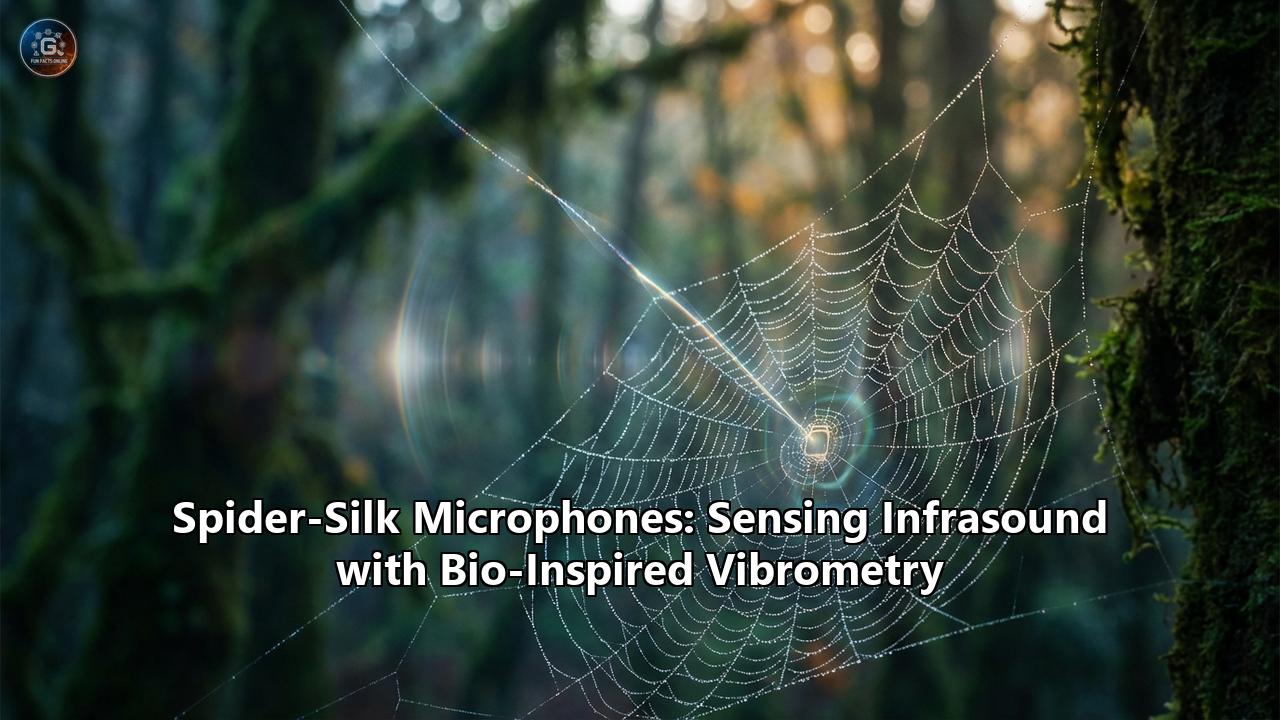
In the quiet corners of a university laboratory, a common bridge spider sits motionless on its web. To the casual observer, it is simply waiting for a fly. But to a team of acoustic engineers and physicists, this arachnid is demonstrating a piece of biological engineering so sophisticated that it makes our most advanced audio technology look primitive. The spider is not just feeling vibrations; it is "hearing" the world with a fidelity that human ears—and the microphones modeled after them—cannot match.
For over a century, human audio technology has been trapped in a single paradigm: the pressure-based microphone. From the first telephones to the latest noise-canceling headphones, we have built devices that mimic the human eardrum. But nature has other ways of listening. New research into "spider-silk microphones" and bio-inspired vibrometry is unlocking a completely different method of sound detection—one that senses the velocity of air particles rather than the pressure they exert.
This technology, born from the delicate strands of a spider's web, promises to revolutionize everything from hearing aids and smartphones to earthquake detection and battlefield surveillance. It is a shift from the heavy, membrane-bound world of human hearing to the weightless, hyper-sensitive world of the insect.
Part I: The Flaw in the Human Ear
To understand why spider silk is such a game-changer, we must first understand the limitations of our own biology.
The Tyranny of PressureThe human ear is a pressure sensor. When a sound wave travels through the air, it compresses and decompresses the air molecules, creating a wave of pressure. Our eardrums are thin membranes stretched tight across a bone; when the pressure wave hits them, they vibrate. Alexander Graham Bell and other early pioneers of audio simply copied this design. Virtually every microphone in existence today—whether it’s the tiny MEMS (Micro-Electro-Mechanical Systems) mic in your iPhone or the massive diaphragm condenser in a recording studio—works on this principle. They are all mechanical eardrums.
The Problem with EardrumsPressure has a major drawback: it is a scalar quantity. It has magnitude (loudness), but no direction. If you measure the air pressure in a room, you know that sound is present, but the pressure reading alone cannot tell you if the sound came from the left, the right, or behind you. Humans solve this by having two ears and a brain that calculates the tiny time delay between them. But for a single microphone, "hearing" direction is physically impossible without complex, bulky arrays of multiple sensors.
Furthermore, pressure sensors struggle with "the cocktail party problem." In a noisy room, a hearing aid amplifies everything equally—the clattering dishes, the background music, and the conversation you’re trying to hear. It cannot physically distinguish the valuable sound from the noise based on direction alone.
The Insect SolutionInsects and arachnids are too small to have widely spaced ears like humans. If a mosquito or a spider relied on pressure differences between two ears, the difference would be too small to measure. Instead, they evolved a different mechanism: flow sensing.
Rather than detecting the squeeze of the air (pressure), they detect the movement of the air (particle velocity). Sound is, after all, just vibrating air. As a sound wave passes, the air molecules physically move back and forth. A spider’s silk, or the fine hairs on a cricket’s leg, are so incredibly light that they don’t block the air; they ride it. They move in perfect lockstep with the air molecules, capturing the vector of the sound—its speed and its exact direction.
Part I: The Binghamton Breakthrough
The pivotal moment for this technology came at Binghamton University in New York, led by Distinguished Professor Ron Miles and his graduate student, Jian Zhou. Miles had spent his career studying the acoustics of the insect world, searching for a way to engineer a microphone that could mimic this "flow sensing" ability.
The Golden WebThe team knew that to detect air velocity, they needed a material that was incredibly thin and lightweight—so light that it had almost no inertia. If the fiber was too heavy, the air would just flow around it like water around a rock. If it was light enough, it would move with the air.
Spider silk is one of the strongest and lightest materials on Earth. To test its acoustic properties, the researchers harvested dragline silk from the bridge spider (Larinioides sclopetarius), a common species found on their campus windowsills. The silk was roughly 1/1000th the width of a human hair.
Because spider silk is not conductive, it couldn't generate an electrical signal on its own. The team developed a novel solution: they coated the silk in a microscopic layer of gold and placed it in a magnetic field. When sound waves hit the silk, it vibrated back and forth with the air particles. This movement of the gold-coated wire within the magnetic field generated a tiny electrical current—a perfect analog of the sound wave.
The Results: Absolute FidelityThe results, published in Proceedings of the National Academy of Sciences (PNAS), were startling. The spider silk didn't just work; it outperformed high-end professional microphones.
- Frequency Response: The silk responded with a perfectly flat frequency response from 1 Hz to 50,000 Hz. This range is staggering. It covers deep infrasound (tectonic plates grinding) to high ultrasound (bats screeching), far exceeding the human hearing range of 20 Hz to 20,000 Hz.
- True Directionality: Because the silk moved with the velocity of the air, it was inherently directional. It formed a "figure-eight" polar pattern, listening perfectly to sound in front and behind while being completely "deaf" to noise coming from the sides (90 degrees).
They had created a microphone that could listen to a whisper in a hurricane, provided the whisper was coming from the right direction.
Part III: From Spider Web to Silicon Chip
While harvesting spider webs makes for great science, it is not a scalable manufacturing model. You cannot put a real spider web inside a smartphone; it’s too fragile and biological. The next challenge was biomimicry—translating the physics of the spider web into a mass-producible silicon chip.
Enter SoundskritThis challenge led to the founding of Soundskrit, a deep-tech company spun out of the Binghamton research. Their engineers faced a difficult task: how to build a "spider web" out of silicon that survives the brutal manufacturing processes of the electronics industry.
Traditional MEMS microphones use a backplate and a diaphragm—effectively a tiny drum. Soundskrit replaced this with a micro-beam architecture. Instead of a solid wall that sound crashes into, they built a porous structure that allows air to flow through it. As the air moves through the sensor, it pushes against tiny, nanoscopic beams that mimic the dragline silk.
Solving the "Boiling Air" ProblemOne of the biggest hurdles in miniaturizing microphones is self-noise. In the microscopic world, air molecules are constantly banging into things due to heat (Brownian motion). For a tiny sensor, this thermal noise sounds like a constant hiss. By designing their "silicon spider web" to be porous, the Soundskrit engineers allowed much of this random thermal noise to pass through the sensor without registering, while the coherent movement of a sound wave was captured. The result is a microphone that is exceptionally quiet and precise, even at microscopic sizes.
Part IV: The Killer Applications
Why does this matter? The shift from pressure sensing to velocity sensing (vibrometry) opens doors that have been closed for decades.
1. The End of Background Noise (The Cocktail Party Solution)This is the "holy grail" of consumer audio. Current noise-canceling headphones use "active noise cancellation" (ANC), which works well for low drones like airplane engines but struggles with sharp, erratic sounds like people talking.
With spider-silk-inspired directional microphones, a hearing aid or earbud can physically "ignore" sound coming from the side. It doesn't need to process the noise and try to filter it out digitally; the microphone simply doesn't hear it.
- Scenario: You are in a crowded restaurant. Your hearing aids switch to "focus mode." The directional sensors zero in on the person sitting across from you. The clatter of cutlery and the chatter of the table next to you—which comes from the sides—physically flows past the sensor without moving the "silk," rendering it silent. The user hears a crystal-clear voice in a sea of noise.
Because the spider silk moves with air flow, it is incredibly sensitive to infrasound—sound waves below 20 Hz that humans cannot hear. Infrasound travels vast distances and is generated by massive physical events.
- Tornado Detection: Tornadoes generate a unique infrasonic "roar" hours before they touch down. Current warning systems rely on radar, which sees rotation but not the actual wind funnel on the ground. A network of these sensors could "hear" a tornado forming miles away.
- Earthquake Precursors: The shifting of tectonic plates often emits ultra-low frequency vibrations before the main rupture. Spider-silk sensors are sensitive enough to detect these precursor shifts, potentially adding precious seconds or minutes to earthquake early warning systems.
While Binghamton focused on the microphone, researchers at Cambridge University and companies like MindMics have been applying similar bio-inspired principles to medicine.
The human body is a noisy machine. Your heart valves opening, your blood rushing through arteries, and your lungs expanding all create vibrations. Most of these are too low-frequency for standard stethoscopes or microphones.
- In-Ear Infrasound: By placing a velocity-sensitive sensor in the ear canal (as MindMics does), one can detect the "infrasonic hemodynography" of the body. The ear canal acts as a perfect coupling chamber for the sounds of the internal body.
- Electronic Spider Silk on Skin: Cambridge researchers, led by Professor Yan Yan Shery Huang, developed "electronic spider silk"—sensors printed directly onto human skin. These fibers are 50 times smaller than a human hair and conform perfectly to the skin's surface. They can monitor pulse, respiration, and even muscle twitches with clinical-grade accuracy, all while being imperceptible to the wearer. This could lead to "tattoos" that continuously monitor heart patients for signs of atrial fibrillation or aortic stenosis.
The military has long been interested in "Acoustic Vector Sensors" (AVS). A sniper's gunshot creates a supersonic crack (shockwave) and a muzzle blast. By measuring the particle velocity vector, a single spider-silk sensor can instantly triangulate the exact location of the shooter. Traditional systems require large arrays of microphones spaced meters apart to do this. A spider-silk sensor could do it from a chip the size of a grain of rice embedded in a soldier's helmet.
Furthermore, drones are distinctively noisy. A network of these sensors could "hear" the specific rotor signature of an enemy drone, track its path based on the vector of the sound, and alert personnel before it is even visible.
Part V: The Future of Listening
We are standing on the precipice of a new era in acoustics. For 100 years, we have been refining the mechanical eardrum, making it smaller and cheaper, but never changing the fundamental physics. The spider-silk microphone represents a jump to a new branch of physics entirely.
Imagine a future where:
- Voice Assistants in smart homes no longer need you to shout over the TV; they can "look" at you acoustically and ignore the television entirely.
- Smartphones have no "bottom" or "top" microphone, but a single sensor that tracks your mouth as you move the phone around.
- Wearables monitor the mechanical health of your heart valve 24/7, predicting a heart attack days before it happens by hearing the turbulence in your blood flow.
The spider has had millions of years of R&D time to perfect the art of listening. By finally paying attention to the humble web, we are learning that the best way to hear the world isn't to block the sound with a wall, but to flow with it. The future of sound is not pressure; it is velocity. And it is hanging by a thread.
Reference:
- https://www.sciencetimes.com/articles/50220/20240517/spider-silk-reveals-breakthrough-high-sensitivity-microphones-study.htm
- https://www.synbiobeta.com/read/spinning-sound-how-spider-silk-could-revolutionize-microphone-technology
- https://www.smithsonianmag.com/smart-news/how-spider-silk-could-inspire-microphones-of-the-future-and-revolutionize-sound-design-180984379/
- https://acoustics.org/spider-silk-sound-system-asa186/
- https://www.researchgate.net/publication/228900715_A_particle_velocity_sensor_to_measure_the_sound_from_a_structure_in_the_presence_of_background_noise