
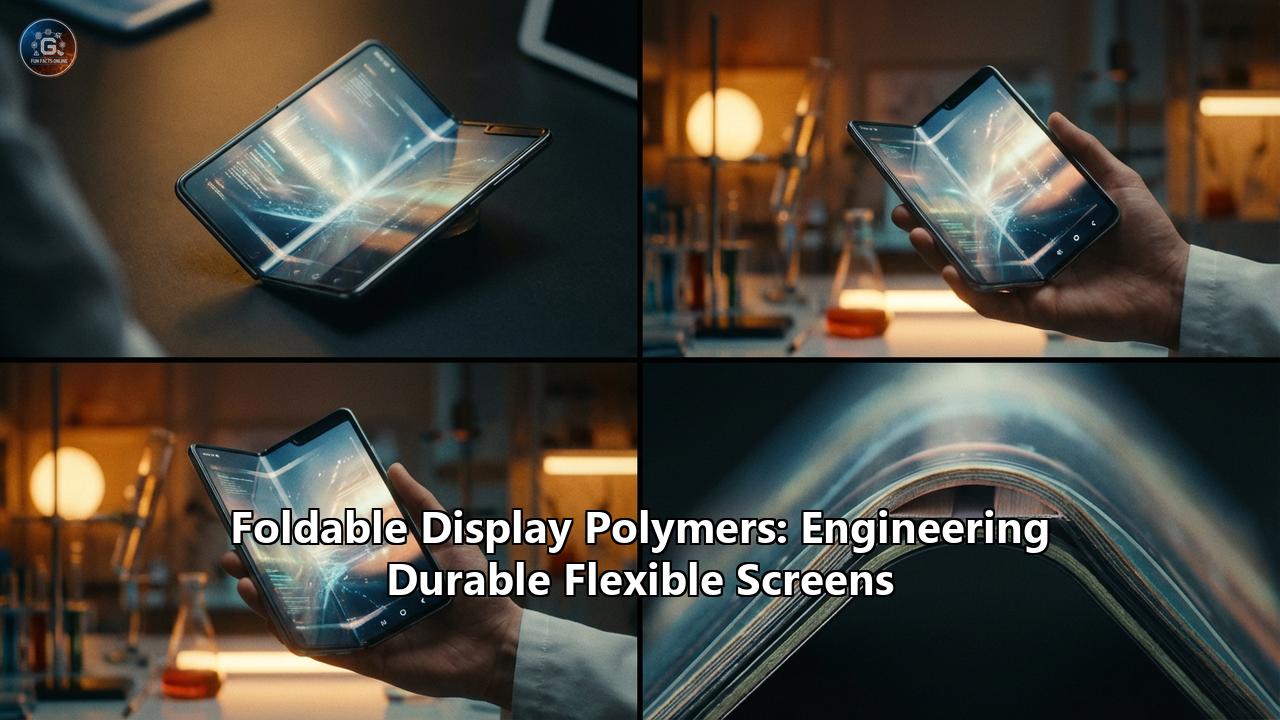
The smartphone era has been defined by the rigid rectangle—a form factor that has dominated for over a decade. But the next frontier of mobile computing is bending that rule, quite literally. Foldable displays represent a paradigm shift in materials science, requiring screens that can withstand hundreds of thousands of folds without cracking, creasing, or losing clarity. At the heart of this revolution lies a battle of advanced materials: the engineering of specialized polymers and hybrid structures that defy the traditional fragility of electronics.
This article explores the deep science behind foldable display polymers, the engineering challenges of durability, the complex manufacturing processes, and the future of screens that roll, stretch, and heal themselves.
1. The Chemistry of Flexibility: Beyond Standard Plastic
To create a screen that folds, you cannot simply use the glass found on a standard smartphone. Traditional glass is brittle; when bent, the tensile stress on the outer surface exceeds its atomic bond strength, causing immediate fracture. The solution lies in high-performance polymers, specifically Polyimides (PI), which have long been used in aerospace for their thermal stability and chemical resistance.
The Challenge of Colorless Polyimide (CPI)
Standard polyimide is naturally yellow or orange—think of the "Kapton" tape used on spacecraft. This color comes from "charge transfer complexes" (CTCs) formed between the electron-rich diamine and electron-deficient dianhydride components of the polymer chain. For a display, this yellow tint is unacceptable.
Engineers had to fundamentally alter the chemistry to create Colorless Polyimide (CPI).
- Fluorination: By introducing bulky trifluoromethyl groups (-CF3) into the polymer backbone, chemists disrupt the packing of the polymer chains. This steric hindrance reduces the formation of CTCs, effectively banishing the yellow color while maintaining the material's mechanical strength.
- Monomer Selection: Using specific monomers like TFDB (2,2'-bis(trifluoromethyl)-4,4'-diaminobiphenyl) helps achieve high transparency (over 90% in the visible spectrum) while retaining a high glass transition temperature (Tg > 300°C), necessary to withstand the intense heat of display manufacturing processes.
Ultra-Thin Glass (UTG): The Hybrid Competitor
While polymers offer superior flexibility, they often lack the "premium" feel and scratch resistance of glass. This led to the development of Ultra-Thin Glass (UTG).
- Schott and Corning: Companies like Schott produce glass that is merely 30 micrometers (µm) thick—thinner than a human hair. At this scale, glass becomes flexible.
- Polymer Reinforcement: UTG is rarely used alone. It is almost always injected or laminated with a specialized polymer resin to enhance its impact resistance. If raw UTG shatters, it creates dangerous shards; the polymer layer acts as a shock absorber and holds the matrix together, creating a composite material that offers the hardness of glass with the bendability of plastic.
2. The Physics of the Fold: Engineering Mechanics
Making a material flexible is only half the battle. The real engineering challenge is managing the forces that occur during the folding motion.
The Neutral Axis Theory
When you bend a material, the outer surface experiences tension (pulling apart), and the inner surface experiences compression (pushing together). Somewhere in the middle sits the Neutral Axis, a plane where there is zero stress.
- Stack Engineering: Display engineers meticulously design the "stack"—the sandwich of OLED panel, touch sensors, polarizers, and cover film—to ensure the delicate OLED components sit as close to the neutral axis as possible.
- Adhesive Mechanics: The layers are bonded with Optically Clear Adhesives (OCAs). These are not simple glues; they are viscoelastic materials designed to flow slightly during folding to relieve shear stress between layers, then snap back to their original position when unfolded. If the OCA is too stiff, the screen delaminates (peels apart). If it's too soft, the screen feels mushy and creeps over time.
The "Waterdrop" Hinge Revolution
Early foldable phones used a simple "U" fold, which forced the screen into a tight radius, creating a sharp crease and high stress.
- Radius Management: The tighter the fold radius, the higher the strain. Industry standard testing (IEC 62715) dictates that screens must survive bending radii of 1.5mm or less.
- The Waterdrop Shape: To solve this, manufacturers moved to a "waterdrop" or "teardrop" hinge mechanism. When the device closes, the screen doesn't fold flat against itself; instead, it tucks into the hinge cavity in a loop shape. This increases the actual bending radius (reducing stress) while allowing the device to physically close flat (preventing dust ingress).
3. Failure Modes: Why Foldables Die
Despite best efforts, foldables have unique failure points that rigid phones do not.
- Creasing: Over time, the polymer chains in the folding region undergo plastic deformation (permanent stretching). While CPI is elastic, repeated stress (hysteresis) eventually prevents the chains from returning to their fully flat state, leaving a visible valley.
- Delamination: The different layers of the display stack have different coefficients of thermal expansion (CTE) and mechanical moduli. Repeated folding or extreme temperature changes (e.g., using the phone in freezing weather) can cause the adhesive bonds to fail, leading to "bubbling" along the crease.
- Particle Ingress: The soft polymer screen is highly susceptible to point-impact damage. If a grain of sand enters the hinge and is pressed against the screen from the back side during opening, it can puncture the OLED panel, causing the dreaded "black line of death"—a row of dead pixels that grows until the screen fails.
4. Manufacturing: The Art of the Impossible
Producing these films requires a shift from traditional batch processing to continuous high-precision manufacturing.
- Solution Casting: CPI is typically manufactured via solution casting. The polyamic acid precursor is coated onto a carrier substrate (like glass or stainless steel), heated to induce imidization (forming the polymer ring structure), and then peeled off.
- Precision Coating: The film thickness must be controlled within ±0.5µm over large areas. Variations in thickness lead to optical distortion and uneven stress distribution during folding.
- Hard Coating: Raw CPI is relatively soft (pencil hardness of 2B or HB). To prevent scratches from fingernails, a siloxane-based hard coat is applied. This coating must be hard enough to resist scratches but thin enough not to crack when the screen folds.
5. Testing Standards: Defining Durability
How do we know a screen will last? The industry relies on rigorous standards, primarily from the IEC (International Electrotechnical Commission).
- IEC 62715-6-21: This standard defines the "folding durability test." Robots fold the device 200,000 to 500,000 times at varying speeds.
- Environmental Stress: Durability isn't just about folding at room temperature. Tests include:
Cold Folding: Folding at -20°C to ensure the polymer doesn't become brittle and shatter.
High Humidity: Storing at 60°C/90% RH to ensure the chemical bonds in the CPI or OCA don't hydrolyze (break down with water).
- Pen Drop Test: A specific weight is dropped from a set height to measure point-impact resistance, simulating keys dropped on the screen.
6. The Future: Self-Healing and Sustainable Screens
The holy grail of foldable polymers is a material that acts like skin: flexible, tough, and capable of repairing itself.
Self-Healing Polymers
Researchers are developing materials incorporating microcapsules or reversible dynamic bonds.
- Microcapsule Approach: When a scratch occurs, it ruptures microscopic capsules embedded in the polymer matrix. These capsules release a healing agent (like a monomer fluid) that polymerizes upon contact with a catalyst in the matrix, filling the crack.
- Vitrimers: A newer class of plastics called vitrimers behaves like a thermoset (strong/hard) at operating temperatures but flows like a liquid when heated. A scratched screen could theoretically be healed by simply using a hair dryer or the heat of the device itself to allow the polymer chains to re-flow and knit back together.
Environmental Impact
The shift to polymers brings sustainability questions. While glass is energy-intensive to melt, it is infinitely recyclable. Complex multi-layer polymer films with embedded electronics are notoriously difficult to recycle.
- Bio-based Polyimides: Research is underway to synthesize polyimide precursors from renewable sources (like isosorbide derived from corn) rather than petroleum.
- Recyclability: New chemical recycling methods aim to depolymerize the CPI back into its monomers at the end of the device's life, allowing the material to be recovered and reused without degradation in quality.
Conclusion
The foldable display is not just a triumph of electronics; it is a masterpiece of polymer science. It represents the successful manipulation of matter at the molecular level to reconcile two opposing properties: hardness and flexibility. As the technology matures, we will likely see the "battle" between glass and plastic end in a merger—hybrid composite materials that offer the best of both worlds, paving the way for devices that can roll up into a pen or stretch like a rubber band. The rigid rectangle is history; the future is fluid.
Reference:
- https://eureka.patsnap.com/report-material-analysis-of-polymer-based-flexible-display-substrates
- https://sydneycbd.repair/tag/phone-hinge-stress-test/
- https://webstore.iec.ch/en/publication/71271
- https://standards.iteh.ai/catalog/standards/iec/d0ff5e6c-d075-4561-a8e3-e55fb4ad9805/iec-tr-62715-6-21-2022
- https://www.szradiant.com/flexible-led-display-screen-durability-5-longevity-tests.html
- https://www.drugplastics.com/resource-hub/blog/choose-plastic-over-glass-for-better-sustainability
- https://www.displaymode.co.uk/how-create-eco-friendly-pop-displays/