
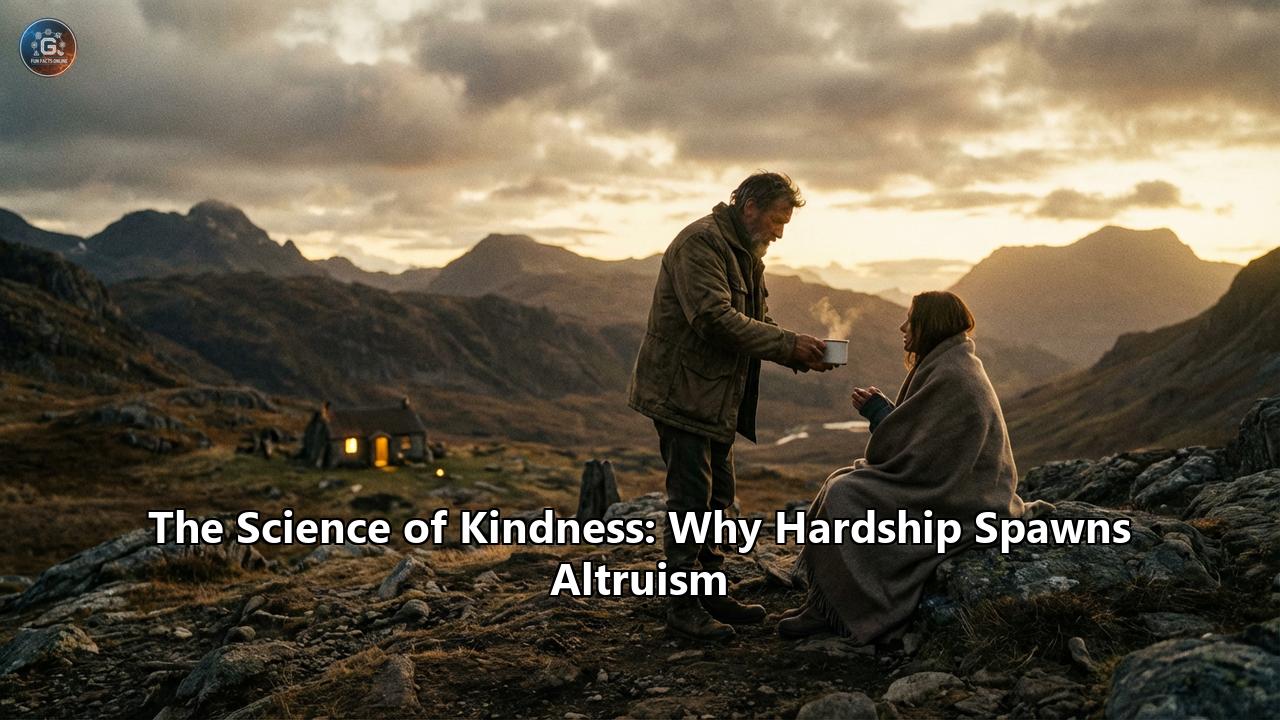
In the chaotic aftermath of the 1906 San Francisco earthquake, amid the rubble and the smoke of a city burning, a strange phenomenon occurred. As order collapsed and institutions crumbled, something else rose in their place: a spontaneous, disorganized, yet fiercely effective network of altruism. Strangers cooked for strangers in makeshift street kitchens. Men gave away their coats. Families shared their last loaves of bread with people they had never met. There was no looting, no descent into Hobbesian savagery. Instead, survivors later recalled a peculiar, almost euphoric sense of brotherhood. As one survivor noted, “While the crisis lasted, people loved each other.”
This phenomenon is not an anomaly. From the Blitz in London to the flooded streets of New Orleans after Katrina, and more recently, the neighborhood mutual aid networks that sprang up during the COVID-19 pandemic, history is replete with evidence of a counter-intuitive human truth: hardship often brings out the best, not the worst, in us.
For decades, psychologists and evolutionary biologists were puzzled by this. The “selfish gene” theory suggested that organisms are wired primarily for self-preservation and the protection of their immediate kin. Why, then, would a person recovering from their own trauma extend a hand to a stranger? Why does suffering, which arguably should make us retreat and hoard our resources, instead frequently spawn a powerful drive to give?
The answer lies in a complex interplay of evolutionary biology, neuroscience, and psychology. It is a concept researchers call “Altruism Born of Suffering” (ABS). It turns out that kindness is not just a moral virtue; it is a biological imperative, a survival mechanism, and perhaps the most potent antidepressant nature has ever devised.
Part I: The Biological Imperative
Beyond the Selfish GeneTo understand why hardship spawns altruism, we must first look at our evolutionary history. For a long time, the dominant narrative in evolutionary biology was competition: survival of the fittest. In this view, altruism was a puzzle. If I give you my food, I have less. If I run into a burning building to save you, I risk my genes perishing while yours survive.
However, this view ignores a fundamental truth about Homo sapiens: we are an obligate social species. We cannot survive alone. Our ancestors who were purely selfish died out because they were ostracized from the group or failed to receive help when they inevitably needed it. Those who developed a capacity for cooperation and shared sacrifice survived.
Kin Selection vs. Group SelectionClassic evolutionary theory explains altruism through "kin selection"—we help those who share our genes to ensure our lineage continues. But disaster altruism often extends to total strangers. This is where "group selection" and "reciprocal altruism" come into play. In a crisis, the boundaries of the "self" expand to include the "tribe." When a community is under threat, the survival of the individual becomes inextricably linked to the survival of the group.
Evolution has equipped us with a "tend-and-befriend" response, a term coined by psychologist Shelley Taylor. While the "fight-or-flight" response is well-known, it is metabolically expensive and often isolating. The "tend-and-befriend" response, driven by different hormonal pathways, compels us to protect offspring (tend) and seek out social groups for mutual defense (befriend). This response is particularly prevalent in females but exists in all humans, serving as a biological glue that holds societies together when external structures fail.
Part II: The Neuroscience of Compassion
The Vagus Nerve: The Highway of KindnessIf altruism has a physical home in the body, it is arguably the vagus nerve. This wandering nerve, the longest of the cranial nerves, connects the brain to the heart, lungs, and digestive tract. It is the central switch of the parasympathetic nervous system—the "rest and digest" system that calms us down.
Research has shown a fascinating link between vagal tone (the strength of the vagus nerve’s response) and compassion. People with higher vagal tone are better at regulating their emotions and are more likely to exhibit prosocial behavior. When we witness suffering and feel a compulsion to help, our vagus nerve is activated. It slows our heart rate and induces a feeling of calmness and connection.
But the relationship goes both ways. Acts of kindness stimulate the vagus nerve. This stimulation has profound physiological effects: it reduces inflammation in the body. Since chronic inflammation is linked to almost every major disease—from heart disease to cancer—kindness is literally a health booster.
The Telomere EffectThe cellular impact of kindness goes even deeper, down to our DNA. Telomeres are the protective caps at the end of our chromosomes, similar to the plastic tips on shoelaces. As we age and experience stress, these telomeres shorten. When they get too short, cells can no longer divide, leading to aging and disease.
Remarkably, studies have found that compassion and altruism can buffer the shortening of telomeres. The "Neuro-Immuno-Senescence Integrative Model" (NISIM) proposes that the prefrontal cortex—the part of the brain responsible for empathy and decision-making—modulates the vagus nerve, which in turn regulates the immune system and inflammation. When we engage in compassionate acts, we are essentially sending a "safety" signal to our cells, preserving our telomeres and, potentially, extending our lives.
The Compassion vs. Empathy DistinctionA crucial distinction in neuroscience that explains how people can sustain altruism during long-term crises is the difference between empathy and compassion.
- Empathy is feeling with someone. If you see someone in pain, your brain’s pain centers light up. You vicariously experience their suffering. While this connects us, it is metabolically draining. Too much unmanaged empathy leads to "empathy fatigue" or burnout.
- Compassion, however, is feeling for someone, accompanied by a desire to help. Neuroscopically, compassion activates different pathways—those associated with reward (ventral striatum) and affiliation (oxytocin).
Tania Singer, a neuroscientist at the Max Planck Institute, has shown that while empathy can lead to distress, compassion is regenerative. It gives us energy. This explains why disaster volunteers often report feeling energized despite exhaustion. They have moved from the draining state of empathy ("I feel your pain and it hurts me") to the empowering state of compassion ("I see your pain and I am doing something to change it").
Part III: Altruism Born of Suffering (ABS)
The Phoenix EffectPsychologist Ervin Staub, a survivor of the Holocaust, pioneered the concept of "Altruism Born of Suffering." His research challenged the notion that violence only begets violence. While it is true that trauma can lead to aggression (the cycle of violence), Staub found that for a significant minority, it leads to the opposite: a profound commitment to helping others.
This is not merely "resilience," which is bouncing back to baseline. This is "Post-Traumatic Growth" (PTG)—bouncing forward. The experience of suffering breaks open the ego and shatters the illusion of invulnerability. For many, this rebuilding process involves integrating the trauma into a new identity focused on service.
The Motivational ProcessWhy do some survivors become aggressors while others become altruists? The research points to several moderating factors:
- Received Help: Survivors who received even small acts of kindness during their ordeal are far more likely to become altruists. This "active bystandership" plants a seed of hope, proving that benevolence exists even in hell.
- Making Meaning: The ability to frame the suffering as a catalyst for understanding others is key. The survivor thinks, "I know what this pain feels like, and I have a unique power to prevent it for others."
- Healing vs. Festering: Unprocessed trauma tends to turn outward as aggression. Processed trauma turns outward as compassion.
A remarkable finding in ABS research is that this altruism is often "inclusive"—it extends beyond one's own group. Studies of survivors of ethnic violence often show that they are more likely to help outgroups (people not of their tribe/religion) than those who have not suffered. The shared identity of "victim/survivor" supersedes ethnic or national boundaries.
Part IV: Sociology of the Disaster Utopia
A Paradise Built in HellAuthor Rebecca Solnit coined the term "disaster utopia" to describe the unique social atmosphere that arises during catastrophes. We are conditioned by disaster movies to expect panic, looting, and selfishness. The reality is starkly different.
In the wake of the Blitz, Londoners defied class structures to shelter together in the Underground. After 9/11, New Yorkers walked calmly out of the city, helping the injured, while an impromptu armada of civilian boats evacuated half a million people from Lower Manhattan—the largest maritime evacuation in history, larger than Dunkirk, and entirely unplanned.
The Suspension of StatusDisasters function as a "great leveler." The things that usually divide us—wealth, job titles, social status—instantly lose their value. A hedge fund manager and a janitor are equal when both are waiting for a boat to escape a flooding city. This suspension of hierarchy allows for a more primal, egalitarian form of social connection to emerge. We return to our factory settings: cooperative primates.
Case Study: COVID-19 and Mutual AidThe COVID-19 pandemic provided a global laboratory for this phenomenon. As governments struggled to respond, "Mutual Aid" groups formed organically.
- Bed-Stuy Strong: In Brooklyn, New York, a group of neighbors used Slack and Google Forms to organize a grocery delivery network for the immunocompromised and elderly. They moved millions of dollars in aid and supported tens of thousands of people, all without a formal NGO structure.
- Leighton Linslade Helpers: In the UK, a Facebook group turned into a town-wide operation, coordinating prescription pickups and food banks. Crucially, these groups were not "charity" (which implies a hierarchy of giver and receiver) but "solidarity" (neighbors helping neighbors).
These groups proved that the "bystander effect" (the idea that people will watch a tragedy without intervening) is largely a myth in high-stakes environments. When the need is clear and the systems fail, people step up.
Part V: The Helper's High – The Feedback Loop
Chemical RewardsWhy does helping feel good? Evolution has rigged the deck to ensure we cooperate. When we perform an altruistic act, our brain releases a cocktail of "happiness" chemicals:
- Dopamine: The reward chemical. It gives us a hit of pleasure, reinforcing the behavior.
- Oxytocin: The "cuddle hormone." It creates feelings of trust and intimacy.
- Serotonin: Regulates mood and social behavior.
- Endorphins: Natural painkillers that produce a mild euphoria, often called the "helper's high."
This chemical reward system acts as a buffer against the stress of the crisis itself. By helping others, we literally medicate our own anxiety. It is a biological feedback loop: we feel bad (fear/stress) -> we help others -> we feel good (dopamine/oxytocin) -> stress is reduced.
From Victim to AgentPsychologically, one of the most damaging aspects of trauma is the loss of agency—the feeling of being helpless. Altruism restores agency. When a survivor acts to help another, they are no longer a passive victim; they are an active shaper of their reality. This shift from passive to active is crucial for mental health recovery. It is why "action" is often prescribed as an antidote to despair.
Part VI: Cultural Variations in Healing
How We GrowWhile the biological hardware for altruism is universal, the software—culture—shapes how it is expressed.
- Western Cultures: Research on Post-Traumatic Growth in the US often focuses on "personal strength" and "new possibilities." The narrative is individualistic: "I survived, and now I am stronger."
- Eastern Cultures: In collectivist societies (like China or Japan), PTG is often expressed through "relating to others" and "spiritual change." The narrative is relational: "We survived, and now our bond is deeper."
Interestingly, studies on "fatalism" in Chinese culture suggest it can be protective. Viewing a disaster as "fate" (rather than a personal failure or random cruelty) can reduce PTSD symptoms, allowing the individual to move more quickly into a state of acceptance and communal rebuilding.
Part VII: Conclusion – The Future of Altruism
Can We Synthesize the Response?The science is clear: we are wired for kindness, and hardship is the trigger that often unlocks it. But the question remains: Do we need a disaster to be this good to each other?
The "disaster utopia" usually fades as normalcy returns. Status symbols come back, hierarchies reassert themselves, and the "brotherhood of pain" dissolves. The challenge for modern society is to cultivate "Altruism Born of Suffering" without the suffering—or at least, to harness the lessons of our crises to build more resilient, compassionate systems in peacetime.
We can do this by:
- Teaching Compassion vs. Empathy: Training schools and workplaces to understand that "feeling for" is sustainable, while "feeling with" is draining.
- Creating "Mutual Aid" Infrastructure: supporting local, horizontal community networks before a crisis hits, so the pathways for connection are already open.
- Reframing Trauma: Moving the mental health narrative from one of pure damage (PTSD) to one that includes the possibility of growth (PTG), helping survivors see their potential as healers.
In a world that often feels fractured, the science of kindness offers a profound hope. It reminds us that when the lights go out, we do not turn on each other; we turn to each other. We are not wolves disguised as sheep; we are, at our core, the species that survived because we learned to share the fire.
Reference:
- https://thereleaseconnection.com/new-earth-physiology-activating-vagus-nerve/
- https://www.youtube.com/watch?v=3kzjh8x54wU
- https://www.youtube.com/watch?v=Seuy9VrKDlY
- https://www.researchgate.net/publication/398031131_Harnessing_the_Neurobiology_of_Empathy_and_Compassion_to_Alleviate_Burnout_in_Neurology
- https://pmc.ncbi.nlm.nih.gov/articles/PMC6005077/
- https://mindfulspark.org/2025/02/03/the-neuroscience-of-compassion-why-empathy-heals-and-how-it-shapes-our-brains/
- http://people.umass.edu/estaub/Altriusm%20born%20ofsuffering%20staub.pdf
- https://www.theguardian.com/business/2022/jun/13/four-in-10-pandemic-era-mutual-aid-groups-still-active-uk-data-suggests
- https://www.psychologytoday.com/us/blog/in-the-garden-of-good-and-evil/201112/altruism-born-of-suffering
- https://www.researchgate.net/publication/27467520_A_Grounded_Theory_Approach_to_Understanding_Cultural_Differences_in_Posttraumatic_Growth