
Introduction: A Heartbeat from the Beginning of Time
It was a Valentine’s Day gift to the world of physics that few will ever forget. On the night of February 14, 2026, deep beneath the snow-covered pine forests of Dubna, Russia, a control room erupted not in romance, but in the thunderous applause of exhausted scientists. At exactly 23:42 Moscow time, screens flickered with the unmistakable signature of success: for the first time in history, two counter-propagating beams of heavy xenon ions were stably circulating within the rings of the NICA (Nuclotron-based Ion Collider fAcility) collider.
This was not just a technical milestone; it was the first breath of a machine built to resurrect the ghost of the early universe.
For decades, humanity has peered back in time using telescopes, capturing the light of ancient stars. But to understand the very moment of creation—the fraction of a microsecond after the Big Bang—we cannot look; we must touch. We must recreate the conditions when the universe was not a vast expanse of cold vacuum, but a microscopic fireball of unimaginable density and temperature. This is the realm of the Quark-Gluon Plasma (QGP), a primordial soup from which all matter eventually coalesced.
The NICA facility, a megaproject of the Joint Institute for Nuclear Research (JINR), has officially unlocked the door to this "Little Bang." With the successful circulation of dual beams, the collider is now poised to smash atomic nuclei together at velocities approaching the speed of light, effectively winding the cosmic clock back 13.8 billion years.
This article delves deep into the significance of this breakthrough, the colossal engineering marvel that is NICA, the profound mysteries of the "quark soup" it seeks to stir, and the surprising ways this machine will revolutionize medicine, space travel, and nuclear energy.
Part I: The Day the Beams Danced
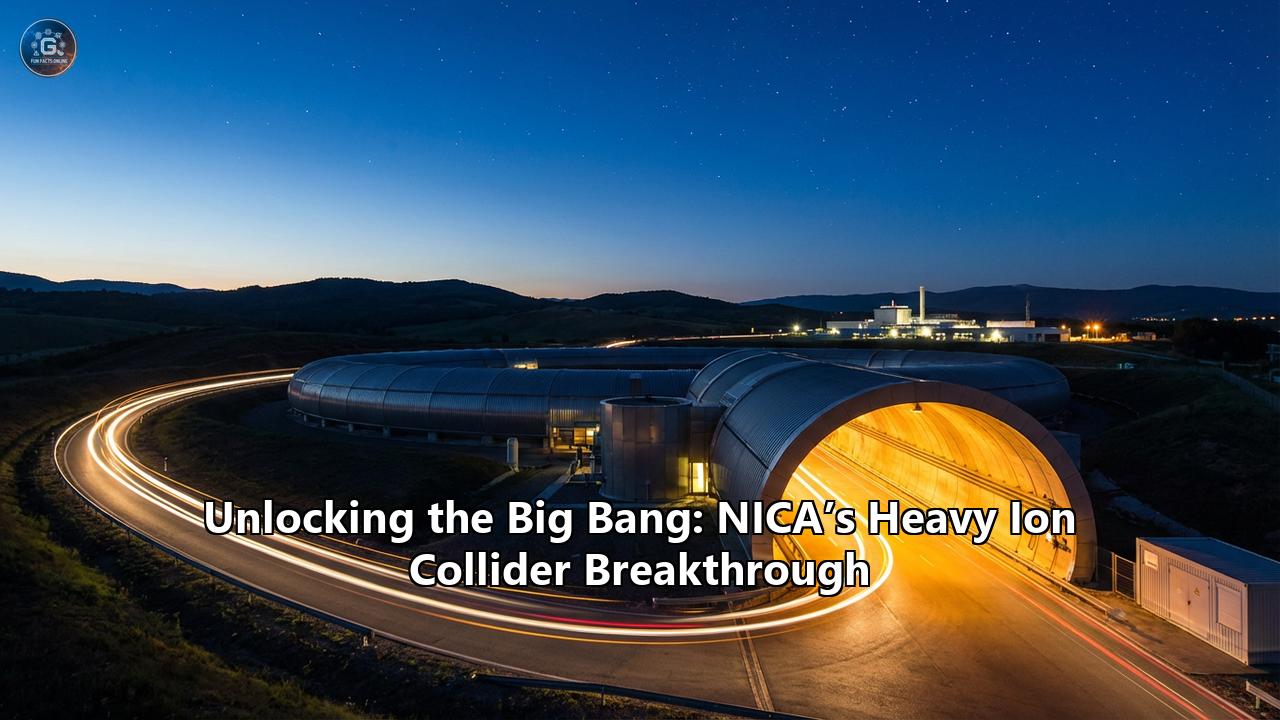
To understand the magnitude of the February 14th breakthrough, one must appreciate the sheer complexity of the machine involved. NICA is not merely a single device; it is a sprawling complex of accelerators, boosters, and storage rings that resembles a vascular system for high-energy particles.
The "technological run" that culminated in this success began nearly a year prior, in March 2025. It was a grueling marathon of testing individual systems—cryogenics, vacuum chambers, superconducting magnets, and beam injection lines. But the ultimate test is always the "circulation mode."
In an accelerator, keeping a single beam of particles moving in a circle is akin to balancing a pencil on its tip while riding a unicycle. The particles, all positively charged, want to repel each other and fly apart. They must be constrained by powerful magnetic fields and focused into a hair-thin strand. To do this with heavy ions like xenon (which are massive and cumbersome compared to the protons used at CERN’s Large Hadron Collider) adds a layer of difficulty. To do it with two beams simultaneously, moving in opposite directions within the same magnetic structure, is a feat of high-wire acrobatics.
On that fateful night, the injection sequence began at the Booster, a smaller synchrotron ring that acts as the "on-ramp" for the heavy ions. The xenon ions were stripped of their electrons, accelerated to relativistic speeds, and then injected into the Nuclotron—the heart of the facility. From there, they were kicked into the main collider rings.
"We saw the beam current stabilize on the monitors," reported Dr. Anatoly Sidorin, Deputy Head of the Accelerator Department, in a press briefing following the event. "Usually, the beam degrades quickly due to imperfections in the vacuum or magnetic field. But it held. Then, we injected the counter-beam. It held too. For the first time, we had the 'collision readiness' state. The machine was alive."
This "dual circulation" is the prerequisite for collisions. Without stable, long-lasting beams, there are no collisions, and thus no data. The success on February 14 signals that the collider’s optics, its "eyes," are perfectly aligned, and its magnetic "muscles" are strong enough to hold the most dense matter in the universe in a tight grip.
Part II: The Science of the "Little Bang"
Why build such a colossal machine? The answer lies in a fundamental gap in our understanding of the universe's history.
The Primordial Soup
In the standard model of cosmology, the universe began with the Big Bang. In the very first few microseconds, the universe was too hot for protons and neutrons to exist. Instead, the fundamental building blocks of matter—quarks and gluons—roamed free in a super-hot, super-dense state of matter known as Quark-Gluon Plasma (QGP).
As the universe expanded and cooled, a dramatic phase transition occurred. The quarks were "confined" into hadrons (protons and neutrons), locking away the free state of matter forever. We live in this "frozen" universe today. We have never seen a free quark; they are always bound inside atomic nuclei.
NICA is designed to melt the ice. By smashing heavy ions (like gold or xenon) together, NICA generates temperatures reaching trillions of degrees Celsius, momentarily breaking the bonds of the strong nuclear force and recreating the QGP.
The Critical Point
But NICA is not just repeating what other colliders have done. The Large Hadron Collider (LHC) in Geneva and the Relativistic Heavy Ion Collider (RHIC) in the US have already created QGP. They operate at incredibly high energies, creating a plasma that is very hot but not necessarily very dense in terms of "net baryon density" (the number of protons/neutrons packed into a volume).
NICA occupies a unique niche. It operates at a lower energy range (4-11 GeV), which seems counterintuitive—isn't higher energy always better? Not in this case. By colliding ions at these specific energies, NICA doesn't just "burn" the nuclei away; it compresses them to maximum density.
"Think of it like boiling water," explains theoretical physicist Dr. Elena Petrova. "The LHC turns water into super-hot steam instantly. NICA is exploring the point where water is under such extreme pressure that it is neither liquid nor gas—the critical point. We are looking for the maximum density of baryonic matter, the same density found in the cores of neutron stars."
This search for the "Critical Point" on the Phase Diagram of Nuclear Matter is the Holy Grail of modern high-energy physics. Finding it would confirm our theories about how the universe evolved and how mass itself emerges from the interaction of particles.
Part III: The Anatomy of a Megaproject
The NICA complex is a triumph of Russian and international engineering, located at JINR in Dubna, a "science city" with a storied history of discovering new elements (including Dubnium).
The Nuclotron: The Beating Heart
The facility is built around the Nuclotron, a superconducting synchrotron that has been operating since the 1990s. NICA is effectively a massive upgrade and expansion of this existing machine. The Nuclotron features unique "hollow" superconducting cables that are cooled by a two-phase flow of liquid helium, a technology pioneered at Dubna that allows for rapid cycling of the magnetic field.
The Booster
Before particles reach the Nuclotron, they enter the Booster. This superconducting ring, with a circumference of 211 meters, is a technological marvel in itself. It is equipped with an electron cooling system—a "hose" of cold electrons that runs alongside the hot ion beam, absorbing its chaotic thermal energy and "cooling" it into a tight, focused stream. This cooling is essential for achieving the high luminosity (collision rate) required by NICA.
The Collider Rings
The most visible new construction is the pair of collider rings, each 503 meters in circumference. These rings are housed in a newly constructed tunnel that shields the outside world from radiation. Inside, the vacuum is ultra-high—$10^{-11}$ Torr—comparable to the void of deep space.
The Detectors: MPD and SPD
The collisions happen at two specific interaction points, where massive cathedral-sized detectors wait to record the debris.
- MPD (Multi-Purpose Detector): This is the primary eye on the "Little Bang." Weighing over 1,000 tons, it features a massive superconducting solenoid magnet and a Time Projection Chamber (TPC). The MPD is designed to track the thousands of particles produced in a single gold-on-gold collision, reconstructing their paths with sub-millimeter precision to find signs of the "mixed phase" of matter.
- SPD (Spin Physics Detector): Coming online in a later stage, the SPD will focus on a different mystery: the spin of the proton. By colliding polarized beams (where the particles spin in the same direction), SPD hopes to solve the "proton spin crisis"—the realization that the constituent quarks of a proton account for only a tiny fraction of its total spin.
Part IV: The Coldest Place in the Universe
One of the most underappreciated aspects of NICA is its cryogenics. To make the magnets superconducting (carrying current with zero resistance), they must be cooled to near absolute zero.
The NICA cryogenic plant is one of the largest in Europe. It produces tons of liquid helium, circulating it through kilometers of piping. On February 14, as the beams circulated, the magnets were held at a temperature of 4.5 Kelvin (-268.65°C).
"In a way, we are creating the hottest point in the universe—the collision—inside a ring that is the coldest point in the universe," says Chief Engineer Viktor Ivanov. "The temperature gradient from the collision point (trillions of degrees) to the magnet coil (near absolute zero) is the steepest in nature. It requires insulation technology that borders on science fiction."
This cryogenic prowess is not just for the collider. It serves as a testbed for future superconducting technologies that could revolutionize power grids and maglev trains.
Part V: The Global Race for Density
NICA does not exist in a vacuum (pun intended). It is part of a global ecosystem of heavy ion physics, often described as a "coopetition"—cooperative competition.
Its main counterpart is the FAIR (Facility for Antiproton and Ion Research) project in Darmstadt, Germany. Like NICA, FAIR is designed to study compressed baryonic matter. However, the two facilities are complementary.
- FAIR focuses on fixed-target experiments with extremely high interaction rates, ideal for finding very rare particles.
- NICA is a collider, which allows for better coverage of the particle spray and different kinematic conditions.
Together with the LHC (high energy, low baryon density) and RHIC (variable energy), NICA completes the global "scan" of the nuclear phase diagram. It fills the crucial gap of "maximum baryon density," a region that has been largely unexplored until now.
The "breakthrough" on February 14 puts NICA firmly in the lead for this specific energy range. With FAIR still under construction, NICA has a window of opportunity to make the first discoveries regarding the "Critical Point" and the nature of matter inside neutron stars.
Part VI: Beyond the Big Bang – ARIADNA and Applied Science
While the hunt for the quark-gluon plasma grabs headlines, NICA has a "secret weapon" that makes it invaluable to society immediately: the ARIADNA (Applied Research Infrastructure for Advanced Developments at NICA fAcility) collaboration.
This program turns the collider’s beams into tools for medicine, biology, and space exploration.
1. Curing the Incurable: Cancer Therapy
Heavy ion beams have a unique property called the "Bragg Peak." Unlike X-rays, which deposit energy all the way through the body (damaging healthy tissue), heavy ions deposit almost all their energy at a specific depth, then stop. This allows doctors to target deep-seated tumors with millimeter precision, sparing organs like the brain or heart.
NICA is being used to research Flash Therapy, a new technique where the entire radiation dose is delivered in a fraction of a second. This method appears to kill cancer cells while inexplicably sparing healthy tissue entirely. Research at NICA’s applied stations is paving the way for the next generation of cancer treatment centers.
2. The Mars Mission Simulator
Space is filled with galactic cosmic rays—heavy ions moving at relativistic speeds. These are the single biggest danger to astronauts traveling to Mars. They can destroy DNA and fry microchips.
NICA is one of the few places on Earth that can simulate this radiation. The SIMBO station (Station of Investigation of Medico-Biological Objects) exposes cell cultures and even small organisms to heavy ion beams to study the biological effects of long-duration spaceflight.
Simultaneously, the SOChI station (Station Of Chip Irradiation) is used by aerospace companies to test microchips. Before a chip goes to Jupiter or Mars, it comes to Dubna to be blasted with ions. If it survives NICA, it can survive the void.
3. Transmuting Nuclear Waste
Perhaps the most ambitious applied project is the study of Accelerator-Driven Systems (ADS) for nuclear energy. By firing a high-energy beam into a subcritical nuclear reactor, scientists can sustain a reaction that cannot melt down (turn off the beam, the reaction stops). More importantly, this process can "burn" long-lived nuclear waste, transmuting isotopes that stay radioactive for 10,000 years into isotopes that are safe in just a few hundred. NICA provides the nuclear data needed to build these future incinerators of radioactive waste.
Part VII: The Human Element
The success of NICA is a testament to the resilience of the scientific spirit. The project spans 19 years of planning and construction, weathering geopolitical storms and economic shifts.
Grigory Trubnikov, Director of JINR and an Academician of the Russian Academy of Sciences, described the February 14th success as the culmination of a generational dream. "We have finished a 19-year journey of construction," he noted. "But in science, the end of construction is just the start of the real work. We are now standing on the shore of a new ocean of knowledge."
The control room on that night was a mix of veterans who built the original Nuclotron in the 90s and young post-docs who were toddlers when the NICA project was first proposed. The collaboration includes scientists from over 30 countries, proving that the quest for the fundamental laws of nature transcends borders.
Conclusion: The Summer of Collisions
The "dual beam" breakthrough of February 2026 is the dress rehearsal. The main event is scheduled for the summer of 2026.
In August and September, the NICA team plans to bring the beams into collision for the first time inside the MPD detector. When they do, the sensors will light up with the tracks of thousands of hadrons, pions, and kaons. Computers will crunch petabytes of data, looking for the tell-tale "flow" patterns that indicate the presence of the Quark-Gluon Plasma.
We are about to look into a mirror that reflects the universe as it was 13.8 billion years ago. We are about to learn why we have mass, why protons don't fall apart, and what lies in the crushed hearts of neutron stars.
The Big Bang is no longer just a theory to be calculated. At NICA, it is about to become an experiment to be observed. The breakthrough has happened. The "Little Bang" is imminent.
Deep Dive: The Physics of "The Mixed Phase"
To truly appreciate the NICA breakthrough, we must understand the "terra incognita" it explores.The Phase Diagram of water is familiar: at low temperature it is ice; add heat, it becomes liquid; add more, it becomes steam. Nuclear matter has a similar diagram, but the axes are Temperature and Baryon Density.
- The Early Universe (High T, Low Density): The Big Bang was incredibly hot but, paradoxically, the net baryon density was low (matter and antimatter were nearly equal). The LHC explores this region. It finds a "crossover" transition—a smooth change from plasma to hadrons, like butter softening.
- Neutron Stars (Low T, High Density): Cold, but crushed to infinite density by gravity.
- The NICA Region (High T, High Density): This is the middle ground. Here, theorists predict a First-Order Phase Transition—a violent, sharp change, like water boiling into steam.
NICA is hunting for the "Critical Point"—the exact temperature and density where the smooth "butter" transition turns into the violent "boiling" transition.
Why does this matter?
If NICA finds this point, it proves that Quantum Chromodynamics (QCD)—our theory of the strong force—has a rich structure similar to electromagnetism. It would explain how the "symmetry" of the early universe was broken to give us the heavy protons and neutrons we are made of today. It is, quite literally, the origin story of mass.
Engineering Spotlight: The Stochastic Cooling
One of the key technologies enabling the February 2026 breakthrough is Stochastic Cooling, a technique famously used to discover the W and Z bosons at CERN in the 80s, but adapted here for heavy ions.
The ion beam is like a swarm of bees. They buzz around, creating "heat" (disorder) in the beam.
- A sensor "picks up" the error in position of a slice of the beam.
- This signal is sent across the ring via a shortcut cable (which is faster than the ions moving in the curve).
- A "kicker" electrode receives the signal just as the ions arrive and gives them a nudge to correct their path.
NICA performs this correction millions of times per second. It is effectively "Maxwell's Demon" at work, reducing the entropy of the beam to pack ions tighter than natural laws would usually allow. This is what allows NICA to reach the luminosity required to see rare events in the plasma.
The Future is Heavy
As the snow melts in Dubna this spring, the cooling towers of NICA will be venting the heat of a machine running at full power. The world’s physicists are booking their tickets. The theoretical papers are being drafted, waiting for the data to fill in the blanks.
On February 14, 2026, the heart of the machine started beating. By summer, it will start speaking. And the story it tells will be the story of us all.
Reference:
- https://www.mdpi.com/2571-712X/4/2/20
- https://fcc.web.cern.ch/cryogenics
- https://www.researchgate.net/publication/351636167_Heavy-Ion_Collisions_at_FAIR-NICA_Energies
- https://www.mdpi.com/2218-1997/7/6/171
- https://www.mdpi.com/journal/particles/special_issues/selected_papers_FAIR_NICA
- https://proceedings.jacow.org/e08/papers/wepp029.pdf
- https://www.jinr.ru/posts/applied-research-at-nica-complex-discussed-in-dubna/